Transcriptional Regulation (W8)
 Call Kai
 Learn
 Practice Test
 Spaced Repetition
 Match
 Flashcards
 Knowt Play
1/34

There's no tags or description
Looks like no tags are added yet.
35 Terms
What is the difference between constitutive and regulated gene expression?
Constitutive genes are expressed continually for essential functions
Regulated genes change expression in response to conditions

What is an operon?
A cluster of nearby genes that work together and are controlled together by regulatory proteins
The genes are usually copied into one mRNA and often make proteins (products) that are used in the same pathway
What are the main parts of a bacterial operon?
A promoter
An operator or activator-binding site
Structural/functional genes
A separate regulatory gene often makes the repressor or activator protein that controls the operon.
What is the role of RNA polymerase in operon expression?
It binds the promoter and synthesizes RNA from the DNA template.
Regulators can block or help this process
What are structural (functional) genes?
Genes that encode proteins that carrying out the cellular function or pathway. The operon controls whether these genes are expressed
Compare negative and positive transcriptional control.
Negative control uses a repressor to reduce or prevent transcription
Positive control uses an activator to increase transcription
What is a repressible operon?
An operon usually on that is turned off when its end product is abundant
These commonly control biosynthetic pathways
Example: tryptophan synthesis

How does the trp operon respond when tryptophan is abundant?
Tryptophan acts as a corepressor by binding the trp repressor
This now-active repressor binds to the operator and blocks transcription
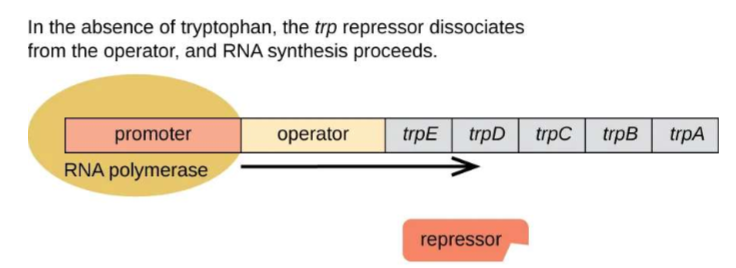
How does the trp operon respond when tryptophan is scarce?
The trp repressor is inactive and cannot bind the operator
So, RNA polymerase continues to transcribe genes needed to synthesize tryptophan
Why is the trp operon repressible?
Tryptophan synthesis is costly and is needed only when environmental tryptophan is unavailable, so having an abundant amount of tryptophan / product shuts off its own biosynthetic genes.
What is an inducible operon?
An operon normally off/low that is turned on when an inducer (often the pathway substrate) is present
These commonly control catabolic pathways
Example: lac operon

How is the lac operon regulated when lactose is absent?
The LacI repressor binds the operator and blocks RNA polymerase, subsequently blocking transcription of genes for lactose use.

How is the lac operon regulated when lactose is present?
Allolactose, derived from lactose, binds the lac repressor and changes its shape
lac repressor then releases from the operator, allowing transcription to proceed at a slow rate

What happens when arabinose is present, and why is this a positively regulated operon?
araC binds arabinose and becomes an activator
Helps RNA polymerase turn on the araBAD genes for arabinose metabolism, so the operon is positively regulated

How does AraC regulate the araBAD operon when arabinose is absent?
AraC binds sites that create a DNA loop and prevent effective RNA polymerase action
It acts as an anti-activator, functionally like a repressor

A cell makes a toxinase enzyme that’s designed only to break down a (pretend) toxic molecule called toxininium. How should toxinase expression respond to toxininium?
It should be inducible: toxininium should inactivate or remove a repressor so toxinase is produced only when the toxin is present.

What is an autoinducer?
A small quorum-sensing signal molecule produced and released by cells
It can diffuse or be transported between cells and accumulates as the population grows
More autoinducer makes cells secrete more autoinducer and transcribe quorum sensing regulated genes
What happens to autoinducer concentration at low versus high cell density?
At low density, autoinducer is diluted or diffuses away
At high density, production by many cells causes it to accumulate to a threshold concentration
Why is quorum sensing useful for costly group behaviors?
It prevents individual cells from wasting energy on a behavior that is ineffective at low population density
Activates it only when enough cells can produce a useful effect
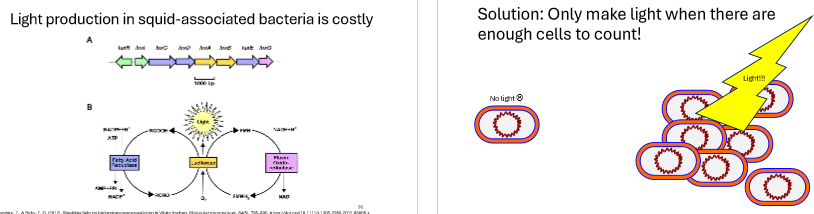
What is an example of costly behavior that quorum sensing is helpful for?
Light production (i.e. bioluminescence)
Uses many ATP, NADPH, and numerous steps
Solution? → Only make light when there are enough cells to count

How does the Vibrio fischeri lux system work?
LuxI synthesizes an autoinducer
At high cell density, the autoinducer binds LuxR
Activated LuxR promotes transcription of lux genes, including luminescence genes and more luxI.
Why does Vibrio fischeri produce light mainly at high cell density in its squid host?
Bioluminescence is energetically expensive and too weak to benefit the host when few bacteria are present
Quorum sensing coordinates light production after enough cells accumulate
What are common outcomes controlled by quorum sensing?
Biofilm and extracellular polymeric substance production
Secreted enzymes or factors
Virulence-related behaviors
Symbiosis functions
Developmental changes
In what situation is quorum sensing especially likely to be used?
When a secreted product or cooperative behavior works only after many cells contribute enough of it
Examples: biofilm formation, host colonization, or extracellular enzyme production.