4.2 Time Series Models
 Call Kai
 Learn
Learn Practice Test
 Spaced Repetition
 Match
Match Flashcards
 Knowt Play
1/23

Earn XP
Description and Tags
Section 4.2 of Exam MAS-II
Name | Mastery | Learn | Test | Matching | Spaced | Call with Kai | Chat |
|---|
No analytics yet
Send a link to your students to track their progress
24 Terms
A white noise process W_t is a sequence of ___ random variables. The second-order properties of are
i.i.d. random variables

Let w_1, ..., w_n be observations from a white noise process. The L-step ahead forecast is
The mean squared error, or ____, is the estimate of the _______ .
Let w_1, ..., w_n be observations from a white noise process. The L-step ahead forecast is
ŵₙ₊ₗ = 0
The mean squared error, or s²_w , is the estimate of the variance σ̂²_W.
Random Walk: Definition and Equation
Defined as partial sums of a white noise process

For a random walk process X_t,
E[X_t]=
Var[X_t]=
γₖ(t) =
ρₖ(t) =

Random Walk: Let x_1, ..., x_n be observations from a random walk process . The L-step ahead forecast is

Random Walk: The L-step ahead forecast standard error is

Random Walk: Drift - How to incorporate in the random walk model

Differencing: Define
Write and interpret first and second-order differences
Differencing a random walk process results in a __________ process
Differencing finds the difference between consecutive observations. It is used to transform a non-stationary series to a stationary series.
Differencing a random walk process results in a white noise process
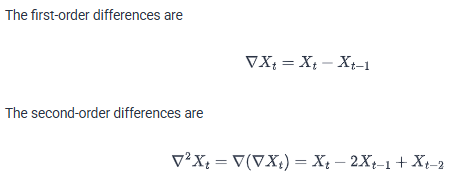
Backward Shift Operator: What does it do and how does it relate to nth order differences

Characteristic Equations: Define
A polynomial written in terms of B. It can be used to determine if a time series is stationary, invertible, and/or parameter redundant.

Characteristic Equations: Determine stationarity, invertibility, and parameter redundancy

Autoregressive Models: Define a model AR(p)
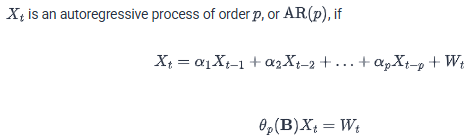
For a stationary AR(1) model:
E[X_t]=
Var[X_t]=
γₖ =
ρₖ =

An AR(1) model is stationary if:

The partial autocorrelation at lag k is the correlation that results after removing the effect of _______________________.
A partial correlogram is a correlogram of the ______________ against the ____.
An AR(p) process will have all partial autocorrelations after lag _ equal to _.
The partial autocorrelation at lag k is the correlation that results after removing the effect of any correlations due to terms at shorter lags.
A partial correlogram is a correlogram of the partial autocorrelations against the lag k.
An AR(p) process will have all partial autocorrelations after lag p equal to 0.
How to find an autoregressive l-step ahead forecast
Use recursion to find the L-step ahead forecast, starting with the one-step ahead forecast of

The L-step ahead forecast standard error is

Moving Average Model Equation

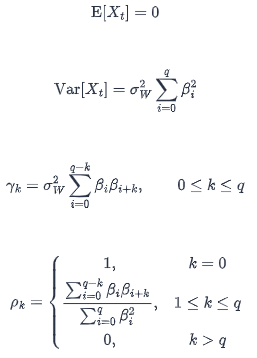
For an MA(q) model:
E[X_t]=
Var[X_t]=
γₖ =
ρₖ =
An _______ MA(q) model can be expressed as a stationary ______ model, and a _________ AR(p) model can be expressed as an invertible ______ model.
An invertible MA(q) model can be expressed as a stationary AR(inf) model, and a stationary AR(p) model can be expressed as an invertible MA(inf) model.
ARMA Model Equation
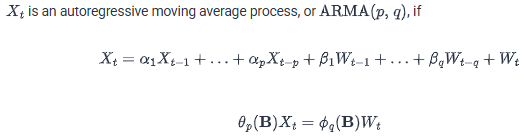
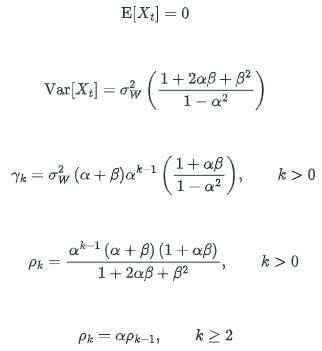
For a stationary ARMA(1,1) model:
E[X_t]=
Var[X_t]=
γₖ =
ρₖ = , k > 0
ρₖ = , k >= 2
ARIMA Models:
A time series {X_t} is integrated of order d, or I(d), if the dth difference of {X_t} is a white noise series, {W_t}
A time series {X_t} follows an ARIMA(p,d,q) process if the dth differences of {X_t} follow an ARMA(p,q) process.
Model Equation
A time series {X_t} is integrated of order d, or I(d), if the dth difference of {X_t} is a _____________
A time series {X_t} follows an ARIMA(p,d,q) process if the dth differences of {X_t} follow an ___________.

Seasonal ARIMA Models:
Seasonal differencing is differencing at a lag equal to the number of ________
X_t is a seasonal autoregressive integrated moving average process, ARIMA(p,d,q)(P,D,Q)_g if (model equation)
The fit of models can be compared using the _____
Seasonal differencing is differencing at a lag equal to the number of seasons
The fit of models can be compared using the AIC
