Neurons + Action Potentials
 Call Kai
 Learn
 Practice Test
 Spaced Repetition
 Match
 Flashcards
 Knowt Play
1/61

There's no tags or description
Looks like no tags are added yet.
62 Terms
What major cellular structures are contained within the soma (cell body) of a neuron?
The nucleus (which features a prominent nucleolus) and other standard organelles.
What are the key structural characteristics of dendrites?
Cell extensions branching off the soma.
Usually many of them per neuron.
Generally short and highly branched.
What is the functional purpose of dendrites?
To receive input from outside the cell and conduct nerve impulses toward the soma
What are the key structural characteristics of an axon?
A cell extension branching off the soma.
Usually one per neuron.
Generally long, with some branching toward the end.
What is the functional purpose of an axon?
To conduct nerve impulses away from the soma, allowing the neuron to influence other cells.
What are the three functional classifications of neurons?
Sensory (afferent) neurons
Motor (efferent) neurons
Interneurons (association neurons)
Where are interneurons (association neurons) located, and what is their function?
They are confined to the CNS and conduct stimuli from one neuron to another neuron
Which functional class makes up the vast majority of neurons in the body?
Interneurons (association neurons)
What is another term for voltage in neurophysiology, and in what unit is it measured?
It is also known as potential, and it is measured in millivolts (mV)
How do neurons generate voltage, and what is the baseline voltage outside a neuron defined as?
Neurons generate voltage using ion currents. The outside of a neuron is defined as 0 mV.
What type of current is generated when positively charged ions (cations) move out of a cell, and how does this change the voltage?
It generates a negative current. As a result, the voltage becomes less positive or even negative.
What type of current is generated when positively charged ions (cations) move into a cell, and how does this change the voltage?
It generates a positive current. As a result, the voltage becomes less negative or even positive.
What are the extracellular and intracellular concentrations of Sodium?
Extracellular concentration: 140 mmol
Intracellular concentration: 15 mmol
Which way does Sodium naturally flow across the membrane, and what type of current does this create?
It creates an inward current, which generates a positive current (making the inside of the cell more positive).
What are the extracellular and intracellular concentrations of Potassium
Extracellular concentration: 5 mmol
Intracellular concentration: 140 mmol
Which way does Potassium naturally flow across the membrane, and what type of current does this create?
It creates an outward current, which generates a negative current (making the inside of the cell more negative).
What types of molecules can cross the lipid bilayer directly versus those that require membrane proteins?
Direct crossing: Only small, nonpolar molecules.
Require membrane proteins: Larger, polar molecules (and charged ions).
How selective are membrane protein channels regarding the ions they allow through?
Protein channels are usually selective for one particular ion (e.g., a channel only lets sodium or only potassium pass).
What are two alternative names for leakage channels, and how do they operate?
They are also called leaky channels or passive channels. They remain open continuously, allowing ions to passively diffuse down their concentration gradients.
What is the functional state of leakage channels, and what do they allow?
They are always open and allow for background ion currents.
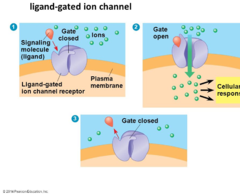
What causes a ligand-gated channel to open, and what is the most common example of this trigger?
It opens when a molecule (ligand) binds to it. The ligand is usually a neurotransmitter.
What causes a mechanically gated channel to open, and where are they typically used?
They open in response to physical pressure or force. They are used by sensory neurons that detect touch, blood pressure, and similar stimuli.
What causes a voltage-gated channel to open, and why are they important?
They open when the electrical voltage of the cell membrane changes. They are essential for generating and propagating action potentials.
What determines the resting membrane potential of a neuron?
The "leakiness" of the membrane, controlled by passive (leakage) ion channels that always allow some ion current to flow.
How does the number of potassium leakage channels compare to sodium leakage channels, and what is the result?
Potassium has more leakage channels than sodium. As a result, the outward potassium current (negative) is stronger than the inward sodium current (positive).
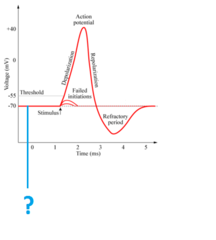
What is the typical resting membrane potential of a neuron?
Around -70 mV
What are graded potentials?
Brief, local changes in the membrane potential.
What is depolarization, and how does it affect a neuron's voltage?
It is when the electrical potential moves closer to zero. For neurons, this means the inside of the cell becomes less negative.
What is hyperpolarization, and how does it affect a neuron's voltage?
It is when the electrical potential moves further away from zero. For neurons, this means the inside of the cell becomes more negative than the resting potential.
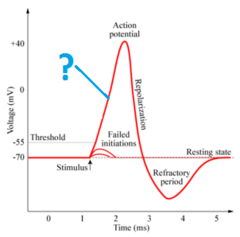
What is repolarization, and how does it affect a neuron's voltage?
It is the movement from a depolarized (or polarized) state back to the original resting potential. For neurons, this means the cell becomes negative again (most commonly following depolarization).
What is an action potential (nerve impulse)?
A brief reversal of membrane potential (an overshoot into positive potential for neurons) that travels quickly down an axon.
How does an action potential travel down an axon?
An overshoot in one region of the axon stimulates an overshoot in the next adjacent part of the axon
What triggers an action potential, and how does it connect to muscle contraction?
It is caused by a depolarization that passes a specific threshold. This is the same electrical stimulus that triggers excitation-contraction coupling in muscles
Which ion channels are most important for generating an action potential?
Voltage-gated ion channels
What are the three general behaviors of voltage-gated ion channels?
A change in voltage opens or closes the channel. 2) The resulting ion current can either amplify or counter the initial voltage change. 3) They are generally specific to a particular ion.
How many gates does a voltage-gated potassium (K⁺) channel have, and what is its state at -70 mV?
It has one gate, and it is closed at -70 mV
How does a voltage-gated potassium (K⁺) channel respond to depolarization and repolarization?
Its gate slowly opens during depolarization and slowly closes after repolarization.
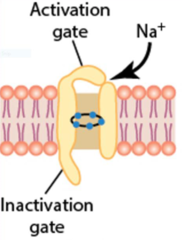
How many gates does a voltage-gated sodium (Na⁺) channel have, and what are their names?
It has two gates: an activation gate and an inactivation gate
What is the state of a voltage-gated sodium (Na⁺) channel's gates at -70 mV (resting state)?
The channel is closed overall (the activation gate is closed, and the inactivation gate is open).
How do a voltage-gated sodium (Na⁺) channel's gates respond as the membrane depolarizes?
The activation gate quickly opens (allowing Na⁺ to rush in), and then the inactivation gate quickly closes (stopping Na⁺ flow).
What happens to a voltage-gated sodium (Na⁺) channel's gates after the membrane returns to resting potential?
The activation gate quickly closes and the inactivation gate quickly opens, resetting the channel to its initial conditions so it is ready for the next depolarization.
Which ion channels are open and closed during the resting state before an action potential begins?
Only passive leakage channels. Closed: Both voltage-gated sodium (Na⁺) channels and voltage-gated potassium (K⁺) channels.
What initiates the depolarizing phase of an action potential?
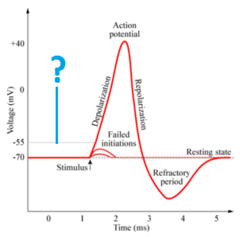
A graded potential reaching and passing the threshold voltage
Which channels open during the depolarizing phase, and what is the electrical result?
Voltage-gated sodium (Na⁺) channels open via their activation gates. This creates a strong positive inward current that causes a membrane potential overshoot
What stops the positive current and initiates the repolarizing phase?
The inactivation gates of the voltage-gated sodium (Na⁺) channels close, while the gates of the voltage-gated potassium (K⁺) channels open at the same time
What happens to the membrane voltage during the repolarizing phase and immediately after?
The outward potassium current returns the membrane back toward resting potential and briefly dips past it into hyperpolarization (because potassium gates close slowly)
What causes the refractory period after repolarization?
Voltage-gated sodium (Na⁺) channels need time to reset their activation and inactivation gates back to their resting positions
What happens if a neuron is stimulated during the refractory period?
A second action potential cannot be stimulated until the sodium channels finish resetting
Where does an action potential start on a neuron?
At the beginning of the axon, called the axon hillock
How does an action potential travel down the length of an axon?
It is regenerated at each adjacent section. Depolarization in one region spreads to the neighboring membrane and causes its voltage-gated sodium channels to open.
What forces an action potential to travel in only one direction down the axon?
The refractory period in the membrane region behind the signal prevents it from firing backward.
Does an action potential physically move like an object down the axon?
No. It is simply the sequential opening and closing of ion channels in adjacent regions, similar to a sign with successive flashing lights
What is the typical threshold membrane potential of a neuron?
-55
repolarization
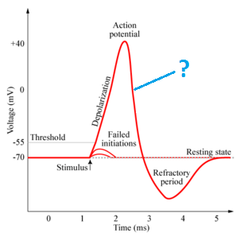
depolarization
threshold
Hyperpolarization
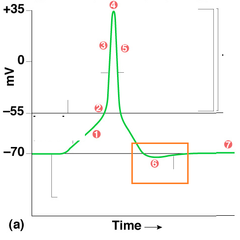
resting potential
voltage gate channel
mechanically gated channel

ligand gated channel
leakage channel
