Greece (week 9/10)
 Call Kai
 Learn
 Practice Test
 Spaced Repetition
 Match
 Flashcards
 Knowt Play
1/151

There's no tags or description
Looks like no tags are added yet.
152 Terms
Composition of ancient Greece
City-states called polis
Years of Persian invasions of Greece
490 BC and 480 BC
Introduction of the Olympic Games
776 BC
Appearance of the Greek gods
Human in appearance
Preferred Greek artistic style
Naturalism
Dining arrangement between men and women in ancient Greece
They ate separately
Order of eating in ancient Greece
Men first, then women, then slaves
Usual number of meals eaten by ancient Greeks
Three meals a day
Typical Greek breakfast
Bread dipped in wine and a teganites (pancake-like food)
Typical Greek lunch
Bread and wine, plus figs, salted fish, cheeses, and olives
Typical Greek dinner
Eggs, fish, legumes, olives, cheeses, bread, figs, and vegetables
Group that mainly ate meat in ancient Greece
The wealthy
Geometric style of pottery (c.)
1000–700 BC
Orientalizing style of pottery (c.)
700–600 BC
Archaic period of pottery (c.)
600–480 BC
Late Archaic to Classical style of pottery (c.)
530–400 BC
Classical to Hellenistic style of pottery (c.)
450–323 BC

Common use for Geometric pottery
Grave marker
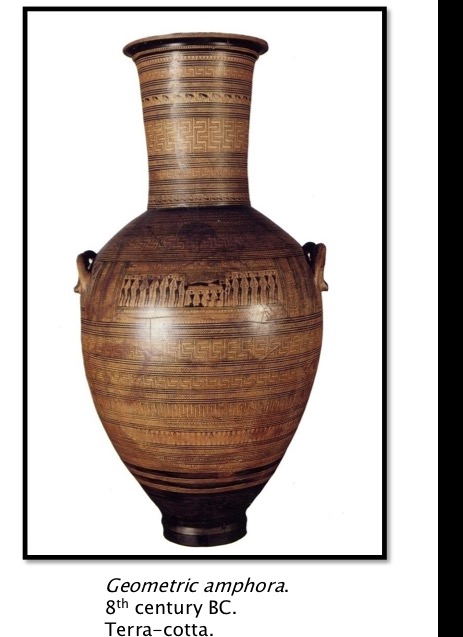
Typical Geometric vase scene
A dead body being carried by rows of figures

Drawing of figures in Geometric pottery
Torsos made of triangles, heads are rounded
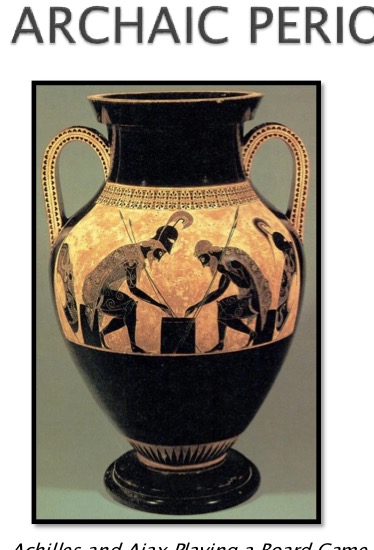
Black-figure painting
Figures painted in black on a red background

Meaning of Achilles' helmet in the Achilles and Ajax vase
That he will win the game

Action Ajax has taken with his helmet in the Achilles and Ajax vase
He has removed it

Source of visual tension in the Achilles and Ajax vase
The diagonals of their spears

White-ground painting
Figures on a white background

Period when white-ground painting became popular
Late 5th century BC

Significance of naturalism in Classical/Hellenistic pottery
High degree of naturalism, including foreshortening

Where white-ground pottery developed
Around Athens

Main use of white-ground pots
Ritual or funerary services
Archaic style of sculpture (c.)
600–480 BC
Early Classical style of sculpture (c.)
480–450 BC
Classical style of sculpture (c.)
450–400 BC
Hellenistic period of sculpture
323–31 BC

Golden Ratio actual number
1:1.618…

Where the Golden Ratio is reflected
In nature, including the human form
Writer on whom the Golden Ratio is based
The Roman engineer Vitruvius
Main concern of ancient Greek artists
Visual harmony and beauty
Influence on early Archaic artists
Egyptian techniques and conventions
Standard Archaic pose
Frontal pose with left leg extended forward and fists clenched


Meaning of Kouros
Boy (Greek)
Kouros sculptures generally depicts
Standing male figures, usually carved from marble

Difference in treatment of male and female Archaic sculptures
Male figures are usually nude, female figures are clothed


Use of Kouros figures
Commemorative purposes (grave markers or to honour individuals)
Realism level of Kouros figures
They show a generic male figure with little realism
Meaning of Kore
Girl (Greek)
Peplos Kore
A standing female figure, possibly a servant of Athena or a goddess


Where the Peplos Kore was found
On the Acropolis

Origin of the name Peplos Kore
Named for her peplos (woolen dress)
Expression of the Peplos Kore
The Archaic smile


Object originally held by the Peplos Kore
A bow and arrow or a pomegranate
Decorations on the Peplos Kore's dress
Images of sphinxes, horses, and goats

Ruler who invaded mainland Greece in 490 BC
Darius the Great
Where the Persians were defeated in 490 BC
Battle of Marathon (won by the Athenians)
Ruler who attempted to invade Greece in 480 BC
Xerxes (Darius' son)

Namesake of the Kritios Boy
The artist Kritios

Another name for the Early Classical style
Severe style (because the figures are not smiling)
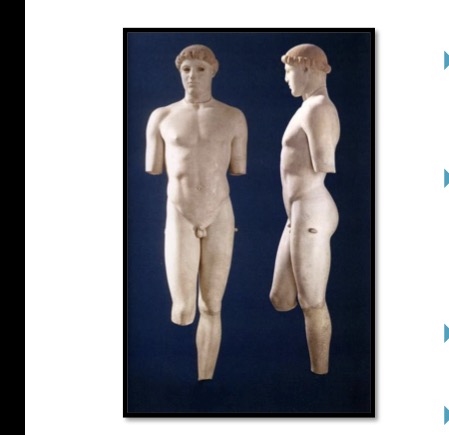
Difference between the Kritios Boy and Archaic statues
The face and body are idealized and more naturalistic

Pose used by the Kritios Boy (has a proper name for the pose)
Contrapposto (weight is carried on one leg)
Contrapposto
A relaxed pose where the weight of the body is carried by one leg

Effect of contrapposto on shoulders and hips
The line of the shoulders contrasts and balances the line of the hips


What the Zeus of Artemision reflects
The Greek interest in athletics

Reason the Artemision statue may be Zeus or Poseidon
The object in his hand is lost (most scholars think it is Zeus)

Method used for the eyes of the Zeus of Artemision
Inlaid with glass

Discovery of the Zeus of Artemision
Recovered from an ancient shipwreck

Reason bronze was preferred for some Greek sculptures
It allowed more fluid sculptures because it has greater tensile strength
First step of the lost-wax process
The artist molds clay into the desired shape

Step added after the clay mold in the lost-wax process
A layer of wax, then a second coat of soft material

Fate of the wax in the lost-wax process
It is melted out as bronze is poured into the mold (leaving a hollow space)
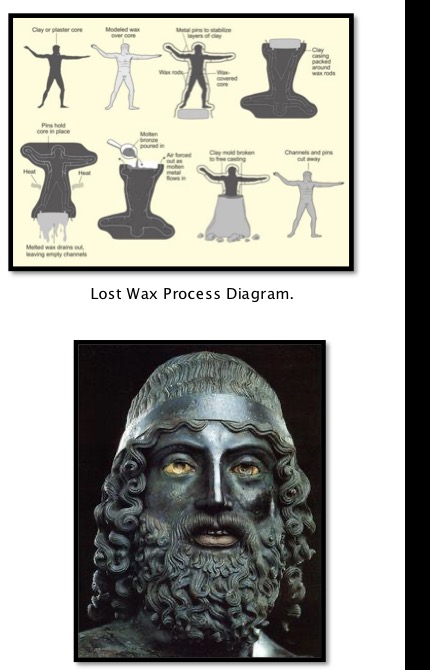
Final result of the lost-wax process
A hollow bronze statue in the exact shape of the original wax


Creator of the Brazen Bull and its patron
Perillos of Athens, for Phalaris, the tyrant of Akragas (Sicily)

Creation date of the Brazen Bull
6th century BC

Material of the Brazen Bull
Iron

Operation of the Brazen Bull
The victim was placed inside the stomach and a fire was lit underneath

Special feature of the Brazen Bull
Metal piping made the victim's screams sound like a bull

Nickname of the Classical style
The Golden Age of Greek art

How Classical artists showed the human body
Idealized: young, no physical defects, nicely proportioned and symmetrical

What Classical figures lacked
Personality and individual expression

Establishment of the Doric order
Around 600 BC

Namesake of the Doric order
The Dorians (who lived on the mainland)

Construction of a Doric column shaft
Individual sections (drums) held together by a metal dowel encased in lead

Establishment of the Ionic order
Around 600 BC

Namesake of the Ionic order
Ionia (the Ionian Islands and coast of Anatolia)

Difference between an Ionic and a Doric column
It is taller and thinner and has more curvilinear decoration

Establishment of the Corinthian order
Around 400 BC
Design used on a Corinthian capital
The acanthus-leaf design

Where Corinthian columns were mainly used
In interiors and associated with luxury

What Greek temples were considered to be
Houses for the gods

Earlier building type that influenced the Greek temple plan
The megaron (from Mycenaean palaces)

Placement of the god's cult statue in a Greek temple
In the main room (the naos), facing east toward an outdoor altar
Main ritual activity inside a Greek temple
Care of the statue (ceremonial dressing and cleaning)
Meaning of Parthenon
Virgin (it is dedicated to Athena)
Location of the Parthenon
On the Acropolis (upper city) of Athens
Designers of the Parthenon
The architects Iktinos and Kallikrates
Supervisor of the Parthenon's sculptural decoration
Phidias
Construction of the Parthenon
Entirely of marble blocks cut and fitted without mortar
What the Parthenon sculptures promoted
Athens' greatness (propaganda)
Contents of the naos of the Parthenon
A huge gold-and-ivory statue of Athena

Fate of the Parthenon in the 15th century
The Turks converted it into a mosque, stored gunpowder there, and it was largely destroyed when shelled
Creator of the Athena Parthenos statue
Phidias
Construction of the Athena Parthenos
Wooden frame covered with ivory (skin) and gold (armor and drapery)