Foundations - Exam 4
 Call Kai
 Learn
 Practice Test
 Spaced Repetition
 Match
 Flashcards
 Knowt Play
1/195

Earn XP
Description and Tags
Note: For the pre-class readings, only the practice questions are included. ATI notes based on highlighted terms, context added as needed. Includes powerpoints, ati, pre-class readings, and scorum.
196 Terms
Review: recall ADPIE.
Assess, diagnose, planning, implementation, evaluation.
What is client education?
An ongoing, goal-driven, interactive process that provides the client with new information.
What is health promotion?
The process of enabling people to increase control over and improve their health.
What is the PN’s role in Client Education?
Reinforcing teaching that the RN has done.
What is the cognitive domain?
The thinking domain; a client must think through information presented to them and be able to comprehend the information.
What are the six stages of the cognitive domain?
Knowledge: recalling prior learned knowledge.
Comprehension: understanding and interpretation of information.
Application: ability to use the data.
Analysis: breakdown of information to understand its structure.
Synthesis: putting the elements together to create a new whole.
Evaluation: deciding the ideal of the ideas.
What does the cognitive domain allow according to client education?
Lecture: allows the learner to gain comprehension and knowledge.
Question-and-answer: allows, teach-back, feedback, and evaluation.
What is the affective domain?
Domain that involves the client’s feelings (values, attitudes, and beliefs)
What are the 5 stages of the affective domain?
Receiving: the agreement and consciousness to receive information.
Responding: the agreement to respond to information.
Valuing: the value of information to the client.
Organization: uniting values, coming to resolutions with conflicts, and forming a value system.
Characterization: having pursuant values.
What does the affective domain allow in respect to client education?
Discussion: allows dialogue of personal topics, expression of feelings, and support.
Why is the affective domain part of client education?
It involves learning based on emotions and feelings; nurse provides information that affects the client’s feelings.
What is the psychomotor domain?
Domain that involves the use of hands-on fine and gross motor skills.
What are the 7 stages of the psychomotor domain?
Perception: being aware of nonverbal cues.
Set: being ready to learn, physically, mentally, and emotionally.
Guided response/imitation: imitation.
Mechanism/manipulation: almost secure with learned skill.
Complex/precision: secure with learned skill.
Adaptation/articulation: ability to adjust if the situation requires.
Origination/naturalization: developing new skills when/if needed.
What does the psychomotor domain allow in relation to client education?
Demonstration: allows the learner to see expectations.
Return demonstration: allows the learner to perform the skill with feedback.
Why is the psychomotor domain included in client education?
It involves the nurse teaching a client hands-on skills.
What are Knowles’s fundamental principles of learning?
Relevance/need to know.
Self-directed.
Life-experience.
Readiness.
Task-centered.
Motivation.
What is health literacy? How does it affect learning?
The ability to read, write, and understand health-related information; limitations result in severe medication errors, increased numbers of ER visits, and more hospital admissions.
What are some factors that promote client education?
Perceived benefit.
Enhanced health literacy.
Nonjudgmental support.
Quiet, low-stimulus environment.
Repetition.
What are some factors that hinder client education?
Fear, anxiety, depression.
Lack of motivation.
Environmental distractions.
Psychomotor deficits.
Physical discomfort (fatigue, pain).
Timing.
What are some barriers to learning?
Impaired cognition.
Language barriers.
Visual and hearing impairments.
Emotional concerns.
Cultural differences.
Fine vs. gross motor skills.
The use of small muscles, such as fingers.
The use of large muscle groups to perform whole body movements.
What is a low-stimulus environment?
An optimal learning environment that reduces distraction & provides good ventilation, adequate lighting, and a comfortable temperature.
Why are low-stimulus environments important for client engagement in an educational session?
Educating clients will have distractions around them.
What is group instruction?
Two or more clients who are obtaining the same learning material simultaneously.
What is individual instruction?
When the educational session engages only the learner and the teacher; most common.
What is the teach-back method?
A technique to determine the client’s level of understanding by having the client explain back to the nurse the information that was taught.
What is cultural diversity?
Occurs within and among cultural groups and includes a multitude of factors impacting diversity such as age, sexual orientation, culture, ethnicity, and socioeconomic status.
What is self-bias?
Personal perception of stereotype
What 3 elements does patient education include?
Maintenance and promotion of health and illness prevention.
Restoration of health.
Coping with impaired functioning.
Why do nurses need teaching skills?
Teaching clients is part of independent nursing practice.
ANA standards.
Patients participate in healthcare decisions.
Hospital stays are brief.
Healthcare is expensive.

Rationale: ANA Code of Ethics for Nurses - nurses are responsible for promoting and protecting health, safety, and rights of patients. Patient teaching is essential in fulfilling that responsibility.
Give an example of each of the following domains of learning, cognitive, psychomotor, and affective.
Cognitive: facts about a disease.
Psychomotor: self-administration of insulin.
Affective: changing belief about diet.
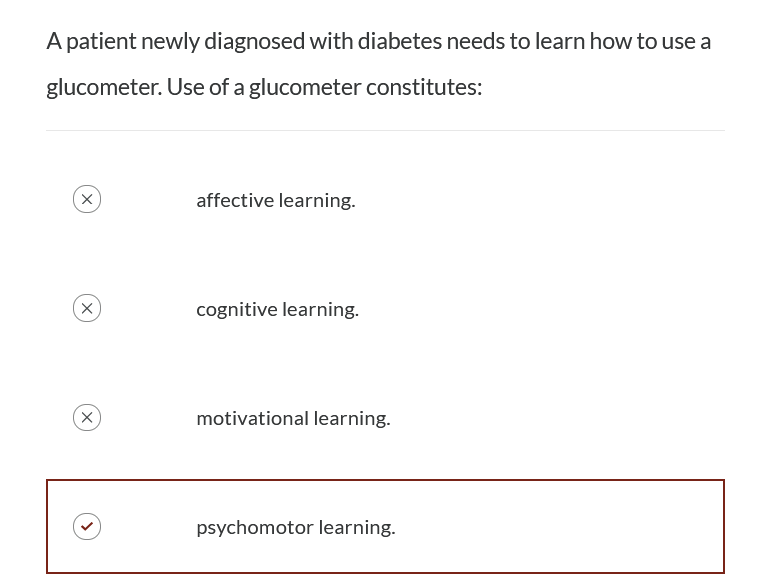
Rationale: psychomotor learning involves acquiring motor skills that require coordination and the integration of mental and physical movements, such as using a glucometer.
What are the 5 rights of teaching?
Right time.
Right context.
Right goal.
Right content.
Right method.
Explain each right of teaching…
Time:
Is the learner ready; free of anxiety and pain?
Trust? Enough time to teach?
Context:
Is the environment quiet and free of distractions?
Soothing? Stimulating?
Goal:
Learner actively involved in planning?
Realistic? Reflect their lifestyle?
Content:
Appropriate for needs? New? Reinforced?
Presented at learner’s level?
Method:
Do teaching strategies fit learning style of client?

Rationale: The client will be most motivated to learn when he recognizes why this skill is important to the success of his overall treatment plan (e.g., medication effectiveness).
Before making a plan for client education, what do healthcare providers consider?
Learning contract.
Teaching goals.
Learning objectives.
When does a learning assessment start?
At admission; teaching methods adapted to meet the needs of individual clients.
Concentration.
Beliefs and practices.
Emotional readiness.
Ability to learn.
Learning style.
What are teaching goals?
Expected final outcome of the teaching and learning process; address all three domains.
What are learning objectives?
Single, specific behaviors that must be completed to accomplish the goal; short term, ideally completed in a handful of sessions.
What are some teaching strategies? Can you explain each?
Lecture.
Group discussion.
Demonstration and return demonstration.
One-to-one instruction and mentoring.
Printed material.
Online sources of information.
Role modeling.
How do we evaluate learning?
Oral questions/interviews/questionnaires/checklists.
Direct observation.
Client reports and client records.
Tests and written exercises.
An ostomy nurse is providing preoperative education for a client who is scheduled for a sigmoid colostomy. The nurse should identify that which of the following client statements is an indication that the client is ready to learn?
A. “I will not look at my incision after the surgery.”
B. “Will you give me pain medication after the surgery?”
C. “Can you tell me about how long the surgery will take?”
D. “I can’t remember what my doctor told me about the surgery.”
C. “Can you tell me about how long the surgery will take?”
An ostomy nurse is educating a client about how to empty their ostomy pouch. Which of the following actions by the client indicates that psychomotor learning has taken place?
A. The client states how often the ostomy pouch should be emptied.
B. The client demonstrates emptying the ostomy pouch.
C. The client writes the steps of how to empty the ostomy pouch on a piece of paper.
D. The client states they understand how to empty their ostomy pouch.
B. The client demonstrates emptying the ostomy pouch.
An ostomy nurse is educating a client about diet. Which of the following actions should the nurse take to evaluate the client’s learning?
A. Encourage the client to ask questions about their diet.
B. Ask the client to list foods to include in their diet.
C. Encourage the client to fill out an evaluation from about how the nurse presented the information about diet.
D. Ask the client if they have additional resources for further instruction about their new diet.
B. Ask the client to list foods to include in their diet.
What is a health record?
A collection of health information and data about an individual client’s health.
What type of information can a nurse document in a client’s EHR (Electronic health record)?
Current medication list.
Documented allergies.
Immunization history.
Lab and radiology reports from current encounter.
Medical history and diagnoses.
Treatments and procedures received.
Why should you lock a computer with a patient’s EHR?
To ensure the confidentiality of the information.

What is the PIE model? What does it stand for?
Type of documentation that omits the plan of care and utilizes flow sheets and progress notes; problem-intervention-evaluation charting.
What is a source-oriented medical record?
Traditional form of documentation, divided into specific sections within the medical record.
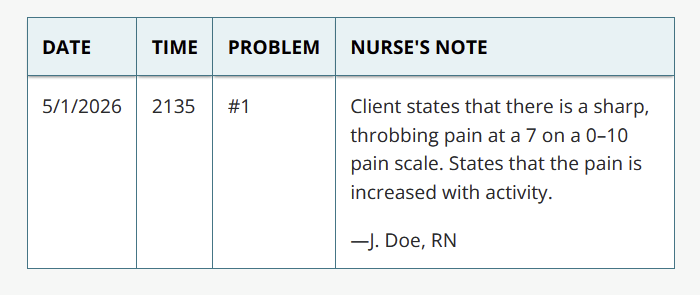
What is a problem-oriented medical record used for?
Used to create a comprehensive and organized approach among all members of the interdisciplinary team.
What does SOAP stand for?
Subjective (from the client).
Objective (measured by the nurse).
Assessment.
Plan.

What is focus charting? What three times must be documented?
Documents a client’s specific health problem by focusing on the nursing diagnosis as well as client changes.
Data.
Action.
Response.
What is charting by exception?
Documenting only unexpected / unusual findings based on standardized protocols.
What should a nurse do during an unplanned EHR downtime?
Start facility downtime procedure and document on approved paper forms.
Verify client identity.
Use downtime workflow to report / follow up on test results.
What is the FACT framework used for?
High-quality documentation; emphasizes factual, accurate, complete, and timely entries.
What does the FACT documentation framework stand for?
Factual.
Concrete, objective, and descriptive information.
Accurate.
Exact descriptions and measurements.
Complete.
Must contain where, why, and how. NON-BIASED.
Timely.
Put in chronological order; clear understanding of what happened.
After client care is performed.
What are verbal orders vs. telephone orders?
Orders received from a provider directly, transcribed by licensed personnel, and later cosigned by the provider.
An order received over the telephone from a provider when the provider is not physically present.
What should a nurse do when receiving a verbal order from a provider?
Transcribe the order into the client’s record so it can be read back.
Verify correct client and check for allergies.
Used closed-loop communication; read back and confirm before implementation.
When receiving telephone orders, what should the nurse do?
Verify client information.
Confirm the order is complete.
Document immediately.
Use read-back to confirm.
Use clarifying techniques.
Clarify before acting.
What are CPOE systems? What does it stand for?
Computerized provider order entry; allows provider to enter and transmit prescription electronically.
What are the benefits of a computerized provider order entry (CPOE)?
Transcription errors are reduced.
Medications can be more quickly administered.
When documenting, what can increase legal risk?
Copying another nurse’s notes without verifying.
Ignoring warnings about communicating as needed.
Delayed completion of key documents.
Leave auto-filled assessment fields unchanged despite client’s condition changing.
What is a health assessment?
A comprehensive assessment of physical, mental, spiritual, socioeconomic, and cultural status of an individual, group or community.
What is a nursing assessment?
Assessment focusing on the patient’s functional abilities and physical responses to illness and other stressors.
What is a physical examination?
Techniques used in a health or nursing assessment to gather objective data about the body.
What is the purpose of a physical examination?
To establish baseline data.
Identify nursing diagnoses, collaborative problems, or wellness diagnoses.
Monitor the status of an identified problem.
Screen for health problems.
Physical examinations establish baseline data. What is that?
Data about a client’s physical status and abilities that serve as a baseline for comparison as the patient’s health status changes.
Recall the different types of physical assessments; e.g., comprehensive, focused, special-needs, ongoing. Define each.
Comprehensive:
gathers subjective and objective data about a patient’s physical, emotional, spiritual, and psychosocial health to identify problems and strengths.
Focused:
gathers data about a specific health problem, body part, or function to identify or monitor concerns.
Special-needs:
evaluates a specific area of patient functioning, such as pain, nutrition, or mobility, to identify risks or problems.
Ongoing:
monitors changes in a patient’s health to identify new problems and evaluate existing problems and goals.
How do you change physical examinations when dealing with infants, toddlers, and elders?
Infants: let parent hold them.
Toddlers: allow them to show you their developmental skills; praise for their abilities and cooperation.
Do invasive procedures last.
Elders: limit position changes; allow extra time to interview and exam.

A. Establish mutual goals with clients.
What are the basics of a comprehensive examination?
Assess muscle strength, mobility, skin temperature and texture.
Posture!
Slump may indicate fatigue, depression, pain.
Speech!
Illogical responses? Difficulty speaking? Rapid speech? Hoarseness? Accent?
Height, weight, vitals, mental state, hygiene.
What are the four major skills used during physical assessments?
Inspection.
Using sight to observe the patient's body and identify abnormalities.
Palpation.
Using touch to assess temperature, texture, tenderness, swelling, and masses.
Percussion.
Tapping the body to assess the size, location, and density of underlying structures.
Auscultation.
Listening to body sounds directly or with a stethoscope.
Additional clinical skill.
Olfaction (sense of smell)
Using smell to identify possible health problems.

*remember integumentary is the body’s outer protection.
C. Integumentary
Why is it important to take vitals?
They are a mean of assessing critical physiological functions.
What are the standard vital signs? What do they indicate?
Body temperature (T).
Pulse (P).
Respirations (RR).
Blood pressure (BP).
Pain (5th vital sign).
O2 saturation (O2 sat).
Indicate a person’s health and function of their body systems.
T or F: Stable signs guarantee that a patient is stable.
False; indicate.
You should monitor vital signs…
As ordered.
What should you do if the patient’s status does not warrant the frequency of vital signs ordered?
Speak with the ordering clinician.
Normal T, P, RR, and BP?
T: 98°-98.6°F oral; 99°-99.6°F rectal.
P: 60-100.
RR: 12-22 breaths/min.
BP: >120/>80
What is the average normal body temperature?
98.6°F
What is core body temperature?
Temperature deep within the body; viscera (internal organs) and liver.
What is body temperature? What is thermoregulation?
Degree of heat maintained by the body; process of maintaining a stable internal body temperature.
The hypothalamus detects internal temperature changes and initiates compensatory mechanisms to maintain a stable environment. Name all the steps…
Heat senses hypothalamus triggered.
Vasodilation, sweating, inhibition of heat production (compensatory mechanisms).
↓ body temperature.
What are compensatory mechanisms?
Mechanisms triggered by the hypothalamus that help maintain a stable environment; vasodilation, shivering, increased metabolism, vasoconstriction/dilation, etc.
How does one’s circadian rhythm influence body temperature?
Temperature fluctuates 1-2°F depending on time of day.
Lowest in the morning, highest late afternoon/early evening.
How do developmental level, environment, gender, exercise, emotions and stress affect body temperature?
Developmental level:
Infants and older adults most susceptible to environment temperature extremes.
Gender:
Female body temp. varies with menstrual cycle, pregnancy, and menopause.
Exercise:
Increase in metabolism; increases core temperature.
Emotions and stress:
Stimulation of sympathetic nervous system; production of (nor)epinephrine, increased body temperature.
What three factors increase body heat production?
Metabolism.
Skeletal muscle movement.
Non-shivering thermogenesis (heat production).
What is a person’s metabolism?
The sum of all physical and chemical processes/changes that take place in the body.
What is your basal metabolic rate (BMR)?
The amount of energy required to maintain the body at rest.
What hormone (in the slides) affects the basal metabolic rate (BMR)?
Thyroxine.
More → Hyperthyroidism (higher).
Less → Hypothyroidism (lower).
What process of skeletal muscle movement results in heat production?
Catabolism/breakdown of fats and carbohydrates.
What are some examples of non-shivering thermogenesis?
Metabolism of fat to produce heat.
Infants.
Disappears in the first month after birth.
What are the variances in temperature mentioned in the slides?
Pyrexia (Fever).
Hyperpyrexia.
Hyperthermia (Heat stroke(.
Hypothermia.
What is pyrexia (fever)?
Fever; above 100°F; rise in core body temp. that increases metabolism and inhibits the multiplication of pathogens.
Clinicians do not treat low-grade fevers unless…
It is greater than 102°F
What resets the hypothalamic thermostat to a higher temperature?
Pyrogens.
What are the benefits of a fever?
Enhances phagocytosis.
Causes breakdown of lysosomes and self-destruction of infected cells.
Release of interferons (protect cells from viral infection).
What is hyperpyrexia?
Abnormally high body temp; greater than 105.8°F.
Why is hyperpyrexia dangerous?
Damages body cells, especially in the brain.
→ seizures, coma, cerebral edema, shock, death.