CHII Module 3 Complete
 Call Kai
 Learn
 Practice Test
 Spaced Repetition
 Match
 Flashcards
 Knowt Play
1/141

There's no tags or description
Looks like no tags are added yet.
Name | Mastery | Learn | Test | Matching | Spaced | Call with Kai | Chat |
|---|
No analytics yet
Send a link to your students to track their progress
142 Terms
What hormones are produced by the posterior pituitary?
Oxytocin and antidiuretic hormone
What hormones are produced by the anterior pituitary?
ACTH, growth hormone, TSH, FSH, prolactin, and LH
If there is hyperactivity in the anterior pituitary gland, what conditions might happen?
Gigantism, acromegaly, acromegalic gigantism, and Cushing’s disease
If there is hypoactivity in the anterior pituitary gland, what conditions might happen?
Dwarfism, acromicria, and Simmond’s disease
If there is hyperactivity in the posterior pituitary gland, what condition might happen?
Syndrome of inappropriate hypersecretion of ADH (SIADH)
If there is hypoactivity in the posterior pituitary gland, what condition might happen?
Diabetes insipidus (DI)
What are the most threatening hypopituitarism deficiencies?
ACTH and TSH; vital for maintaining a balanced metabolism
What are the manifestations of low ACTH?
Anorexia, malaise, lethargy, low serum cortisol, hypoglycemia, vomiting, and pale/gray complexion
What are the manifestations of low TSH?
Decreased libido, weight gain, low thyroid hormone, cold intolerance, low HR, constipation, and slowed cognition
What are the manifestations of low GH?
Decreased bone density and muscle strength, pathologic fractures
What are the manifestations of low LH and FSH?
Loss of sexual characteristics in males and females like facial/body hair, decreased libido, impotence, amenorrhea; neurologic changes such as loss of visual acuity (peripheral vision is early sign), temporal headaches, diplopia, ocular muscle paralysis, limiting eye movement
How is hypopituitarism diagnosed?
Blood levels of pituitary hormones, hormone stimulation testing, CT scan of head, MRI of head, angiography in brain
What interventions should be implemented if someone has an LH and FSH deficiency?
Androgen therapy and/or female hormone replacement therapy (HRT)
What are the side effects of androgen therapy?
Gynecomastia, acne, baldness, prostate enlargement
What are the contraindications for androgen therapy?
Patients with prostate cancer
What are the adverse side effects of HRT?
DVT and HTN
What interventions are done for growth hormone deficiency?
Human GH injections SQ
What are the interventions for TSH deficiencies?
Replaced with thyroid hormone levothyroxine
What are the interventions for ACTH deficiencies?
Replaced with cortisol
What is an important education point for patients taking replacement hormones?
MAINTAIN REGULATION, teach med adherence
What is the most common cause for hyperpituitarism?
Hyper-secreting pituitary adenoma; usually excess GH, prolactin and ACTH
What are the manifestations of excessive growth hormone?
Broad nose, coarse facial features, excessive sweating, voice deepening, enlarged hands, enlarged organs, HA, changes in vision, fatigue and lethargy, backache and arthralgias
What are the manifestations of hyperprolactinaemia?
Erectile dysfunction, hypogonadism, galactorrhoea, gynecomastia, amenorrhea
What are the manifestations of excess ACTH?
HTN, hyperglycemia, purple striae, abdominal obesity, buffalo hump, moon-shaped face
What is a prolactinoma?
Prolactin secreting tumor, most common; causes decrease in normal levels of sex hormones, loss of libido, infertility and spontaneous milk flow
What is gigantism?
Hyperpituitarism; onset of GH hypersecretion BEFORE puberty, continues into adulthood resulting in abnormal height
What is acromegaly?
Hyperpituitarism; GH hypersecretion AFTER puberty, changes are seen in face, hands, feet and ears, NOT height
How is hyperpituitarism diagnosed?
Hormone levels in blood and urine, CT, MRI, suppression testing
What are some non-surgical management actions for hyperpituitarism?
Encourage patient to express concerns and fears about altered physical appearance and/or sexual dysfunction, drug therapy may be used alone or in combination with surgery or radiation
What medications may be prescribed for hyperpituitarism?
Dopamine agonists to inhibit the release of prolactin and GH (bromocriptine and cabergoline); somatostatin analogs (octreotide and lanreotide) and GH receptor (pegvisomant) blockers are most common and effective for acromegaly
What are some considerations for radiation therapy for excess GH patients?
Takes a long time to achieve therapeutic effect (years), not recommended for acromegaly; side effects are hypopituitarism, optic nerve damage, and other eye and vision problems
What are some surgical management interventions for hyperpituitarism?
Hypophysectomy, most common long-term treatment for hyperpituitarism
What is a hypophysectomy?
Surgical removal of pituitary gland along with tumor, minimally invasive trans-nasal or trans-sphenoidal; causes HYPOpituitarism, so they need lifelong multiple hormone therapies
What are some pre-op care actions for a hypophysectomy?
Explain the goal of the treatment, explain that certain changes made by the hormones are NOT reversible (GH)
What are some post-op care actions for a hypophysectomy?
Nasal packing for 2-3 days after surgery and mustache dressing, breathe through mouth; decrease sense of smell for 3-4 months after procedure; tell patient not to brush teeth, blow nose, cough, sneeze, or bend forward after surgery (increases ICP and delays healing); monitor neuro hourly for 24 hours, monitor I&O, observe for complications, prevent increased ICP, perform oral rinses and apply moisturizers over lips, teach about self-administration of prescribed hormones
What are some possible complications of a hypophysectomy?
DI, CSF leakage, infection, increase ICP, meningitis
How do you identify a CSF leak?
Assess nasal drainage for presence of glucose, halo sign, persistent severe headaches; most CSF leaks heal themselves but the provider must be notified promptly
What is Diabetes Insipidus (DI)?
Water metabolism problem caused by an ADH deficiency OR inability of kidneys to respond to ADH
What are some causes of DI?
Brain tumors, head trauma, or other causes of cerebral edema
What is Arginine vasopressin deficiency (AVP-D)?
Classification of DI, central DI; problem in the hypothalamus or pituitary gland; lack of ADH production or release
What is Arginine vasopressin resistance (AVP-R)?
Classification of DI, nephrogenic DI; renal tubes do not respond to ADH (severe kidney injury); can be drug related, LITHIUM and DEMECLOCYCLINE interfere with kidney response to ADH
What is the cardinal sign of DI?
Excretion of large amounts of very DILUTE urine with excessive thirst; causes dehydration and hypovolemia
What should be done if DI is suspected?
24-hour fluid I&O, consider if urine output is more than 4L
What are some characteristics of DI urine?
Dilute with low specific gravity (less than 1.005) and low osmolarity (50-200 mOsm/kg)
What are some manifestations of DI?
Hypotension, tachycardia, weak pulses, hemoconcentration, poor skin turgor, dry mucous membranes, decreased cognition, ataxia, increased thirst, irritability
For AVP-D, what interventions are anticipated?
Desmopressin (FIRST LINE AGENT) and aqueous vasopressin (IV, IM or SQ); hydration with hypotonic IV fluids in acute care management
For AVP-R, what interventions are anticipated?
Depends on underlying cause; sodium restriction, reduced protein intake, or thiazide diuretics to induce volume depletion
What are the nursing priorities for DI?
Early detection of dehydration and managing hydrations
What are some general interventions for DI?
Replace fluids equal to urinary output, monitor STRICT I&O and daily weights, report weight changes in timely manner (1kg=1 liter of fluid), monitor for S/S of dehydration and sever hypovolemia, and monitor serum and urine lab results
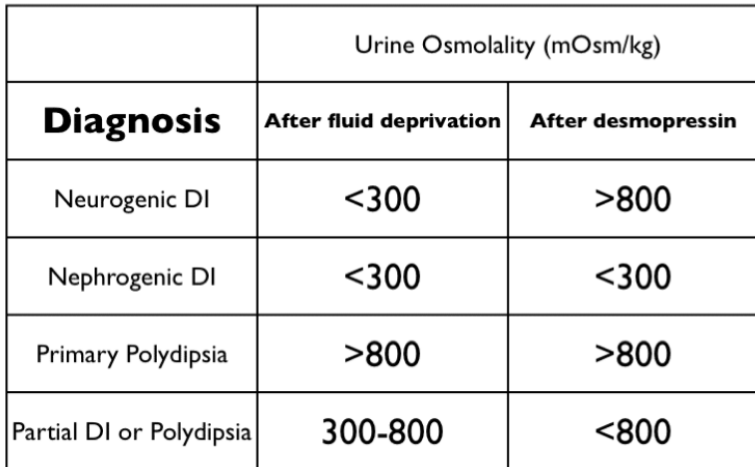
What is the water deprivation test?
Best test to diagnose central DI; urine production, blood electrolyte levels and weight are measured regularly for 24 hours, during which the person is not allowed to drink

Fluid deprivation test numbers
Medieval torture
What are some education points for a patient with DI?
Polyuria and thirst are signals for the need of another drug dose, use daily weights to estimate dehydration or overhydration, verify proper demonstration of drug self-administration, encourage pt to always wear a self-id bracelet
What are some side-effects of nasal sprays?
Ulceration of the mucous membranes, allergy sensation of tightness; inhalation of the spray into the lungs precipitates pulmonary problems
What is Syndrome of Inappropriate Antidiuretic Hormone (SIADH)?
Failure of negative feedback system; ADH secretes even when plasma osmolarity is low or normal; water retention leading to fluid overload; fluid and electrolyte imbalance
What are the causes of SIADH?
Shock, trauma, stress, pulmonary infections, malignancies, and cancer therapy
What are some early symptoms of SIADH?
R/t water retention and dilutional hyponatremia; cerebral edema, lethargy, headaches, mood changes, disorientation, change in LOC, sometimes seizure and/or coma, N/V, anorexia, weight gain, bounding pulse, HTN, hypothermia, decreased urine output volume and increased urine osmolarity
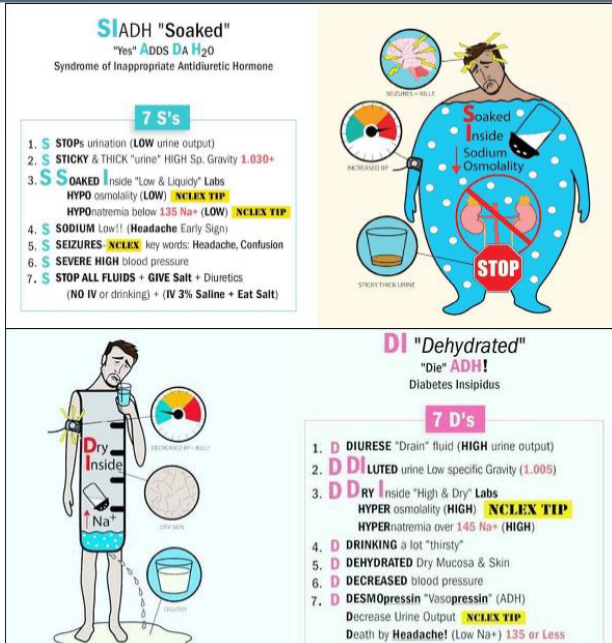
pic of SIADH and DI
Top right is me fr

What are some interventions for SIADH?
Fluid restriction of 500-1000 (monitor for fluid overload), meds like vasopressin receptor antagonists and diuretics, treat/manage underlying cause, hypertonic saline if Na is low
If a patient with SIADH has tube feedings and/or GI tube med administrations, what is one consideration?
Use saline instead of water
What are some nursing considerations for SIADH?
Frequent neurologic checks, patient safety (fall risk and seizure precaution), measure I&O, treat hyponatremia, assess for signs of volume overload at least Q2H
What might cause adrenal gland hypofunction/insufficiency (Addison's disease)?
Inadequate secretion of adrenocorticotropic hormone (ACTH), dysfunction of the hypothalamic pituitary control mechanism, or direct problems with adrenal gland tissue
What does adrenal gland hypofunction lead to?
Loss of aldosterone and cortisol action
What does decreased cortisol lead to?
Hypoglycemia
What does decreased aldosterone lead to?
Potassium excretion decreased BUT sodium and water excretion increased
What are the primary causes of adrenal gland hypofunction?
Autoimmune dx, metastatic dx, AIDS, and adrenalectomy
What are the secondary causes of adrenal gland hypofunction?
Pituitary tumors, hypophysectomy, sudden cessation of long-term high dose glucocorticoid therapy
What are some assessments for adrenal gland hypofunction?
Ask about any radiation activity, past and current drug use (steroids, cancer), changes in activity, GI problems, hypoglycemia, hyperkalemia, and hyponatremia
What are some manifestations of adrenal gland hypofunction?
Lethargy, fatigue, muscle weakness, anorexia, N/V, diarrhea, abdominal pain, hypoglycemia (sweating, HA, tachycardia, changes in neuro status, dehydration)
What is an acute adrenal insufficiency/Addisonian crisis?
Life-threatening event; need for cortisol and aldosterone is greater than available supply; loss of aldosterone leads to severe hypotension r/t blood volume depletion
What are some causes of adrenal insufficiency?
Stressful events such as surgery, trauma, and severe infection
What are some interventions for adrenal gland hypofunction?
Monitor fluid deficit by weighing daily and strict I&Os, as well as labs for hemoconcentration and electrolyte disturbances; prevent hypoglycemia with glucose monitoring and address underlying problem (hydrocortisone, oral cortisol, or mineralocorticoid hormone therapy); assess cardiac function with continuous cardiac monitoring and vital signs Q1-4 hours
What is adrenal gland hyperfunction (Cushing's Syndrome/Disease)?
Hypersecretion of cortisol by adrenal cortex results in hypercortisolism or excessive androgen production
What is the difference between Cushing's Syndrome and Cushing's Disease?
Cushing's syndrome is the set of symptoms that result from the surplus of cortisol, while the disease is the syndrome but it is caused by an ACTH-producing pituitary tumor
What are some causes of adrenal gland hyperfunction?
ACTH-producing pituitary adenoma most common non-drug cause, most common drug cause is glucocorticoids
What are some assessments for recognizing Cushing's Syndrome in a patient?
Health hx and glucocorticoid therapy; weight gain, increased appetite, changes in fat distribution (truncal obesity, moon face, buffalo hump); skin, cardiac, musculoskeletal and immune changes; glucose metabolism (fasting glucose high), increased androgen production (acne, increased body hair, oligomenorrhea); emotional instability and mood disorders, sleep pattern disturbances
What are some lab assessments for Cushing's Syndrome?
Blood, salivary and urine cortisol levels (elevated), dexamethasone suppression testing (Set doses of drug given with a 24 hour urine collection, urinary corticosteroid excretion and cortisol levels suppressed in healthy patients)
What are some imaging assessments for Cushing's Syndrome?
Identify pituitary lesions; CT, MRI, and arteriography
What are some potential complications for patients with Cushing's Syndrome?
Fluid overload d/t hormone induced water and sodium retention, potential for injury d/t skin thinning, poor wound healing and bone density loss, and potential for infection d/t hormone induced reduced immunity; HTN, increased hepatic gluconeogenesis and insulin resistance, cardiovascular disease
How do you help treat any complications for patients with Cushing's syndrome?
Restore fluid balance (monitor for fluid overload) at least Q2H, prevent injury and infection, monitor for acute adrenal insufficiency; potential surgical management with hypophysectomy
What is hyperaldosteronism?
Increased secretion of aldosterone with mineralocorticoid excess
What are some primary causes of hyperaldosteronism (Conn Syndrome)?
Excessive secretion of aldosterone from adrenal gland(s), usually caused by an adrenal adenoma
What are some secondary causes of hyperaldosteronism?
High levels of angiotensin II that are stimulated by high plasma renin levels (kidney hypoxia, diabetic nephropathy, excessive use of some diuretics)
What kind of electrolyte and blood volume imbalances occur with hyperaldosteronism?
Hypernatremia, hypokalemia, and metabolic alkalosis; increased blood volume which increases BP, at risk for strokes, MIs and kidney damage
What are the manifestations for hyperaldosteronism?
Most common are HTN and hypokalemia; HA, fatigue, muscle weakness and dehydration;
What diagnostics are used for hyperaldosteronism?
Imaging with CT and/or MRI; Lab studies, elevated Na with decreased K, metabolic alkalemia, elevated plasma aldosterone; urine has low specific gravity and high aldosterone
What is the most common treatment for hyperaldosteronism?
Surgery; removal of one or both adrenal glands
What are some pre-op considerations for hyperaldosteronism?
Potassium level MUST be corrected before surgery, usually with spironolactone and potassium supplements
What are some post-op considerations for hyperaldosteronism?
If unilateral removal, temporary glucocorticoid replacement; if bilateral, lifelong glucocorticoid replacement; When surgery cannot be performed, spironolactone therapy continued to control hypokalemia and HTN
What is pheochromocytoma?
A nonmalignant catecholamine producing tumor of the adrenal medulla; tumors produce store and release epinephrine and norepinephrine, overproduction of catecholamine (fight or flight)
What life-threatening event is a patient with a pheochromocytoma at risk for?
Hypertensive crisis
What are the manifestations of a pheochromocytoma?
Most common are HTN, HA, and sweating; flushing, anxiety/panic, palpitation, abdominal pain, dizziness, blurred vision, diabetes symptoms, tachycardia, and heart failure
What are some nursing management considerations for a patient with a pheochromocytoma?
Assess for and manage symptoms of HTN and/or hypertensive crisis; prevent additional injury and complications; perioperative patient care needs to include patient education, informed consent, and postoperative management
How is pheochromocytoma treated?
Alpha-adrenergic blocking agents (doxazosin, tolazoline) and removal of the tumor
What is hypothyroidism?
Insufficient thyroid hormone production causing a decreased metabolic rate
What is Hashimoto's thyroiditis?
Autoimmune destruction of thyroid tissue, most common cause of primary hypothyroidism in iodine-sufficienct regions
What is radioactive iodine (RAI)?
Destruction of thyroid tissue following treatment of hyperthyroidism
What are some other etiologies of hypothyroidism?
Thyroid surgery and medications like lithium and amiodarone (impair thyroid hormone production or alter function)
What are some manifestations of hypothyroidism?
Excessive sleeping, constipation, cold intolerance poor circulation, bradycardia, dry skin, hair loss, brittle nails, weight gain, intolerance of exercise, poor memory, depression
What are some labs for hypothyroidism?
Dramatic reduction of T3 and T4, HIGH TSH in primary hypothyroidism, decreased or near normal TSH in secondary hypothyroidism
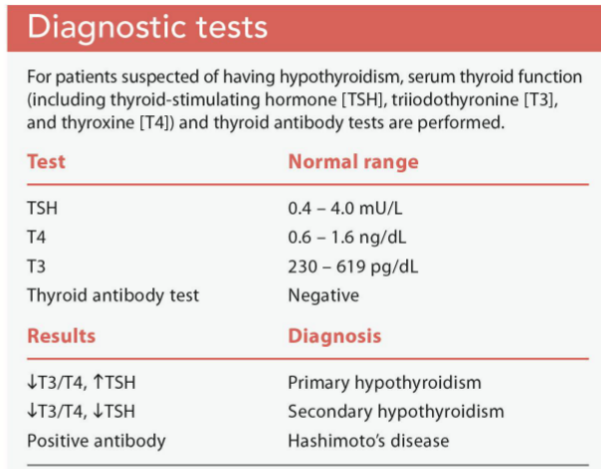
Figure for thyroid
Very interesting very cool
