PSYCH 372 - Chapter 12: Intelligence and Personality
 Call Kai
 Learn
 Practice Test
 Spaced Repetition
 Match
 Flashcards
 Knowt Play
1/39

Earn XP
Description and Tags
lectures from Dr. Kathleen Munley
40 Terms
What is eugenics?
The scientifically inaccurate theory that humans can be improved through selective breeding of populations
What are some historical examples of eugenics?
19th century England (Sir Francis Galton) → “Selective breeding” can be used to improve intelligence of human race, gave rise to eugenics movement
1920s-1970s, United States → forced sterilization of mental patients in some states to prevent conception of ‘genetically inferior’ children
1930s and 1940s, Germany → Nazi eugenics (racial ideology, forced sterilization, murder)
What is IQ?
Intelligence quotient → standard measure of intelligence obtained using the Wechsler Adult Intelligence Scale (WAIS) or Wechsler Intelligence Scale for Children (WISC)
What are the components of the Weschler scales?
Memory tests
Vocabulary tests
Arithmetic tests

How are results of IQ tests reported?
As two forms of intelligence:
Verbal IQ
Performance/non-verbal IQ
How is intelligence generally used for genetic studies?
A single measure (overall test score) is commonly used: “g” for “general cognitive ability”
Represents common factor present in all intelligence subtests (verbal, spatial, numerical, mechanical)
What does the IQ scoring curve look like?
IQ scores are normalized to a population reference, in which 100 is the mean and 15 is one standard deviation

What are the results of twin and family studies of intelligence?
1981 review: Average correlation for MZ twins = 0.86, DZ twins = 0.6
1997 meta-analysis: Heritability of IQ: 48%
Twin and adoption studies indicate substantial heritability for IQ
What are some lessons from twin and family studies of intelligence?
Environmental effects are important, even when genetic effects are at large
Heritability depends on age
Environmental effects on IQ are limited to making the IQ of twins different, rather than similar
Genetic effects on intelligence are correlated across different IQ tests
What proof do we have that environmental effects still affect intelligence even with a high heritability?
IQ has been increasing over time (higher IQs in people born in 1990s vs. 1940s)
How does heritability change with age?
Genetic contribution peaks between 60-70 years old and falls by age 80
Most likely explanation: as we age, we restrict and choose our own environmental exposures, and these choices are partly genetically determined
Eg. bright individuals are more likely to select intellectually stimulating environments (reading books, going to museums), which feeds back to increase IQ
• Reflects active gene-environment correlation
What has been observed regarding how environmental effects influence IQ in twins?
MZ twins reared apart (MZA) have no shared environmental effects
Differences in IQ due to environment, similarities due to genetics
2015 Swedish adoption study showed that adoption into improved socioeconomic circumstances results in modest increase of 2-5 IQ points

How have we observed that genetic effects on intelligence are correlated across different IQ tests?
Genetic correlations among cognitive subtests are typically > 0.6
Indicates that same genes are responsible for heritability of intelligence
There is a common set of genes involved in intelligence that has pleiotropic effects (one gene encode multiple unrelated traits)

What is another proxy for intelligence other than IQ used by researchers?
Educational attainment - total years of schooling
What was the 2018 social genomics consortium?
Used a sample of 1.1 million people and identified 1,271 independent loci that contribute to variation in educational attainment
What are the main findings of the 2018 social genomics consortium?
Peaks near genes enriched for expression in central nervous system
Neurotransmitter secretion, ion channel activation, and synaptic plasticity
No enrichment of glial cells
What are some key implications from intelligence GWAS?
“g” is negatively correlated with attention deficit hyperactivity disorder (ADHD), depressive symptoms, Alzheimer’s disease, and schizophrenia
“g” is positively correlated with longevity
IQ genetic data have been used to relate intelligence to brain anatomy
How are intelligence and brain anatomy related based on GWAS findings?
Overall brain volume is heritable, and some brain structures have heritable variation
No genome-wide significant loci have been found that contribute to both IQ and brain volume
What is personality?
The stable part of an individual’s attitudes, behavioral patterns, and emotional responses
How is personality measured?
Short, self-report questionnaires:
Answers treated as responses to a set of stimuli (questions) rather than truth
Correlations between responses used to generate personality factors
5 correlated responses (factors) can be extracted using factor analysis
What are the big five?
Five factors that have been agreed upon to describe human personality: OCEAN
Openness
Conscientiousness
Extraversion
Agreeableness
Neuroticism
In a short questionnaire, participants may be asked 3 questions pertaining to each trait
What is the genetic epidemiology of personality?
Review of twin and adoption studies suggests heritabilities for the big five range from 30-45%
Study of twins and their relatives showed heritability for neuroticism is 41% in females and 35% in males
What is neuroticism?
The propensity (natural inclination) of individuals to experience negative or unpleasant emotions such as anxiety, worry, sadness, anger, and irritability
One of the big 5
What is emphasized by genetic studies of personality?
Non-shared environment
Non-shared environmental factors are difficult to determine (survey of studies found~3% of variation in behavioral outcomes is due to measured, non-shared variables)

What does personality look like in twins?
Twins have similar correlation coefficients for personality scores, regardless of whether they were raised apart or together

What is an inversion polymorphism?
A structural chromosomal variation in which a segment of DNA is rearranged in reverse order
What were the findings of the UK Biobank GWAS for personality?
Found 2 loci on chromosomes 8 and 17 that cause inversion polymorphism
Showed that personality is highly polygenic, with each trait contributing a very small effect (0.02-0.04% of total variance)
Personality traits and certain psychiatric disorders exist on a continuum
What is principal component analysis (PCA)?
Statistical method that examines relationships between personality traits and psychiatric disorders
Personality traits and certain psychiatric disorders exist on a continuum
Angles between arrows = correlations (< 90° is positive, > 90° is negative)

What are personality disorders?
Represent stable, typically dysfunctional features of a person, often reflecting problems in the structure of the self and/or patterns of interpersonal relationships
How does language about a personality disorder differ from other disorders?
They are about what you “are” instead of what you “have”
What are the forms/clusters of personality clusters form DSM-III?
Odd cluster
Dramatic cluster
Anxious cluster
What are some personality disorders in the odd cluster?
Paranoid
Schizoid
Schizotypal
Personality disorder
What are some personality disorders in the dramatic cluster?
Antisocial
Borderline
Histrionic
Narcissistic personality disorder
What are some personality disorders in the anxious cluster?
Avoidants
Dependent
Obsessive compulsive personality disorder (NOT OCD)
What is schizotypal personality disorder (SPD)?
Personality disorder characterized by deficits in social and interpersonal skills, eccentric behavior, and cognitive or perceptual distortions
What have twin and family studies found about SPD?
SPD is more common in relatives of patients with schizophrenia (7-15%) vs. relatives of controls (1-2%)
26% heritability
No large-scale molecular genetic studies of SPD
What is the schizophrenia spectrum?
The group of related mental disorders that includes schizophrenia and SPD
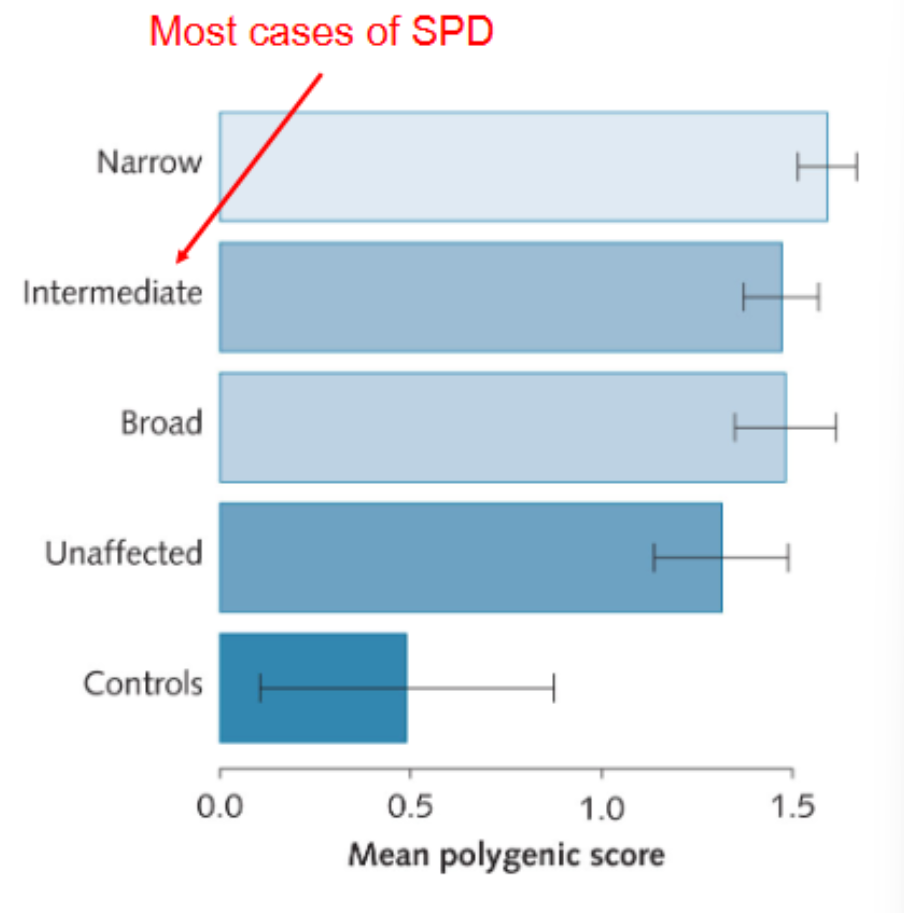
2014 schizophrenia spectrum study sed high density pedigrees: contained ≥ 2 SCZ cases and multiple individuals with other SCZ-like symptoms (e.g., SPD)
What is antisocial personality disorder (APD)?
Personality disorder characterized by pervasive disregard for and violation of the rights of others, including deceit and manipulation
What are the major findings of the 2002 meta-analysis on APD?
41% heritability, 16% shared environment
Shared environment effects are dynamic: strongest in children and lowest in adults
More common in males than females
Stronger heritability within than across generations (45% vs. 31%)
What are Eric Turkheimer’s 3 laws of behvaioural genetics?
All human behavioral traits are heritable
The effect of being raised in the same family is smaller than the effect of genes
A substantial portion of the variation in complex human behavioral traits is not accounted for by the effects of genes or families
In theory, with a large enough sample size, any behavioral trait can be mapped