enzyme catalytic mechanisms
 Call Kai
 Learn
Learn Practice Test
 Spaced Repetition
 Match
Match Flashcards
 Knowt Play
1/6

There's no tags or description
Looks like no tags are added yet.
Name | Mastery | Learn | Test | Matching | Spaced | Call with Kai | Chat |
|---|
No analytics yet
Send a link to your students to track their progress
7 Terms
What is Acid-Base Catalysis?
Occurs when a partial proton transfer from an acid, or to a base, lowers the necessary free energy of a reaction's transition state. It involves acids donating protons to reduce unstable carbanion-like states, or bases abstracting protons
Residues like Histidine can continuously alternate between acting as a general acid and a general base throughout a reaction to effectively shuttle protons and drive cleavage.

What is Covalent Catalysis?
Involves rate acceleration through the transient (temporary) formation of a catalyst-substrate covalent bond. This often involves a nucleophile (an atom with a lone pair) binding to a carbonyl group.
This mechanism is actively occurring for the entire duration that the enzyme is physically sharing electrons with the substrate (e.g., the prolonged acyl-enzyme intermediate phase in chymotrypsin). It only stops when that bond is completely broken.
What are the three major ways Metal Ion Catalysis facilitates reactions?
Metal ion cofactors (like Fe2+, Cu2+, Zn2+) participate by
1) Binding substrates to orient them properly for reaction
2) Mediating oxidation-reduction reactions through reversible changes to the metal ion's oxidation state
3) Electrostatically stabilizing or shielding negative charges
Metal ions are highly effective stabilizers because they can have charges greater than +1, and their concentration does not alter the pH of the solution like H+ would
What is Electrostatic Catalysis and how is it triggered by substrate binding?
It is the amplification of existing electrostatic interactions that stabilize proteins, leading to a reduction in the required energy of the reaction. It occurs because the binding of a substrate physically excludes water from the active site.
Desolvation is the main driver here. Because polar solvents interfere with and weaken electrostatic interactions, forcing water out creates a localized non-polar environment that maximizes internal charge interactions (such as the Aspartate stabilizing Histidine triad interaction)
How do Proximity and Orientation Effects speed up reaction rates?
The closeness and spatial orientation of molecules heavily impacts reaction speed. Enzymes facilitate this by bringing substrates together.
Binding them in their proper orientation
Reducing or removing their kinetic movement (such as rotation, vibration, and general translational movement).
Locking the substrates in place has the largest effect on speed.
This is not a one-time event; it is a continuous physical requirement enforced by the rigid enzyme scaffold throughout the entire catalytic cycle whenever a molecule binds, reacts, or leaves.
What is Preferential Binding of the Transition State Complex?
Potentially the most important catalytic mechanism, it means the enzyme binds to the transition state with much more affinity than it does to either the starting substrates or the final products.
The enzyme's active site is physically molded to complement the highest-energy, most awkward geometric shape the substrate must adopt to react (like a tetrahedral oxyanion or a 5-bonded phosphate). The enzyme stabilizes this specific deformed substrate geometry to overcome the activation energy barrier.
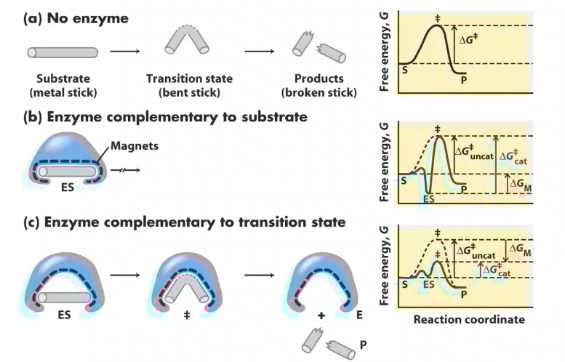
How does the complementarity of an enzyme's active site drive the Induced Fit model and transition state stabilization?
An enzyme's active site is highly complementary in shape, charge, and polarity specifically to the transition state for the reaction, and to a lesser extent, its starting substrate. This precise complementarity is the basis for the specificity of enzyme-catalyzed reactions
During an induced fit, the initial binding causes the enzyme to dynamically shift its shape. Because the active site structurally "wants" to bind the transition state, it physically forces the substrate's bonds to bend and deform into that unstable intermediate state to maximize the binding interactions, effectively pulling the reaction over the activation energy barrier.