Blood and Tissue Parasites: Hemoflagellates, Malaria, Coccidia & Trematodes
 Call Kai
 Learn
 Practice Test
 Spaced Repetition
 Match
 Flashcards
 Knowt Play
1/109

There's no tags or description
Looks like no tags are added yet.
110 Terms
What are hemoflagellates?
A group of protists, including Trypanosomatidae, characterized by flagella.
What are the two non-taxonomic groups of hemoflagellates?
Monoxenous and Heteroxenous.
Name two genera of hemoflagellates.
Leishmania and Trypanosoma.
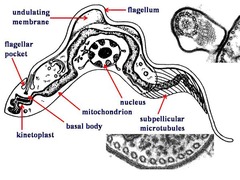
What is a kinetoplast?
A unique organelle found in hemoflagellates containing DNA.

What is the function of the glycosome in hemoflagellates?
It acts as a peroxisome-like organelle involved in metabolism.
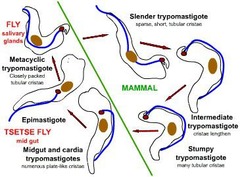
List the morphologic forms of hemoflagellates.
Amastigote, Promastigote, Epimastigote, Trypomastigote.
What disease does Leishmania cause?
Leishmaniasis.
What are the intermediate hosts and vectors of leishmaniasis?
Sand flies.

What is the reservoir host for Leishmania?
Mammals such as dogs and rodents.
What causes Old World cutaneous leishmaniasis?
Leishmania tropica and Leishmania major.
What is the vector for Old World cutaneous leishmaniasis?
Phlebotomus.
What is the pathology of visceral leishmaniasis caused by L. donovani?
Enlarged spleen (splenomegaly), anemia, cachexia, and emaciation.
What causes New World mucocutaneous leishmaniasis?
Leishmania braziliensis.
What is the primary immune response in resistant hosts to Leishmania?
Cell-mediated immunity.
What are the two broad groups of Trypanosomes?
Salivaria and Stercoraria.
What is the vector for Trypanosoma brucei?
Glossina (tse tse fly).

What is the primary pathology of T. brucei brucei in livestock?
Acute form of nagana, causing anemia, fever, and brain lesions.
What are the symptoms of T. b. gambiense?
Chronic African sleeping sickness, causing anemia, fever, and coma.
What is the treatment for early stages of African sleeping sickness?
Suramin.
What causes Chagas disease?
Trypanosoma cruzi.
What is the vector for Trypanosoma cruzi?
Rhodnius and Triatoma.

What is Romana's sign?
A chagoma found over the eyelid in acute Chagas disease.
What is the acute phase pathology of Chagas disease?
Heart muscle invasion leading to heart failure and nervous disorders.
What is the role of variant-specific surface glycoproteins (VSG) in T. brucei?
They act as antigens recognized by the host immune system and provide a barrier to antibodies.

What happens to the VSG coat in T. brucei?
It is periodically shed, allowing new variants to emerge.
What is the life cycle of T. cruzi in the human host?
It is intracellular during part of its life cycle.
What is the significance of the Lsh gene in Leishmania?
It controls resistance to L. donovani.
What is the effect of chronic exposure to parasite antigens in T. brucei?
It may contribute to CNS damage and death.
What disease is caused by Trypanosoma?
Chagas disease
What are the chronic effects of Chagas disease on the heart?
It can cause heart damage and destroy autonomic ganglia of the esophagus and colon.
What are the symptoms of megaesophagus and megacolon associated with Chagas disease?
Loss of muscle tone, disrupted peristalsis, and inability to swallow or defecate.
What is a significant immunological tactic used by Trypanosoma?
It infects immune system cells and sheds antigens.
What is the role of IL-2 in the immune response affected by Chagas disease?
Chagas disease suppresses IL-2 production, leading to immune system exhaustion.
What is the primary vector for Plasmodium species responsible for malaria?
Anopheles mosquitoes.
What is the significance of hemozoin in Plasmodium infections?
It is produced in host red blood cells and is a waste product of the parasite.

Describe the general life cycle of Plasmodium.
It alternates between sexual (gamogony) and asexual phases (schizogony and sporogony) in two hosts.
What occurs during the pre-erythrocytic cycle of Plasmodium?
Sporozoites invade liver cells and develop into merozoites.

What happens during the erythrocytic cycle of Plasmodium?
Merozoites invade red blood cells, forming trophozoites and eventually schizonts.
What is the role of the ookinete in the Plasmodium life cycle?
It invades the gut wall of the mosquito and develops into an oocyst.
Which Plasmodium species is responsible for the most severe form of malaria?
Plasmodium falciparum.
What are the symptoms of benign tertian malaria caused by P. vivax?
Fever typically recurs every 48 hours and is characterized by relapses.
What distinguishes P. falciparum from other Plasmodium species?
It invades red blood cells of all ages and can cause severe symptoms with high levels of parasitemia.
What is the significance of Maurer's clefts in P. falciparum infections?
They are irregular botches formed by proteins deposited in the RBC membrane.
What causes the periodic febrile response in malaria?
The rupture of mature schizonts releasing merozoites and waste products.
What is cerebral malaria, and which Plasmodium species is it associated with?
A severe complication characterized by headache and coma, primarily associated with P. falciparum.
What is algid malaria?
A condition that may result from cyto-adherence of infected RBCs in the gastrointestinal tract.
What is blackwater fever?
A severe condition caused by massive lysis of RBCs, leading to dark urine and renal failure.
What type of immunity is observed in malaria infections?
Partial immunity acquired gradually through repeated exposure.
How does pregnancy affect immunity to malaria?
Immunity is lost during pregnancy.
What is the role of the spleen in malaria pathology?
It removes uninfected RBCs and is involved in the destruction of infected RBCs.
What is the significance of hypnozoites in P. vivax infections?
They are dormant forms that can cause relapses of malaria.
What is the typical cycle duration of fever in P. malariae infections?
72 hours.
What is the primary reservoir host for Plasmodium species?
Primates.
What are the three stages of the malaria paroxysm?
Cold stage, hot stage, and sweating stage.
What is the role of TNF in malaria pathology?
It contributes to the removal of uninfected RBCs and can provoke hypoglycemia and coagulopathy.
What do nursing infants receive from their mother's milk?
Antibodies, providing temporary immunity until weaning.
What type of immune response is induced by Plasmodium's PAMPs?
Strong proinflammatory immune responses.
What immune response is associated with sporozoites of Plasmodium?
Humoral immune response and Antibody-Dependent Cellular Cytotoxicity (ADCC).
How does the immune system respond to infected liver cells by Plasmodium?
Through a cell-mediated response involving cytotoxic T lymphocytes, particularly CD8+ T cells.
What is the role of CD4+ T cells in the immune response to Plasmodium?
They regulate the balance between Th1 (IFN-γ) and Th2 (IL-4) mediated immune functions.
What happens to the Th2 mediated immune response as the severity of malaria infection increases?
The Th2 mediated immune response increases.
What is a consequence of overproduction of proinflammatory cytokines in malaria?
It can lead to the destruction of uninfected red blood cells and conditions like Blackwater fever.
What factors determine the drug regimen for treating malaria?
The clinical status of the patient, the species of the infecting parasite, and the area's drug-resistance status.
What are common antimalarial drugs?
Quinine and its derivatives.
What is the sickle cell trait and its relation to malaria?
It is a mutation in the hemoglobin gene that provides resistance to malaria in carriers (AS).
What is the Duffy blood group and its significance in malaria?
It is a receptor for P. vivax; merozoites can penetrate RBCs only at genetically determined receptor sites.
What characterizes the morphology of Coccidians?
They have an apical complex with conical structures containing rhoptries, micronemes, polar rings, and conoid.
What are the three major stages of the Coccidian life cycle?
Sporogony, Schizogony, and Gametogony.
What disease does Eimeria tenella cause?
Hemorrhagic cecal coccidiosis in poultry.
What is the life cycle of Eimeria tenella?
Involves oocyst sporulation, oral ingestion, invasion of gut epithelial cells, and multiple rounds of schizogony.
What are the stages of Toxoplasma gondii in its life cycle?
Includes oocyst, sporozoite, tachyzoite, and bradyzoite (zoitocyst).
What is the definitive host of Toxoplasma gondii?
Cats, where sexual reproduction occurs.
What are the acute and chronic phases of Toxoplasma gondii infection?
Acute phase involves tachyzoite production; chronic phase involves bradyzoite and zoitocyst formation.
What is the primary immune response to Toxoplasma gondii?
Cell-mediated immunity (CMI) is most important.
What are some control measures for Toxoplasma gondii?
Cooking meat, freezing at -14°C, and cleaning cat litter boxes regularly.
What happens during the enteroepithelial cycle of Toxoplasma gondii?
Cats ingest oocysts or tissue cysts, leading to the release of sporozoites or bradyzoites that invade gut cells.
What is the significance of bradyzoites in Toxoplasma gondii infection?
They can persist in tissues and reactivate in immunocompromised individuals.
What is the pathology associated with Toxoplasma gondii in humans?
Can cause flu-like symptoms, brain abscesses, and congenital toxoplasmosis.
What is the role of innate immunity in Toxoplasma gondii infection?
It induces pro-inflammatory cytokines that activate adaptive immune responses.
What is the consequence of cyst wall formation in Toxoplasma gondii?
It does not elicit an inflammatory reaction, leading to premunition.
What are the hosts involved in the lifecycle of sarcocystosis?
A definitive host (carnivores) and an intermediate host (herbivores).
What are the two types of sarcocystosis?
Intestinal type (diarrhea, mild fever, vomiting) and muscular type (muscle pain, transitory edema, fever).
What disease does Cryptosporidium cause?
Cryptosporidiosis.
How does Cryptosporidium affect AIDS patients?
It causes profuse, unrelenting diarrhea.
What type of lifecycle does Cryptosporidium have?
Monoxenous; all hosts, including humans, shed oocysts.
What is a leading cause of waterborne disease among humans?
Cryptosporidium.
What is the first step in the life cycle of Cryptosporidium?
Oocysts contain sporozoites.
What do sporozoites develop into in the life cycle of Cryptosporidium?
Trophozoites.
What is the definitive host for Babesia bigemina?
Rhipicephalus/Boophilus tick.
What disease is caused by Babesia bigemina?
Babesiosis.
What is the impact of Babesia bigemina on livestock?
It significantly affects livestock health and productivity.
What is the general morphology of Platyhelminthes?
Typically bilaterally symmetrical and lack a body cavity (acoelomates).
What type of digestive system do Platyhelminthes have?
A two-way digestive system.
What is the function of flame cells in Platyhelminthes?
They function like a kidney, removing waste materials.
What are the two subclasses of Trematoda?
Digenea and Aspidobothrea.
What is the typical life cycle of a digenean trematode?
It consists of a definitive host (vertebrate) and a first intermediate host (mollusk).
What are the three types of suckers found in trematodes?
Monostome, amphistome, and distome.
What is the function of the tegument in trematodes?
To protect the parasite, evade the host immune system, absorb nutrients, and control motility.
What is the first stage in the general life cycle of trematodes?
Egg.
What is the second stage in the general life cycle of trematodes?
Miracidium.