Unit 1, Part 3: Poetry
 Call Kai
 Learn
 Practice Test
 Spaced Repetition
 Match
 Flashcards
 Knowt Play
1/28

There's no tags or description
Looks like no tags are added yet.
29 Terms
Form refers to how a poem is structured
-the arrangement of lines and stanzas.
. Line: A single row of words in a poem.
. Stanza: A group of lines, like a paragraph in poetry.
a. Form (Lines and Stanzas)
Example (stanza):
I wandered lonely as a cloud (line 1)
That floats on high o'er vales and hills (line 2)
- William Wordsworth
This is a stanza with two lines (a couplet).
a. Form (Lines and Stanzas) Example
The speaker is the voice
talking in the poem-it is
not always the poet. The
speaker may be fictional, a
character, or a persona.
b. Speaker vs. Poet

b. Speaker vs. Poet Example

c. Imagery

c. Imagery example

d. Figurative Language

e. sound devices

f. tone and mode

Identify the tone and mode:
"Do not go gentle into that good night" by Dylan Thomas
Do not go gentle into that good night,
Old age should burn and rave at close of day;
Rage, rage against the dying of the light.
Though wise men at their end know dark is right,
Because their words had forked no lightning they
Do not go gentle into that good night.
Connect with what you are reading
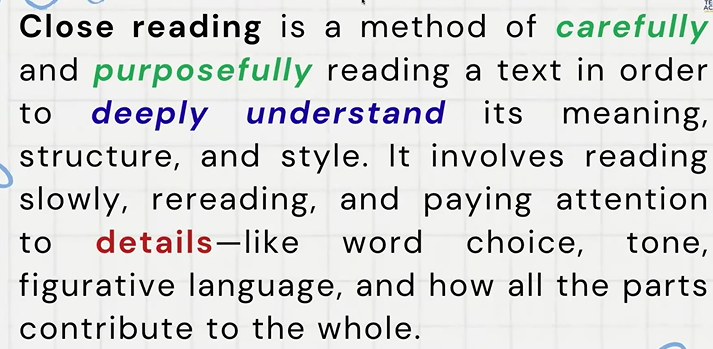
How to read a poem

Levels of Reading
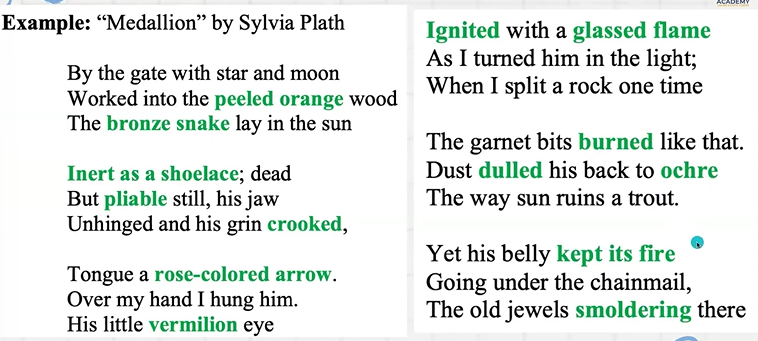
He hung it

Reading along the lines “what does the text say?”
colors- warm (sunset) → intensifies (burned



Read between the line “colors”
snakes- calmingness, boldness
ignite- brave, passionate
death- ending
Medallion- award for a life well lived 👩🏼⚕️

Read beyond the lines
The Raven by Edgar Allan Poe

Actual NMAT poem: The Rave
The Waiting Room by Elizabeth Bishop

Actual NMAT poem: The Waiting Room
Two roads diverged in a yellow wood,
And sorry I could not travel both
And be one traveler, long I stood
And looked down one as far as I could
To where it bent in the undergrowth;
Then took the other, as just as fair,
And having perhaps the better claim,
Because it was grassy and wanted wear;
Though as for that the passing there
Had worn them really about the same,
And both that morning equally lay
In leaves no step had trodden black.
Oh, I kept the first for another day!
Yet knowing how way leads on to way,
I doubted if I should ever come back.
I shall be telling this with a sigh
Somewhere ages and ages hence:
Two roads diverged in a wood, and I—
I took the one less traveled by,
And that has made all the difference.
Actual NMAT poem: The Road not taken
Disappointment
“I shall be telling this with a sigh”
The Road Not Taken Main Idea (Read along the lines)
Gloomy colors - reject
The Road Not Taken Main Idea (Read between the lines)
Travel- choices, life, journey
“Two roads diverged in a yellow wood,”
Babalik ako sa isa pang daan same lang naman pala
“And both that morning equally lay
In leaves no step had trodden black.”
Kaso ang haba pala andito na ko so i doubt i still want to comeback
“Oh, I kept the first for another day!
Yet knowing how way leads on to way,
I doubted if I should ever come back.”
Wala na time mag start ulit, malayo na na travel mo
The Road Not Taken Main Idea (Read beyond the lines)
Flooding

Read along the lines
Rain is a blessing, we pray for it to come. But a rain in the city leads to flooding.
City - center of power; government
We- general population
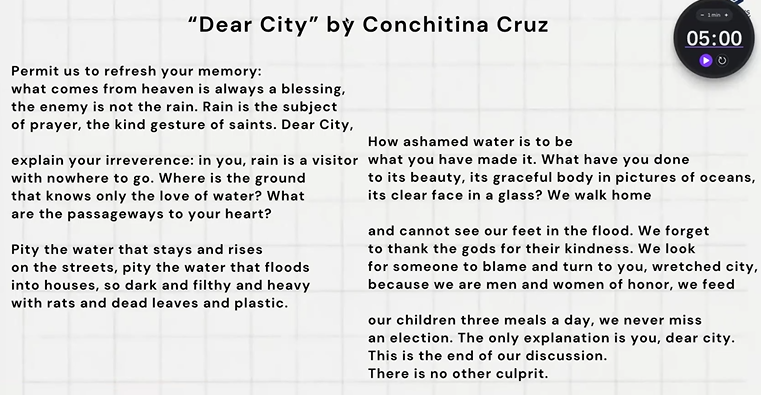
Read between the lines
Corruption
Read beyond the lines
B. Rain is a natural blessing, but the city turns it into
something shameful.
1. What central contrast does the speaker draw
about rain in the poem?
A. Rain is destructive in rural areas but harmless in
cities.
B. Rain is a natural blessing, but the city turns it into
something shameful.
C. Rain symbolizes anger, while the city symbolizes
peace.
D. Rain is feared by humans, but loved by animals.
.
C. Accusatory and disappointed
2. What is the primary tone of the speaker toward
the city?
A. Admiring and nostalgic
B. Neutral and observational
C. Accusatory and disappointed
D. Indifferent and dismissive
B. Personification-giving human qualities to water
“visitor with nowhere to go”
3. Which literary device is most prominent in
describing the city's relationship with water?
A. Hyperbole-exaggerating the city's size
B. Personification-giving human qualities to water
C. Alliteration-repetitive use of consonant sounds
D. Simile-comparing a city to a province
D. Citizens believe that the city should be held
accountable.
4. What societal critique emerges from the lines
"we feed our children three meals a day, we never
miss an election"?
A. Citizens prioritize political campaigns over family.
B. Citizens cannot influence the fate of the city.
C. Citizens are too poor to take care of their families.
D. Citizens believe that the city should be held
accountable.
A. Sees the city as the only logical target for blame,
regardless of complexity.
“not B kasi wala naman clear evidence”
5. The closing lines ("This is the end of our discussion.
There is no other culprit.") suggest that the speaker ...
A. Sees the city as the only logical target for blame,
regardless of complexity.
B. Has found clear evidence of corruption in the city's
officials.
C. Wants the city to negotiate with the gods about the
rain.
D. Believes disasters are fated and cannot be changed.