Module 4: Complexation
 Call Kai
 Learn
Learn Practice Test
 Spaced Repetition
 Match
Match Flashcards
 Knowt Play
1/79

Earn XP
Description and Tags
Name | Mastery | Learn | Test | Matching | Spaced | Call with Kai | Chat |
|---|
No analytics yet
Send a link to your students to track their progress
80 Terms
What is another name for a complex?
A coordination compound.
What type of chemical reaction forms a complex?
A donor-acceptor mechanism, also known as a Lewis acid-base reaction.
Additional Information: In a Lewis acid-base reaction, it's all about sharing electron pairs rather than swapping hydrogen ions.
In complexation, which component acts as the Lewis base?
The donor.
Additional Information: By definition, a Lewis base is any species that donates an electron pair. Non-metal atoms with unshared lone pairs (like Nitrogen or Oxygen) fit this description.
In complexation, which component acts as the Lewis acid?
Back: The acceptor.
Additional Information: A Lewis acid is an electron-pair acceptor. Metal ions make great acceptors because their positive charge draws electron density toward them.
What happens to a complex (SmLn) when conditions in a solution change?
It can break back down into the free substrate (S) and ligand (L) because complex formation is reversible.
Additional Information: Since these aren't permanent covalent bonds, factors like diluting the drug, changing temperature, or altering pH can shift the equilibrium and break the complex apart.
What is a coordinate covalent bond, and how does it differ from a standard covalent bond?
A covalent bond where both shared electrons come from the same atom, unlike a standard covalent bond where each atom supplies one electron.
Additional Information: In complexation, the donor atom supplies the full electron pair into the empty orbital of the acceptor metal/ion.

How do the non-covalent forces in complex formation compare to intramolecular forces like covalent bonds?
They are relatively weak forces compared to strong intramolecular covalent bonds.
Additional Information: Because these non-covalent interactions are weak, complexes can easily form and break apart under different physiological or formulation conditions.
What are electrostatic interactions in complexation?
Attraction and repulsion effects between charges, such as charge-charge, charge-dipole, and dipole-dipole interactions.
Additional Information: Like charges repel and opposite charges attract. These interactions help orient molecules correctly so a complex can form.
What causes dispersion forces (van der Waals forces) between molecules?
A quantum mechanical effect where synchronized electronic motion between two molecules creates temporary dipoles that attract each other.
Additional Information: As electrons move around, they temporarily bunch up on one side of a molecule, inducing a micro-attraction in neighboring molecules.
What two components are required to form a hydrogen bond?
A proton donor (HA) and a proton acceptor (B).
Additional Information: The hydrogen atom attached to an electronegative element acts as a bridge, pulling the acceptor atom toward it.
What interaction occurs when an electron moves from a donor molecule to an acceptor molecule?
A charge-transfer interaction.
Additional Information: A classic example is the dark blue or purple iodine-starch complex used as an indicator in chemical titrations.
Why do non-polar molecules associate together in hydrophobic interactions?
Liquid water tries to exclude non-polar molecules, forming a cage of water around them that pushes them together.
Additional Information: Water prefers to hydrogen-bond with itself rather than interact with non-polar drugs, so it forces non-polar regions to cluster together into a complex.
Significant structural shape changes undergone by a cyclodextrin molecule when a guest molecule enters its cavity lead to what driving force in complexation?
Release of conformational strain.
Additional Information: Imagine a tight ring adjusting its angles to fit something inside. Relieving that physical twisting/strain makes the resulting complex much more stable
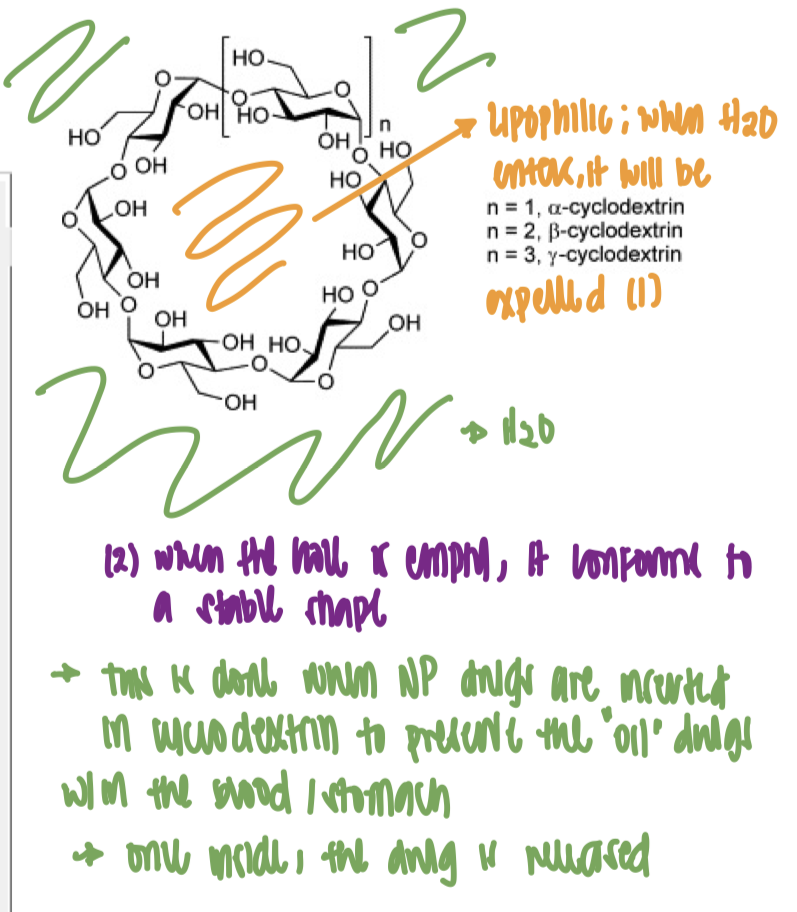
What type of molecules occupy the somewhat lipophilic cavity of an empty cyclodextrin in aqueous solution because they cannot fulfill all of their hydrogen-bonding requirements?
High-energy water molecules.
Additional Information: Water prefers to interact with other water molecules. Sitting inside a greasy cavity is uncomfortable for water, raising its energy state until it gets displaced.
The expulsion of high-energy water molecules from a cyclodextrin cavity into the bulk aqueous solution serves as a major thermodynamic driving force for what process?
Inclusion complex formation.
Additional Information: Returning those trapped water molecules to the main solution lets them form happy hydrogen bonds with other water molecules, which lowers the total energy of the system.
What type of complex consists of a central metal ion bonded to one or more electron-pair donor ligands (such as ammonia, chloride ions, or ferrocene)?
Metal Ion Complexes.
Additional Information: In these complexes, the metal ion acts as a Lewis acid (acceptor) and the ligands act as Lewis bases (donors) to form coordinate covalent bonds.
What term describes the total number of bonds formed between a central metal ion and its attached ligands?
Coordination Number.
Additional Information: The coordination number determines the geometry of the complex. For example, a coordination number of 4 often gives a square planar or tetrahedral shape, while a 6 gives an octahedral shape.
True or False: A central metal ion is restricted to having only one specific coordination number.
False (metal ions can have more than one coordination number).
Additional Information: A metal ion's coordination number can change depending on its oxidation state, the size of the ligands, and the environment of the solution.
What is the coordination number of the square planar platinum-based anticancer drug cisplatin?
Four.
Additional Information: Cisplatin, Pt(NH3)2Cl2, has platinum (Pt2+) bonded to two ammonia molecules and two chloride ions, giving it 4 coordinate bonds in total.
What central transition metal is present in cisplatin and other related chemotherapy complexes?
Platinum.
Additional Information: Platinum complexes work as anticancer agents by cross-linking with DNA in cancer cells, preventing them from dividing and replicating.

What causes acute iron toxicity during oxygen deprivation, and what antidote is used to treat it?
An accumulation of Fe3+ from oxymyoglobin breakdown, which is treated using deferoxamine.
Additional Information: Deferoxamine acts as a specialized claw (chelator) that selectively binds excess ferric iron (Fe3+) to form ferrioxamine, a water-soluble complex that is easily filtered and excreted by the kidneys.
How is ferrioxamine eliminated from the human body?
Through kidney excretion (in the urine).
Additional Information: Once deferoxamine wraps around the harmful Fe3+ ion, the complex becomes non-toxic and hydrophilic, allowing the urinary system to wash it out without damaging tissues.
Why is carboplatin less toxic to the kidneys and peripheral nervous system compared to cisplatin?
Because of the presence of its bidentate dicarboxylate ligand.
Additional Information: A bidentate ligand grips the central platinum atom at two points simultaneously. This creates a more stable, less reactive ring structure that reduces unwanted side-effect damage to kidney cells and peripheral nerves.
What structural shift causes the copper-containing protein hemocyanin to turn blue upon binding to oxygen?
A transition from the Cu(I) state to the Cu(II) state.
Additional Information: Hemocyanin is an oxygen-transport protein found in crustaceans and mollusks (functioning like hemoglobin in humans). When oxygen binds, it oxidizes copper from colorless Cu+ to bright blue Cu2+.
Which trace metal complex is confined inside Vitamin B12 (Cyanocobalamin)?
Cobalt.
Additional Information: Cobalt exists in two primary oxidation states, Co(II) and Co(III). At the heart of Vitamin B12, it holds an octahedral organometallic structure essential for red blood cell formation and nerve function.
Which is the only metal ion present in crystalline insulin?
Zinc.
Additional Information: Zinc ions coordinate six insulin molecules together to form a stable hexamer in the pancreas and pharmaceutical injections, allowing for controlled, prolonged release of the hormone.
Which two non-insulin enzymes require a zinc complex to function properly?
Carboxypeptidase and carbonic anhydrase.
Additional Information: Zinc acts as a critical Lewis acid catalyst inside these enzymes: carboxypeptidase uses it to break down dietary proteins, and carbonic anhydrase relies on it to convert carbon dioxide into bicarbonate to balance blood pH.
What two chelating antidotes are commonly used to treat lead and mercury toxicity?
The dicalcium salt of EDTA and 2,3-dimercaptopropanol (BAL / British Anti-Lewisite).
Additional Information: Heavy metals poison the body by binding to vital enzyme sulfhydryl (−SH) groups. Antidotes like BAL contain multiple thiol groups that outcompete human tissues to trap the metal ions into safe, excretable chelates.
What does the term "chelate" literally mean based on its Greek origin?
Claw (cheleˋ).
Additional Information: Just like a crab's claw grabs an object from two sides, a chelating agent uses two or more of its donor atoms to grab a single central metal atom at multiple points, forming a highly stable ring complex.
What are three common examples of chelating agents used in pharmaceutical formulations?
Citric acid, tartaric acid, and EDTA (ethylenediamine tetraacetic acid).
Additional Information: These compounds contain multiple electronegative donor atoms (like oxygen and nitrogen) spaced perfectly to wrap around metal ions, acting as "sequestrants" that grab and neutralize metal impurities in drug solutions.
How does tetracycline form poor-bioavailability complexes, and which specific metal ions are involved?
It forms hydrophilic chelates with polyvalent cations such as Calcium (Ca2+), Iron (Fe3+,Fe2+), Aluminum (Al3+), and Magnesium (Mg2+).
Additional Information: When tetracycline grabs onto these bulky, charged metal ions, the resulting complex becomes too large and hydrophilic to easily slip across the lipophilic lipid membranes of the small intestine into the bloodstream.
Taking tetracycline simultaneously with milk, dairy products, antacids, or mineral supplements can reduce its oral bioavailability by up to what percentage?
Up to 90%.
Additional Information: Dairy contains abundant Ca2+, while antacids and mineral supplements are packed with Mg2+, Al3+, or Fe2+/Fe3+. Administering them together essentially inactivates almost the entire dose of the antibiotic before it can ever be absorbed.
Besides tetracyclines, what other major class of antibacterial drugs (including nalidixic acid and ciprofloxacin) forms chelates with polyvalent ions that drastically lower oral bioavailability?
Quinolones (or fluoroquinolones).
Additional Information: Fluoroquinolones possess a carbonyl and a carboxyl group sitting adjacent on their central ring structure, forming a ideal two-pronged "claw" designed to trap multivalent metals like Ca2+ and Mg2+.
What happens to the stability and shelf-life of β-lactam antibiotics when they form metal chelates with ions like Cu2+?
Their shelf-life decreases significantly because the complexed β-lactam ring becomes much more susceptible to specific base hydrolysis (OH− attack).
Additional Information: When a metal ion like Cu2+ binds to the antibiotic, it pulls electron density away from the sensitive β-lactam ring. This creates a partial positive charge on the ring's carbonyl carbon, making it a target for hydroxyl ions (OH−) in water to attack and break open the ring, rendering the drug inactive.

What type of forces hold molecular complexes together, and what are their two main components?
They consist of one or more substrates and ligands held together by relatively weak, non-covalent forces.
Additional Information: Unlike metal ion complexes that rely on coordinate covalent bonds, molecular complexes rely on gentle non-covalent interactions like hydrogen bonding, electrostatic attraction, van der Waals forces, and hydrophobic interactions.
What are the three ways molecular complexes can be classified?
By the bonding/interaction type (e.g., electrostatic, charge-transfer, H-bonding, hydrophobic).
By the type of substrate and ligand (e.g., small molecule–small molecule, drug–receptor, antigen–antibody).
By the structure formed (e.g., self-assembled aggregate, micelle, clathrate, inclusion complex).
Additional Information: Classifying complexes helps pharmacists predict how drugs will behave—whether they will form a tight lock-and-key fit with a target biological receptor or assemble into a protective micelle delivery system.
How are molecular complexes categorized when classified by their primary bonding or interaction type?
By the specific non-covalent force holding the substrate and ligand together, such as electrostatic interactions, charge-transfer, hydrogen bonding, or hydrophobic interactions.
Additional Information: Identifying the primary interaction type helps formulation scientists know how environmental factors like pH or ionic strength will affect the complex's stability.
What is an example of a small molecule interacting with a macromolecule in complexation classification?
A small drug molecule binding to a large polymer (like PVP or HPMC) or a plasma protein (like human serum albumin).
Additional Information: Small molecules are typically low-molecular-weight chemical compounds, while macromolecules are large, complex chains made of repeating units or amino acids.
Which classification category includes critical biological interactions like enzyme–substrate, drug–receptor, and antigen–antibody binding?
Classification based on the type of substrate and ligand forming the complex.
Additional Information: Almost all pharmacology relies on these substrate-ligand pairings, where a key (ligand/drug) fits into a lock (substrate/receptor) to trigger or block a biological response.
What type of molecular complex structure forms when surfactant molecules spontaneously group together in water once reaching a specific concentration threshold?
A micelle.
Additional Information: Micelles form with hydrophobic tails tucked inside away from water and hydrophilic heads facing outward, creating a tiny oil pocket that can dissolve insoluble drugs.
What is an inclusion complex, and which structural classification category does it fall under?
A structure where a guest molecule is trapped inside the cavity of a host molecule (like cyclodextrin), falling under classification by the type of structure formed.
Additional Information: Unlike aggregates or simple physical mixtures, inclusion complexes rely on host-guest geometry where the host physically surrounds the guest without forming covalent bonds.
Which two non-ionic water-soluble polymers are commonly used in pharmaceutical formulations to build hydrogels and increase viscosity?
Polyvinyl pyrrolidone (PVP) and hydroxypropyl methylcellulose (HPMC).
Additional Information: These non-ionic polymers do not carry an electrical charge, which makes them highly compatible with a wide variety of active drug substances without risking charge-based precipitation.
What physical shape do PVP polymer chains adopt in aqueous solution that allows them to trap and bind drug molecules?
Coils (or coiled structures).
Additional Information: When dissolved in water, PVP unfolds into flexible random coils. Drug molecules slip into these coiled pockets and bind through gentle non-covalent forces.
In povidone-iodine, what ion must be present alongside iodine to allow PVP to successfully bind and form the complex?
Iodide ions (I−).
Additional Information: Iodide reacts with elemental iodine (I2) to form triiodide (I3−), which then nests securely inside the PVP polymer coils to create a stable, water-soluble antiseptic.
What is the primary clinical application of the povidone-iodine complex?
As an antibacterial agent used for the treatment and prevention of skin or wound infections.
Additional Information: Complexing iodine with PVP reduces skin toxicity, staining, and irritation while maintaining a broad spectrum of antimicrobial activity against bacteria, viruses, and fungi.
By what mechanism do PVP and HPMC function as solubility and dissolution enhancers for poorly soluble drugs?
Through the formation of water-soluble complexes with the drug molecules.
Additional Information: When a hydrophobic drug complexation partner pairs up with hydrophilic polymers like PVP or HPMC, the polymer's water-loving groups drag the drug into solution, speeding up how fast the tablet breaks down and dissolves in the stomach.
What specific role do PVP and HPMC play in pharmaceutical formulations when they form water-soluble complexes with poorly soluble drugs?
Solubility and dissolution enhancers.
Additional Information: When a hydrophobic drug pairs up with hydrophilic polymers like PVP or HPMC, the polymer's water-loving groups pull the drug into solution, increasing its overall solubility and speeding up how fast it dissolves in gastrointestinal fluids.
What is a key example of an anionic, ionic water-soluble polymer that forms complexes with basic drugs in aqueous solution?
Carboxymethylcellulose (CMC).
Additional Information: CMC carries negatively charged carboxylate groups (−COO−) along its backbone, allowing it to electrostatically attract positively charged basic drug molecules.
Name four basic drugs that form complexes with carboxymethylcellulose (CMC) in aqueous solutions.
Atenolol, diphenhydramine, lidocaine, and propranolol.
Additional Information: Because these drugs are weak bases, they become positively charged in aqueous environments and bind tightly to the negatively charged polymer chains of CMC.
Which two anionic polysaccharides interact with drugs to alter their aqueous solubility and chemical stability?
Gum Arabic and alginates.
Additional Information: Both polymers are derived from natural sources (tree sap and brown seaweed, respectively) and contain carboxylic acid groups that interact with charged or polar drug molecules.
At what pH condition does chitosan become positively charged, allowing it to form nano-sized complexes with negatively charged DNA and RNA?
Acidic pH.
Additional Information: Chitosan contains primary amine groups (−NH2). Under acidic conditions, these groups gain protons to become positively charged (−NH3+), enabling strong electrostatic binding to the phosphate backbone of nucleic acids.
What major pharmaceutical delivery application utilizes nano-sized complexes formed between chitosan and nucleic acids (DNA/RNA)?
Gene delivery.
Additional Information: Naked DNA and RNA degrade rapidly in the bloodstream and cannot cross cell membranes easily. Complexing them with chitosan wraps them into protective nanoparticles that can enter cells via endocytosis.
Which anionic polymer forms drug complexes that are specifically used to modify drug delivery schedules and release rates?
Alginates (or alginate polymers).
Additional Information: Alginates cross-link in the presence of divalent cations like Calcium (Ca2+) to form hydrogel matrices or microparticles, allowing controlled or extended drug release in the GI tract.
Which local anesthetic and anti-inflammatory drug class interact with each other to form a drug-drug complex?
Benzocaine and salicylates.
Additional Information: Benzocaine is a local anesthetic, and when mixed with salicylates, non-covalent binding between the two molecules forms a drug-drug complex that can alter drug absorption and activity.
Which three anticancer drugs are known to form dimers and trimers in aqueous solutions, as well as an etoposide-paclitaxel complex?
Paclitaxel, doxorubicin, and etoposide.
Additional Information: Self-association (forming dimers or trimers) and cross-complexation between different chemotherapeutic agents in solution can alter their effective molecule size, drug solubility, and cellular uptake.
What happens when cocaine and morphine are combined in aqueous solution?
They form a binary complex that can affect their pharmacokinetics and biological activity. “Speedball”
Additional Information: Binary complexation alters how each individual drug distributes, metabolizes, and binds to physiological receptors compared to when administered alone.
Cocaine speeds up heart and breathing rates and increases the body's demand for oxygen. Morphine dramatically slows breathing and depresses the central nervous system. This physiological tug-of-war starves the brain, heart, and lungs of necessary oxygen.
Which two major classes of antibacterial agents form drug-drug complexes with each other, leading to physical or chemical incompatibility?
β-Lactam antibiotics and aminoglycosides.
Additional Information: β-Lactams (like penicillins) can chemically react with or complex aminoglycosides (like gentamicin) in the same IV fluid or solution, inactivating both drugs. They should never be mixed together in the same IV bag or syringe.
Which two specific drugs are mentioned that form complexes with the negatively charged anticoagulant heparin?
Polymyxin B and streptomycin.
Additional Information: Heparin is a highly anionic (negatively charged) polycationic binder, so positively charged basic drugs like polymyxin B and streptomycin bind tightly to it via strong electrostatic interactions.
Which two small molecules are commonly used to form water-soluble complexes with various poorly soluble drugs and vitamins?
Caffeine and nicotinamide.
Additional Information: Caffeine and nicotinamide act as hydrotropes—small organic compounds that enhance the aqueous solubility of hydrophobic drugs and vitamins through planar stacking or weak molecular complexation.
Which types of dietary components reduce oral drug absorption through drug complexation?
Dietary fibers (including psyllium, guar gums, and carbohydrates such as cyclodextrins).
Additional Information: These macromolecular fibers act like physical traps or binding sponges in the gastrointestinal tract, holding onto drug molecules and preventing them from crossing the intestinal membrane into systemic circulation.
How do cholestyramine and related bile acid sequestrants accelerate cholesterol elimination?
By forming complexes with bile acids that reduce their ability to be reabsorbed in the gut.
Additional Information: Bile acids are made from cholesterol in the liver. When cholestyramine traps bile acids and forces them out in the feces, the liver is forced to burn up more circulating cholesterol to synthesize new bile acids.
What defines an inclusion complex in terms of its host and guest structure?
Entrapment of a substrate (guest) inside a cage or cavity formed by one or more ligand (host) molecules.
Additional Information: Inclusion complexes rely on spatial fitting rather than covalent chemical bonding. The guest molecule fits physically inside the host's central cavity like a key inside a lock.
What is a classic example of a guest-host inclusion complex where a single host ligand entraps one or more guest molecules?
Cyclodextrin complexes.
Additional Information: Cyclodextrins are cyclic oligosaccharides shaped like truncated cones with a lipophilic interior and a hydrophilic exterior, allowing them to isolate non-polar drug guests inside aqueous media.
Besides cyclodextrins, what three other large molecules can form monomolecular inclusion complexes?
Water-soluble dextrins, crown ethers, and calixarenes.
Additional Information: Crown ethers feature repeating ether rings optimized for trapping specific metal cations, while calixarenes are cup-shaped macrocycles that can enclose small organic molecules.
What term describes interactions where dietary components like psyllium, guar gums, or cyclodextrin-like carbohydrates bind to active pharmaceutical ingredients in the GI tract to reduce their oral bioavailability?
Drug-food interactions (specifically via dietary fiber complexation).
Additional Information: High-fiber meals or bulk-forming laxatives can adsorb drug molecules onto their carbohydrate matrix or trap them within sticky gel networks, preventing the drug from reaching the intestinal mucosa for absorption.
What structural classification applies to host-guest systems where a substrate molecule is physically trapped inside a cage or hollow cavity provided by one or more ligand molecules without forming covalent bonds?
Inclusion complexes.
Additional Information: Inclusion complexes depend primarily on non-covalent forces (such as hydrophobic interactions and van der Waals forces) along with a precise dimensional fit between the host cavity and the guest molecule.
What specific type of inclusion complex arrangement is formed when deoxycholic acid crystals organize into tubular pathways to enclose compounds like paraffins, organic acids, esters, ketones, or solvents?
Channel Lattice Type (or channel-type inclusion complexes).
Additional Information: Unlike single-molecule host cavities, channel lattices are created by the collective crystal packing of multiple host molecules, forming long continuous tunnels that accommodate elongated guest molecules.
Which bile acid derivative is a principal example of a host molecule capable of assembling into a channel lattice structure?
Deoxycholic acid (a cholic acid derivative).
Additional Information: Deoxycholic acid molecules stack in a crystal lattice that leaves open, parallel channels. Guest molecules like organic solvents, fatty acids, or paraffin chains fit snugly inside these crystalline tunnels.

What specific inclusion complex arrangement is formed by clays such as montmorillonite (the principal constituent of bentonite) when they trap guest molecules like hydrocarbons, alcohols, and glycols?
Layer Type inclusion complexes.
Additional Information: Layer-type complexes consist of parallel sheets or stacks of mineral lattices. Guest molecules slide into the interlayer spaces (galleries) between these sheets, causing the lattice to swell.
What is the primary constituent of bentonite clay that is capable of forming layer-type inclusion complexes?
Montmorillonite.
Additional Information: Montmorillonite has a 2:1 layered aluminosilicate structure with flexible interlayer spaces that readily expand to intercalate organic guest molecules like alcohols and glycols.

What structural type of inclusion complex is characterized by host molecules crystallizing into a cage-like lattice that traps the coordinating guest compound inside?
Cage Type (or Clathrates).
Additional Information: Clathrates differ from channel or layer types because the host molecules assemble into a fully enclosed 3D cage. The trapped guest cannot escape unless the crystalline lattice is dissolved or melted.
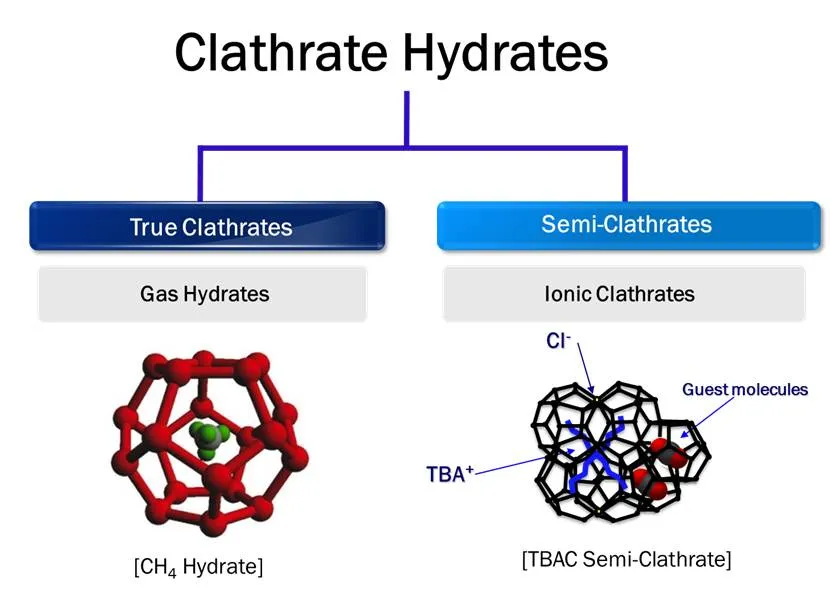
Which USP official drug exists as a crystalline clathrate containing a combination of water, isopropyl alcohol, and the active drug salt?
Warfarin sodium (USP).
Additional Information: Warfarin sodium clathrate is a white crystalline powder where isopropyl alcohol and water molecules are entrapped within the sodium warfarin crystal lattice, ensuring high chemical purity and precise physical stability for pharmaceutical manufacturing.

What type of inclusion compound is characterized by the entrapment of a single guest molecule within the cavity of a single host molecule?
Monomolecular Inclusion Compounds.
Additional Information: Unlike channel, layer, or cage (clathrate) complexes where multiple host molecules build a collective crystal lattice around guest species, monomolecular inclusion relies on a 1:1 host-to-guest interaction inside an individual host molecule's cavity.
What class of cyclic glucose oligomers serves as a primary example of monomolecular inclusion compounds?
Cyclodextrins.
Additional Information: Cyclodextrins are non-reducing, doughnut-shaped cyclic oligosaccharides produced from starch by enzymatic conversion, possessing a hydrophobic interior cavity and a hydrophilic outer surface.

How do cyclodextrins improve the efficacy and performance of poorly soluble pharmaceutical products?
By forming water-soluble inclusion complexes that enhance drug solubility and oral bioavailability.
Additional Information: By wrapping hydrophobic drug molecules inside their central cavity, cyclodextrins keep lipophilic active ingredients dissolved in aqueous gastrointestinal fluids, allowing faster dissolution and significantly improved drug absorption.
What is another common term used to refer to macromolecular inclusion compounds such as zeolites, dextrins, and silica gels?
Molecular sieves.
Additional Information: These materials possess three-dimensional frameworks containing precisely sized cages and channels that filter, trap, or separate molecules based on their physical dimensions.
Which three-dimensional structural features within macromolecular inclusion compounds allow them to trap guest molecules and function as molecular sieves?
Cages and channels.
Additional Information: The atomic arrangement of zeolites and silica gels creates interconnected porous networks that selectively admit smaller guest molecules while excluding larger ones.
How does unwanted drug complexation lead to therapeutic or pharmaceutical incompatibilities?
It produces negative drug-drug, drug-excipient, or drug-food interactions that impair critical physicochemical and biopharmaceutical properties of the drug.
Additional Information: While complexation is intentionally used to improve solubility or stability, unwanted complexation causes physical or chemical incompatibilities—such as precipitation, inactivation, or reduced absorption—that degrade formulation quality and clinical outcomes.
Which biopharmaceutical property is negatively impacted when an unwanted complexation incompatibility occurs between a drug and polyvalent cations in food or antacids?
Rate of absorption (or bioavailability).
Additional Information: Incompatibilities like tetracycline-calcium complexation reduce intestinal membrane permeability and absorption rates, preventing the active drug from reaching therapeutic blood levels.
Which ten physicochemical and biopharmaceutical properties of a drug can be altered—either beneficially or through unwanted incompatibilities—by complexation?
Aqueous solubility
Chemical stability
Dissolution rate
Partition coefficient
Permeability
Rate of absorption
Bioavailability
Biological activity
Volatility
Physical state
Additional Information: Understanding how complexation modulates these ten parameters allows pharmaceutical scientists to design effective delivery systems while avoiding formulation incompatibilities during manufacturing and co-administration.