Regulation of Renal Na and H20 Excretion II
 Call Kai
 Learn
Learn Practice Test
 Spaced Repetition
 Match
Match Flashcards
 Knowt Play
1/34

There's no tags or description
Looks like no tags are added yet.
Name | Mastery | Learn | Test | Matching | Spaced | Call with Kai | Chat |
|---|
No analytics yet
Send a link to your students to track their progress
35 Terms
What is renal free water balance?
The difference between water excreted and water required to excrete solute load.


Positive free water balance indicates what?
Hyponatremia (<136 mmol/L).

Negative free water balance indicates what?
Hypernatremia (>145 mmol/L).

Urine Water Excretion equation
=urine solute excretion/osmolality of urine

What is the purpose of regulating water balance?
Maintain constant osmolality and prevent water shifts between compartments.
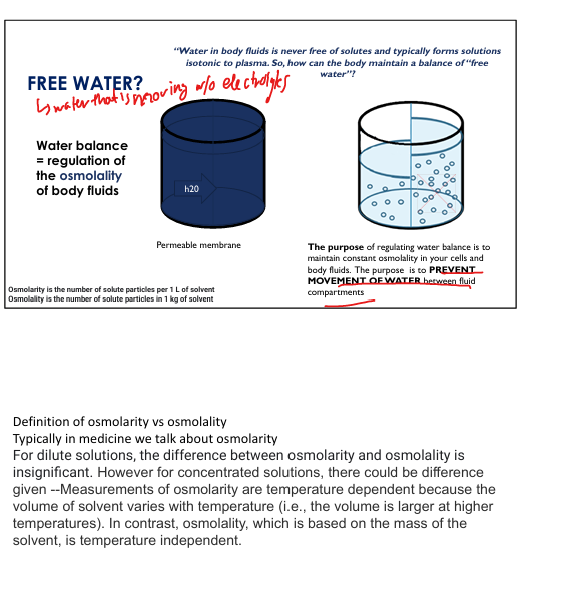
Define osmolarity vs osmolality.
Osmolarity = solute per liter
Osmolality= solute per kg

What happens when Uosm > Posm?
Water retention (negative free water clearance).

What happens when Uosm < Posm?
Water excretion (positive free water clearance).
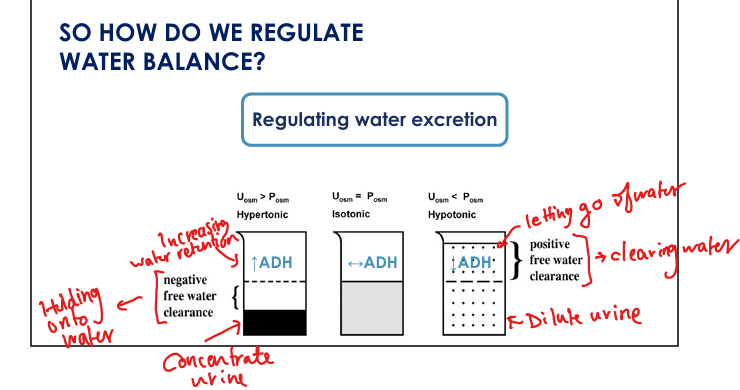
Major factors regulating free water excretion?
ADH, hyperosmolar medulla, AQP2 channels.

Where are osmoreceptors located?
Hypothalamus (PVN, SON).

Which aquaporins are basolateral and always open?
AQP3 and AQP4.

What receptor does ADH bind in kidney?
V2 receptor (Gs → ↑cAMP → AQP2 insertion).

What is free water reabsorption?
Water reabsorption without solute (requires ADH + medullary gradient).

What is free water excretion?
Water excretion without solute (requires low ADH).

What creates the hyperosmolar medullary gradient?
NaCl reabsorption in TALH + urea recycling + vasa recta countercurrent.

Which nephron segment is the diluting segment?
Thick ascending limb (NaCl reabsorption without water).

What is the role of urea in the medullary gradient?
Increases inner medullary osmolality → enhances water reabsorption.

What regulates urea recycling?
ADH (increases urea permeability in inner medullary collecting duct).

What maintains the medullary gradient?
Vasa recta countercurrent exchange.

What happens to urine in absence of ADH?
Large volume of dilute urine (Uosm ~50–100).

What happens to urine in presence of ADH?
Small volume of concentrated urine (Uosm up to 1200).

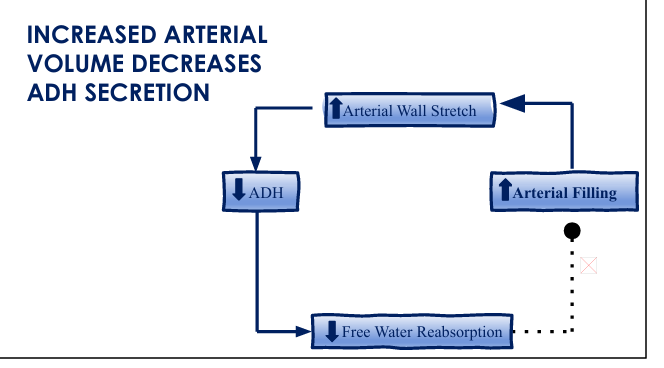
How does hypovolemia affect ADH response to osmolality?
Sensitivity increases → ADH released even at lower osmolality.
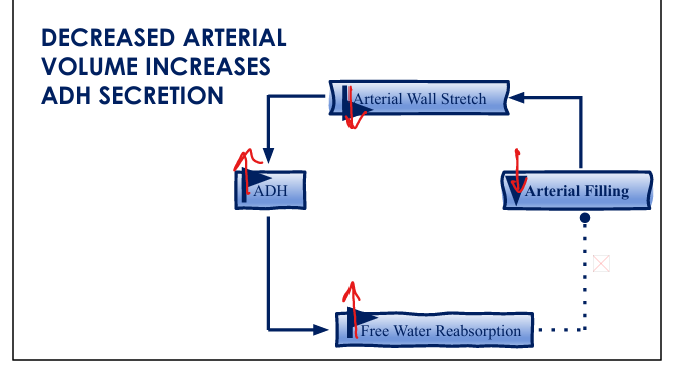

How does hypervolemia affect ADH response?
Sensitivity decreases → ADH suppressed despite higher osmolality.
Define diabetes insipidus.
Inability to concentrate urine and conserve water → excessive free water loss → hypernatremia. Normal blood sugar, either have deficiency of ADH(central) or no response to ADH(nephrogenic)

Cause of central DI?
No ADH production (hypothalamus/pituitary).

Cause of nephrogenic DI?
Kidney unresponsive to ADH (V2/AQP2 defects).

Define SIADH.
Excessive ADH secretion unrelated to osmolality or volume → water retention → hyponatremia.

Common causes of SIADH?
Malignancy (small cell lung CA), SSRIs, thiazides, CNS disease, pulmonary disease.
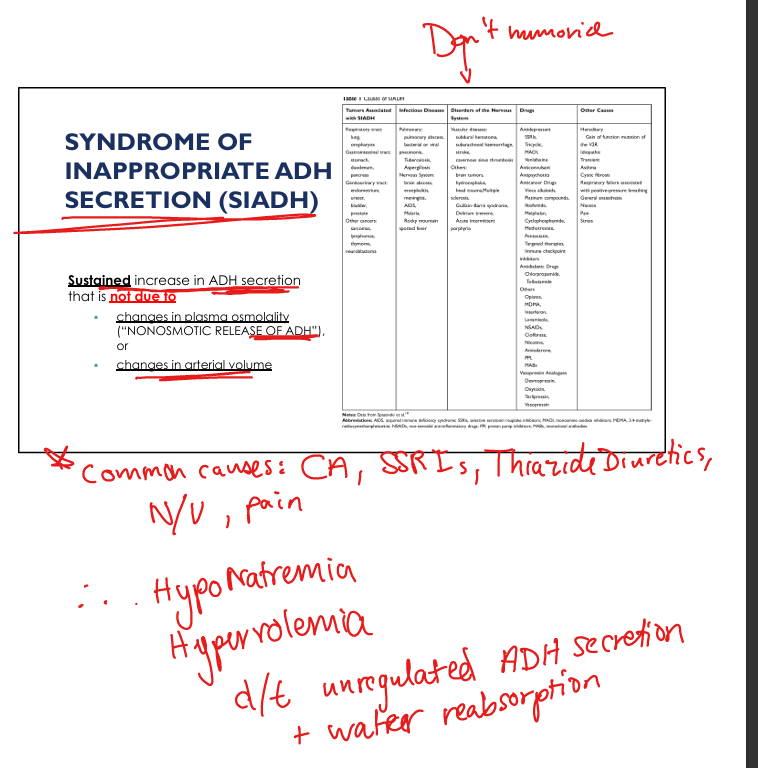
Lab findings in SIADH?
Hyponatremia, low serum osmolality, high urine osmolality, high urine Na.


Mechanism of hyponatremia in SIADH?
Excess water reabsorption → dilutional hyponatremia.

Effect of ANP on kidney?
↑GFR, ↓Na reabsorption, ↓RAAS, ↑natriuresis.
Effect of dopamine on kidney?
↓PT Na reabsorption, ↑renal blood flow.
Effect of NO on kidney?
↓renin, ↓Na reabsorption.
Explain CHF sodium/water retention.
Low cardiac output → perceived low arterial volume → ↑ADH, ↑RAAS, ↑SNS → Na/H₂O retention → edema.

Why does CHF cause hyponatremia?
ADH‑mediated water retention dilutes serum sodium.
