LEC 15 FEEDING AND DRINKING TYPES
 Call Kai
 Learn
 Practice Test
 Spaced Repetition
 Match
 Flashcards
 Knowt Play
1/64

There's no tags or description
Looks like no tags are added yet.
65 Terms
Herbivores
eat general plant vegetation (e.g. cows, rabbits)
Carnivores
eat meat; animal protein (e.g. lions, wolves)
Insectivores
eat insects (e.g. shrews, many bats)
Browsers
eat shrubs and herbaceous vegetation (e.g. deer, giraffes)
Grazers
eat mostly grasses - monocots (e.g. African bovids)
Folivores
eat leaves (e.g. howler monkeys, koalas, colugos)
Frugivores
eat fruit (e.g. many primates, many bats)
Nectarivores
eat pollen and nectar (e.g. many bats and marsupials)
Granivores
eat seeds (e.g. many rodents)
Sanguinivores
eat/drink blood (e.g. vampire bats)
Basal feeding type/skull morphology
insectivores
heterodont dentition
different types of teeth; insectivores
homodont dentition
all teeth are the same; many aquatic mammals
Myrmecophagous
feeding on ants; convergent in different groups
convergent adaptations for myrmecophagy
reduction of teeth or no teeth
- peg like teeth in armadillos
strong front feet & large claws for digging
tongue sticky and cylindrical
tongue is anchored at the posterior end of the sternum rather than the throat
enlarged salivary glands situated in the neck

Masseter muscle; carnivores vs herbivores
larger in herbivores for grinding plants

temporalis; carnivores vs herbivores
larger in carnivores for holding prey

articulation of jaw: carnivores
articulation of jaw nearly in line with tooth row

articulation of jaw: herbivores
articulation of jaw high above tooth row
teeth differences in carnivores, omnivores, and herbivores
- carnivores with carnassial
- omnivores with molars
- herbivores with cheek teeth

carnassial teeth
carnivores; shearing soft or tough food

molars
omnivores; rolling and crushing turgid or brittle food

cheek teeth
herbivores; shredding and grinding tough food
Bunodont Dentition
Modified quadrate dentition where the cusps are of lower elevation

Selenodont dentition
When the ridges become sharp as in the cheek teeth of deer

Lophodont dentition
when the cones become ridges as in the cheek teeth of the horse

Zalambdodont
having molar teeth with V-shaped ridges

Dilambdodont
W-shaped

Brachyodont
tooth length; low crowned teeth for omnivores

Hypsodont
tooth length; high crowned teeth for grazers

enamel
hard, outermost layer of a tooth
digestion: secreted in the oral cavity
Salivary amylase, contains α-Amylase. Splits starches into simple sugars
digestion: secreted in stomach
containing hydrochloric acid, pepsin from chief cells, splits protein chains into polypeptides.
digestion: secreted in small intestine
Lipase, α-Amylase, Trypsin and Chymotrypsin, Carboxypeptidase A
and B,Ribonuclease and Deoxyribonuclease
breaks down polypetides into amino acids
digestion: secreted in pancreas
pancreatic juice, neutralize gastric acids
digestion: secreted in
bile and bile salts disperse fat
digestive tract: insectivores
short intestine, no cecum

digestive tract: carnivore

digestive tract: ruminant herbivore

digestive tract: non-ruminant herbivore
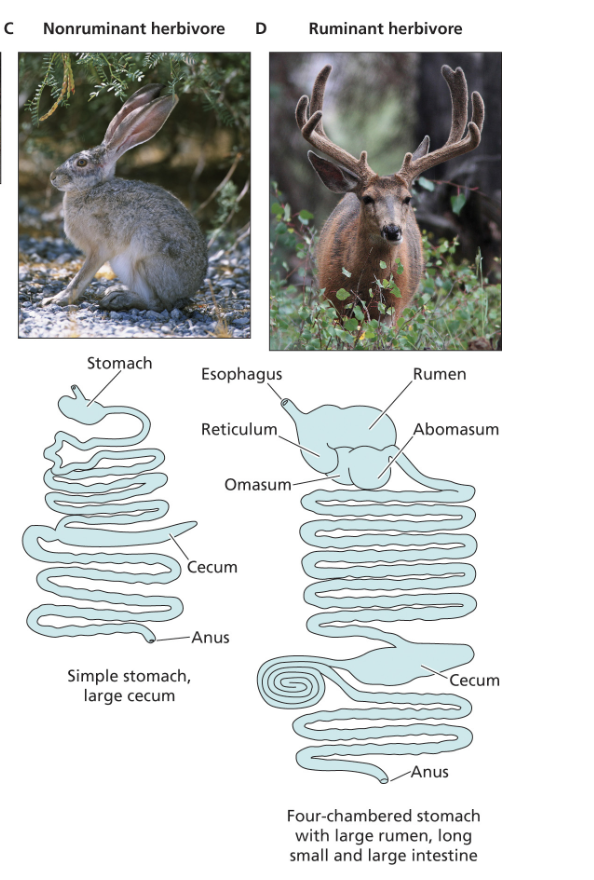
difficulty in herbivore digestion
materials like cell wall and cellulose are difficult to breakdown
hindgut fermentation
Digestion: enzymatic
non-ruminant herbivores; horses, rhinos, elephants, lagomorphs, hyraxes, etc.
foregut fermentation
digestion: microbial
ruminant herbivores; hippos, kangaroos, etc.
Ruminant stomach
Specialized four-compartment stomach consisting of the rumen, reticulum, omasum, and abomasum
Hindgut Fermentation Process
- initial digestion with chewing
- digestion continues to in simple stomach and moves rapidly to the small intestine
- nutrients are absorbed in the small intestine
- small food particles enter the small intestine then cecum and the large particles go into large intestines then feces
colon fermentation= large animals
cecum fermentation= small animals
Foregut Fermentation Process
multichambered stomach with cellulose digesting microorganisms; four chambers have functions
goes into 1st chamber- rumen to moist and kneaded
2nd chamber, large floating particles passes to reticulum to form cud
that is later regurgitated for further chewing
3rd chamber, the omasum, absorbs water and nutrients,
4th chamber, the abomasum, acts like the true stomach by secreting enzymes to digest food.
Rumen
moisten food, mix with microorganisms and fermentation begins
Reticulum
- receives larger particles of food, forms a softened mass (cud), and fermentation continues
- cud can be regurgitated and chewed again and the process repeats until food bolus is ready
food bolus
Mass of chewed food ready for swallowing.
Omasum
food bolus kneaded by macular wall
Abomasum
the true stomach; where digestive enzymes are added
Coprophagy
eating feces; produce soft and hard feces. soft feces is re-consumed and re-digested (e.g. lagomorphs, rodent shrews, some marsupials)
blood-feeding in vampire bats
3 species globally; stores blood in an enlarged, narrow stomach that absorbs water to concentrate the blood. water is excreted to reduce weight for flight
nectar feeding bats
some bats have coevolved tongue morphology with certain flower species
gum feeding
South American marmosets (Callithrix) have modified incisors w/ enamel on outer surface. Teeth wear into chisels which the use to gouge grooves into trees to stimulate flow of plant gums, which they consume.
water balance
the balance between water intake and water excretion, which keeps the body's water content constant
water and retention of moisture
The ability to maintain water balance in
terrestrial homeotherms is critical to survival, especially in arid environments
physiological threats in hot environments
Heat stress and water stress
potential sources of water loss
evaporation, respiration, excretion, lactation
potential sources of water gain
drinking free water, dietary water, metabolic water
solutions to limit water loss and enhance water gain
1) less of sweat glands
2) no panting
3) live in burrow systems
4) fur coat
5) long snouts/rostrum (air becomes dryer as it leaves the snout)
6) reduction of water content in urine and feces (kidneys)
7) lactate only during favorable seasons
8) increase concentration of milk
9) feed at night when humidity is higher
10) drink free water
function/goal of the mammalian kidney
metabolism of proteins creates toxic ammonia and is then converted to urea to be excreted
urea
less toxic and more soluble than ammonia; accumulated and released as urine
nephron of the mammalian kidney
works in urine formation and concentration of urine
Loop of Henle
alters concentration of urine; pulls out salts, water, and other useful materials (long in desert species and shorter in tropical species)