unit 4: transmission
 Call Kai
 Learn
 Practice Test
 Spaced Repetition
 Match
 Flashcards
 Knowt Play
1/54

There's no tags or description
Looks like no tags are added yet.
55 Terms
Transmissions
Machines that provide controlled application of power
o Connects a power source (engine or motor) to driven components (wheels, shafts, cables)
o Provides different ratios (often using gears) between the power source and driven components
o Necessary for applications requiring a wide range of speeds – Car driving on city streets vs on the highway, wind turbine operating in low or high winds
Four main types of transmissions
Manual
Automatic
CVT (Continuously Variable Transmission)
DCT (Dual Clutch Transmission)
Manual Transmission
Gears are shifted manually using a clutch and shifter
Operating Manual Transmission Process
o Foot operated clutch is engaged before every shift (disconnects engine and transmission)
o Shifter is moved by hand into the appropriate gear slot (mechanically selects the gear)
o Clutch is released and throttle is pressed to engage engine and transmission in the next gear
o Also called “standard” or “stick shift” transmissions
Manual Transmission Advantages
o Driver gets to select the gear and engine RPM (ideal when passing or driving uphill)
o Provides the purest driving experience, most intimate connection between car and driver
o Simple, cheap and easy to maintain o Natural theft prevention
Manual Transmission Disadvantages
o More driver effort and skill required
o Inconvenient for heavy traffic (constant stop & go)
Manual Transmission Applications
Sports cars, motorcycles, ATV’s, most consumer European vehicles
Manual Gearbox
Compound gear train that provides different gear ratios between an input and output shaft
o Gears are engaged and disengaged by the driver to create different gear ratios
o Gears are selected according to the desired output torque or speed
• Most modern manual gearboxes have 5 or 6 gears (speeds)
Gear Ratio and Gearboxes
o Gear ratio highest in lowest gear (1st) – Most available torque, lowest maximum speed
o Gear ratio decreases with each successive gear
o Gear ratio lowest in highest gear (5th or 6th) – Least available torque, highest maximum speed
Manual Transmission Components
Shafts
Gears
Dog clutch
Manual Transmission Components: Shafts
o Input shaft (connected to engine) – Always rotates with engine
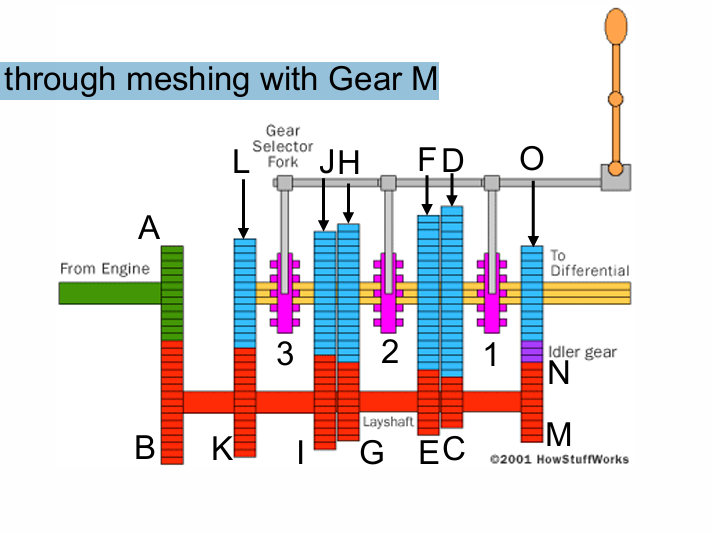
o Layshaft or countershaft – Always rotates with input shaft through meshing of Gears A & B
o Output shaft (connected to wheels) – Rotates only when an output gear is selected
o Input and output shafts are in line → Reverted Layout
Reverted Layout and Shafts/Gears
True for RWD (rear wheel drive) layouts as shown where engine is mounted longitudinal
FWD (front wheel drive) cars are not reverted since engine is mounted transverse
Manual Transmission Components: Gears
Input gear
Layshaft gears
Output gears
Idler gear

Manual Transmission Components: Input Gears
o Input gear (1) mounted on input shaft – Always rotates with engine via input shaft

Manual Transmission Components: Layshaft gears
Layshaft gears (7) mounted on layshaft – Always rotate through meshing of Gears A & B

Manual Transmission Components: Output gears
Output gears (6) mounted around output shaft – Always rotate through meshing with their corresponding layshaft gear
o Output gears are connected to the output shaft only when the dog clutch is engaged
o Only one output gear is connected to the output shaft at any one time
Manual Transmission Components: Idler gears
o Idler gear (1) mounted on a bearing – Always rotates through meshing with Gear M

Dog Clutch
(3 total) – Controlled by the driver to select the desired gear ratio o Slide along and rotate with the output shaft to engage the desired gear
o Splined hub on inside of dog clutch matches splined output shaft – Always rotate together
o Manual shifter pushes dog clutch back or forth along output shaft o Each dog clutch controls two different gears
o Teeth on dog clutch fit into matching cut outs in desired gear
o Tapered surfaces use friction to match speeds before teeth engage
o Called a Synchromesh Transmission
Synchromesh Transmission
Synchromesh Transmission – Conical surfaces with friction material provide speed matching of gear and shaft before full engagement of the dog clutch
Gearbox Ratio Depending on Gears engaged
itotal = Nb/Na * Output gear/lay shaft gear
Total Vehicle Gearing
Transmission (gearbox) gear ratio, ig
Differential (final drive) gear ratio, if
Total gear ratio, it
Transmission Gear Ratio
Transmission (gearbox) gear ratio, ig – Changes based on selected gear o Starting off in first gear (high gear ratio) vs highway driving in top gear (low gear ratio)
Differential Gear Ratio
• Differential (final drive) gear ratio, if – Same gear ratio applied to all transmission gears
o Provides final speed reduction and increase in torque to the wheels
Total Gear Ratio
• Total gear ratio, it – Changes based on selected gear
o Product of the two gear ratios above
𝑖𝑡 = 𝑖𝑔 ∙ 𝑖𝑓
Planetary Gear Trains Components
Sun gear
Planet gear(s)
Ring gear (annulus)
Planet carrier
Sun gear Def
Central gear meshing with planet gear(s)
Planet gear(s) Def
One or more outer gears that mesh with the sun gear and ring gear
Ring gear (annulus)
– Internal gear surrounding and meshing with planet gear(s)
Planet carrier
– Single rigid component that planet gears are mounted to
Planetary Gear Trains Shafts
• Components are mounted to 3 external shafts that transfer power between them
o Sun gear shaft – Carries sun gear
o Ring gear (annulus) shaft – Carries ring gear (annulus)
o Planet carrier shaft – Carries planet carrier and therefore, planet gears
o All shafts share same axis of rotation, making them coaxial
Configurations of Planetary Gear
Different gear ratios can be selected depending on which of the shafts is locked
o Case 1 – Ring gear (annulus) locked
o Case 2 – Sun gear locked
o Case 3 – Planet carrier locked
o Case 4 – Direct drive (entire gear set locked together)
• Case 1 – Ring gear (annulus) locked
o Sun gear and planet carrier are the input and output
o In both cases, input and output shafts rotate in the same direction
o Gear ratio typically >2, corresponds to 1st gear in a 3 speed transmission
• Case 2 – Sun gear locked
o Ring gear and planet carrier are the input and output o In both cases, input and output shafts rotate in the same direction
o Gear ratio typically between 1 & 2, corresponds to 2nd gear in a 3 speed transmission
Case 3 – Planet carrier locked
o Sun gear and ring gear are the input and output o In both cases, input and output shafts rotate in opposite directions
o Gear ratio typically between 1 & 2, corresponds to reverse gear in a 3 speed transmissio
Case 4 – Direct drive, entire gear set locked together and rotates as a single uni
o Every component is both the input and output
o Input and output shafts rotate in the same direction
o Gear ratio equals 1, corresponds to 3rd gear in a 3 speed transmission

o Ds = Pitch circle diameter of sun gear
o Da = Pitch circle diameter of annulus gear
o Dp = Pitch circle diameter of planet gear
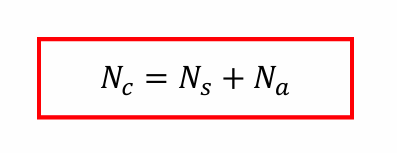
Nc = carrier
Na = annulus/ring
Ns = sun
Automatic Transmission
• Gears are shifted automatically by mechanical or electronic control o Driver uses the throttle only, no clutch or shifter to manage
o When the engine RPM reaches a suitable point, gears are shifted automatically
o Shift points are controlled mechanically or electronically based on performance and economy
o Majority and increasing number of vehicles have automatic transmissions
Automatic Transmission Advantages
o User friendly, no experience or training required
o Easy and simple driving experience, guaranteed a smooth and quiet ride
o Modern automatics have a high number of gears (7, 8 or 9) which improves fuel economy
Automatic Transmission Disadvantages
o Added weight and complexity
o More expensive to buy, maintain and replace
o Boring (for some)
Automatic Transmission Applications
o Most consumer cars, some sports cars
Ravigneux Gearset
Ravigneux Gearset – Double planetary geartrain with 2 separate concentric input shafts
o Gears are changed by locking and unlocking different components using clutch packs
o 5 different configurations possible (4 forward gears & 1 reverse gear)
o Used in 4 speed automatic transmissions
Ravigneux Gearset – Components
• 9 gears (including 1 ring gear), 2 concentric shafts, 1 common planet carrier
o Small sun gear and planet gears (red), Large sun gear and planets (blue)
o Ring gear (yellow) surrounds blue planet gears, which act as the ring gear for red planet gears
o All planet gears mounted to a common planet carrier (tan), hidden in left picture
Ravigneux Gearset, how many gearsets?
4 + reverse
CVT
• Uses a steel belt and pair of movable pulleys to provide an infinite number of ratios
o Belt runs between two coned pulleys connected to the engine and drive shaft
o Pulleys move in and out laterally, causing the belt to ride up or down the coned surfaces
o Changing contact diameters of the pulley changes the drive ratio
o Pulleys are adjusted continuously based on engine RPM and driving speed
CVT Advantages
o Smooth, stepless driving with no defined ratios
o Excellent fuel economy in almost all driving conditions
o No driver skill or knowledge required (similar to automatic transmission)
CVT Disadvantages
o Maintenance and replacement can be costly
o Can be a delay in acceleration when throttle is pressed
o Monotonous engine sound, very little connectivity with driver
CVT Applications
Some consumer cars, snowmobiles, farm and landscaping equipment
CVT Components
• 2 shafts, 2 conical pulleys (input & output), pulley control system, steel belt
o Input & output pulleys are adjustable axially to bring them closer together or farther apart
o Conical surfaces change effective contact diameter for the belt and thus, the gear ratio

Electric Cars
• Electric cars do not use multi speed transmissions
o Instead they use carefully selected fixed gear ratios for maximizing efficiency
o Electric motors produce torque evenly across a wide range of RPM
o Torque is delivered instantly (no need to develop it through increasing RPM as is the case with an internal combustion engine)
o Multi speed transmissions in electric cars would only add unnecessary weight and cost
DCT Full
Dual Clutch Transmission
DCT
• Type of automatic transmission that uses 2 separate clutches to engage 2 concentric input shafts carrying odd and even numbers of gears
o Similar to 2 half manual transmissions
DCT vs Manual
• Comparison to Standard Manual Transmission
o Manual requires driver to shift gears using the clutch and shifter, DCT does so automatically
o Manual has interruption in power delivery every time the clutch is pressed, DCT does not due to pre selection of gears and dual clutch layout (smooth power delivery)
o DCT shifts much faster (~0.1 s) than manual (0.5 – 1 s for a typical driver) o DCT is more fuel efficient (3 – 5%) than manual
DCT vs Regular Automatic Transmission
o Automatic uses a double planetary gear set and a torque converter (fluid coupling)
o DCT is an automatically controlled version of the manual transmission and uses the same gearing arrangement as manuals (helical gears on parallel shafts)
o DCT is more fuel efficient (5 – 10%) than automatic (losses from torque converter)
o DCT is more expensive than automatic (newer technology)
DCT Applications
o Sports cars, higher end consumer cars, some motorcycles
o DCT’s can come with a manual option (paddles or buttons for shifting, still no clutch pedal)
o 2004 VW Golf R32 was the first production car to offer a DCT (called a DSG)