chapter 1 - rates of reactions
 Call Kai
 Learn
 Practice Test
 Spaced Repetition
 Match
 Flashcards
 Knowt Play
1/15

There's no tags or description
Looks like no tags are added yet.
16 Terms
when do reactions occur?
when molecules collide into one another
in a reaction between molecule A and B, what is the rate proportional to?
the number of collisions between A and B
so, if you double the concentration of B, you should double the collisions between A and B
so, you would expect the reaction rate to double
what form is the rate reaction normally written in?
rate = k × [A]m[B]n
the numbers m and n tell you how the rate depends on the reactants
m is the order of reaction with respect to A, while, n is the order of reaction with respect to B
k is the rate constant

first order reaction?
a reaction is first order with respect to a reactant when the rate depends on its concentration raised to the power of one

second order reaction?
a reaction is second order with respect to a reactant when the rate depends on its concentration raised to the power of 2
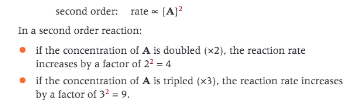
example: the rate equation and overall order for a reaction

example: rate constant from experimental results
*note= always start where A doubles and B stays the same
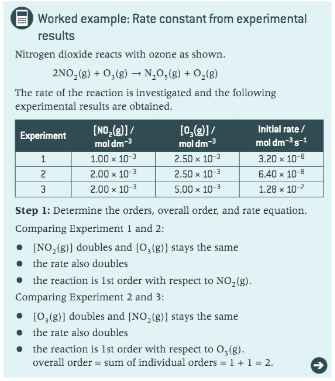

example: harder rate constant from experimental results

how to know if reactant is zero, first or second order?
zero order - no matter what you do to the concentration, the rate does not change
first order - what you do to the concentration, the rate changes by the same factor
second order - whatever you do to the concentration, the rate changes by the same factor squared
3 key rules when finding the units of the rate constant?

what is the overall order?
m + n
features of the rate constant?
it is temperature dependent
it has different units for different reactions
what do the units of the reaction rate have to be?
concentration over time
but the units of the products of the reactants are never that, so you need to assign units to k to sort it out
the larger the rate constant, the faster the reaction
calculating the rate constant?
E.g. the rate equation for the production of I-Cl is: Rate = k[I2]1[Cl2]1
Given that the concentrations of I2 and Cl2 are 1moldm-3, and the rate of reaction is 40moldm-3t-1, what is the value of k?
k = 40moldm-3t-1 ÷ (1moldm-3)2 = 40mol-1dm3t-1
calculating the rate of reactions?
E.g. if a reaction obeys the equation:
Rate = k[A][B], where the rate constant is 0.5dm3mol-1t-1, and the reactant concentrations are both 2moldm-3
The rate is 2moldm-3 × 2moldm-3 × 0.5dm3mol-1t-1 = 2moldm-3t-1