bio lab 3, general bones and axial bones
 Call Kai
 Learn
Learn Practice Test
 Spaced Repetition
 Match
Match Flashcards
 Knowt Play
1/60

There's no tags or description
Looks like no tags are added yet.
Name | Mastery | Learn | Test | Matching | Spaced | Call with Kai | Chat |
|---|
No analytics yet
Send a link to your students to track their progress
61 Terms

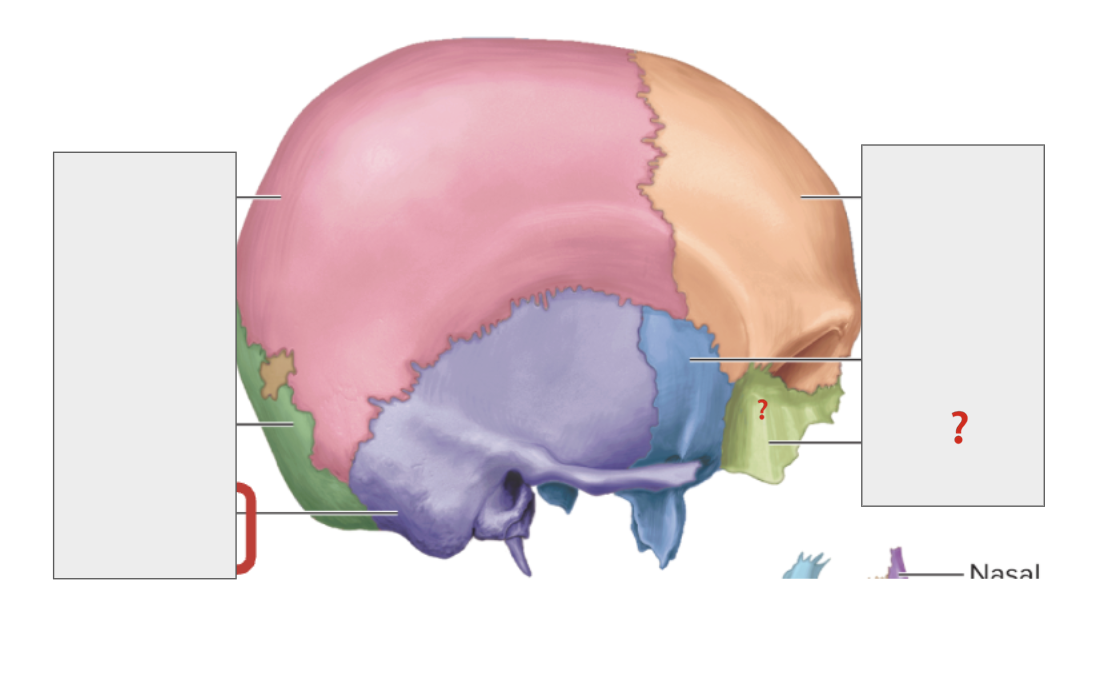
Frontal Bone
Ethmoid Bone

Sphenoid bone

Temporal bone
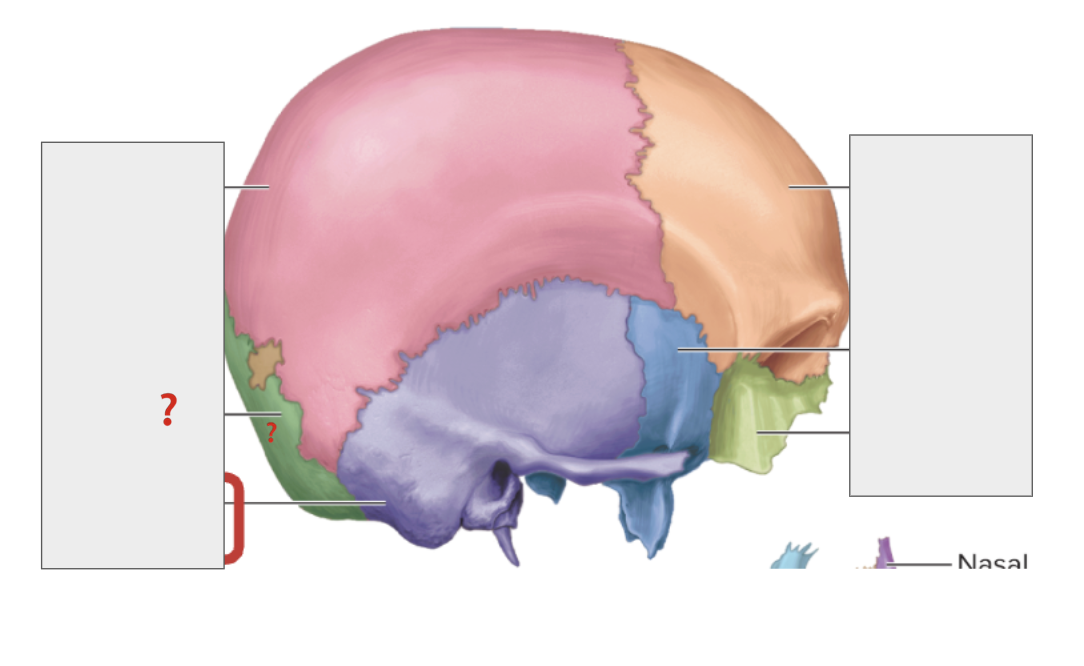
Occipital bone

Parietal bone

Mandible

maxilla
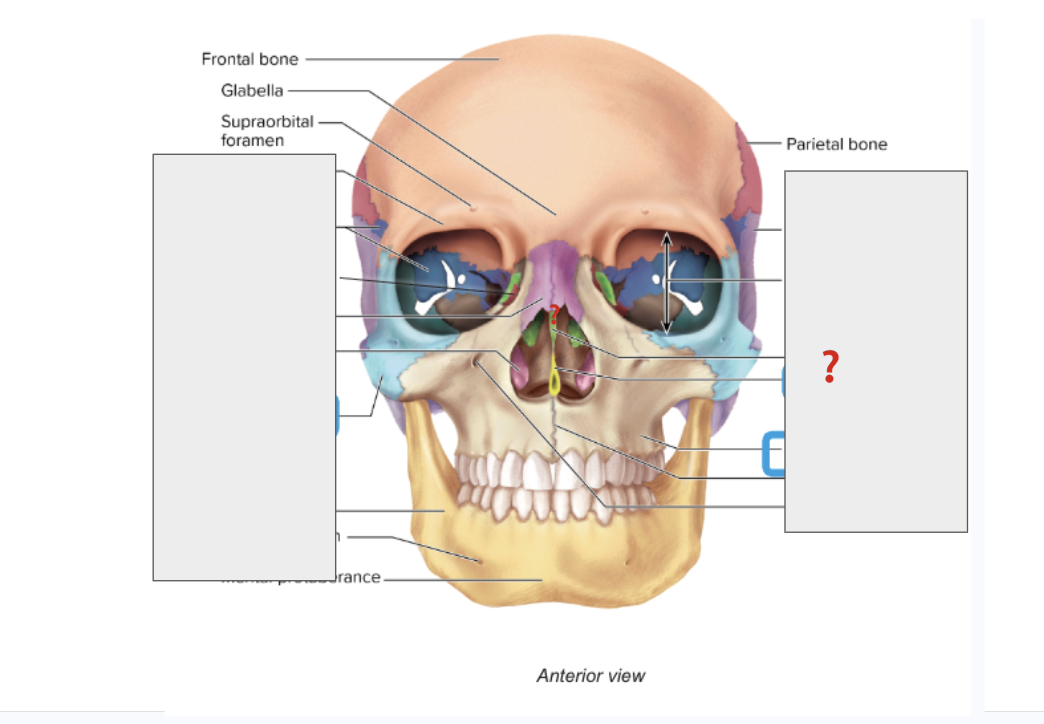
vomer
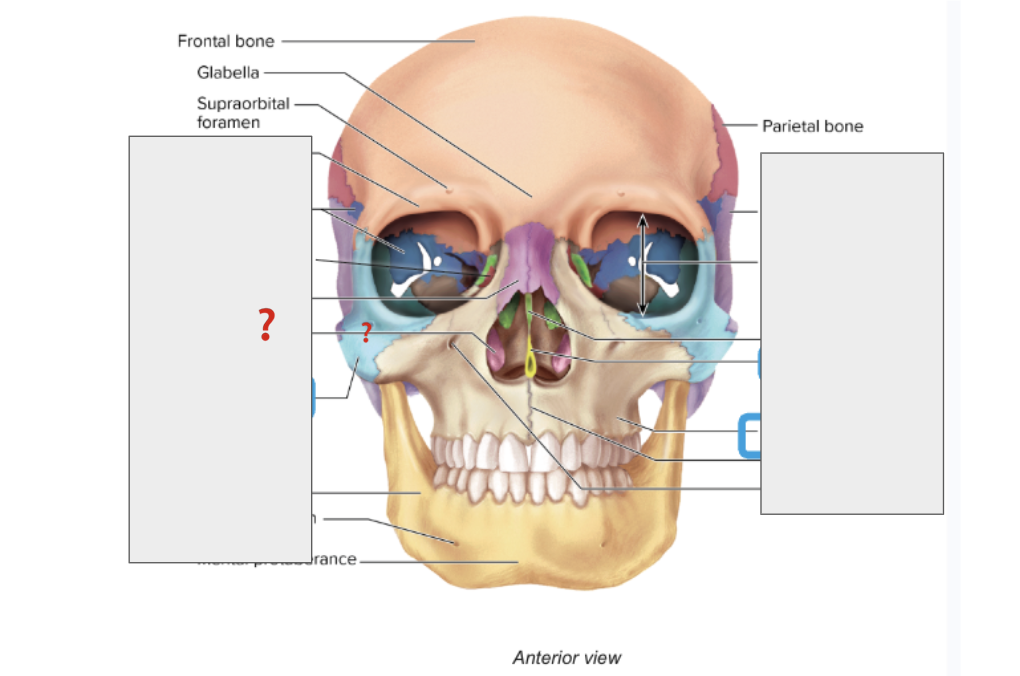
zygomatic bone (matching on the other side)

inferior nasal concha

nasal bone

lacrimal bone

palatine bone
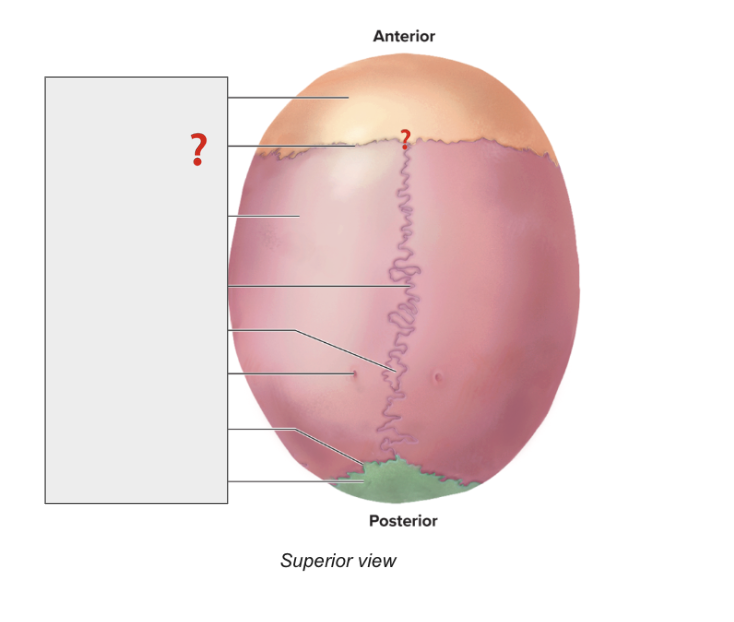
coronal suture

saggital suture

Lambdoid suture
What is this bone?
Located inferior to the mandible and superior to the larynx
Provides attachment points for many muscles of the neck
Hyoid bone

manubrium

body
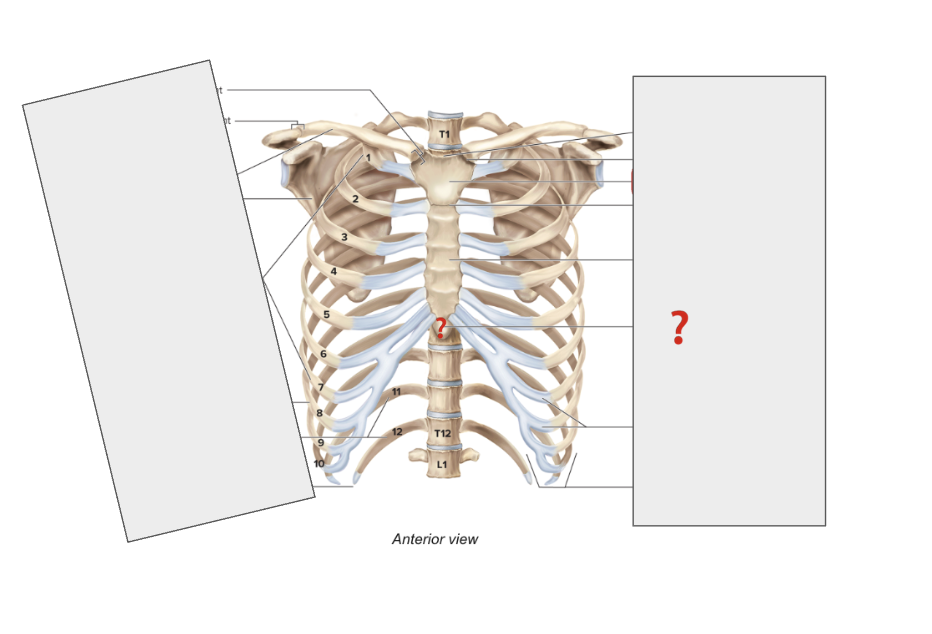
xiphoid process
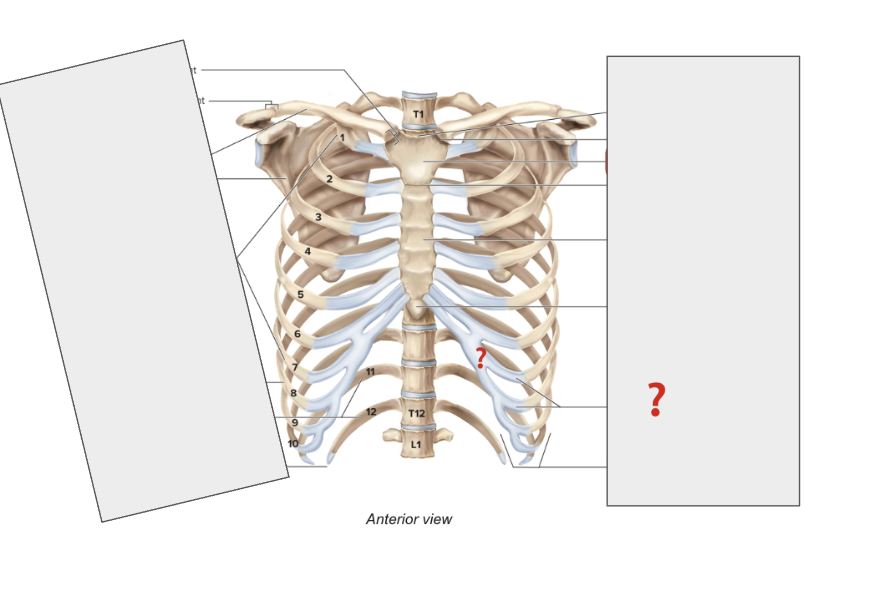
costal cartilage

floating ribs (11-12)

true ribs (1-7)

false ribs (8-12)
How many vertebrae are there and how many are unfused?
24 unfuse, 33 total
Whats the saying to help remember the verterbrae?
Breakfast at 7 (cervical), Lunch at 12 (thoracic), Dinner at 5 (lumbar), Wine at 9 (sacrum/coccyx)
What bones names in the vertebral do we need to know?
Atlas- C1, connects to occipital bone of the skull.
Axis- C2, connects C1 to
C3. C3-C7 are small narrow bones distinct from thoracic and lumbar vertebrae.
Thoracic articulate with 12 thoracis ribs.
Lumbar are weight-bearing (larger body/area).
Sacrum connects to os coxa (pelvic girdle) and fully fused by late adulthood. The coccyx is the tailbone and fully fuses when we are in our 20s.
What is the Pectoral Girdle and what are the subcategories?
Bones that help form the shoulder joint
Clavicle- collar bone, sit superior to the sternum, articulate to the scapulae on the lateral portion
Scapula- shoulder blade, sit posterior to the ribs
Humerus, point to the location and where is it in location to the body
Brachial region, articulates with the scapula at the shoulder, articulates with the radius and ulna at the elbow
Upper Limbs- antebrachial
Radius- antebrachial region, located on the lateral side in anatomical position
Ulna- antebrachial region, located on the medial side in anatomical position
Radis and unla articulate with each other at two points and are connected by interosseous membrane
Upper Limb- Carpal
Carpals- two rows of four wrist bones.
Scaphoid- later side, proxmical row
Lunate- promixal row
Triquetrum- proximal row
Pisiform- medial side, proximal row, anterior to the triquetrum
Trapezium- later side, distal row
Trapezoid- distal row
Capitate- distal row
Hamate- medial side, distal row
What is the study mnemonic for the carpals?
Lateral to medial, medial to lateral: So Long To Pinky, Here Comes The Thumb
Upper Limb- Metacarpals
Metacarpal I - lateral, aligns with thumb
Metacarpal II - aligns with index finger
Metacarpal III - aligns with middle finger
Metacarpal IV - aligns with ring finger
Metacarpal V - medial, aligns with pinky
The bones in the phalanges.
Thumb: Proximal phalanx I, distal phalanx I.
Other fingers: Poximal, middle and distal
Os coxae
Includes the Sacrum and Coccyx. Bones that help support the weight of the body, contain bones that help support the weight of the body, contain pelvic viscera, and help form the hip joints.
Bones in the Os coxae
Three fused bones:
Illium: wide crest, palpable at the hip
Ischium: posterior and inferior, palpable at buttocks
Pubis: anterior crest, palpable at pubic region
Femur
femoral region, articulates with the os coxa, articulates with the patella, tibia and fibula at the knee joint
patella
the knee cap, patellar region, sesamoid bone that articulates with the femur anteriorly, serves as a fulcrum, a pivotal point allowing muscles to apply force to extend the leg
tibia and fibula
tibia is on the anterior and medial side of the lower leg (aligned with the big toe). fibula is on the lateral side of the lower leg, difficult to palpate. they articulate with each other at two points, proximal and distal. are connected by interosseous membrane.
tarsals
the ankle bones. 7 total.
1) talus, most proximal
2) calcaneus
3) navicular
4)medial cuneiform
5) intermediate cuneiform
6) lateral cuneiform
7)cuboid
tarsal mnemonic
tiger cubs need MILC (talus, calcaneus, navicular, medial cuneiform, intermediate cuneiform, lateral cunieform, cuboid)
metarsals
there is 5, all labeled I through V. I is the big toe and V is the pinky toe
phalanges on the foot
Digit 1: promixal phalanx I
Digit 2-5: Proximal phalanx, middle and distal
condyle
rounded knob that articulates with another bone
epicondyle
an extended region found “above” (epi-) a condyle
crest
a narrow ridge
facet
smooth, flat concave/convex surface that articulates with another bone
fissure
a narrow crack or slit
foramen
a hole, usually round
fossa
shallow basin
head
prominent end of a bone, proximal
meatus
opening or entrance to canal
process
any bony prominence
protuberance
a bony outgrowth
sinus
an air filled cavity
spine
sharp slender process
ramus
branch or arm
trochanter
two large prominences
tubercle
small rounded nodule
tuberosity
rough elevated surface