Ch 17. Urinary Physiology
 Call Kai
 Learn
 Practice Test
 Spaced Repetition
 Match
 Flashcards
 Knowt Play
1/46

There's no tags or description
Looks like no tags are added yet.
47 Terms
Overall function of the urinary system?
Cleans the blood
Urine = the waste removed from the blood
Renal cortex vs. renal medulla?
Cortex = outer (superficial) region
Medulla = deep region, made of the renal pyramids

Functional unit of the kidney, and what it does?
Nephron
Filters the blood and makes urine
What do collecting ducts do, and where are they?
Collect urine from many nephrons
Located in the renal pyramids
Path of blood through the kidney?
Blood goes from the aorta into the renal artery, then the segmental, interlobar, arcuate and cortical radiate arteries. It enters the nephron through the afferent arteriole and passes through the glomerulus. It leaves through the efferent arteriole into the peritubular capillaries. It then drains into the cortical radiate, arcuate and interlobar veins, then the renal vein and the inferior vena cava. There is no segmental vein.
The kidney's two capillary beds?
1st: glomerulus, between the afferent and efferent arterioles
2nd: peritubular capillaries, which come off the efferent arteriole and follow the nephron tubules
Order of the nephron's parts?
The glomerular capsule (the ball around the glomerulus) leads into the proximal convoluted tubule, then the nephron loop (loop of Henle), then the distal convoluted tubule. The distal convoluted tubule empties into the collecting duct.
Which part of the nephron is in the medulla?
Only the nephron loop
The rest of the nephron is in the cortex
Cortical vs. juxtamedullary nephron?
Juxtamedullary sits closer to the medulla
Juxtamedullary has a longer loop that goes deeper into the medulla
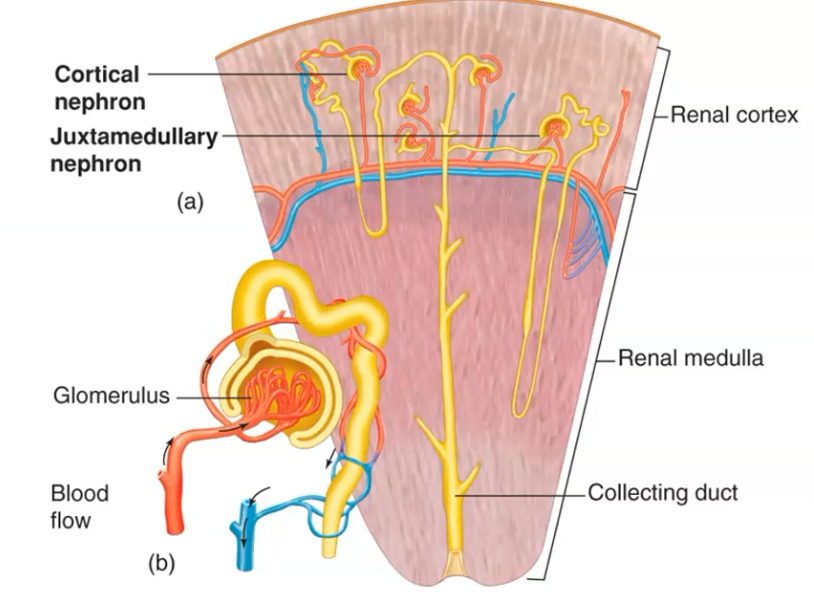
The remaining cards are physiology, the cards you just run through are anatomy review.
The 3 steps of urine formation?
Filtration
Reabsorption
Secretion

What is filtration, and where does it happen?
Material leaves the blood at the glomerulus and enters the glomerular capsule
What leaves = the filtrate
What does NOT get filtered?
Proteins
Cells
What is reabsorption?
Moves what we need from the filtrate (nephron tubules) into the peritubular capillaries
Examples: water, Na⁺, K⁺, Ca²⁺, medications, hormones
What is secretion, and how is it different from excretion?
Secretion: material moves from the peritubular capillaries back into the nephron tubule (filtrate)
Excretion: getting rid of urine (urination)
When does filtrate become urine?
Once the collecting ducts collect it
What is GFR?
Glomerular filtration rate
How much filtrate both kidneys make per minute
How do the afferent and efferent arterioles differ in diameter?
Afferent is bigger than efferent
Main way GFR is controlled?
By changing the diameter of the afferent arteriole
What makes up the glomerular filter?
Fenestrations (holes in the glomerulus)
Filtration slits (made by the interlocking feet of podocytes)

What is proteinuria, and why are blood cells normally not in urine?
Proteinuria = protein in the urine, caused by a defect in the filter
RBCs are too big to fit through the fenestrations
How does filtrate amount relate to urine output?
More filtrate means more urine
Less filtrate means less urine
How much filtrate do we make per day?
About 45 gallons
Most of it is reabsorbed
How does dilating the afferent arteriole raise GFR?
Afferent dilation: More blood enters the glomerulus → pressure increases → GFR, filtrate, and urine increase.
Afferent constriction: Less blood enters → pressure decreases → GFR, filtrate, and urine decrease.
The two ways GFR is controlled?
Extrinsic: sympathetic nervous system
Intrinsic: autoregulation by the kidney itself
How does the sympathetic division affect GFR when blood pressure drops or during exercise?
Increased sympathetic activity: Increases cardiac output and constricts afferent arterioles → GFR, filtrate, and urine decrease, conserving blood volume. Vasoconstriction increases TPR, raising blood pressure.

Main goal of autoregulation, and its 2 mechanisms?
Keep GFR constant
Myogenic constriction
Tubuloglomerular feedback
Myogenic autoregulation: what does the afferent arteriole do when BP drops or rises?
BP drops: afferent dilates
BP rises: afferent constricts
Either way, GFR doesn't change

Tubuloglomerular feedback: which cells sense what, and how does the afferent arteriole respond?
Macula densa cells (juxtaglomerular apparatus, ascending limb) sense Na⁺/water in the filtrate
Too much: afferent constricts, so GFR drops
Too little: afferent dilates, so GFR rises
What is obligatory water loss?
Minimum urine needed to clean the blood: 400 mL/day
Below that, dialysis is needed
Where does most reabsorption happen?
Proximal convoluted tubule (PCT)
How is Na⁺ reabsorbed in the PCT?
Enters the cell by cotransport (facilitated diffusion).
Na⁺/K⁺ pump on the basal side pumps it out, keeping Na⁺ low inside the cell
Without the pump, Na⁺ reabsorption stops
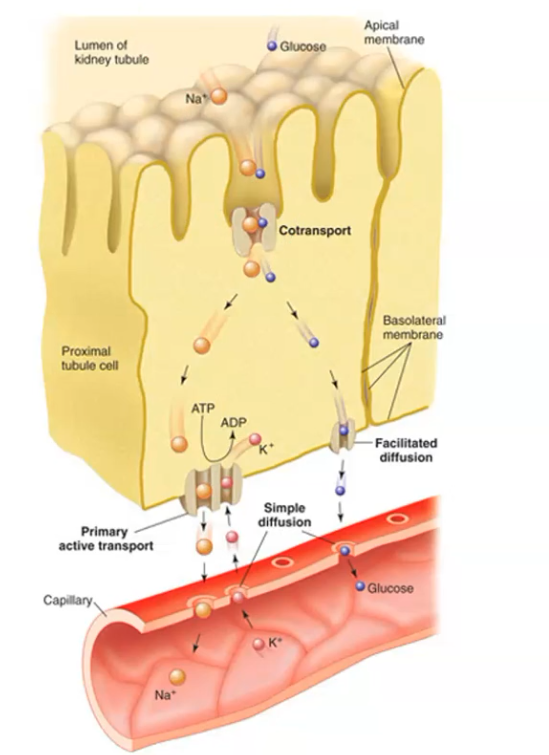
How is glucose reabsorbed in the PCT?
Secondary active transport: cotransport with Na⁺
Leaves the cell into the capillary by facilitated diffusion
If the Na⁺/K⁺ pump stops, glucose isn't reabsorbed either
How are Cl⁻ and water reabsorbed?
Cl⁻ follows Na⁺ passively (negative charge)
Water follows solute
Both depend on active transport of Na⁺
How much Na⁺, Cl⁻ and water is reabsorbed in each part of the nephron?
PCT: 65%
Nephron loop: 20%
Together: 85%
Remaining 15%: DCT and collecting duct, depending on hydration (ADH and aldosterone)
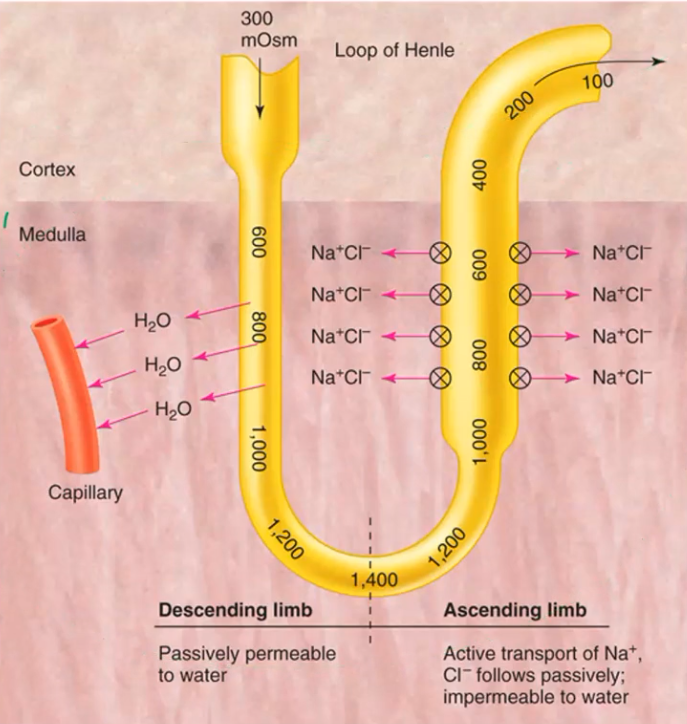
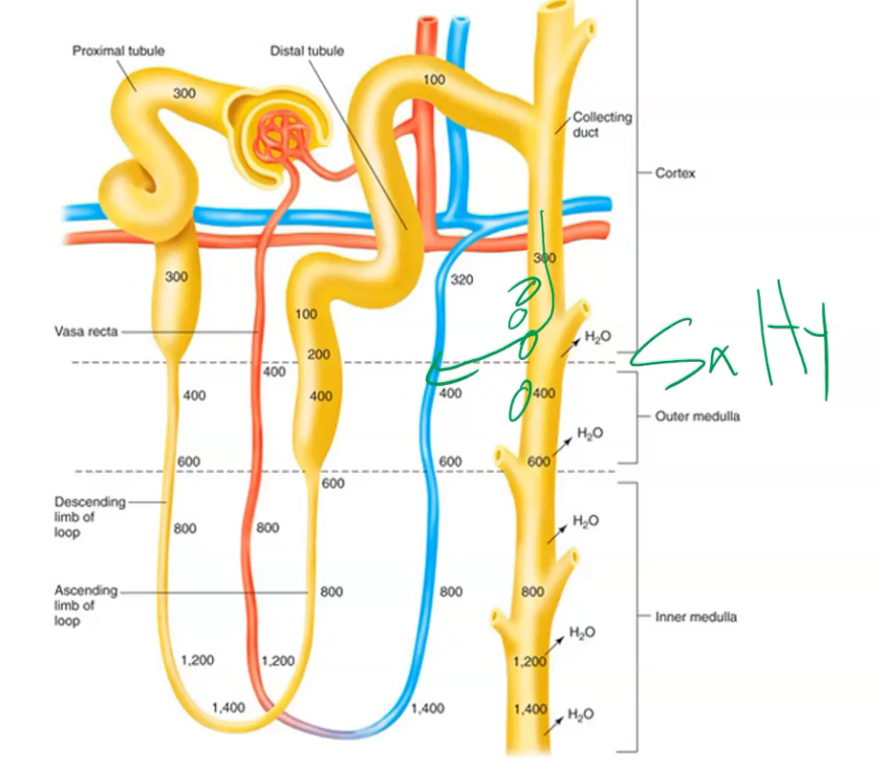
How does saltiness change in the renal medulla, and what makes it salty?
The deeper you go, the saltier it gets
Na⁺, Cl⁻ and urea
How does the countercurrent multiplier work?
As filtrate goes down the descending limb, the medulla gets saltier, so water leaves the loop (following the salt) and the capillaries reabsorb it.
In the ascending limb, Na⁺ is actively pumped out by the Na⁺/K⁺ pump and Cl⁻ follows passively. So water is reabsorbed in the descending limb and salt in the ascending limb.
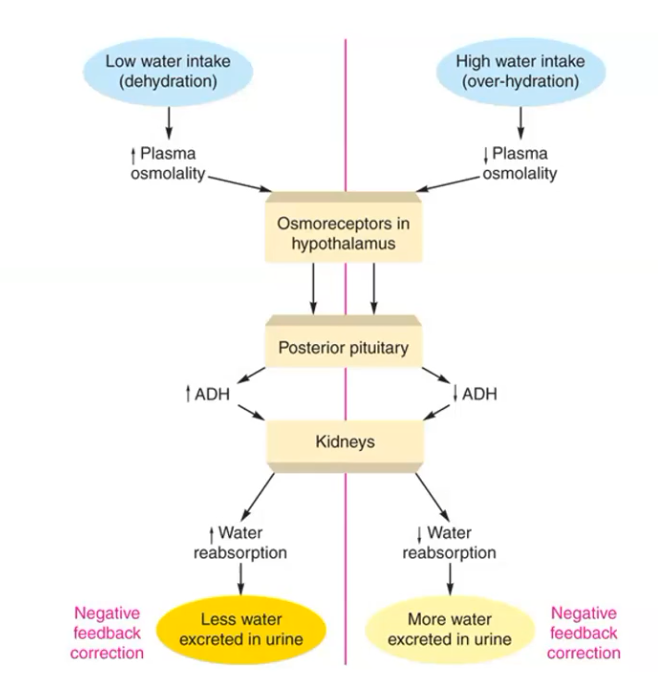
When is ADH released, what does it target, and what does it do?
Released when dehydrated or blood volume is low
Targets the collecting ducts
Adds aquaporins, so water is reabsorbed
What does ADH depend on to work?
The saltiness of the renal medulla
Without the salt, water isn't reabsorbed no matter how many aquaporins are added
ADH pathway during dehydration?
Low water intake: Increases plasma osmolality → hypothalamus triggers ADH release → aquaporins increase → more water reabsorbed, less urine produced.
Overhydration: Decreases ADH → less water reabsorbed, more urine produced
Where does aldosterone act, and what does it do?
Acts on the DCT and collecting duct
Activates Na⁺/K⁺ pumps
Reabsorbs Na⁺, Cl⁻ and water
Secretes K⁺, which is excreted
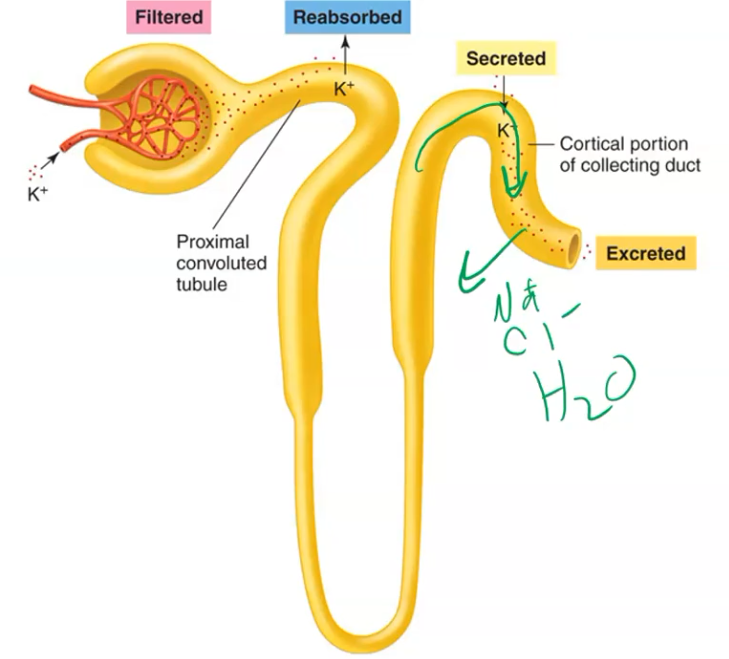
What does K⁺ in the urine indicate?
Aldosterone has been released
Normally most K⁺ is reabsorbed in the PCT
Key difference between aldosterone and ADH?
Aldosterone creates its own salt gradient, so water follows
ADH depends on the medulla already being salty
Renin–angiotensin–aldosterone pathway?
Granular cells of the juxtaglomerular apparatus release renin. Renin converts angiotensinogen into angiotensin I, and ACE in the lungs converts angiotensin I into angiotensin II. Angiotensin II signals the adrenal cortex to release aldosterone, which makes the DCT and collecting duct reabsorb Na⁺. Cl⁻ and water follow.

What triggers aldosterone release?
Low BP
Low blood volume
Low Na⁺
How does the body respond to low Na⁺ intake?
Low plasma Na⁺ is detected by the hypothalamus, so the posterior pituitary releases less ADH. Less water is reabsorbed, so urine volume goes up and blood volume goes down. Lower blood volume, along with more sympathetic activity, triggers the juxtaglomerular apparatus to release renin. That makes angiotensin II and then aldosterone, which increases Na⁺ reabsorption in the collecting duct.

When is ANP released, and what does it do?
Released when high blood volume stretches the atria
Works against both aldosterone and ADH
Gets rid of salt and water, lowering blood volume