Powers and Borders 3: China
 Call Kai
 Learn
 Practice Test
 Spaced Repetition
 Match
 Flashcards
 Knowt Play
1/25

There's no tags or description
Looks like no tags are added yet.
26 Terms
What was China’s "Century of Humiliation" (1839–1949), and how does it drive modern CCP policy?
Between 1839 and 1949, China suffered repeated foreign invasions, unequal treaties, loss of territory, and civil war. Since then, the Chinese Communist Party (CCP) established the People's Republic of China (PRC) in 1949.
A core goal has been ensuring China is never weak or divided again, projecting strength as a rising global hegemon (dominant superpower) and restoring what it views as its historical borders.
The CCP is the Chinese Communist Party—the single political party that rules China today.
To tie everything together simply:
CCP = The ruling political party (the group in charge).
PRC = The country they rule (modern China).
Who are the Han Chinese, and what is the CCP's "One China" / national unity policy?
Han Chinese are the majority ethnic group in China, making up over 91% of the total national population and dominating the CCP leadership. To prevent national fragmentation, the CCP promotes strict national unity and suppresses ethnic or religious variance.
Alongside this, the CCP enforces its "One China" principle—which states that there is only one sovereign Chinese state (the PRC) and that Taiwan belongs to it—requiring other countries to cut official ties with Taiwan to have diplomatic relations with China.
What are the "Three Evils" that the CCP uses to justify exerting political and ethnic dominance across China?
The "Three Evils" (or "Three Forces") are terrorism, extremism, and separatism. The CCP uses this framework to justify tight central control and crackdowns in border regions so they cannot break away from Beijing.
Why are Tibet and Xinjiang considered "geostrategic buffer states" by China?
Both Tibet and Xinjiang are vast, mountainous borderlands that form a defensive geostrategic buffer, protecting China’s densely populated, wealthy eastern heartland from potential foreign land invasions.

Why is Xinjiang economically and strategically vital to China? (Give trade and resource reasons)
Trade Gateway: Bordering 8 countries (Kazakhstan, Kyrgyzstan, Tajikistan, Afghanistan, Pakistan, India, Russia, and Mongolia), it is China’s overland "front door" to Central and South Asia and a vital hub for the Belt and Road Initiative (BRI).
Resources: It is rich in oil, natural gas, coal, and agriculture—producing roughly 70–85% of China's cotton (and around 20% of the global supply).
Front door" means Xinjiang acts as China's main overland entry and exit point for moving goods, energy, and people between eastern/central China and neighboring countries to the west and south
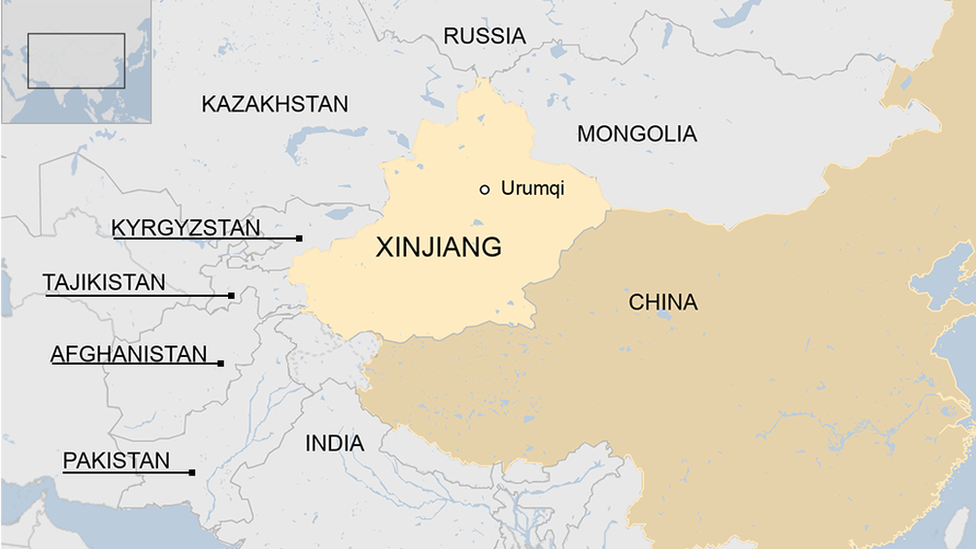
How has the CCP used "Sinicization" to change the demographics of Xinjiang since 1949?
In 1949, Uyghurs (a Turkic-speaking, predominantly Muslim ethnic group) made up ~76% of Xinjiang's population, while Han Chinese were only ~6%. Through state-backed migration and new railway links, Beijing has diluted the local population so that Han Chinese now make up roughly 40–42% of Xinjiang ("Chinese-ifying" the region).
Turkic refers to a massive, broad family of languages and ethnic groups spread across Eurasia—from Eastern Europe to Siberia and Western China. This family includes Uyghurs, Kazakhs, Uzbeks, Kyrgyz, Tatars, and Turks.

What events led to the modern security crackdown in Xinjiang, and how has the CCP suppressed Uyghur culture and human rights?
Following separatist demands in the 1990s and deadly ethnic riots in 2009, the CCP launched a massive security crackdown (intensifying after 2017):
Detention: Roughly 1 million Uyghurs and other Muslim minorities have been detained in "re-education" and forced labour camps, and 600,000–800,000 children placed in state-run boarding schools.
Cultural Assimilation: Religious expressions such as wearing hijabs and long beards were banned, leaving people no free choice over how they live.
Surveillance & Human Rights: Reports cite violations of international humanitarian law (including exploitation and abuse in camps), alongside heavy security that keeps foreign journalists out.
How did forced labour in Xinjiang affect global supply chains and transnational corporations (TNCs) like H&M?
Because detainees in labour camps were used to pick Xinjiang's cotton (70%+ of China's supply), Western TNCs like H&M stopped sourcing cotton from the region in 2020–2021. In retaliation, Chinese consumers boycotted H&M and it was removed from major Chinese e-commerce platforms, severely damaging its operations in China.
How did Tibet lose its independence to China, and what happened in 1959?
Tibet functioned as an independent state from 1912 until 1951, when China’s People's Liberation Army (PLA) invaded and annexed it. Although China initially promised political and religious autonomy, it eroded these rights.
After a failed uprising in 1959, Tibet’s Buddhist spiritual leader, the Dalai Lama, along with tens of thousands of Tibetan refugees, escaped to India and set up a government-in-exile.
A government-in-exile is a political group that claims to be a country's legitimate government, even though it cannot exercise legal power in its home territory and operates from a foreign country instead

Why is Tibet known as the "Third Pole" or "Asia's Water Tower," and why does this matter geopolitically?
Tibet holds the largest reserve of freshwater and glacial ice outside the Arctic and Antarctic. Major Asian rivers—including the Yangtze, Yellow, Mekong, Indus, and Brahmaputra—originate here, giving China upstream control over water vital for agriculture and hydropower across South and Southeast Asia.

What key mineral resources does Tibet possess?
Tibet holds massive reserves of iron ore (1 billion tonnes), zinc/copper/lead (40 billion tonnes), and roughly 2.4 million tonnes of lithium—which is vital for global electrification, EV batteries, and green technology.
How has the CCP exerted ethnic political dominance in the Tibet Autonomous Region (TAR)?
By building high-altitude infrastructure (such as the Qinghai–Tibet Railway) to encourage Han Chinese migration and dilute the native Tibetan population, while restricting Tibetan Buddhism and the use of the Tibetan language in schools.
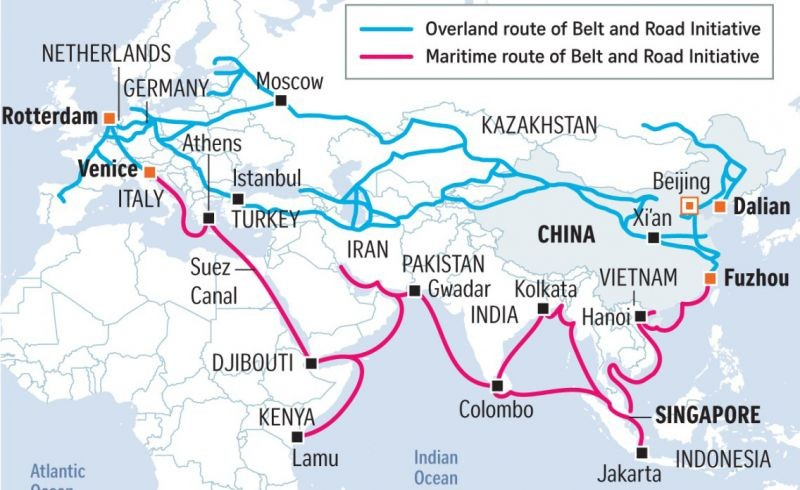
What is China’s Belt and Road Initiative (BRI)?
Launched in 2013 and often called the "Modern Silk Road," the BRI is a massive global infrastructure and trade strategy involving US$1 trillion to $3 trillion in planned investments across 70+ countries (now over 140 partners). It connects China with Central Asia, Europe, East Africa, and Southeast Asia via railways, pipelines, and maritime ports, aiming to make BRI economies account for roughly one-third of global GDP.

How does the BRI pose a threat to the sovereignty of participating countries ("Debt-Trap Diplomacy")?
Developing countries take large Chinese loans to build major infrastructure; when they struggle to repay the debt, Chinese government can extract strategic concessions, take over state assets, or pressure governments to align their foreign policy and UN votes with China (a form of geopolitical imperialism).
Explain the case study of Hambantota Port in Sri Lanka (2017).
Sri Lanka took heavy Chinese loans to build Hambantota Port, struggled to repay the debt, and in 2017 signed a 99-year lease handing control of the port and surrounding land to a Chinese state-owned company. This directly undermined Sri Lanka’s sovereignty and gave China a strategic foothold in the Indian Ocean.
A lease is a legally binding contract where an owner (lessor) grants another party (lessee or tenant) the right to use property, land, a vehicle, or equipment for a set period in exchange for payment
Why does the United Nations (UN) fail to take binding action against China over human rights abuses or territorial disputes?
Economic Leverage: Many countries rely on Chinese trade and Belt Road Initiative infrastructure loans, so they refuse to vote against China.
Security Council Veto: Even if a majority of nations pass a resolution in the UN General Assembly (which is non-binding), binding action requires the UN Security Council, where China is one of the 5 permanent members (P5) and holds veto power to block any resolution against itself.
Why does China claim Taiwan, and why is Taiwan diplomatically isolated (marginalized)?
When the CCP (Party) won the Chinese Civil War in 1949, the defeated Nationalist government fled to Taiwan, which operates with its own democratic government, constitution, and military. However, under its "One China" principle (which states that there is only one sovereign Chinese state: the PRC (Government)) and Taiwan belongs to it).
China views Taiwan as a breakaway province. In 1971 (UN Resolution 2758), the UN transferred China's seat from Taiwan to the PRC (Communist Party), and today almost no countries officially recognize Taiwan because China cuts off trade and diplomatic ties with any nation that does.
The One China principle is Chinas core diplomatic position that there is only one sovereign state under the name China, with the People’s Republic of China (PRC) as its sole legitimate government and Taiwan as an inalienable part of Chinese territory
diplomacy is how governments officially talk to each other, sign treaties, exchange ambassadors, and join international bodies

How does the CCP actively threaten Taiwan's sovereignty and territorial integrity?
China regularly sends military fighter jets and warships across the Median Line into Taiwan’s Air Defence Identification Zone (ADIZ) (averaging hundreds of incursions, up to ~260+/month at peak periods) and conducts large-scale military blockade drills around the island (such as in August 2022 and May 2024) as an intimidation strategy, operational preparation and strategic signalling of a potential future attack.
Why is the South China Sea economically and strategically important?
Global Trade: Covers over 3 million sq km and carries 20–30% of global sea trade; worth over $3.3 to $3.5 trillion annually, including ~60% of China’s own trade.
Oil & Gas: Holds roughly 11 billion barrels of untapped oil (plus huge natural gas reserves), and around 80% of China’s crude oil imports (carrying ~24 million barrels/day from the Persian Gulf to East Asia) pass through the South China Sea.
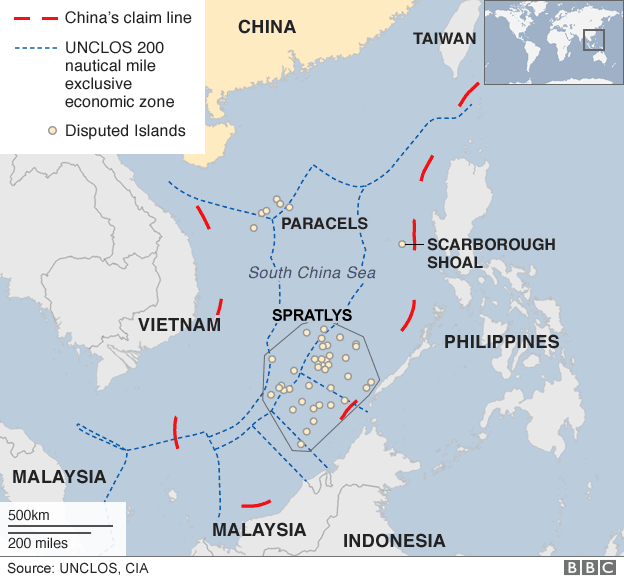
What is the "Nine-Dash Line," and which countries have overlapping claims in the South China Sea?
The Nine-Dash Line is a U-shaped boundary drawn on Chinese maps (originally introduced by the Republic of China in 1947) through which Beijing claims roughly 90% of the South China Sea. This illegally overlaps with the claims of 5 other states: the Philippines, Vietnam, Malaysia, Brunei, and Taiwan.
How has China physically altered the South China Sea to assert territorial control?
China has dredged sand and poured concrete onto tiny submerged reefs and coral atolls in the Spratly and Paracel Islands (such as Fiery Cross Reef, Subi Reef, and Mischief Reef) to build artificial islands complete with runways, radar stations, ports, and military bases.
What is UNCLOS (1982), and how does it apply to the South China Sea?
The United Nations Convention on the Law of the Sea (UNCLOS), signed in 1982, establishes that the seas are global commons owned by no one, while coastal states get an Exclusive Economic Zone (EEZ) extending ~370 km from their coastline where they control fishing and seabed resources (while foreign ships do not receive freedom of navigation).
What happened at the Permanent Court of Arbitration in 2016 regarding the South China Sea?
The Philippines took China to an international tribunal under UNCLOS due to the artificial islands. In 2016, the court ruled in favour of the Philippines, declaring China’s Nine-Dash Line had no legal basis and that artificial islands do not generate a 200-nautical-mile EEZ. China rejected the ruling and continues to ignore it.
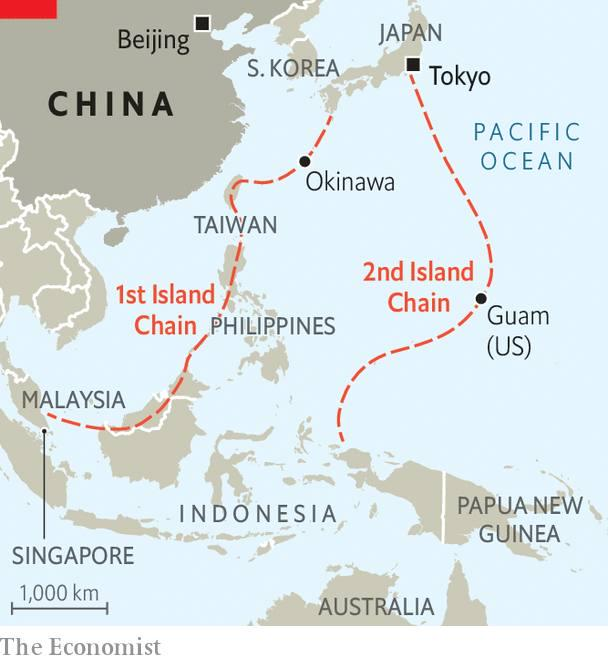
What is the "First Island Chain," and why does China view it as a strategic threat?
The First Island Chain is a string of US-allied territories off East Asia stretching from Japan through Taiwan and the Philippines down to Borneo (Island near Indonesia, the north of it is Brunei the country btw)
Because these islands sit directly off China’s coastline, Beijing feels "boxed in" and militarily contained by the US and its allies, motivating China to project naval power outward.
How have China, the Philippines, and the United States escalated tensions in the South China Sea?
Chinese Intimidation: Chinese Coast Guard ships routinely use water cannons and ramming tactics to block and damage Philippine fishing and supply vessels.
US–Philippines Response: The US committed $500 million in military defence funding to the Philippines, gained access to 4 new military bases there, and conducts regular joint "war games" (military exercises) and naval Freedom of Navigation Operations (FONOPs) with allies like Japan to prove the waters remain international.
Synthesize: How do China's threats to sovereignty originate from its desire for (1) Historical legitimacy, (2) Economic & resource security, and (3) Political / strategic security?
Historical legitimacy: China seeks to overcome its "Century of Humiliation" (1839–1949) by restoring what it views as its historical borders and asserting pre-1949 territorial claims over Taiwan, Tibet, Xinjiang, and the South China Sea.
Economic and resource security: Controlling trade corridors through the BRI and South China Sea alongside securing cotton, lithium, oil, and river headwaters in Xinjiang and Tibet, ensures China has the raw materials and export routes needed to sustain its economic growth.
Political / strategic security: Assimilating border regions and militarizing artificial islands creates defensive buffer zones that neutralize separatist movements and push back against US military containment along the First Island Chain.