3 - Instrumental Conditioning (NOT INCLUDING TEXTBOOK)
 Call Kai
 Learn
Learn Practice Test
 Spaced Repetition
 Match
Match Flashcards
 Knowt Play
1/83

There's no tags or description
Looks like no tags are added yet.
Name | Mastery | Learn | Test | Matching | Spaced | Call with Kai | Chat |
|---|
No analytics yet
Send a link to your students to track their progress
84 Terms
Chaining
Used to develop a sequence of desired behaviours; each correct response is reinforced with the chance to perform the next step in the sequence; step by step, a chain of responses is built leading to the final sequence of behaviours.
Continuous Reinforcement (CRF)
A reinforcer follows every correct response made by the individual.
Contrast Effects
Changes in the value of a reward lead to shifts in response rate; negative contrast: a response originally receiving a high reward is shifted to a lower reward, resulting in reduced responding; positive contrast: a response originally receiving a low reward is shifted to a higher reward, resulting in increased responding.
Cumulative Recorder
Records the cumulative response rate during an instrumental conditioning experiment.
Discriminative Stimuli
A signal to the organism when a given response-reinforcer relationship is valid; can indicate either the presence (S+) or absence (S−) of the relationship.
Fixed Interval (FI) Schedule
The first correct response that occurs after a fixed interval of time is reinforced.
Fixed Ratio (FR) Schedule
Reinforcement follows after a fixed number of responses.
Law of Effect
A response followed by a satisfying effect is strengthened and likely to occur again in that situation; a response followed by an unsatisfying effect is weakened and less likely to occur again in that situation.
Mirror Neuron
A cell that responds in the same way when performing an action as it does when the organism possessing that cell observes someone else perform the action or even imagines performing the action; believed to play a key role in observational learning.
Operant Chamber
Also referred to as a Skinner Box; a special chamber with a lever or other mechanism by which an animal could respond to produce a reinforcer.
Overjustification Effect
A newly introduced reward for a previously unrewarded task can alter an individual’s perception of that task; a task previously regarded as having intrinsic value (an activity pursued because it is, in and of itself, rewarding) becomes viewed as work with extrinsic value (an activity undertaken only because it leads to reward coming from other sources).
Partial Reinforcement (PRF)
The reinforcer follows only some of the responses.
Post-Reinforcement Pause
A period during which the organism momentarily stops responding before starting up again; occurs after reinforcement on a fixed ratio schedule.
Primary Reinforcer
A reinforcer with intrinsic value, such as food, water, or a mate.
Secondary Reinforcer
A reinforcer that can be exchanged for a primary reinforcer; money is the most commonly used for humans.
Shaping
Used when a desired behaviour is too complex for a subject to discover on their own in a single step; the behaviour is broken down into smaller, easier steps, eventually leading to the more complex behaviour.
Variable Interval (VI) Schedule
Reinforcement follows the first correct response to occur after a variable interval of time has passed; the average time required characterizes a particular VI schedule.
Variable Ratio (VR) Schedule
Reinforcement follows after a variable number of responses have been completed; the average number of responses required characterizes a particular VR schedule.
instrumental conditioning
learning a contingency b/w a behaviour and a consequence
Thorndike’s experiment
placed a hungry cat in a box with food outside
only way the cat could escape was by pulling a rope
Thorndike hypothesized that as trials went on, the cat would get progressively faster at escaping
stamped in
favourable behaviours are “stamped in” because they are followed by favourable consequences
stamped out
unfavourable behaviours are “stamped out” because they did not lead to favourable consequences
Law of Effect
behaviours w/ positive consequences are stamped in
behaviours w/ negative consequences are stamped out
classical vs instrumental conditioning
instrumental conditioning considers overt behaviours that are operated by an actor, leading to a reinforcer
instrumental conditioning is also referred to as
operant conditioning
reinforcer
any stimulus that is presented after a response that impacts the frequency that the response is performed at
reward training
presentation of a positive reinforcer
leads to increase in behaviour
punishment training
presentation of a negative reinforcer
leads to decrease in behaviour
omission training
removal of a positive reinforcer
leads to decrease in behaviour
escape training
removal of a negative reinforcer
leads to an increase in behaviour
e.g. child is forced to do the dishes daily, but told if they do their homework every day, they can skip the chore on the weekend
to have the best effect on the behaviour, a reinforcer should be presented/removed when?
directly after
the response rate for a given behaviour can be visualized using a ________ _______
cumulative recorder
auto shaping
learning without direct guidance
e.g. if you put a pigeon in a cage, and every time it pecks the keyhole a seed gets released, the pigeon will eventually realize the contingency w/o any guidance
shaping by successive approximation
used for behaviours that are too complex to be autoshaped
smaller approximations that eventually build up to the full response
chaining
technique used to develop a sequence of behaviours
each behaviour is reinforced w/ the opportunity to perform the next behaviour in a sequence
e.g. learning the alphabet → each letter informed you of what letter came next
in shaping by successive approximation, a behaviour is reinforced only if it is a closer approximation of the desired final behaviour than the behaviour last reinforced. This is also thought as reinforcing on the basis of __________.
improvement
Chaining reinforces the behaviour so long as it is performed in a defined ____.
order
discriminative stimulus (SD/S+)
a contingency is valid
e.g. environment of parents home becomes an SD for vegetable eating behaviour (for a girl who is rewarded w/ dessert every time she eats her vegetables at her parents house)
Sδ/S-
a contingency is not valid
e.g. environment of grandparents home becomes an Sδ for vegetable eating behaviour (the girl will learn that under these conditions, eating vegetables will not lead to a dessert reward)
SD generalization gradient
literally same thing as the generalization gradient in classical conditioning
when the SD and Sδ are in the same modality (e.g. colours of light or tones), introduction of training w/ an Sδ leads to better stimulus _________ and fine tuning of behaviour that is more sharply directed to the SD.
discrimination
CS+ vs SD
CS+: paired w/ US and elicits a response reflexively
response is involuntary + automatic
SD: paired w/ response reinforcer outcome; SD DOES NOT reflexively elicit the response
SD sets the occasion for a voluntary response
CS- vs S-
CS-: presents the absence of the US
eventually leads to learning of an inhibitory response
S-: signifies that response reinforcer contingency is not valid
continuous reinforcement
a response leads to a reinforcer in every trial
partial reinforcement
a response leads to a reinforcer in some trials
ratio schedule of reinforcement
based on the # of responses made by a subject, which determines when reinforcement is given
e.g. the pigeon on an FR-1 schedule is rewarded with food for each pecking response
the pigeon on an FR-2 schedule is rewarded with food for every 10th pecking response
interval schedule of reinforcement
based on the time since the last response that was reinforced
e.g. the pigeon on an FI-1 min schedule is rewarded w/ food for the first pecking response after a 1-minute period. Over an hour, the pigeon has the potential to earn 60 food pellets
on the FI-10 min schedule is rewarded w/ food for the first pecking response after a 10-minute period. Over an hour, the pigeon has the potential to earn 6 food pellets.
ratio and interval schedules can be either ____ or ______
fixed, variable
fixed schedule
constant schedule
variable schedule
random schedule
e.g. for VR-10 schedule, the pigeon must peck an average of 10 times over all the trials to get the food, but each trial the pigeon doesn’t necessarily need to peck exactly 10 times
FR vs FI vs VR
F - fixed
R - ratio
I - interval
V - variable
4 basic schedules of reinforcement
fixed ratio (FR)
fixed interval (FI)
variable ratio (VR)
variable interval (VI)
ratio strain
caused by a stingy FR schedule (too many responses required for the reward, e.g. the pigeon needs to peck 500 times before they get the food…too many times)
subject will stop responding
pause and run pattern
type of cumulative record that participants placed on a fixed ratio schedule display
following reinforcement, the participant will pause with inactivity before beginning the next run of respondinga
a lack of motivation leads to procrastinating behaviour in a ____ ____ schedule
fixed ratio
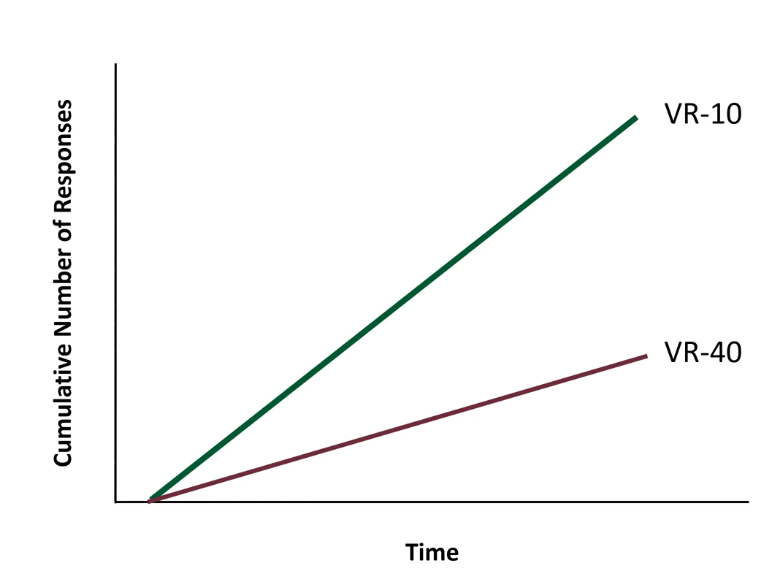
a cumulative record of responses reinforced on a variable ratio schedule looks like what?

a VR-10 schedule will have a ______ slope than a VR-40 schedule
steeper
fixed interval schedules produce a cumulative record with a characteristic _____ pattern. Following reinforcement, there is a ____ period, in which responding drops, then slowly starts picking up again and peaking just before the next reinforcement is scheduled to be delivered following a response
scallop, lull

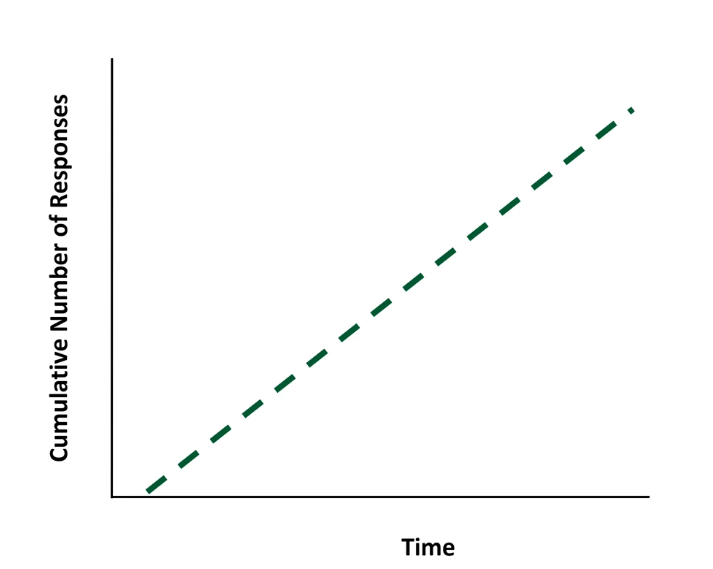
variable interval schedules produce a cumulative record with a very _____ rate
steady
learning is best on a _____ rather than continuous reinforcement schedule
partial
variable schedules are more resistant to extinction compared to ____ schedules
fixed
drug effects with repeated administration lead to ______
tolerance
if a drug is given to someone in the same vs different environment, how would the person react (compared to the control which is giving the drug in the same environment)? What about giving a mock drug?
same: drug would have same effect
different: drug would have more effect
mock drug: drug would have less effect
autoshaping
learning a simple behaviour without external guidance

overjustification effect
newly introduced reward for a previously unrewarded task (task was previously viewed as something that was rewarding in itself, but now is only regarded rewarding because there is an actual reward at the end)
3 ways to do instrumental conditioning
chaining
autoshaping
shaping by successive approximation