1.1 Nature of Economics
 Call Kai
 Learn
 Practice Test
 Spaced Repetition
 Match
 Flashcards
 Knowt Play
1/160

There's no tags or description
Looks like no tags are added yet.
161 Terms
What is economics, and why is it called a social science?
It uses scientific methods to study human behaviour and societies, focusing on the production, distribution and consumption of goods and services. It’s “social” because it studies people and their interactions.
Why is economics different from natural sciences like physics or chemistry?
It deals with complex human interactions influenced by countless variables, so behaviour is much harder to predict and control than physical or chemical reactions.
What is an economic model?
A simplified representation of economic reality, used to understand, explain and predict economic behaviour.
Why do economists use models?
Real economic situations are too complex to analyse in full, so models simplify them and make them manageable.
What is an assumption in economics?
A generalisation about behaviour that is made so a complex situation becomes manageable.
Give an example of a model that simplifies the whole economy.
The Circular Flow of Income. It reduces the economy to a few key agents (households, firms, government) and their interactions.
What does ceteris paribus mean?
A Latin phrase meaning “all other things being equal” or “all other factors held constant”.
What is the purpose of ceteris paribus?
It lets economists analyse a causal relationship between two variables without distortion from other changing factors.
Explain how ceteris paribus applies to the law of demand.
The law of demand says that as the price of a good falls, quantity demanded rises. This only holds if other factors, such as consumer income, tastes and the price of substitutes, stay unchanged.
Why is ceteris paribus a limitation of economic models?
In the real world, “other things” are rarely constant, so models may not match what actually happens.
Why can’t economists conduct laboratory-controlled experiments?
It is impossible to isolate and control all the variables affecting human economic behaviour in a real-world economy.
What do economists do instead of running controlled experiments?
They use the social scientific method.
What are the four steps of the social scientific method, in the order economists follow them?
Develop a hypothesis. Come up with a testable idea about how two things are related.
Conduct empirical research. Gather real-world data through observation, surveys and historical records.
Analyse the data. Look for patterns that support or contradict the hypothesis, often using ceteris paribus to isolate the relationship.
Draw conclusions. Decide whether the hypothesis is supported, then use it to build or refine the model.
What is empirical research, and what are three ways economists gather it?
Gathering data from the real world. Methods are observation, surveys and historical records.
Why are economic theories often open to debate?
Results can vary over time and between cultures, so theories are open to interpretation. Models are built on hypotheses that have been repeatedly tested through empirical research.
“The usefulness of a model depends on its assumptions.” Explain what this means.
If the assumptions are realistic, the model’s predictions are more reliable. If they are unrealistic, the model may give misleading results, so the model is only as good as its assumptions.
How can two economists look at the same data and reach different conclusions?
They may make different assumptions, which leads to different interpretations of the same data.
Evaluate: “Models are pointless because they are unrealistic.” Give one point for and one against.
For: simplifying and holding things constant means models can ignore real-world factors and be inaccurate.
Against: without simplification, the economy is too complex to analyse at all. Models help economists understand, explain and predict behaviour, and they can be refined through empirical testing.
A government wants to know the effect of cutting the price of train tickets. Explain how an economist would use ceteris paribus, and why the real world result might differ.
They would assume income, tastes and the price of substitutes like cars and buses stay the same, so any change in train use can be linked to the price cut. In reality, those other factors can change at the same time (for example, petrol prices rising or incomes falling), so the actual result may differ from the model’s prediction.
Why does the inability to run experiments make economics less certain than physics, and how do economists try to deal with it?
Variables can’t be isolated and controlled, so results are less precise and can change across time and cultures. Economists deal with it by testing hypotheses repeatedly with empirical research and using ceteris paribus when analysing data.
What is a positive economic statement?
An objective statement that describes “what is”, “what was” or “what will be” in the economy.
What are the two key features of positive statements?
They are based on empirical evidence (facts and data), and they can be tested or falsified, meaning proven true or false.
A positive statement can be wrong. Why is it still positive?
Being positive is about whether a statement can be tested against evidence, not whether it is correct. “The UK’s unemployment rate is 20%” is almost certainly false, but it is still positive because you can check it against data.
Why is “a rise in interest rates will lead to a fall in consumer spending” positive even though it is about the future?
It is a prediction that can be tested with evidence. Once interest rates rise, we can check the data to see whether spending fell.
What is a normative economic statement?
A subjective statement that expresses an opinion or value judgement about what ought to be.
What are the two key features of normative statements?
They are based on opinions, ethics, morals and beliefs, and they cannot be tested or proven false because they are a matter of debate.
Which of these is normative, and why?
(a) “The minimum wage rose by 5% this year.”
(b) “The minimum wage should be raised.”
(b) is normative. It says what should happen, which is an opinion. (a) is positive because it can be checked against data.
What are some words that often signal a normative statement?
Words like “should”, “ought”, “must”, “fair”, “unfair” and “better”. They show the speaker is giving an opinion on what ought to happen.
What is a value judgement?
A view about what is morally or subjectively important.
What is the link between value judgements and normative statements?
Value judgements underpin all normative statements. Every normative statement is built on someone’s view of what is important or right.
At what levels do value judgements influence economic decision-making? Give an example for each.
Individuals: choosing a job based on ethical values rather than just the salary.
Governments: prioritising spending on defence over welfare, or the other way round, based on political beliefs.
How do value judgements affect the goals of economic policy?
They determine what a policy is trying to achieve. For example, whether a government prioritises economic efficiency or equality is itself a value judgement.
(Links to 1.1.1) How does the social scientific method explain why positive statements can be tested but normative ones can’t?
The method involves developing a hypothesis, gathering empirical data and analysing it. A positive statement can be checked against real-world data, but a normative statement is an opinion about what ought to be, so there is no data that can prove it true or false.
(Links to 1.1.1) Why is a hypothesis a positive statement rather than a normative one?
A hypothesis is a testable claim about how variables are related, which is what positive statements are. It can be supported or rejected using empirical evidence.
(Links to 1.1.1) Why does ceteris paribus matter when testing positive statements?
Positive statements are tested with data, and in the real world many factors change at once. Ceteris paribus holds the other factors constant so the economist can isolate the effect of one variable on another and test the claim properly.
(Links to 1.1.1) Economists use models built on assumptions. Why might assumptions involve value judgements, and why is that a problem?
The assumptions an economist chooses can reflect their own beliefs about how people behave or what matters. Different economists may then reach different interpretations of the same data, which blurs the line between objective positive analysis and subjective opinion.
“Economics should be purely positive.” Evaluate this.
For: positive economics is objective and testable, so it is more reliable and less open to bias.
Against: economics is used to make policy decisions, and policy involves choices about what is important, such as equality versus efficiency. These need value judgements, so purely positive economics can’t tell us what we should do.
Why can’t economists settle a debate like “income inequality is unfair and must be reduced” using data alone?
It is a normative statement based on a value judgement about fairness. Data can show how large inequality is and what the effects of reducing it might be (positive), but it cannot prove whether inequality is unfair, because that depends on opinion.
How can positive economics help governments make normative decisions, even though it can’t make the decision for them?
Positive analysis provides evidence on the likely effects of a policy, such as how a tax cut would affect investment or inequality. The government then uses its value judgements to decide whether those effects are worth it. Evidence informs the decision, but values make it.
A newspaper says: “The government should cut taxes because it will boost growth.” Explain why this contains both a positive and a normative element.
“It will boost growth” is positive, because it can be tested against evidence. “The government should cut taxes” is normative, because it is an opinion about what ought to happen. Even if the growth claim is true, the conclusion also depends on a value judgement that growth is worth prioritising over other goals, such as equality or public services.
What is scarcity?
When there are finite resources (e.g. land, labour, capital) but infinite human wants and needs.
Why is scarcity called “the economic problem”?
Resources are limited but wants are unlimited, so not everything can be produced or consumed. Choices must be made about how to allocate limited resources between competing uses.
How does scarcity explain why economics exists?
Because of scarcity, choices have to be made. Economics is the study of how those choices are made.
(Links to 1.1.1) Why can scarcity be seen as a key assumption behind economic models?
Models need assumptions to make complex situations manageable. Assuming wants are infinite while resources are finite gives economists a simple starting point for analysing how choices are made.
What are factors of production?
The resources used to produce goods and services.
A baker buys a new oven for her bakery. Which factor of production is the oven, and what is the reward for owning it?
Capital, because it is a manufactured (man-made) resource. The reward for capital is interest.
A farmer rents out a field to a wind farm company. Which factor of production is the field, and what reward does the farmer receive?
Land, because it is a natural resource. The reward for land is rent.
A student takes a risk and starts her own tutoring agency. Which factor of production is she supplying, and what is her reward?
Enterprise, because she is taking risks to start a business. The reward for enterprise is profit.
Why is enterprise a different factor of production from labour, even when the same person does both jobs?
Labour is human effort and is rewarded with wages. Enterprise is the risk-taking involved in starting or expanding a business and is rewarded with profit. An owner who also works in the business supplies both, but they are separate roles with different rewards.
Why do all factors of production count as scarce resources?
There is only a limited supply of each one at any time, while wants are unlimited. That is why choices have to be made about how to use them.
What is opportunity cost?
The value of the next best alternative foregone when making an economic decision.
Why is opportunity cost described as the “real cost” of a choice?
It measures what you actually give up, the next most desirable good or service that could have been produced or consumed with the same resources, not just the money spent.
Consumer example: what is the opportunity cost of buying a new video game?
The cinema ticket you can no longer afford (the next best alternative you gave up).
Producer example: what is the opportunity cost of a firm using its factory to produce cars?
The bicycles it could have produced instead.
Government example: what is the opportunity cost of increased spending on healthcare?
Reduced spending available for other uses, such as education or defence.
A common mistake is to say opportunity cost is “everything you give up”. What is wrong with this?
Opportunity cost is only the value of the next best alternative, not every alternative you could have chosen.
(Links to 1.1.2) “Spending an extra £5bn on healthcare means £5bn less for education” is positive, but “the government should spend more on healthcare” is normative. Explain why.
The first can be checked against budget data, so it is positive. The second is an opinion about what ought to happen, based on a value judgement that healthcare matters more than other uses of the money, so it is normative.
What is a renewable resource? Give an example.
A resource that can be replenished over time, so its use can be sustainable. Examples are wind power, solar energy and forests.
What is a non-renewable resource? Give an example.
A resource that is finite and cannot be replenished once depleted. Examples are oil, coal and natural gas.
Why does using non-renewable resources involve a high opportunity cost for future generations?
Once used up, they are gone, so future generations cannot use them. What future generations give up is the benefit those resources would have provided.
Evaluate: “Renewable resources solve the problem of scarcity.”
For: they can be replenished, so their use can be sustainable and they reduce the opportunity cost for future generations.
Against: scarcity still exists because wants are infinite and the resources (and the land, labour and capital needed to harness them) are still limited. Using them still has an opportunity cost, and over-use, for example of forests, can still deplete them.
A government must choose between building a new hospital and a new railway line, using the same funds. Explain how scarcity and opportunity cost apply.
Scarcity means the government cannot afford to do everything, so it must choose. The opportunity cost of building the hospital is the railway line (the next best alternative), and the opportunity cost of the railway is the hospital. The choice also involves value judgements about which is more important, which links to normative statements (1.1.2).
Why does opportunity cost matter to consumers, producers and governments, even though they face different choices?
Because scarcity affects all three. Each has limited resources (income, factors of production, tax revenue), so every choice means giving something up. Considering the opportunity cost helps them judge whether a decision is worth it.
(Links to 1.1.1) Why can economists not test the opportunity cost of a decision using a controlled experiment, and how do they get around this?
It is impossible to isolate and control all the variables affecting real world choices, and you cannot do both options at once to compare them. Economists use the social scientific method instead (hypothesis, empirical research, data analysis, conclusions), often using ceteris paribus when analysing the data.
What is a production possibility frontier (PPF)?
A curve that shows the maximum potential output combinations of two goods or services an economy can achieve when all its resources are fully and efficiently employed.
What are the two goods usually shown on the axes of a PPF, and how do they differ?
Capital goods (e.g. machinery, tools) are used for future production. Consumer goods (e.g. phones, food) are for immediate consumption.
Can a PPF be used for goods other than capital and consumer goods? What do you assume if it isn’t specified?
Yes. It can show the trade-off between any two goods or services, such as healthcare vs education, or t-shirts vs butter. If it isn’t specified, assume the standard capital goods vs consumer goods model.

What does a point on the curve (A, B, C or D) represent?
A productively efficient output combination, where all resources are fully and efficiently used.

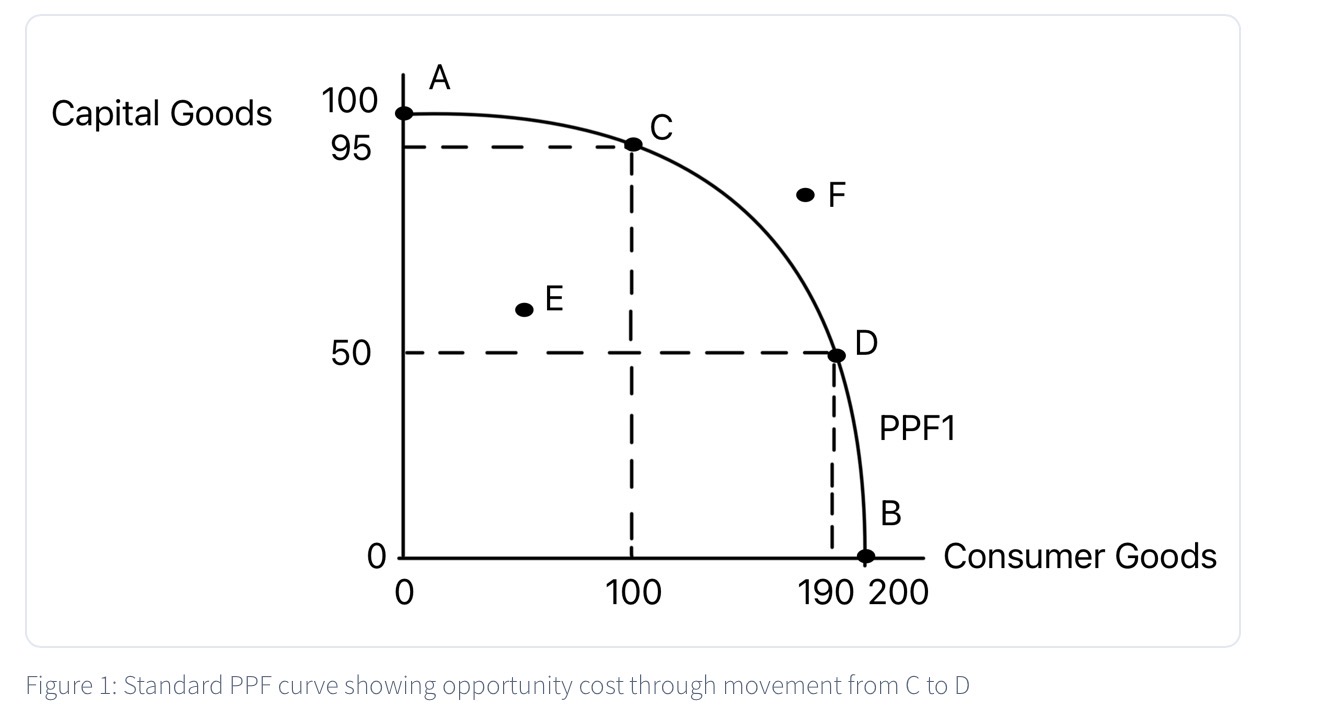
What does a point inside the curve (point E) represent?
Productive inefficiency and unemployed resources. The economy could produce more of both goods at zero opportunity cost.


What does a point outside the curve (point F) represent?
An output combination that is currently unattainable with the existing resources and technology.


Why can the economy produce more of both goods at zero opportunity cost when it is inside the PPF?
Some resources are unemployed or used inefficiently. Putting them to work lets output of both goods rise without giving anything up.

What is allocative efficiency?
When the economy produces the combination of goods and services that maximises society’s welfare.
Why can’t we identify the exact point of allocative efficiency on a PPF?
It depends on what society values most, which can’t be read from the diagram. We can only infer that it improves if the economy produces more of one good without reducing the production of the other.

With the move from E to C marked.
Explain why moving from E to C improves allocative efficiency.
Output of both goods increases, so society gets more of everything without giving anything up. That improves welfare.


Why does a point on the PPF not have to be allocatively efficient, even though it is productively efficient?
Productive efficiency only means resources are fully and efficiently used. A point on the curve might produce a combination society doesn’t want most, so it may not maximise welfare.
How does a PPF show opportunity cost?
To produce more of one good, the economy must give up some of the other. The amount given up is the opportunity cost.

Why is the PPF bowed outwards (concave to the origin)?
Not all resources are perfectly adaptable between different uses. This illustrates increasing opportunity cost.


What is increasing opportunity cost, and why does it happen as you move along the PPF?
Each extra unit of one good costs more units of the other. It happens because resources are better suited to one use than the other, so moving them to the less suitable use is less productive.


What does a movement along the PPF (e.g. C to D) show?
The opportunity cost of producing more of one good. To produce more consumer goods, the economy must sacrifice some capital goods.

With C and D marked. Using the diagram, what is the opportunity cost of moving from point C to point D?
Moving from C to D gives 90 more consumer goods (100 to 190) but loses 45 capital goods (95 to 50). The opportunity cost of the extra consumer goods is 45 capital goods.


Using Figure 1, what is the opportunity cost of moving from point A to point C?
The loss of 5 capital goods (100 to 95), in return for 100 more consumer goods (0 to 100).


Using Figure 1, what does it mean to say the opportunity cost of producing at point A is 200 consumer goods?
Opportunity cost can be expressed at a single point. At point A, all resources go to capital goods, so the economy gives up the 200 consumer goods it could have produced instead.

(Links to 1.1.3) How does the PPF show both scarcity and opportunity cost?
Scarcity: the economy can’t go beyond the curve because resources are limited. Opportunity cost: because of that limit, producing more of one good means giving up the next best alternative, some of the other.

What is the difference between a movement along the PPF and a shift of the PPF?
A movement along the curve is caused by reallocating existing resources. A shift of the whole curve is caused by a change in the economy’s productive potential.


What does an outward shift of the PPF represent?
Economic growth, an increase in productive potential.


What are the two types of cause of an outward shift of the PPF? Give an example of each.
What are the two types of cause of an outward shift of the PPF? Give an example of each.


What does an inward shift of the PPF represent?
Economic decline, a reduction in productive potential.
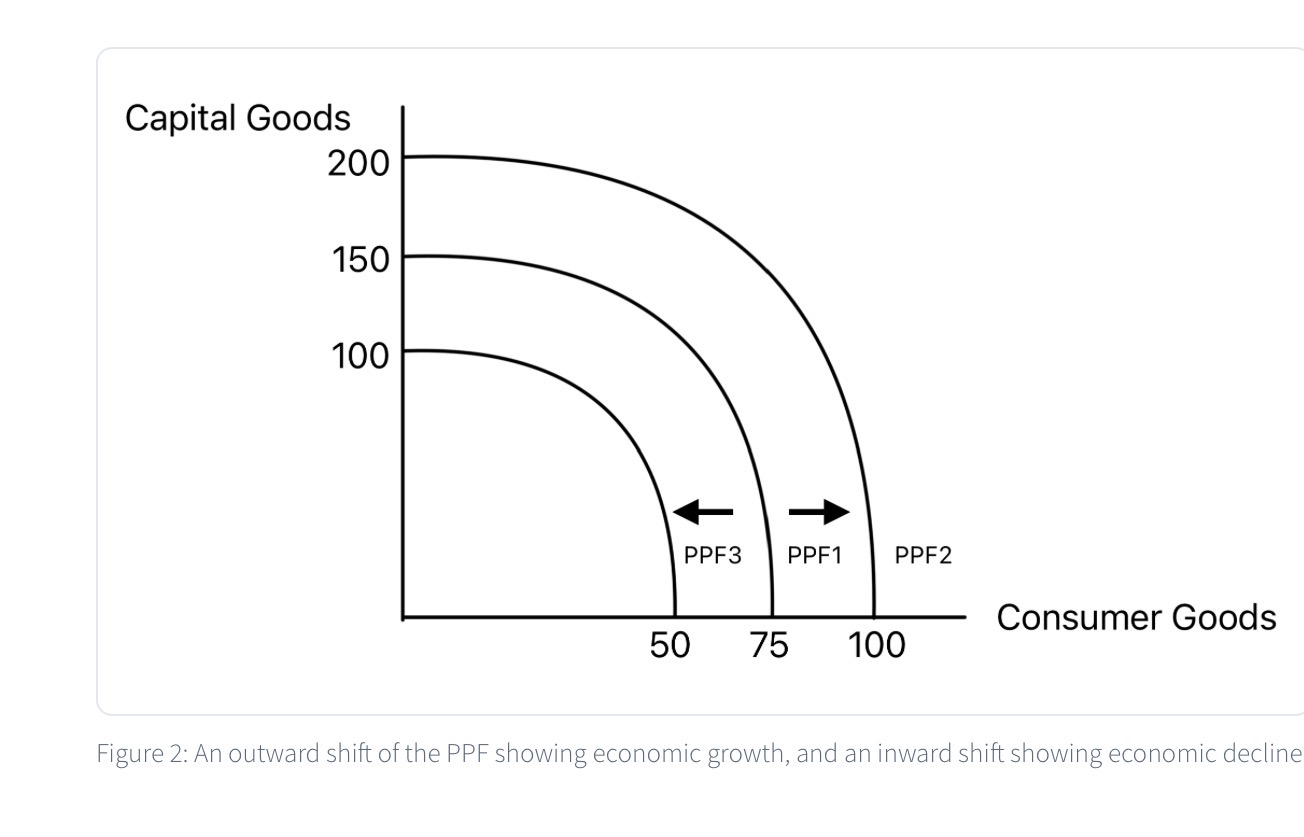

Give three causes of an inward shift of the PPF.
Natural disasters (e.g. a tsunami destroying capital), war or conflict, and widespread long-term unemployment that causes skills to deteriorate (“scarring”).


Why does long term unemployment cause an inward shift rather than just a move inside the PPF?
Short-term unemployment means resources are idle, which is a point inside the curve. Long-term unemployment causes workers’ skills to deteriorate, which permanently reduces the quality of labour and so the economy’s productive potential.

(Links to 1.1.3) Which factors of production are affected in each of these cases: immigration, a tsunami, better training?
Immigration increases the quantity of labour. A tsunami destroys capital (and may damage land). Better training improves the quality of labour.
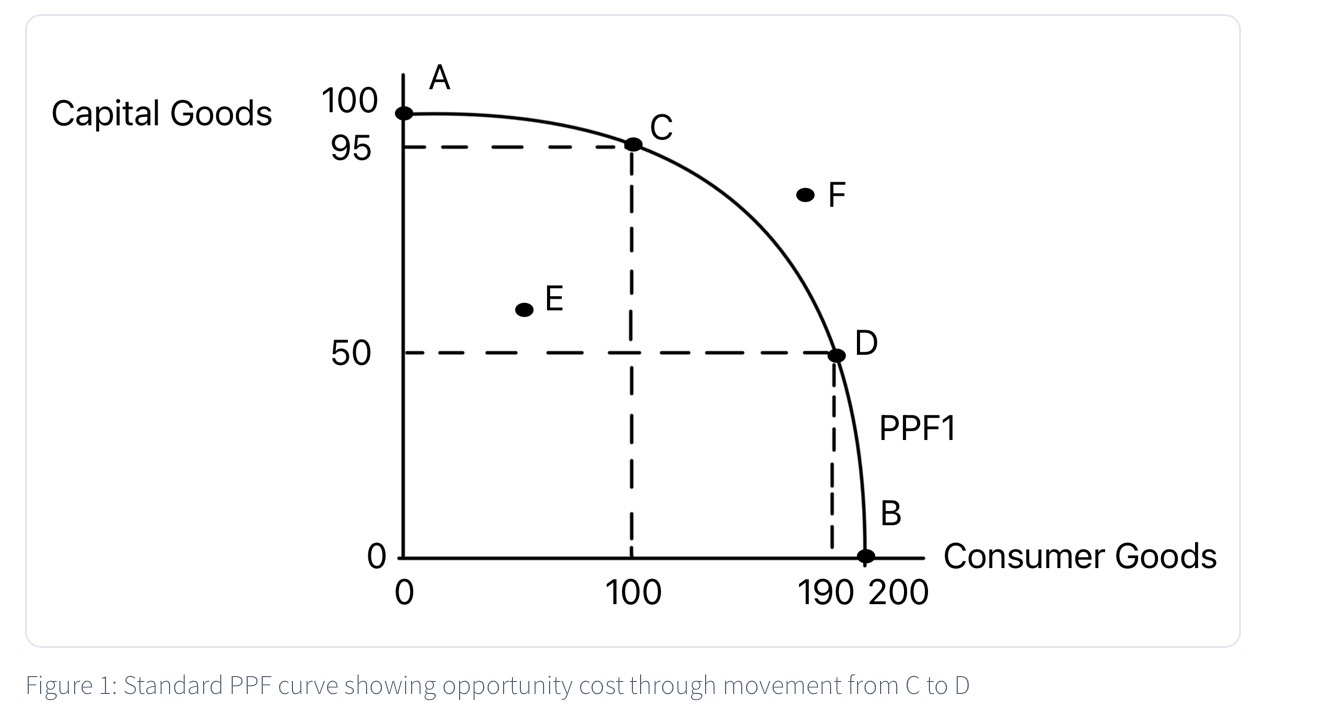
With points C, D and E. An economy moves from point E to point D. Explain what has happened to efficiency and opportunity cost.
The economy has moved from productive inefficiency to productive efficiency by using unemployed resources. Output of both goods can rise at zero opportunity cost at first, as long as the economy remains inside the PPF. Once it reaches the curve, producing more of one good requires giving up some of the other.

Evaluate: “A country on its PPF is better off than a country inside its PPF.”
For: it uses all its resources fully and efficiently, so it produces more output.
Against: it may not be producing the combination society values most, so it may not be allocatively efficient. A country inside might have a better mix, and what matters for welfare also depends on value judgements (see 1.1.2).

Explain how a government could cause an outward shift of the PPF.
It could invest in education and training (improving labour quality), fund research and technology (improving capital quality), or increase the quantity of factors, for example through policies encouraging immigration. All of these increase productive potential.
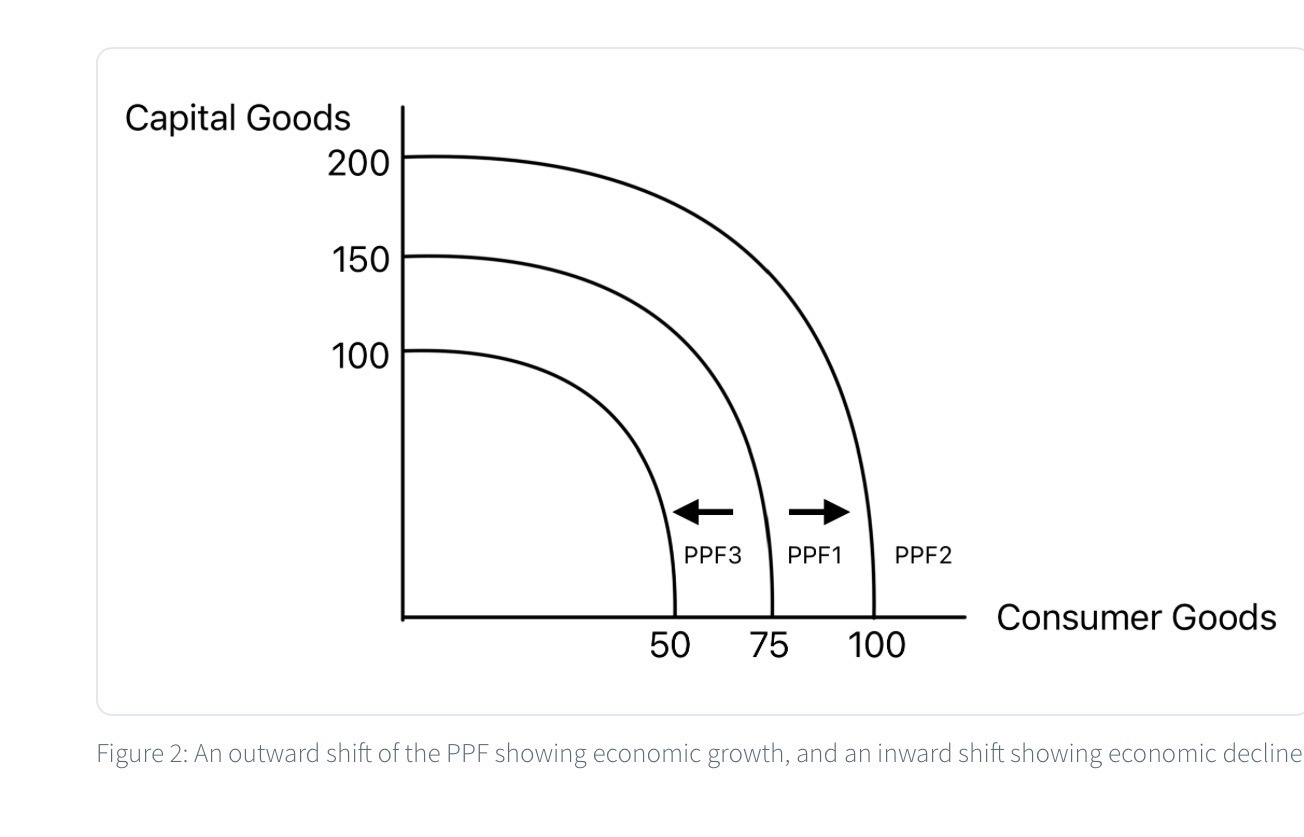

(Links to 1.1.1) Why is the PPF a model, and what assumptions does it rely on?
It simplifies a complex economy into two goods, so it is a simplified representation of reality. It assumes resources are fully and efficiently employed on the curve and that technology and resources are fixed unless the curve shifts. Real economies produce many goods, so it can’t show every trade-off.

(Links to 1.1.2) “The government should produce more capital goods and fewer consumer goods.” Why is this normative, and how can the PPF still help?
It’s an opinion about what ought to happen, based on a value judgement about what matters (e.g. future growth over present consumption). The PPF can show the positive facts, such as how many consumer goods would be given up, but it can’t say whether that sacrifice is worth it.
What is specialisation?
When individuals, firms, regions or countries concentrate on producing a specific good or service.
What is the division of labour?
A form of specialisation where the production process is split into separate tasks, and each worker is assigned a specific, repetitive task. This lets the worker become highly skilled and efficient at that task.
What is the difference between specialisation and the division of labour?
Specialisation is the broad idea of concentrating on one good or service, and it can apply to individuals, firms, regions or countries. The division of labour is a specific form of it, where one production process is split into tasks and each worker does one repeatedly.
What example did Adam Smith use to show the benefits of the division of labour?
A pin factory. He showed that splitting production into specialised tasks drastically increases productivity (output per worker).
In Adam Smith’s pin factory, how much more productive was each specialised worker?
10 specialised workers could produce 48,000 pins a day (4,800 each), compared with fewer than 20 pins from one unspecialised worker. So each specialised worker was at least 240 times as productive.