Land (Correct)
 Call Kai
 Learn
 Practice Test
 Spaced Repetition
 Match
 Flashcards
 Knowt Play
1/109

There's no tags or description
Looks like no tags are added yet.
110 Terms
Difference between proprietary rights and personal rights
Proprietary rights: can be enforced by an action in rem (use or possession of the land can be recovered, holder of the right does not have to settle for damages if they are deprived of their right. Can be enforced against a third party.
Personal rights: can only be enforced by a personal action for damages if the right is breached. Personal rights will bind only the original parties to the right - no recourse against a 3P.
What are the rights that have proprietary status?
Freehold estate
leasehold estate
an easement
a mortgage
a restrictive covenant
an estate contract
a beneficial interest in a trust of land
A holder of such a right will have a right to occupy or use or restrict what can be done on the burdened land in some way
How do you find out if a piece of land is subject to a proprietary right?
Proprietary rights in land must be made apparent by registration if they are to bind a purchaser of subsequent rights in the same land
Meaning of estate
a proprietary right of possession
2 types which determine the length of time the right of possession can be enjoyed:
freehold
leasehold
Meaning of the freehold estate
This is known as a fee simple absolute in possession
A right of possession which lasts until the owner for the time being dies without heirs (without any blood relatives and without having disposed of it by will)
In possession denotes that the fee simple owner has a current right to use and enjoyment of the property. Physical possession is not necessary here and includes receiving rent if the property is let to a tenant under a lease
If the current owner dies without next of kin and without a will, the land is regarded as bona vacantia and the estate reverts to the crown
What is a leasehold estate?
This is also known as a term of years absolute/lease
This is an estate of certain duration
The leaseholder may grant a lease of a lesser duration out of their own leasehold, while still retaining the original lease = sub-lease
The residue of an estate after the granting of a lease = freehold reversion
If the grantor holds a leasehold estate the residue = leasehold reversion (when the lease ends, the right to physical possession of the land automatically reverts to the landlord)
Comparison table of freehold and leasehold estate

What is a commonhold?
This is a type of freehold created out of a freehold registered estate
Designed to meet the needs of owners of flats or apartments and other properties where the owners are interdependent on each other
There is a freehold owner in the form of a company called the commonhold association - owner of each flat is a member of the association. It is responsible for maintaining the communal areas of the building
What is an interest?
A proprietary right of limited use.
Does not give a right to possess the land in the way an estate does, rather it gives the interest holder the right to do something on the land or restrict what can be done on the land
Also known as incumbrances
What are the legal interests?
Mortgages
Easements granted for a term equivalent to a freehold or leasehold estate
Rights of entry
What are the equitable interests?
Restrictive covenants
Estate Covenants
Interests in a trust of land
Easements granted for an uncertain term
Meaning of mortgage
Legal interest
A bundle of rights (right to possess and sell the land in the event of default in the mortgage repayments) granted over property in exchange for a loan of money
Borrower grants the mortgage, not the lender
Meaning of easement
A proprietary right to use land which belongs to somebody else e.g. rights of way
Must be granted for a term equivalent to one of the legal estates to be a legal easement (if granted for an uncertain duration then it will only be an equitable easement)
Meaning of right of entry
Legal interest in land
A right of entry is either:
A right for a landlord to re-enter leased premises and end the leasehold estate in the event of tenant default or some other specified event occurring OR
A rentcharge owner’s right to hold the land if money owed is not paid. A rentcharge is a legal right to receive a periodic sum paid by the owner of the land.
Also known as a forfeiture clause
Meaning of restrictive covenant
A promise relating to the land which prevents a landowner from doing something on their land e.g. promise not to sell alcohol from the land
This is an equitable interest
Meaning of estate contract
A contractual right to a legal estate (whether freehold or leasehold)
There are different types:
A contract to buy land
a contract to grant a lease
an option to purchase land
a right of pre-emption
Meaning of interest in a trust of land
Beneficiaries have an equitable interest in the land under a trust
Why does the distinction between legal and equitable interests matter?
Remedies - when a legal interest is infringed the person would have a automatic right to damages under the common law and equitable remedies. When an equitable intrest is infringed, the person is not entitled to damages as a right, the remedies granted are at the discretion of the court
Enforcement of the interest against 3Ps
How can transfer of a freehold estate be achieved?
sale
will
gift
operation of law
What are the 3 stages of sale of a freehold?
exchange of contracts
completion of the deed
registration
What happens pre-exchange of contracts?
Buyer carries out searches of the public registers and confirm seller actually owns the land + find out about any proprietary rights which benefit or burden the land
What happens at the exchange of contracts
Seller and buyer enter into a binding contract in which they agree the price and other terms + buyer pays a deposit to the seller
All land contracts must comply with LP(MP)A 1989 s2:
Contract must be in writing
Contract must contain all the expressly agreed terms (either by being set out in the document or by referring to some other document, usually the Law Society standard conditions of sale are incorporated by reference)
Must be signed by both parties (this can be done electronically if agreed by the parties. Usually there is an exchange of contracts = 2 copies of the contract are drawn up. 1 copy is signed by the seller and the other by the buyer. To create a binding contract the parties then exchange their copies)
NOTE: the contract is voluntary and is not necessary to effect a legal transfer
Can a land contract be varied
Yes but any material term (any term that is essential to the nature of the contract) that is varied needs to be in accordance with LP(MP)A 1989 s2
What happens at the completion of the deed
This usually takes place some weeks after exchange of contracts or at the same time
deed = a written legal document
Requirements of a valid deed (LP(MP)A 1989 s1):
deed must be clear on the face of the document that it is intended to be a deed (done so by labelling the doc as a deed)
The deed must be validly executed
The deed must be delivered (this requires acknowledgement that a person entering into a deed intends to be formally bound by its provisions, this is done by dating the document)
How can it be validly executed?
Seller is an individual: deed must be signed by the seller in the presence of a witness. The witness needs to sign the deed to confirm that they have witnessed the signing of the deed by the individual entering into that deed = attesting
Seller is a registered company: several ways to execute deed:
2 directors signing
1 director and a witness signing
1 director and the co secretary signing
affixing the company seal
NO LEGAL REQUIREMENT FOR BUYER TO SIGN THE DEED
Normally a standard form of transfer deed is used (TR1)
The buyer also pays the seller the balance of the purchase money
Seller moves out of the property and hands keys to buyer
For unregistered land legal title passes at this point + triggers a legal requirement to register the land for the first time within 2 months of completion otherwise legal title will revert back to the seller
What happens at registration?
The buyer sends the completed deed to the Land Registry.
For RL legal title does not pass until registration has taken place.
Summary of transfer of the freehold estate

What is the effect of the land contract?
Passes on equitable interest in the land to the buyer = an estate contract
What are the types of estate contracts?
Contract to buy land = sale contract to record the terms of the agreement and to commit themselves to the purchase/sale
Contract for lease = this may be done prior to the grant of a lease to commit the landlord and tenant to enter into the lease in the future
Option agreement = gives another party a right during the option period to serve notice that they wish to buy the land. If the notice is served during the option period, the seller must sell the land to the buyer but the buyer is not obliged to exercise to option and buy the land
right of pre-emption = gives another party a right of first refusal in the event the landowner decides to sell the land so the land owner cannot sell the land without first offering it to the party holding the right
failed legal estate/interests can be recognised as an estate contract = when parties fail to create a legal interest/estate the courts will recognise an equitable intrest in the land privided: there is a document that complies with LP(MP)A s2 and the remedy of specific performance is available
What is the enforceability of an estate contract?
Estate contracts are a proprietary right in land and are capable of binding and being specifically enforceable against 3Ps if it is protected
If the interest holder fails to protect the estate contract and the 3P is a donee (someone who is gifted or inherits the land) they will be bound by a properly created estate contract regardless of registration
Remedies for breach of a land contract
Common law
Damages - available as a right. The usual measure of damages is the loss which C has suffered as a result of the breach
Equitable remedies at the discretion of the court taking into account equitable principles (e.g. behaviour of both parties)
Specific performance - court order compelling the defaulting party to carry out positive contractual obligations including transferring the land to the buyer. Only available where, amongst other things, the contract is sufficiently certain, C is ready, willing and able to perform the contract and damages would be inadequate
Injunction - court order restraining somebody from doing something including breaching a contract by selling the land to someone else
What do 1 December 1990 and 1 April 1998 mean for compulsory registration of unregistered land?
1 Dec 1990: All of England and Wales became a compulsory registration area. A sale of unregistered land must be registered (first registration).
1 Apr 1998: Gifts and transfers on death (assent - meaning the personal representative passing inherited land to the beneficiary) also trigger first registration.
Do you have to register unregistered land just because you own it?
No. Registration is only required when a triggering event occurs:
Transfer of the freehold estate by sale, gift or court order
Grant of a lease for a term of more than 7 years
A first legal mortgage of the freehold or of a leasehold with more than 7 years to run
Assignment (transfer) of a lease of UL with more than 7 years to run
An assent, vesting assent or vesting deed which is a disposition of the freehold or a leasehold with more then 7 years to run
Grant of a lease to take effect in possession more than 3 months after the date of the grant
These apply to both RL and UL.
If UL the event triggers a requirement to register the land for the first time
If RL the event triggers a requirement to update the register
3 principles of land registration
Mirror principle
Register should reflect all matters that the property has the benefit of and all the matters that the property is subject to
Never fully realised due to the existence of overriding interests (intrest that does not appear on the register but will be binding on the owner of the legal estate and any buyer of it)
Curtain principle
Register records the ownership of the legal estate in the property, the legal title so any equitable/beneficial ownership is not on the register
Insurance principle
accuracy of register guaranteed by the state so if there is an error with the register it will be corrected and anyone who has suffered any loss will be compensated
what is the official copy
The Land Registry registered title documents and include the register of the title plan.
What are the 3 parts of the register?
Property register
a description of the land (address) by reference to the title plan
type of estate, freehold or leasehold
details of any rights (easements) that benefit the land
Proprietorship register
name and address of the registered proprietor of the land
details of any restrictions affecting the registered proprietor’s ability to deal with the land
class of title (see image)
Charges register
details of intrests the land is burdened by including details of any leases the land is subject to

what does the statutory definition of land include?
The surface; buildings or parts of buildings on the land; other corporeal hereditaments; and other incorporeal hereditaments
what are incorporeal hereditaments
benefits of any proprietary rights that the land has but which have no physical substance e.g. an easement
what are corporeal hereditaments
Physical things attached to the land = fixtures
What is the general rule regarding fixtures
Whatever is attached to the land becomes part of the land
What is the test for determining if an object is a fixture or chattel?
2 part test
(1) Degree of annexation test
How the object is fixed/attached to the land/building
The more firmly the object is fixed to the land or building, the more likely it is to be classed as a fixture (even if it is fairly easy to move)
if the object rests on the land by its own weight it is considered chattel
(2) Purpose of annexation test
why the object is attached to the land/building - was the annexation for the more convenient use or enjoyment of the chattel as a chattel or to enhance the land or building in some way
The degree of annexation test raises a presumption that the thing in question is or is not a fixture. the presumption can then be rebutted by objectively looking at the purpose.
Botham v TSB Bank provides some guidance to the status of household objects and shows that each object must be viewed on its own merits:
ornamental items, carptes and curtains, light fittings attached by screws, kitchen appliances (if not integrated and can be removed without causing damage) = chattel
kitchen units, items installed by a builder, bathroom fittings (bathtub etc) = fixtures
In practice:
conveyance of land includes all fixtures automatically unless specifically excluded in the contract
usually buyer and seller agree which items pss into sale by completing a Law Society fixtures and contents form (Form TA10) which forms part of contract

What right does a land owner have to the airspace
The right is restricted to such height as is necessary for the ordinary use and enjoyment of the land and the structures upon it
Above that height the owner has no greater rights than any other member of the public
Thus distinction between: upper airspace (no exact height from which this begins) and lower airspace (belongs to landowner)
If a structure overhangs your property so that it is in the lower airspace that is a trespass irrespective of whether damage is caused to your property
There is statutory immunity from trespass or nuisance for any innocent flight of aircraft
what right does the land owner have to the ground below?
A conveyance of land ordinarily carries with it all that is beneath the surface up to approx 300m except:
minerals (inc. gold and silver) = they belong to the Crown
treasure (meeting statutory definition of treasure) = belong to the Crown
coal = belongs to Coal Authority

½ Summary of the formality rules for creation and transfer of the estates and intrests in land

½ Summary of the formality rules for creation and transfer of the estates and intrests in land

How can a mortgage be a legal interest?
If granted by the legal owner over the legal estate
complies with formalities: deed + registration
when do you have an equitable mortgage?
mortgage of an equitable interest (this needs be only in writing and signed by the grantor in order to be valid)
defective legal mortgage (either not granted by a valid deed or not completed by registration BUT complies with LP(MP)A 1989 s2 (in writing, contains all the agreed terms and is signed by both mortgagor and mortgagee) it will be classes as a contract to grant a legal mortgage)
summary of formalities for legal and equitable mortgages

What is the legal date of redemption?
Date specified on which the borrower had to repay the loan in full in the mortgage deed, if payment not made in full by this time the borrower forfeited the property to the lender
What is the equitable right to redeem?
Allows the borrower to repay the loan at any time after the legal date of redeption has passed
What is the equity of redemption?
Bundle of rights which protect the borrower’s rights as owner and prevent exploitation by lender:
equitable right to redeem supplements legal right to redeem
No postponement or prevention of redemption
no collateral advantages
no unconscionable terms
Why is there no postponement or prevention of redemption
It is in the lender’s interest to keep the borrower on the hook for as long as possible and thus push back the legal date for redemption as far as possible as that date is the first day on which the loan can be repaid and the property can be taken back.
Courts will not allow a clause which prevents redemption altogether; lender may be allowed to postpone the date but there must be no clog or fetter on the equity of redemption
Why was postponement upheld in Knightsbridge but not in Fairclough?
Fairclough: estate was a leasehold which is a depreciating asset so the borrower could not get back exactly what it had mortgaged on redemption.
Knightsbridge: estate was freehold which is enduring and rarely loses value so the borrower would get back what they mortgaged on redemption; deal favoured borrower as they got something in return for the postponed redemption date

What is an option to purchase?
A mortgage may include an option for the lender to purchase the mortgaged property which is a proprietary right for the lender to require the borrower transfer the property to it as some point in the future
This is a clog on the equity of redemption and equity will strike such terms down, esp in domestic cases
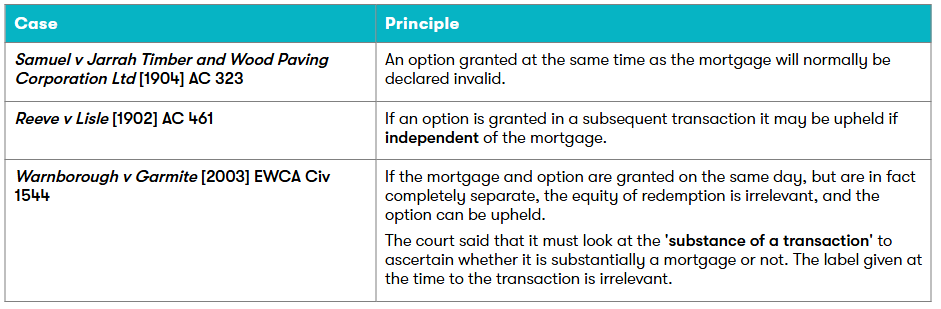
Effect of collateral damages
Lenders are entitled only to repayment of capital advanced plus interest.
A collateral advantage e.g. a lender trying to extract additional value from the borrower may be struck out as being contrary to the equity of redemption if it is unconscionable, in the nature of a penalty or if it is repugnant to the equitable right to redeem
what is a solus tie
Lender makes it a condition of the mortgage that the borrower buys all of its supplies from the lender (often seen where lenders are breweries or oil co)
As a general rule solus ties are upheld in commercial transactions if they end within the mortgage term

What can the court do with unconscionable terms in a mortgage agreement?
Strike them out but the term in question must be more than simply unfair or unreasonable:
If penalty interest rate imposed in the event of borrower default far exceeds the lender’s losses = void
higher interest rate can be justified if the borrowers have a poor credit history and are a credit risk
higher interest rate can be justified where the lender is in financial difficulties itself providing it is not exercising any discretion for an improper purpose

Types of undue influence (UI)
overt acts of improper pressure or coercion such as unlawful threats
situations where one party has influence or ascendancy over the other and the first party takes advantage of that influence/ ascendancy (underlying relationship is sufficient for UI to be exercised)
Situation where there is taking advantage of influence or ascendancy in a relationship
Husband (business owner) wants their spouse to enter into an agreement with the effect that the spouse’s share in the matrimonial home is used as security for a loan to the business owner’s business
If spouse has placed trust and confidence in the business owner and the business owner abuses it in seeking the spouse’s consent to the transaction by misrepresenting the nature of the transaction = UI
Influence can come from either the trust placed in one another or if one party is very vulnerable or dependent thus allowing one person to have significant influence even if one party has not positively placed trust or confidence in the other party
in which relationships is there an irrebuttable presumption that one party has an influence over the other
parent and child
guardian and ward
trustee and beneficiary
solicitor and client
doctor and patient
How does a party prove it has been the victim of UI
Must show:
a relationship of trust and confidence (or one of the relationships with irrebuttable presumption of influence) AND
a transaction which requires and explanation = a transaction which does not fit with what would be expected in the relationship concerned e.g. a suspicious type of transaction or suspiciously high in value
A husband offering their interest in the matrimonial home as security for a loan to their spouse’s business is not a transaction requiring explanation - person alleging UI needs to prove that unfair advantage was taken of the relationship
what happens when UI is proved?
A contract or gift by deed may be set aside (this is discretionary to the court) - Court may not allow this when the innocent party delayed in making claim or C’s conduct has been underhand
The mortgage deed will be unenforceable against the spouse which proved UI so the spouse’s interest would still rank ahead of the lender’s
When is a bank put on enquiry for risk of UI?
whenever one party in a non-commercial setting is standing as surety for the other party
Lender not put on inquiry of EI if the purpose of the loan is for the joint benefit of the co-owners
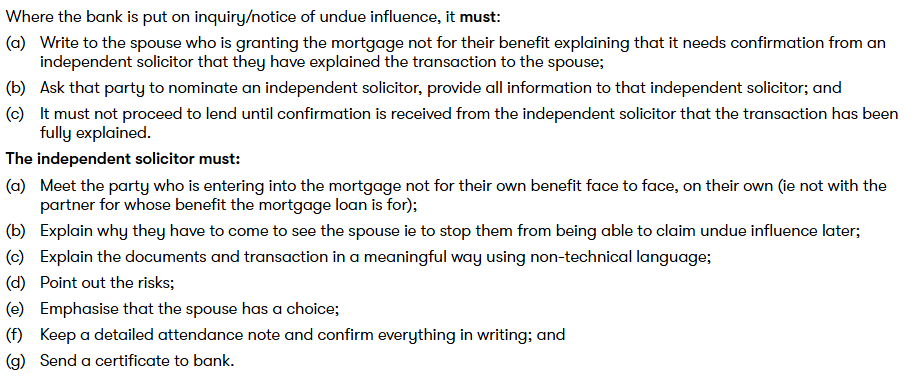
If the bank is put on inquiry of UI it must follow the guidelines laid down in Etridge - if it does this the bank is protected from future claims of UI
What are the Etridge guidelines
what does priority between registered charges depend upon?
The order in which they are entered on to the register regardless of the order in which the mortgage deeds may have been signed
When 2 or more are created at the same time the application for registration will specify the order of priority
what does priority between equitable charges depend upon?
The order of creation
What is the effect of a notice on the charges register as to priority?
Protects an equitable mortgage by making it take priority over a subsequent legal mortgage (not an equitable mortgage - the usual rule still applies)
An equitable mortgage not protected by a notice will not take priority to a subsequent registrable disposition of wither a registered estate or registered charge: 1. A owns RL and borrows from Bank A which takes and equitable mortgage. Bank A does not put notice in the register. 2. A sells land to B for value + registered as new owner 3. B takes land free of Bank A’s equitable mortgage because no notice. Bank A has only a personal claim against A
what is postponement in regards to priority?
Lenders agree to alter the position that would apply according to the priority rules by entering a deed of priority or intercreditor deed which is then registered at the Land Registry
Mortgagees will also require an express waiver or postponement to be included in a mortgage agreemnt so that the rights of any person living at the mortgaged property with the mortgagor are postponed to the intrests of the mortgagee (can enforce security and take posession in event of default)
Rights of an equitable mortgagee
debt action under the mortgage contract for money owed
application for foreclosure
appointing a reciever
Rights of an legal mortgagee
sue on the contract for the outstanding debt
repossess the property
sell it
appoint a reciever
forecolsure
What is a debt action
personal action against borrower
rarely used because if borrower can’t make repayments how can it pay out on claim thus often used in addition to other remedies
has been used if there is negative equity - lender may take possession of and sell the property but if the sale proceeds do not cover the outsanding debt the lender may cliam the shortfall
right to take possession
precursor to sale - enables the lender to offer the propety for sale with vacant possession
in residential cases possession must be a last resort and lender must explore altrentives like extend mortgage term or schedule new payment plan
right to sale
Borrower loses all rights to the property and sale proceeds applied to the outstanding debt
any surplus forwarded to the borrower
any shortfall and borrower may be sued personally
right to a receiver
Receiver acts as a manager of the mortgaged property and is used by the lender as an alternative to seeking possession where a property needs management e.g. dealing with tenant issues or finalising any development of the mortgage land
They get an income from the property before sale and will apply any income towards the outstanding mortgage debt
This is the borrower’s agent and the lender is not liable for the reciever’s negligence
A receiver must act with due diligence, subject always to the main duty of paying off the mortgage debt
right to foreclosure
Rare
It allows a lender to take the mortgaged property in satisfaction of the debt so the freehold will vest in the lender
Lender’s right to possess
Arises as soon as the mortgage is granted = a right of the lender
Mortgage deeds often include a term which recognises that the right to possess is postponed for as long as the borrower pays the agreed instalments
Not necessary to obtain a court order prior to taking possession but it is a criminal offence to use or threaten violence for the purpose of gaining entry to property
Pre-Action Protocol for Possession Claims 2008 sets out the steps which a court will expect a lender to have taken before resulting in possession of residential property. If they fail to do so they can suffer delays in obtaining possession and may have to pay the borrower’s legal costs
Court has a statutory jurisdiction to postpone possession proceedings in cases involving a ‘dwelling house’ to allow the borrower time to remedy any default or discharge the loan
s36 AJA 1970 statutory jurisdiction to postpone the lender’s right to possess
Under s 36, the court can postpone possession if:
The mortgage is over land that consists of or includes a dwelling-house (residential property).
The lender has brought court proceedings seeking possession.
The court considers that the borrower is likely to be able to pay the sums due within a reasonable period = the remainder of the mortgage term (ongoing monthly mortgage instalments; and the arrears, usually through additional payments over time)
If the conditions are met, the court can:
Adjourn the possession proceedings — postpone the hearing to a later date.
Stay or postpone execution of a possession order — delay the enforcement of an existing order requiring the borrower to leave.
Postpone the date for possession — allow the borrower to remain in the property for a further period.
The court cannot…
Prevent the lender from obtaining possession altogether
Postpone possession if no possession order has been applied for
Prevent a lender from exercising a power of sale without first obtaining a court order
The property must be wholly or partly residential, but it does not necessarily have to be the borrower's own home.

Key considerations for the lender’s right to sell
This is a right so no court order is needed
The power of sale must: exist, have arisen and become exercisable
Lender’s right to sell: does it exist?
Most mortgage docs will include an express power of sale and will set out exactly how and when the power will be exercised
In the absence of express power a right to sell can be implied into a legal mortgage under LPA 1925 s101(1)(i)
Lender’s statutory right to sell: when does it arise?
Arises when the mortgage money has become due
capital and interest repayment mortgage = power of sale arises as soon as one portion of capital is due meaning that it arises as soon as one payment is due regardless of whether it is actually paid
interest only mortgage = the capital is not due until the end of the loan term. Mortgage money becomes due at the legal redemption date usually 6 months from the start of mortgage
If lender sells after the power has arisen but before it is exercisable, a sale to an innocent purchaser will be valid but lender will be liable in damages to the borrower
Lender’s statutory right to sell: when is it exercisable?
When the right to sell has been expressly conferred, the wording will set out in what circumstances the power can then be exercised
If the power arises under LPA 1925 s101(1)(i) the power will become exercisable only when at least one of the criteria in s103 applies

Lender’s duties when exercising the right to sell
After the sale the lender is trustee of the surplus proceeds of sale and must hand them to the person next entitled (whether another lender or the borrower)

dominant vs servient tenement
dominant tenement = the land which is benefitted by the easement. The person who receives the benefit is the grantee
servient tenement = land which is burdened by the easement. The person who grants the easement is the grantor
when is an easement legal vs equitable?
Legal = if the duration of the right is equivalent to one of the two legal estate - freehold or leasehold
Equitable = when an easement is not granted for the duration equivalent to a freehold or leasehold estate
what is a positive vs negative easement?
Positive = allow the holder to use the servient land in a particular way
Negative = rare - don’t involve entering the neighbouring land as the right conferred can be enjoyed from the holder’s land e.g. right to light
How are easements different from quasi easements
Quasi-easements = benefits enjoyed over one’s own land
They can become easements if the land is ever partitioned
How are easements different from public rights
Public rights are not exercised by an individual or particular body, the right by its nature is exercised by the general public
How are easements different from licences
Licence can authorise somebody to use land in the same way as an easement
However a licence is not a proprietary right, it is only personal and cannot be enforced against a 3P
How are easements different from profits a prendre
Profits a prendre = confers on the holder the right to take anything, such as produce, animals, fish or minerals from the land
Easements do not
How are easements different from restrictive covenant
easement = servient owner cannot do anything on the servient land which would interfere with the right
restrictive covenant = restrict what is to be done on the servient land and is to promise to not do something on the burdened land
difference between grant and reservations of easements
Grant = where a landowner sells or leases part of their land and gives the buyer/tenant an easement over the land which they have retained
Reservation = where a landowner sells or leases part of their land to a buyer/tenant and retains a right over the land sold or leased. This is strictly construed against the person reserving it and any attempt by the seller/landlord to extend the right will fail

what are the 3 ways an easement may be created?
expressly
impliedly
by prescription
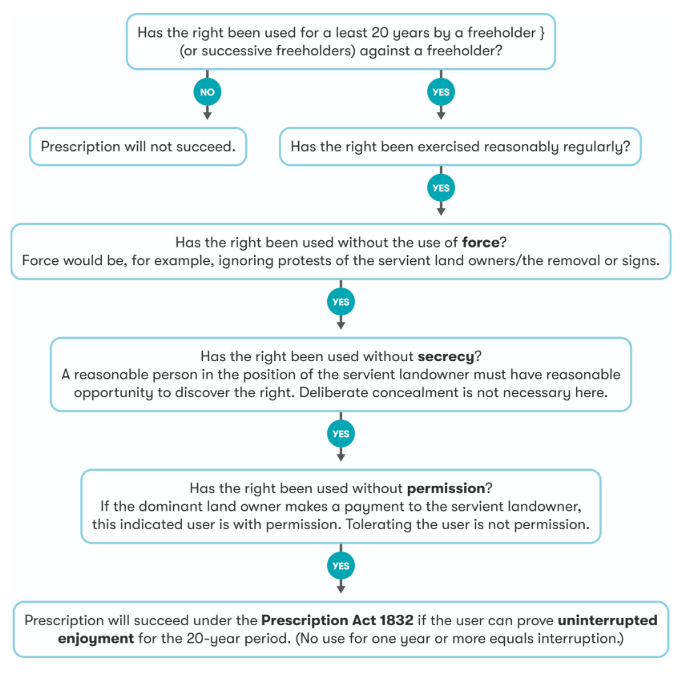
how is an easement acquired by prescription?
Easements acquired by prescription are legal easements.
Prescription = an easement where it has been been exercised over land for a long time (at least 20 years) yet no express grant or reservation can be traced
3 types of prescription:
prescription at common law
prescription under the doctrine of Lost Modern Grant
Prescription Act 1832 - success if the user can prove uninterrupted enjoyment for the 20-year period (no use for 1 year or more = interruption)
For all types the basic criterion is:
1. continuous user = reasonably regular use by a freeholder or successive freehold owners against a freeholder
2. as a right = right must be used without force, without secrecy and without permission
force = ignoring signs that prohibit the use or ignoring the protests of the servient landowners
without secrecy = a reasonable person in the position of the servient landowner must have reasonable opportunity to discover the right
permission = e.g. if the dominant landowner makes payment to the servient landowner for the use. Tolerating the user is not permission
Criteria for a right to be an easement
1. Right must be capable in principle of being an easement
Test in re Ellenborough Park
2. Right must not be prevented from being an easement by the presence of one of the disqualifying factors
additional compulsory expenditure by the servient owner, use which amounts to exclusive possession, permission
3. The right must have been acquired as an easement. This is done is 3 ways:
by complying with the statutory formalities for an express grant or reservation
by one of the recognised methods of implied acquisition
by prescription

Easements: capability (re Ellenborough Park)
There must be a dominant and servient tenement
2 different pieces of land: one which benefits from the exercise of the right (the dominant tenement) and one which is burdened by its exercise (the servient tenement)
The right must accommodate the dominant tenement
the right must have some direct beneficial impact on the dominant tenement
Qs: (i) does the right benefit any owner of the land? (ii) does it cease to be of use once the dominant owner has parted with the land? (iii) does the right make the dominant land a better or more convenient property? (iv) does the right add value or amenity to the dominant land?
Rule to decide whether a right benefits the land itself or simply benefits a business from that land: question to ask is whether the business is a necessary incident to the use of the land, or is a completely unconnected business. If there is a nexus between the land and the business run from the land, a right that benefits that business will also benefit the land.
Hill v Tupper: right claimed was a right to put boats on a canal which adjoined C’s land. The right did not accommodate the dominant tenement as it did not benefit the land itself: it simply benefited the business which C carried on the land
Moody v Steggles: a right to hang a sign on an adjoining building which pointed down a side-street to C’s pub was an easement. The sign benefitted a long-established business which had become normal use of that land
the dominant and servient land must be sufficiently proximate to each other = normally they would be next to each other but this need not be the case.
There must be diversity of ownership
the dominant and servient land must be owned by different people
an owner cannot claim an easement over his own land as this would be a quasi easement
if the dominant and servient land ever come back into common ownership, any easement enjoyed by would be extinguished
The right must lie in grant
Right must be capable of forming the subject matter of a deed
The right must be:
Granted by a capable grantor to a capable grantee = person who grants the right must have the power to do so, they must be over 18 and own the legal estate.
Capable of reasonably exact description = nature and extent of the right must be clear enough for the court to know exactly what is to be enforced, by reference to a plan for example
judicially recognised = right should be within the general nature of rights traditionally recognised as easements:
right of way
right of drainage and other rights through pipeline
right of support
right to use sporting and leisure purposes
right of storage
right to park
The list of easements is not exhaustive but a new easement recognised cannot be negative in nature

Easements: disqualifying factors
1. The exercise of the right must not amount to exclusive possession of the servient tenement
Where the servient owner cannot use the servient land at all (exclusive possession) the claim for an easement will fail
2 tests for what amounts to exclusive possession: (a) ouster principle/ reasonable use = looks at the degree of use left; (b) possession and control = asks whether the servient owner retains ultimate possession and control of the servient land, subject to the reasonable exercise of the right
(a) Batchelor v Marlow: M had a right to park 6 cars on commercial land belonging to B from 8:30am until 6pm from Mon to Fri each week. B was left with no reasonable use of the land either for parking during the time the spaces were likely to be needed, so the right claimed could not be an easement. Binding
(b) Mancrieff v Jamieson: M claimed a right to park on a cliff top on Shetland, which beleonged to J. J argued that M’s use of the parking space amounted to exclusive possession. Relying on the ouster principle, he argued that he had no reasonable use of the space left. Use was not exclusive possession. Persuasive
Kettel v Blomfol Ltd: court applied the Batchelor test but in a Mancrieff way - C claimed a parking easement. It was held that the servient owner had not been deprived of reasonable use (ouster test) because he could still do anything he liked on the parking are except interfere with the parking (possession and control)
Providing the servient landowner retains control of the space and is able to do anything with it except interfere with the right then the right will probably be disqualified in the circumstances
2. The exercise of the right by the dominant owner must not involve additional, unavoidable expenditure by the servient owner
if the exercise of the right by the dominant owner requires the servient tenement owner to spend extra money, the right is disqualified from being an easement
a servient tenement owner is not obliged to carry out repairs or maintenance to enable the dominant owner to enjoy an easement. Instead, they must allow the dominant owner onto the servient land to carry out any repairs at the dominant onwer’s request
3. The exercise of the right must not depend on permission being given by the servient owner
the dominant owner must exercise the benefit as of right
if the dominant owner asks for permission every time the right is exercised, it cannot be an easement

easements: express acquisition
Most easements are created expressly and arise when land is sold or leased and are set it in writing in the transfer deed or lease.
To be legal the easement must be created for a term equivalent to a freehold or leasehold estate.
Express legal easements: formalities
All expressly granted legal interests must be created by deed = comply with the formalities in s1 LP(MP)A: (1) must be clear it is intended to be a deed; (2) delivered (dated); (3) must be validly executed by the grantor
where the servient land is registered, the easement must be substantively registered at the Land Registry to be legal = benefit of easement noted on the Property register of the dominant land’s title and the burden is noted in the Charges Register of the servient land’s title
if any formalities or registration requirements are not met = easement may be equitable
Express equitable easements: formalities
these are easements for an uncertain term
Formalities: (1) must be made in writing; (2) must be signed by the grantor
no substantive registration is needed for an equitable easement to exist
Failed legal easements may be equitable
these are easements which fall within the definition of legal easements in LPA 1925 s1(2)(a) but have been created correctly may be recognised in equity as estate contracts = enforceable contract to create a legal easement
The failed legal easement must comply with the formalities for an estate contract: (1) must include all expressly agreed terms; (2) must be made in writing; (3) must be signed by both parties
no substantive registration is needed for an equitable easement to exist

easements: implied acquisition
4 methods of implied acquisition:
necessity
common intention of the parties
the rule in Wheeldon v Burrows
LPA 1925 s62
If one of these applies, the easement will be implied into a document from which it was omitted.
If an easement is implied into a lease it will come to an end when the lease comes to an end; if it is implied into a transfer deed then the easement will last for the duration of the freehold
Status
implied legal easement = an easement which is implied into a transfer deed or a legal lease is an implied legal easement as the easement takes its status from the status of the doc it is implied into
implied equitable easement = if the easement is implied into a contract or an equitable lease it is an implied equitable easement
easements: implied by necessity
Available where someone is claiming to have been granted an easement impliedly - very rare for an easement to be impliedly reserved by necessity
An easement will be implied by necessity where it can be shown that its existence is essential in order that any use of the dominant tenement can be made = right of way to otherwise landlocked land
It is not enough that the right in question merely adds to the enjoyment of the dominant land e.g. easements for drainage, sewerage and the supply of electricity
easements: implied acquisition by common intention
Available where someone is claiming to have been granted an easement impliedly - rare for an easement to be impliedly reserved by common intention
Common intention:
land is sold or leased for a particular purpose (a general intention as to how the property should be used is not enough; the parties must intend for the property to be used in some definite and particular manner)
purpose is known to both parties
easement is essential to achieve the common purpose
An easement may be implied by the common intention of the parties when it is necessary for the enjoyment of some expressly granted easement e.g. a right to park in a parking space usually also requires a right of way to enable the holder of the right to reach the parking space
Where a seller or landlord wishes to rely upon an easement having been impliedly reserved by common intention, there is a heavy burden of proof to show that the specific easement was mutually intended - not enough to show that the seller or landlord has openly exercised the right prior to the first transaction

easements: implied acquisition under the rule in Wheeldon v Burrows
Available where someone is claiming to have been granted an easement impliedly - not possible for an easement to have been reserved by the rule in Wheeldon
Where an owner (A) of a plot of land sells or leases some of their land to an owner or tenant. The new owner or tenant will impliedly acquire as easements all those rights which A had previously exercised over the land it retains for the benefit of the land it has just sold/leased to the new owner/tenant.
The requirements of Wheeldon v Burrows:
Only applies where the right being claimed would have been a grant to the claimant
The right must have been enjoyed as a quasi-easement by the seller or the landlord before the land was divided = = immediately prior to the transfer or lease, there was a common owner and occupier of the whole. As soon as there is a division of ownership and occupation of the land, any 'quasi-easements' that existed at the time of the division can become full easements benefiting the land which has now become the dominant tenement, provided the requirements under this rule are met.
The quasi-easement must have been 'continuous and apparent' = To be continuous, the right need not have been enjoyed constantly or incessantly, but there must be some degree of permanence. To be apparent, there must be some clue as to the existence of the right from a careful inspection of the land.
The quasi-easement must be necessary for the reasonable enjoyment of the dominant land = test is met if the right enhances the land in some way.
The quasi-easement must be in use by the common owner at the date of the transfer or lease of the dominant land = This means it must have been enjoyed as a quasi-easement by the seller or the landlord before the land was divided, at the time of the transfer or lease of the dominant land. This is a matter of fact. It does not mean that the right being claimed as an easement must have been in use immediately prior to the sale or lease of what is to become the dominant land, but it must be shown to have been enjoyed in the recent past, and that it is expected to be used again in the near future.

Easements: implied acquisition under LPA 1925 s62
Available where someone is claiming to have been granted an easement impliedly - not possible for an easement to have been reserved by LPA 1925 s62
It will only imply an easement into a conveyance (a transfer or lease of land by deed) = it will not imply an easement into a contract
It ensures that when someone buys freehold land or leases land, the buyer or tenant will receive the benefit of all existing easements which affect that land whether they have been expressly or impliedly granted
s62 has an upgrade effect = it operates to upgrade informal rights into full legal easements. Requirements:
Only applies where the right being claimed would have been a grant to the claimant.
There must have been prior diversity of occupation of the dominant and servient land.
An informal permission of licence must have been granted to the occupier of the dominant tenement to use the servient land in some way.
There must have been a conveyance (ie a transfer by deed or a legal lease) of the dominant tenement.
The last three requirements are sequential, so there must firstly have been prior diversity of the two pieces of land, meaning part of the land is leased or the land is divided by transfer. Following this division, an informal permission is granted. At this point, the right is just a licence, nothing more. However, if there is then a subsequent conveyance of the dominant land (eg a new lease when the existing lease expires), the informal permission is upgraded to an easement at this point and implied into the conveyance (ie the new lease).
As an implied easement takes its status from the status of the document it is implied into, the implied easement is legal.
The impact of the PSS Platt v Crouch interpretation of LPA 1925, s62 is that LPA 1925, s 62 can be used in the same set of circumstances as the rule in Wheeldon v Burrows, when the land has been divided for the first time ie there is no prior diversity of occupation. In fact, as gou will learn below, using LPA 1925, s62 in this situation is easier for a claimant than the rule in Wheeldon v Burrows because there are less requirements to satisfy. In particular, it is not necessary to show the right is ' necessary to the reasonable use of the land'ie enhances it in some way.
The limit of LPA 1925, s 62 is that it only can be used where there is a 'conveyance' (ie a legal lease or transfer deed) whereas the rule in Wheeldon v Burrows can imply an easement into a contract.
The two sets of rules relating to the 'upgrade' effect of the LPA 1925, s 62 are
therefore:
(a) When there is prior diversity of occupation, in other words landlord and tenant situations like in Wright v Macadam. In these cases the easement is implied when the lease has expired and the land is re-let to the same tenant; or to a different tenant; or mag even be sold to the same or a different owner.
(b) It also applies to quasi-easement situations like PSS Platt v Crouch to imply the easement into the first lease or transfer deed. The right must be continuou and apparent. This means the right must have been exercised recently and regularly,. and there must be some physical evidence of the exercise of the right — such as a track for a right of way; or a manhole cover for a right of drainage.
