BSCI 330 Exam 2
 Call Kai
 Learn
 Practice Test
 Spaced Repetition
 Match
 Flashcards
 Knowt Play
1/177

There's no tags or description
Looks like no tags are added yet.
178 Terms
What is the key function of the Mitochondria?
It generates most of the cell’s ATP
How does the mitochondria generate ATP?
Uses oxidative metabolism to break drown carbs, amino acids, and lipids
What makes up the mitochondria?
Outer membrane, Inner membrane, Intermembrane space, and the matrix

What is a key feature of the outer membrane of mitochondria?
Has many porins (channel proteins)
What happens in the Inner membrane of mitochondria?
The Electron Transport Chain (ETC)
What is the purpose of cristae in the mitochondria?
Provides surface area needed to generate ATP
What is the purpose of the intermembrane space in mitochondria?
Stores proteins like cytochrome C and can trigger cell death by swelling (lyse the cell)
What happens in the Matrix of mitochondria?
The Krebs cycle, oxidative metabolism, and mitochondrial transcription and translation
What’s inside the Matrix of the mitochondria?
Mitochondrial DNA (mtDNA) and mitochondrial ribosomes
What is cardiolipin?
Lipid that helps inner membrane fold into Cristae in Mitochondria
What are features of the Mitochondria?
Circular genome, nuclear genome all from mom, independent regulation and replication
What hints that the Mitochondria came from bacteria?
Presence of cardiolipin in eukaryote (rare), circular genome, two individual membranes as double membrane
Where are ribosomes found?
Cytoplasm, mitochondria, and Chloroplasts
What does a ribosome do?
It makes proteins
What organelle does not have a membrane?
Ribosomes
What is a ribosome made of?
A large subunit and a small subunit containing proteins and RNA molecules
How many parts does a ribosome have?
2
How many proteins does a eukaryote have in a ribosome?
over 80
How many RNA molecules does a eukaryote have in a ribosome?
4
How many proteins does a prokaryote have in a ribosome?
55
How many RNA molecules does a prokaryote have in a ribosome?
3
Where are ribosomes assembled?
In the nucleus
True or False? Ribosomal subunits are always linked
False
When does a ribosomal subunit come together?
When translation is about to begin
What is the Endoplasmic Reticulum (ER)
A complex membraned organelle that extends throughout the cytoplasm
How much the cell membrane does the ER make up?
50%
What is a feature of the ER?
It’s continuous with the nuclear membranes
What does Rough ER do?
Acts in protein synthesis of transmembrane and secreted proteins, as well as protein folding and modification
What does the Smooth ER do?
Stores calcium, makes phospholipids and sterols, and detoxifies lip-soluble toxins
Which ER has ribosomes attached on the outside?
Rough ER
Why is the ER membrane bilayer asymmetric?
All new membrane lipids add to in the ER bilayer
What solves the asymmetry of ER bilayer?
Scramblase
What does Scramblase do?
It catalyzes the moving of phospholipids using ATP hydrolysis
The outer membrane needs to be oriented
Asymmetrically
The ER membrane needs to be oriented
Symmetrically
What changes the outer membrane of the cell to asymmetrical?
Flippase
What does flippase do?
It catalyzes the flipping of specific proteins to adjust the bilayer into the correct orientation (ex. phosphatdydlyserine on the inside)
What assists with protein folding in the ER?
N-linked Glycosylation
What happens during N-linked Glycosylation?
Rough ER attaches a premade carbohydrate, oligosaccharide, to the amine of amino acid asparagine.
What carbohydrate is used during N-linked Glycosylation?
A common oligosaccharide
What is the main function of the Golgi apparatus?
It sorts proteins
Where is the final maturation of proteins?
The Golgi
What makes up the Golgi apparatus?
Cisternae
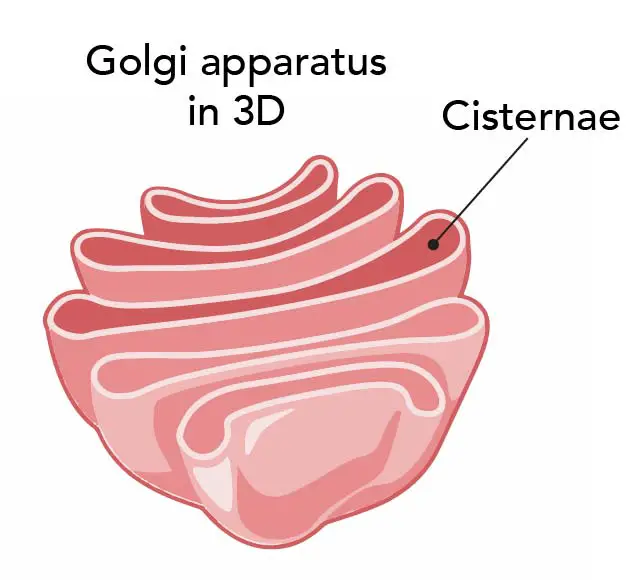
What are cisternae?
A series of compartments that make up the Golgi
How many faces does the Golgi have?
2
Which Golgi face is close to the ER?
Cis
Which Golgi face is far from the ER?
Trans
Where does O-linked Glycosylation occur?
The Golgi
How does O-linked Glycosylation occur?
The Golgi makes a new carbohydrate, built custom for a specific function
It modifies the existing N-linked Glycosylation by adding sugars to serine or threonine at the -OH group
What’s the difference between N-linked and O-linked Glycosylation?
N-linked Glycosylation alters a premade carbohydrate; It’s linked by the amine of asparagine.
O-linked Glycosylation uses a custom and specific functioning carbohydrate; It’s linked by the -OH group in serine or threonine.
Which direction is RNA synthesized?
5’ to 3’
Which direction is DNA read by RNA polymerase?
3’ to 5’
What synthesizes RNA?
RNA polymerase
How many RNA Polymerases do Eukaryotes have?
3
How many RNA Polymerases do Prokaryotes have?
1
Do all RNA polymerases make the same RNA?
No
Where does transcription begin?
Promoter
How does transcription begin in Prokaryotes?
RNA polymerase recognizes a specific gene sequence and binds to promoter
How does transcription begin in Eukaryotes?
RNA Polymerase 2 uses general transcription factors to bind to the promoter region.
What are general transcription factors?
Proteins that position RNA polymerase on the promoter
How do transcription and translation occur in Prokaryotes?
They happen simultaneously
Where does transcription occur?
The nucleus
What are the two challenges eukaryotic cells face in transcription?
The nuclear membrane separates transcription and translation, and Eukaryotic DNA is stored as chromatin
How do eukaryotic cells overcome the transcriptional challenges?
RNAs have additional requirements and have to be modified, and the structure of DNA (chromatin) has to be modified
Initiation of Transcription
RNA is assembled at the promoter and can bring a few nucleotides together to begin the process
Processivity
The same synthetase is used to make the whole molecule from start to finish
What is an example of processivity?
RNA polymerase is continuously adding nucleotides at 3’ end of growing chain
Is carbohydrate synthesis an example of processivity?
No
What contributes to processivity?
Elongation factors
What are transcriptional Elongation Factors?
Proteins that help move RNA polymerase along using energy from ATP hydrolysis.
How do elongation factors get energy?
ATP hydrolysis
How do transcriptional Elongation Factors work?
They keep opening up the DNA in front, moving the histones out of the way.
How does the RNA polymerase know that transcription has ended?
Sequences alert the RNA polymerase that they’ve reached the end of the gene
How does transcription end in Prokaryotes?
The RNA polymerase reaches the terminator sequence and transcribes it; it then folds into a 3D structure and ends
How does transcription end in Eukaryotes?
The Polyadenylation signal is transcribed and then the 3’ end is cleaved off.
What are the 3 types of mRNA processing? (In order)
5’ cap, RNA splicing, and Poly-A tail
When is the 5’ cap added to the mRNA?
As soon as the 5’ end leaves the RNA polymerase
What is the purpose of the 5’ cap?
Marks RNA stand as mRNA-to-be; Alerts if RNA is intact after leaving the nucleus; Used by ribosomes to bind to RNA for translation
What is the 5’ cap made of?
Methylated guanine, specifically 7-methyguanosine, linked by a triphosphate bond going 5’ to 5’
What is RNA splicing?
When introns are removed using the spliceosome, and then stitched back together to make an in tact molecule.
What are Introns?
Intervening sequences, thought to come from transposons
What are Exons?
Expressed sequences
What is the spliceosome made of?
snRNPS that assembled on pre-mRNA to form a bigger structure
What are snRNPs?
SnRNA (the catalyst) and multiple proteins
How does splicing know to occur?
RNA sequences found at intron-exon boundaries direct splicing
Why are introns important?
They allow for alternative splicing and variation in mRNA molecules
What is alternative splicing?
Introns getting spliced out facilitate the splicing of exons alongside them
What is the poly-A tail?
When the 3’ end of RNA is poladenylated at the end of transcription with a repeating sequence of about 200 A’s
What does the poly-A tail do?
Helps make sure the 3’ end is intact and didn’t fall off when leaving the nucleus; alerts that transcription is finished
How does the poly-A tail alert that transcription is finished?
Poly-A binding proteins bind to the tail and alerts the cell
Where is mature mRNA taken after transcription?
The cytoplasm
What does the Nuclear Export Receptor do?
mRNA binds and it guides it through the nuclear pore complex into the cytosol
What percent of the RNA is mRNA?
5%
What percent of the cell is rRNA?
80%
What do rRNAs do?
Makes up the structure and catalytic core of ribosomes; Ribozyme
\
Why is there only one codon for AUG?
Having multiple would risk translation starting in the wrong place; limits places translation can start
What is Degenerate Code?
When there is more than one codon for an amino acid
Why doesn’t reverse translation work?
It can’t work due to degenerate code.
What is the relationship between tRNA and mRNA in transcription?
tRNA acts as a translator
What is the function of tRNA?
It matches amino acids with codons