HMP 600 - Quiz 1
 Call Kai
 Learn
Learn Practice Test
 Spaced Repetition
 Match
Match Flashcards
 Knowt Play
1/54

There's no tags or description
Looks like no tags are added yet.
Name | Mastery | Learn | Test | Matching | Spaced | Call with Kai | Chat |
|---|
No analytics yet
Send a link to your students to track their progress
55 Terms

How we define health varies based on…
values, existinand g social conditions, cultural norms, personal factors

Health is a product of many…
interrelated and overlapping factors that change over time, and has so much to do with the world around us and individual behavior

What is the last line of defense to protect and ensure health (like goalie in soccer)?
Medicine and healthcare services

What doesn’t necessarily meet our needs or expectations when treating individual or population health?
Healthcare services and the healthcare system
The 2 models of healthcare delivery
Regionalized and dispersed

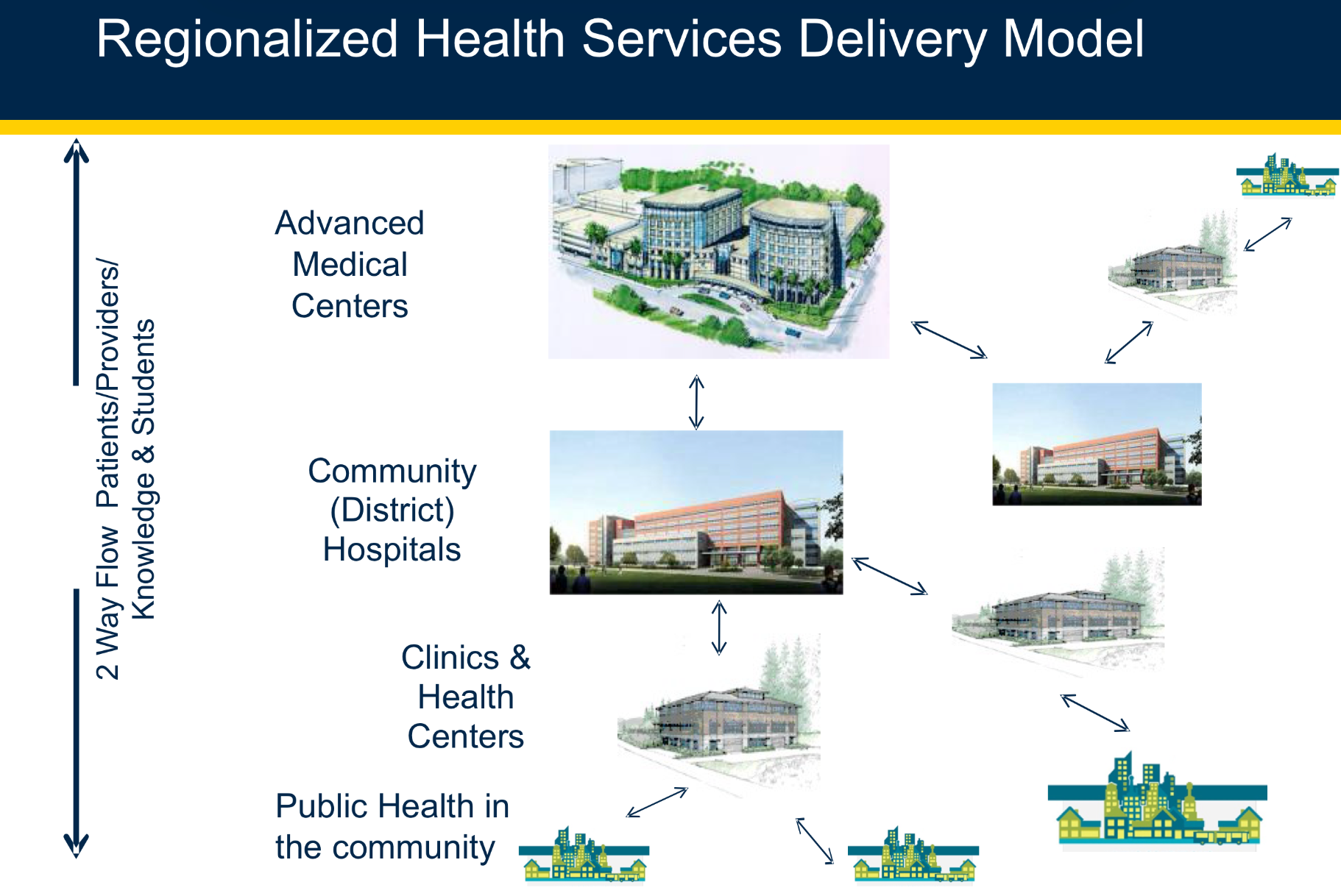
Regionalized Delivery System
The organization and coordination of all health resources and services within a defined area
Different types of physicians and facilities are assigned to distinct tiers in the primary, secondary, and tertiary levels in an ordery/regulated fashion
Planned distribution of care types/locations based on population
Focus on primary care
Care coordination between levels of care (more specialized care requires referral from lower levels)

Primary Care
Prevention and Wellness: Focuses on routine checkups, immunizations, screenings, and lifestyle counseling to stop health problems before they start.

Secondary Care
Medical care provided by medical specialists and community or regional hospitals when a patient needs advanced expertise beyond the scope of a general primary care doctor
Tertiary Care
Highly specialized, advanced medical treatment provided in major hospitals or specialized medical centers
Patients usually need a referral from a primary or secondary care provider to get in.
It treats severe, rare, or life-threatening health issues
Pros of Regionalized Models
Universal access to primary care
Efficient use of resources (simplified admin system)

Cons of Regionalized Models
Requires coordinated investment & management
Delays in delivering specialty care (ie. specialist shortages)

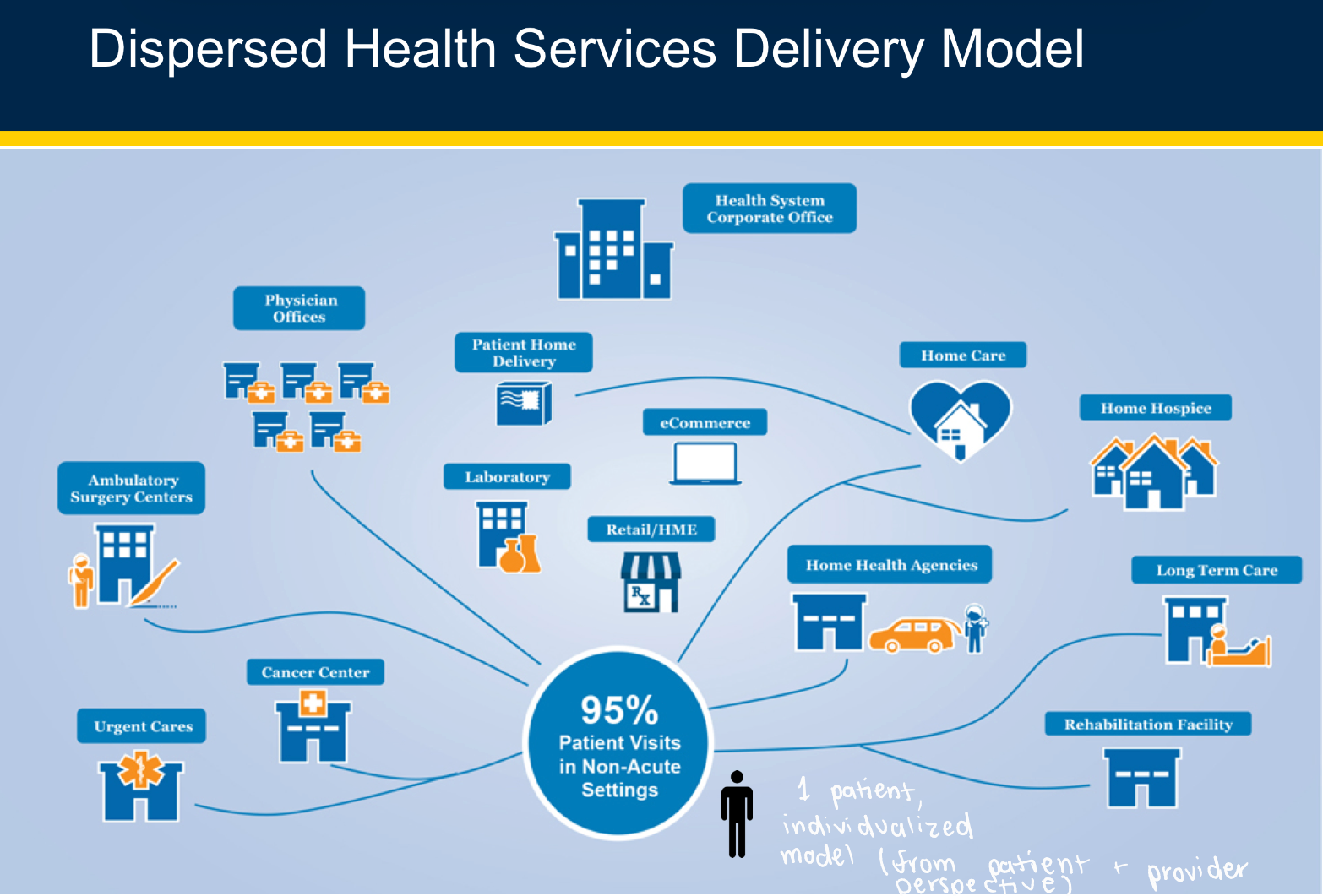
Dispersed Model
Independent providers of care decide location/service
Patient choice of providers
Focus on specialized care
Many different providers at each level
Incomplete coordination between/across levels

Pros of Dispersed Model
Patient Choice
Provider Incentives

Cons of Disbursed Model
Excess resources in some places, limited resources in others (rural health providers)
Care might be fragmented and uncoordinated
Which model of healthcare delivery does the US have?
Dispersed model

Why does the US have a dispersed model of healthcare delivery?
- services (physicians, hospitals, etc). are private, evolution of financing health insurance in US
- regulation did not control growth or plan for coordination of hospitals or health services

Hill Burton Act (Hospital Survey & Construction Act)
After WW2, funding of non-coordinated growth of private hospitals
Federal matching funds to states for hospital construction (new and expansion), to ensure adequate supply of hospital beds
An obligation to provide emergency services to any person living in its service area who cannot afford those services (“community benefit” obligation of hospitals)

Certificate of Need Laws
Used as a check for hospital growth
New York State created the first law to limit/regulate hospital growth in 1964
1974: National Health Planning & Resources Development Act
Required states to adopt Certificate of Need (CON) Laws to get hospital building approval by showing need to the state to build hospitals (so that there can be areas that aren’t underbuilt or overbuilt)
To regulate expanding bed capacity, establish new or expanding health services, technological expenditures,

Hill-Burton Long-Term Impacts
Made the hospital the center focus of health care delivery
Government involved in direct support of health care, but not in planning distribution (compare to regionalized delivery model)
Left a legacy of small (inefficient) hospitals
Led to unplanned, uncoordinated growth

Non-Profit Hospital
Exemption from federal income tax
Must provide "community benefits" (averages 8% of operating expenses), works to contribute to the community for the greater good
Exempt from state and local property taxes
Use of tax-exempt bond financing
Can accept charitable contributions (also may be tax-deductible for donors)

For-Profit Hospital
Provide health services to generate revenue/profits (legal obligation to promote wealth of shareholders within boundaries of law)
Surplus revenues go to owners/shareholders

What are community benefits?
Obligations for non-profit hospitals, Affordable Care Act (ACA) - added 4

Vertical Integration
The integration in one company of two or more stages of production (levels of supply chain) normally operated by separate companies
Supply chain is under 1 company

Horizontal Integration
The expansion of one company through internal expansion, acquisition or merger of two or more companies at same level of production in industry (supply chain)
Expansion to a company by adding more chains under it (mergers and acquisitions within the supply chain)
Community Health Needs Assessment (CHNA)
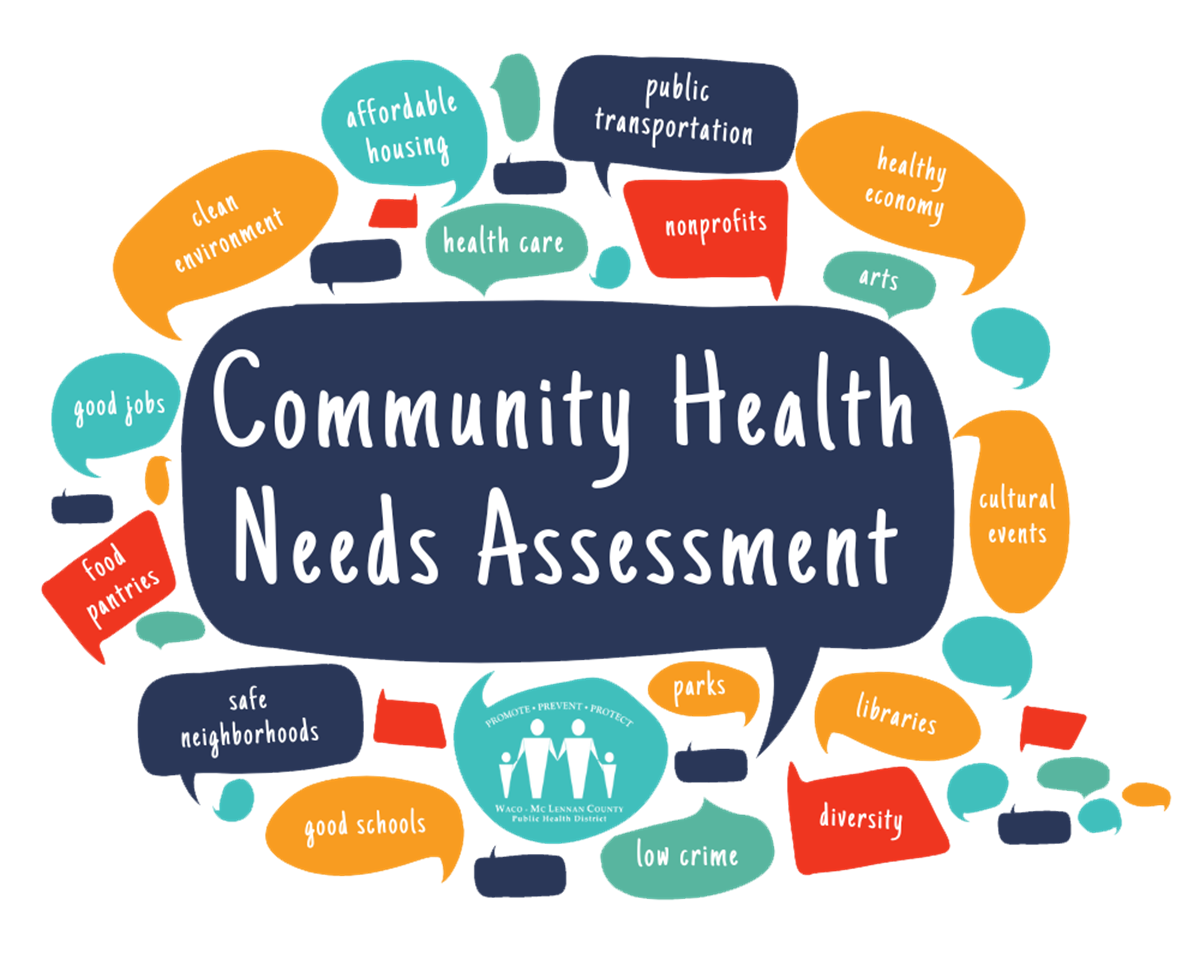
Evaluation of community health requirements and resources (financial barriers to care, adequate nutrition, SDOH)
One of the community benefits that the ACA added for non-profit hospitals (needs to happen every 3 years)

Private Equity
A form of for-profit health care company ownership reflecting investment in healthcare facilities by private parties.
Shares of private, investor-owned organizations such as private equity own firms aren’t traded on public markets (they aren’t required to follow the same regulations as public companies)

Impacts of PE on Healthcare
Increase healthcare prices
Not better healthcare quality despite being more expensive
Private equity acquisition increase physician turnovers (ohysicans leaving the practice)
Increased reliance on nurse practitioners and PAs
Definition of Safety Net Providers (in Primary Care)
Not for-profit and public organizations who have a legal obligation or commitment to provide comprehensive primary care to underserved communities in rural & urban areas
Serve primarily low-income patients, and populations of color (important services for millions of patients)
Rely heavily on allied health professionals (NPs, PAs, RNs, etc.) , funding model and "payer mix" primarily - public sources

Safety Net Providers (4)
1. Not for-profit and public organizations (ie. private & public hospitals)
2. Federally Qualified Health Centers (FQHCs) - Qualified grant funding under the Section 330 of the Public Health Service Act, federal oversight
3. Look-alike health centers (Meet PHS 330 Eligibility but don’t receive funding)
4. State & local community health centers

Federally Qualified Health Centers (FQHCs)
Qualified grant funding under the Section 330 of the Public Health Service Act, federal oversight
Look-alike Health Centers
Looks like and functions like a FQHC, but doesn’t receive federal PHS 330 funding while eligible
Sometimes doesn’t want federal oversight
Might not have the money/resources to apply for funding

Indian Health Service (IHS)
Mission is to raise the physical, mental, social, and spiritual health of American Indians and Alaska natives to the highest level
The only department of HHS whose principal mission is to deliver health services directly to individual citizens

History of Indian Health Service (IHS)
The US government promised native people health services in exchange for treaty terms (land) in the constitution in 1787
Native people face many health disparities and negative health outcomes from centuries of negative treatment (smallpox, tuberculous, etc)
Challenges of Safety Net Providers
Resources
Staffing
Funding Models
Patient Populations

Healthcare Provider Deficiency
Gap between the adult populations demand for primary care services and the capacity for primary care, as currently delivered, to meet demand

Healthcare Provider Shortage
Suggests that simply producing more physicians will address the primary needs by eventually meeting demand

Why do we have a shortage of primary care physicians?
Access problems (can’t find appointments, long wait times)
More demand (changes in population, aging more sick population)
Shortage of providers
Changes in future supply of providers (retiring, nurses leaving due to burnout)
The 5 A’s
1. Affordability
2. Availability
3. Accessibility
4. Accommodation
5. Acceptability

Affordability
Cost of care to patient (including of getting to services)

Availability
Presence of providers
Wait times for appointments
Flexible appointment times

Accessibility
Distance to provider location
Type of transportation
Mode of access/appointment

Acceptability
Extent of patient comfort with provider (language/communication barriers, trust, cultural competency)

Health Professional Shortage Areas (HPSAs)
Geographic areas, population groups, or health care facilities that have shortages of dental, mental health, or primary medical care providers

Medically Underserved Areas (MUAs)
Geographic areas and populations with a lack of access to primary care services

1972 National Health Services Corps (NHSC)
Supports more than 18,000 primary care medical, dental, and behavioral health providers through scholarships and loan repayment programs to serve in HPSAs (typically in CHCs/FQHCs)

Shortage of (diverse) clinical providers
the lack of minority health professionals is compounding the nations persistent racial and ethnic health disparities
How can we address the deficiencies in primary care?
Recruit and train more physicians in primary care, particularly from under-represented racial/ethnic minority groups
Support physicians working in underserved areas
Expand use of non-physician clinicians: allied health professionals (working to full scope of practice abilities)
Remember that licensure of different types varies by state
Expand use of non-clinical personnel and role of new technology

What other populations need long-term care (LTC) or long-term support or services LTSS other than the elderly 65+ years old?
Those who need support with activities of daily living (eating, walking, dressing, bathing, etc.)
Disabled people
Recovery from surgery/injury
Home and Community-Based Services (HCBS)
Community-based population living at home needs for long-term care
Roughly 11M people
Half aren’t elderly
13% are getting paid caregiving support

Institutional Sources of LTC & LTSS
Nursing Homes
Skilled Nursing Facilities

Are most providers of LTSS (regardless of type) for-profit or non-profit?
For-profit

What has significant deficiencies in institutional LTC & LTSS?
Quality of long-term support or services

Challenges of the LTC & LTSS Industry
Understaffing (COVID-19 exacerbated staffing needs)
Some state-level policies can address deficiencies in workforce
Skilled Nursing Facility
For rehabilitation/therapy and recovery beyond the scope of regular hospital acute care (where you can immediately go home after treatment)
Provides on-going medical care/treatment
Usually for-profit, or paid partially by Medicare (actual medicare treatment)
Residential Long-Term Care
When a person has a long-term chronic illness or disability, a gradual onset, or a chronic-progressive/disability
Not medical care/medical treatment
Social service model (residental needs), while going to the doctor or nurse independently