Chapter 4: Carbon and the Molecular Diversity of Life
 Call Kai
 Learn
 Practice Test
 Spaced Repetition
 Match
 Flashcards
 Knowt Play
1/28

There's no tags or description
Looks like no tags are added yet.
29 Terms
Study this figure of Stanley Miller's experiment to simulate conditions thought to have existed on the early Earth. Explain the elements of this experiment, using arrows to indicate what occurs in various parts of the apparatus
1. Water mixture in the "sea" flask was heated; vapor entered the "atmosphere" flask.
2.The "atmosphere" contained a mixture of hydrogen gas (H2),methane (CH4), ammonia (NH3), and water vapor.
3.Sparks were discharged to mimic lightning.
4.A condenser cooled the atmosphere, raining molecules down into the sea flask.
5.As material cycled through the apparatus, Miller periodically collected samples for analysis
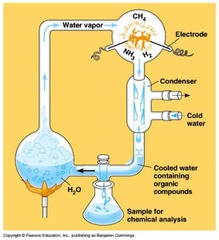
What was collected in the sample for chemical analysis? What was concluded from the results of this experiment?
From the samples collected for chemical analysis, Miller identified a variety of organic molecules that are common in organisms. These included simple compounds, such as formaldehyde (CH2O) and hydrogen cyanide (HCN), and more complex molecules, such as amino acids and long chains of carbon and hydrogen known as hydrocarbons.
Miller concluded that organic molecules, a first step in the origin of life, may have been synthesized abiotically on the early Earth

Make an electron distribution diagram of carbon. It is essential that you know the answers to these questions:

How many valence electrons does carbon have?
4
How many bonds can carbon form?
4
What type of bonds does it form with other elements?
Covalent bonds
Carbon chaines form skeletons. List the ypes of skeletons that can be formed.
Straight, branched, closed ring
What is a hydrocarbon? Name two. Are hydrocarbons hydrophobic or hydrophilic?
Hydrocarbons are hydrophobic molecules consisting of only carbon and hydrogen, such as benzene, methane, petroleum and fats. They don't dissolve in water. The majority of their bonds are relativley nonpolar carbon to hydrogen linkages.
What is the difference between an isotope and an isomer?
An isotope is an alternative form of the same element containing an equal number of protons but a different number of neutrons in its atomic nucleus, and thus some different properties. C-12, C-13 and C-14 are isotopes of the element carbon.
An isomer is an alternative form of the same compound with the same formula but a different arrangement of
atoms in the molecule, and thus different properties. Pentane and 2-methylbutane are structural isomers of each other
Identify the three types of isomers. For each type, give a key character and an example.
Structural isomers such as pentane and 2-methylbutane differ in the covalent arrangements of their atoms; the locations
of double bonds may also vary.
Geometric isomers such as rhodopsin's have the same covalent partnerships, but differ in
their spatial arrangements due to the inflexibility of double bonds, which must be reassembled as, unlike single bonds, they cannot simply be rotated. An atom or group of atoms attached to a double-bonded carbon may be on the same side
(cis) or on opposite sides (trans).
Enantiomers such as ibuprofen's differ in spatial arrangement around an asymmetric
carbon, resulting in molecules that are mirror images of each other and thus named L or D after the Latin terms for left
and right (levo and dextro, respectively).
Give one example of enantiomers that vary in their pharmacological effect.
Albuterol is used to relax bronchial muscles, improving airflow in asthma patients. Only the effective R-Albuterol is marketed as the ineffective S-Albuterol form counteracts the active R form.
Label the molecules testosterone and estradiol and identify the differences.
Testosterone has an O double-bonded to its first carbon ring, instead of estradiol's single-bonded OH (1). Estradiol has
two more double-bonds in its first carbon ring than testosterone does (2). Finally, testosterone has a methyl group
attached to it (3) which estradiol lacks.

Define functional group.
Functional groups affect molecular function by being directly involved in chemical reactions.
Hydroxyl Functional Group
Structure:
(-OH): H atom bonded
to an O atom bonded to
the C skeleton
ex. ethanol
Properties:
•Polar due to presence of electronegative oxygen atom.
•Can form H-bonds with water molecules, helping dissolve the organic compounds to which it is attached (like sugars)

Carbonyl Functional Group
Structure: (>CO): C atom joined
to an O atom by a
double bond
ex. Ketones: if carbonyl group is within a carbon skeleton(acetone)
Aldehydes: if carbonyl group is at end of carbonskeleton (propanal)
Properties:
•Ketones and aldehydes may be structural isomers of one another with different properties (like acetone and propanal).
•Both groups are found in sugars, giving rise to 2 major groups of sugars:
- Aldoses: contain an aldehyde
- Ketoses: contain a ketone

Carboxyl Functional Group
Structure: (-COOH): O atom
double-bonded to a C
atom also bonded to
an -OH group
ex. acetic acid (gives vinegar its sour taste)
Properties:
•Has acidic properties (it's a source of H+ ions) because the covalent bond between oxygen and hydrogen is so polar
ex. Acetic acid dissociates into acetate ion
•Found in cells in ionized form (with -1 charge) These are called carboxylate ions

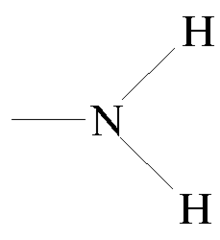
Amino Functional Group
Structure: (-NH2): N atom bonded
to two H atoms and to
the C skeleton
ex. Glycine - because it also has a carboxyl
group, glycine is both an amine and a carboxylic acid
- Compounds with both
of these groups are
called AMINO ACIDS
Properties:
• Acts as a base (can pick up an
H+ from surrounding solution;
water in living organisms)
• Ionizes (with +1 charge) under
cellular conditions
Sulfhydrl Functional Group
Structure: S atom bonded to H
atom
ex. Cysteine - an important sulfur-containing amino acid
Properties:
•2 sulfhydryl groups can
react, forming a covalent bond
(this "cross-linking" helps
stabilize protein structure)
- Cross-linking of cysteines in
hair proteins maintains
curliness or straightness of hair
- Straight hair can be curled with
curlers by breaking and reforming the cross-linking bonds)

Phosphate Functional Group
Structure: (-OPO32-): P atom bonded to four O atoms; one O bonded to the C skeleton; two Os carry negative charges
ex. glycerol phosphate - takes part
in many important chemical reactions in cells and provides backbone for phospholipids (most prevalent molecules in cell)
Properties:
• Contributes negative charge to molecule of which it is a part (-2 when at end of molecule; -1 when located internally in chain of phosphates)
• Has potential to react with water, releasing energy (part of ATP)

Methyl Functional Group
Structure: C bonded to three H atoms; not
necessarily attached to a C atom
ex. 5-Methyl cytidine - component of DNA
that has been modified by addition of methyl group
Properties:
• Addition of a methyl group to
DNA or molecules bound to DNA affects expression of gene (how
proteins are synthesized)
• Arrangement of methyl groups in male and female sex hormones
affects their shape and function

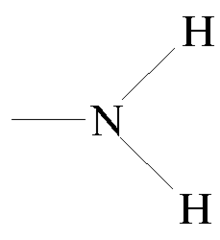
-NH2
amino
Can form cross-links that stabilize protein structure
sulfhydryl

Key component of ATP
phosphate

Can effect gene expression
methyl

Is always polar
hydroxyl

Determines the two groups of sugars
carbonyl

Has acidic properties
carboxyl

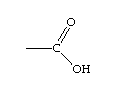
-COOH
carboxyl
Acts as a base
amino
