Intro to the Vocal Tract
 Call Kai
 Learn
Learn Practice Test
 Spaced Repetition
 Match
Match Flashcards
 Knowt Play
1/31

Earn XP
Description and Tags
Zsiga Chapter 1 content and Slide 1 of LING 313
Name | Mastery | Learn | Test | Matching | Spaced | Call with Kai | Chat |
|---|
No analytics yet
Send a link to your students to track their progress
32 Terms
Tools for Speech Research
autopsy
x-ray
sonography
MRI
Autopsy
shows anatomy of vocal tract
no physiology for sounds or sequences
doesn’t show shape and structure of its parts
X-ray
cannot visualize tongue and skin-like figures of speech
daniel jones
swallowed lead to visualize vowels
dangerous and unethical
sonography / ultrasound
sound waves pass through materials of differing densities
sonar probe send sound waves through the tongue
MRI
best use for soft tissues
mid-sagittal sections to show vocal tract clearly
coronal section (ear to ear) shows whole head
Parts of the sublaryngeal tract
lungs and diaphragm

what is the purpose of the lungs in the sublaryngeal tract
allows air to enter and body and fill the ribcage
expand and contracts by squeezing or pulling the abdomen
what is the purpose of the diaphragm in the sublaryngeal tract
dome-shaped muscle separates chest from stomach
contracts and flattens, so the lungs enlarge
which airstream mechanism is used for majority of consonants in the IPA chart
pulmonic airstream mechanism (egressive)
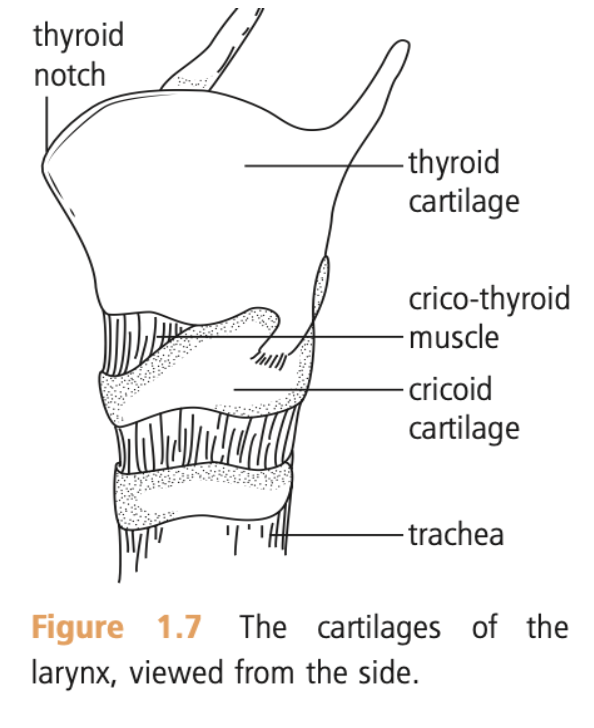
what are the hard parts of the larynx
trachea
cricoid cartilage
arytenoid cartilages
thyroid cartilage
hyoid bone

what are the muscles in the larynx
abductor
adductors
pitch manipulators
what is the abductor muscle in the larynx? and what is it’s purpose?
‘pushing part’
posterior crico-arytenoid (PCA)
widens aperture for inhalation
what are the adductor muscles in the larynx?
Inter-arytenoid (IA)
Lateral crico-arytenoid (LCA)
Transverse oblique arytenoids
what is the purpose of adductor muscle called ‘lateral crico-arytenoid’ in the larynx?
‘bring together part’
narrows aperture for exhalation / whispering
what muscles are used for pitch manipulation in the larynx?
thyroid-arytenoid (TA)
crico-thyroid (CT)
how does the thyroid-arytenoid (TA) manipulate pitch?
loosens vocal cords and lowers pitch

how does the crico-thyroid (CT) manipulate pitch?
stretches the vocal cords and increases pitch

what is the purpose of the trachea and which cartilages surround it?
connects mouth and lungs
cartilages
cricoid (top)
thyroid (sits over the cricoid)
arytenoids (sits on cricoid plates, hidden behind the thyroid)
parts of the vocal folds
vocal ligament
vocalis muscle
vestibular folds
what is the vocal ligament
multiple layers of tissue
thin and thick on the inside edge
thick and muscular at the sides
what is the vocalis muscle
the muscle that runs inside the vocal folds
what are the vestibular folds
‘false vocal folds’
vibrations not active for speech
used in throat singing
what is the epiglottis
the tissue flap that folds and rises to the larynx for swallowing
what is the pharynx and what is its purpose?
the open space at the back of the mouth
the space allows movement of the tongue for vowels and consonant sounds
what is the supra-laryngeal tract? and what is its purpose?
the structures above the larynx
allow creations of distinctive speech sounds via active and passive articulators
what is the tongue and what is its purpose?
muscular hydrostat
no bones, but muscles allow the tongue to move along regions
major divisions include: tip, blade and body
what are the active articulators? what is the purpose?
articulators used to narrow the vocal tract against one or more passive articulators
lower tongue
tongue front
tongue body (tip and blade)
tongue root (very back of the tongue)
what are the passive articulators? what is its purpose?
everything that does not move
upper lip
upper teeth
alveolar ridge
post alveolar region
hard palate
velum
uvula
pharyngeal wall
what is the velum? what is its purpose?
regulates the velar port
the velum actively moves for the need of sound
the velum opens during speech (ex. [m] and [n] for nasal qualities)
it can hold position and stay there while other active articulators move
what is the relationship between cartilages in the larynx and voicing?
cricoid, thyroid and arytenoids in the vocal folds make up the larynx
vocal folds attach to the thyroid cartilage in front
the arytenoid cartilages in the back
vocal folds change by adjusting the position of thyroid and arytenoid cartilages