IGCSE review

0.0(0)
Studied by 0 people
call kaiCall Kai
learnLearn
examPractice Test
spaced repetitionSpaced Repetition
heart puzzleMatch
flashcardsFlashcards
GameKnowt Play
Card Sorting

1/65

encourage image

There's no tags or description

Looks like no tags are added yet.

Last updated 9:58 PM on 9/27/26
Name
Mastery
Learn
Test
Matching
Spaced
Call with Kai
Chat

No analytics yet

Send a link to your students to track their progress

66 Terms

1
New cards
Element
Substance containing one type of atom.
2
New cards
Compound
Two or more different elements chemically bonded; separated only by chemical reactions.
3
New cards
Mixture
Two or more substances not chemically bonded; separated by physical methods.
4
New cards
Molecule
Two or more atoms covalently bonded.
5
New cards
Properties of ionic compounds
High melting and boiling points; conduct electricity when molten or dissolved but not when solid; usually soluble in water; strong electrostatic forces between ions.
6
New cards
Properties of covalent compounds
Simple molecules have low melting and boiling points; usually do not conduct electricity; weak forces between molecules; giant covalent structures have very high melting points.
7
New cards
Exothermic reaction
Releases energy; surroundings get hotter; products have less energy than reactants.
8
New cards
Endothermic reaction
Absorbs energy; surroundings get colder; products have more energy than reactants.
9
New cards
Activation energy (Ea)
Minimum energy needed for a reaction to occur.
10
New cards
Catalyst
Lowers activation energy by providing an alternative pathway; does not change the overall energy change.
11
New cards
Physical change
No new substance is formed; usually reversible.
12
New cards
Chemical change
A new substance is formed; usually difficult to reverse.
13
New cards
Collision theory
Particles must collide with enough energy to reach activation energy and with the correct orientation.
14
New cards

Collision theory in terms of

Number of particles per unit volume

Higher concentration means more particles per unit volume, causing more collisions and a faster reaction.

15
New cards
Frequency of collisions between particles
More frequent collisions give more opportunities for successful collisions, increasing reaction rate.
16
New cards
Kinetic energy of particles
Higher temperature gives particles more kinetic energy, causing more successful collisions and a faster reaction.
17
New cards
Recognizing oxidizing and reducing agent
Oxidation = loss of electrons; reduction = gain of electrons. Oxidising agent causes oxidation and is reduced. Reducing agent causes reduction and is oxidised. OIL RIG = Oxidation Is Loss, Reduction Is Gain.
18
New cards
Methyl orange
Red in acid; yellow in alkali.
19
New cards
Classify oxides either acidic or basic related to metallic and non-metallic character
Metal oxides are usually basic; non-metal oxides are usually acidic.
20
New cards
Preparation of soluble salts using an alkali by titration
Titrate acid and alkali to the end-point; repeat without indicator; evaporate some water; crystallise; filter; dry.
21
New cards
Preparation of soluble salts using excess metal
Add excess metal to acid; filter excess metal; evaporate; crystallise; filter; dry.
22
New cards
Preparation of soluble salts using excess insoluble base
Add excess base to acid; filter excess base; evaporate; crystallise; filter; dry.
23
New cards
Preparation of soluble salts using excess insoluble carbonate
Add excess carbonate to acid; produces salt + water + CO₂; filter excess; evaporate; crystallise; filter; dry.
24
New cards
Preparation of insoluble salts by precipitation
Mix two soluble solutions; an insoluble salt forms as a precipitate; filter, wash and dry.
25
New cards
Halogens at room temperature
Fluorine = pale yellow gas; chlorine = green-yellow gas; bromine = red-brown liquid; iodine = grey-black solid.
26
New cards
Halide ions
Fluoride, chloride, bromide and iodide ions are colourless in solution.
27
New cards
Properties of transition metals
High melting points and densities; strong; good conductors; form coloured compounds; have variable oxidation states; often act as catalysts.
28
New cards
Physical properties of metals
Usually shiny, strong, malleable, ductile, good conductors and have generally high melting points.
29
New cards
Physical properties of non-metals
Usually dull, brittle if solid, poor conductors and have generally lower melting points.
30
New cards
Alloy
Mixture containing a metal and one or more other elements; usually harder
31
New cards
Brass
Alloy of copper and zinc.
32
New cards
Stainless steel
Mainly iron, chromium and nickel; resistant to corrosion.
33
New cards
Condition for rusting of iron
Iron requires both water and oxygen to rust.
34
New cards
Barrier methods to prevent rusting
Painting, oiling, greasing, plastic coating and electroplating prevent water and
35
New cards

Blast furnace (extraction of iron; hematite)

Hematite is Fe₂O₃.

Production of Reducing Agent

C(s) + O2(g) -> CO2(g)
CO2(g) + C(s) -> 2CO(g)

Reduction of Iron Ore

3Fe2O3(s) + CO(g) -> 2Fe3O4(s) + CO2(g)
Fe3O4(s) + CO(g) -> 3FeO(s) + CO2(g)
FeO(s) + CO(g) -> Fe(l) + CO2(g)
Fe2O3(s) + 3C(s) -> 2Fe(l) + 3CO(g)

Slag Formation

CaCO3(s) -> CaO(s) + CO2(g)
CaO(s) + SiO2(s) -> CaSiO3(l)

36
New cards
Aluminium from bauxite
Aluminium is extracted from bauxite by electrolysis; aluminium oxide is dissolved in molten cryolite; Al³⁺ ions gain electrons at the cathode.
37
New cards

Presence of water test

  • Anhydrous copper(II) sulfate: Add a few drops of the liquid to a white powder sample of CuSO₄. If the solid turns from white to bright blue, water is present, forming hydrated copper(II) sulfate (CuSO₄ ⋅ 5H₂O). [1, 2]

  • Anhydrous cobalt(II) chloride: Use cobalt chloride paper impregnated with CoCl₂. In the presence of water, the paper changes from blue to pink (CoCl₂ ⋅ 6H₂O). [1, 2]


38
New cards
Treatment of domestic water supply
Filtration removes insoluble particles; chlorination kills microorganisms.
39
New cards
Composition of air
About 78% nitrogen, 21% oxygen, 0.9% argon and 0.04% carbon dioxide.
40
New cards
Carbon dioxide from complete combustion of carbon-containing fuels
Complete combustion produces carbon dioxide and water.
41
New cards

Carbon monoxide and particulates from incomplete combustion of carbon-containing fuels

Incomplete combustion can produce carbon monoxide and water and sometimes soot (C)
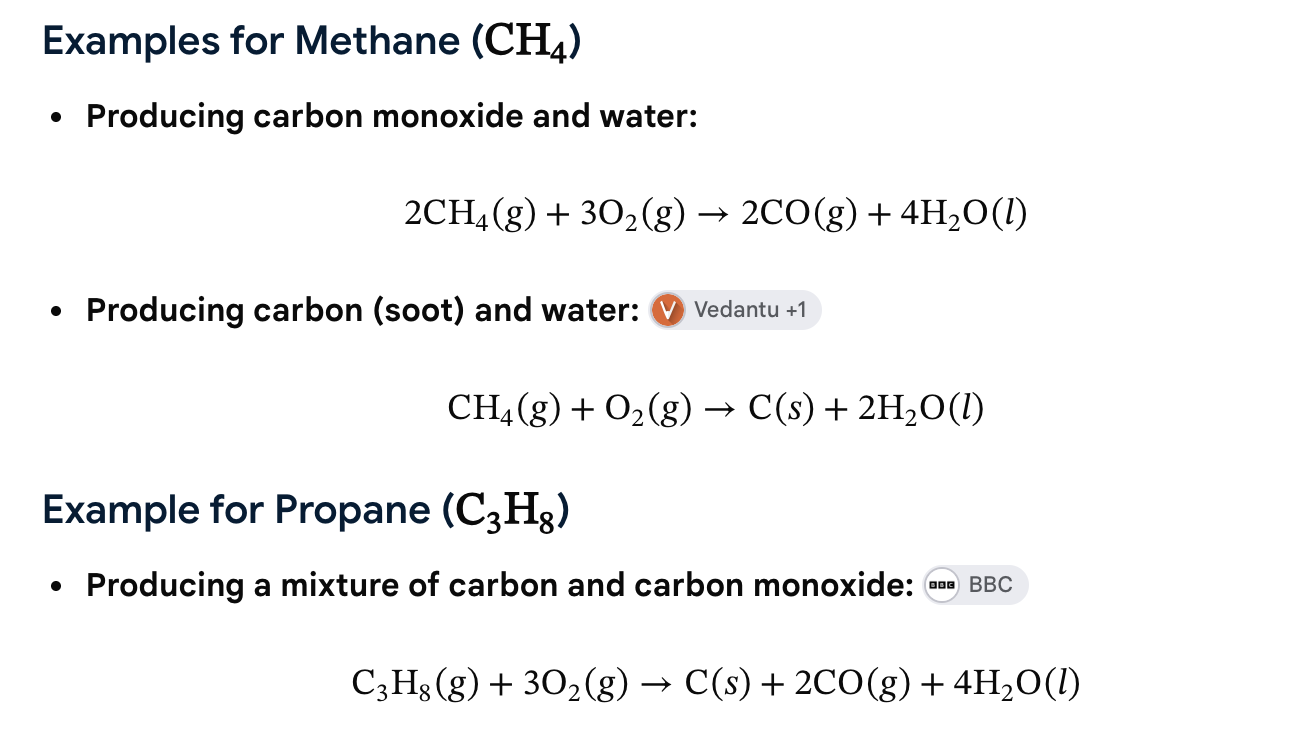
<p>Incomplete combustion can produce carbon monoxide and water and sometimes soot (C)</p>
42
New cards
Methane from decomposition of vegetation and digestion in animals
Methane is produced by anaerobic decomposition and digestion; methane is a greenhouse gas.
43
New cards
Oxides of nitrogen from car engines
High temperatures in car engines cause nitrogen and oxygen to react, forming nitrogen oxides.
44
New cards

Sulfur dioxide from combustion of fossil fuels containing sulfur compounds

Burning sulfur-containing fossil fuels produces sulfur dioxide.

Fuel (containing S) + O2 -> CO2 + H2O + SO2


45
New cards
Effect of carbon dioxide
Higher CO₂ levels increase global warming, contributing to climate change.
46
New cards
Effect of carbon monoxide
Toxic gas that reduces the blood's ability to carry oxygen.
47
New cards
Effect of particulates
Increase the risk of respiratory problems and cancer.
48
New cards
Effect of methane
Higher methane levels increase global warming, contributing to climate change.
49
New cards
Effect of oxides of nitrogen
Cause acid rain and respiratory problems.
50
New cards
Effect of sulfur dioxide
Causes acid rain.
51
New cards

Homologous series

Family of compounds with the same functional group and general formula;

  • Same General Formula: E.g.,

    C𝑛

    H2𝑛+2

    for alkanes.

  • Similar Chemical Properties: Due to having the same functional group.

  • Gradual Physical Trends: Boiling and melting points increase regularly as molecular mass increases.

  • Common Preparation: They can be synthesized using similar chemical methods.


52
New cards
Fossil fuels
Coal, natural gas and petroleum; non-renewable fuels.
53
New cards
Methane as the main constituent of natural gas
Natural gas is mainly methane (CH₄); used for heating and cooking.
54
New cards
Petroleum
Mixture of hydrocarbons separated by fractional distillation.
55
New cards
Refinery gas fraction
Contains small molecules with low boiling points; used for heating and cooking.
56
New cards
Gasoline
petrol fraction
57
New cards
Naphtha fraction
Used as a chemical feedstock.
58
New cards
Diesel oil
gas oil fraction
59
New cards
Bitumen fraction
Contains large molecules with high boiling points; used for making roads.
60
New cards
Fractional distillation: decreasing chain length
As fraction size decreases, hydrocarbon chain length decreases.
61
New cards
Fractional distillation: lower boiling points
Shorter hydrocarbon chains have weaker intermolecular forces and lower boiling points.
62
New cards
Test for saturated and unsaturated hydrocarbons
Add aqueous bromine. Unsaturated hydrocarbons decolourise bromine water from orange
63
New cards
Cracking
Breaks large alkane molecules into smaller molecules using high temperature and a catalyst; produces smaller alkanes and alkenes.
64
New cards
Properties of alkenes with bromine
Alkenes react with bromine in an addition reaction; bromine water is decolourised.
65
New cards
Properties of alkenes with hydrogen
Alkenes react with hydrogen in the presence of a nickel catalyst to form alkanes; C₂H₄ + H₂ → C₂H₆.
66
New cards
Properties of alkenes with steam
Alkenes react with steam in the presence of an acid catalyst to form alcohols; C₂H₄ + H₂O → C₂H₅OH.



