SEA Art Hist
 Call Kai
 Learn
Learn Practice Test
 Spaced Repetition
 Match
Match Flashcards
 Knowt Play
1/61

There's no tags or description
Looks like no tags are added yet.
Name | Mastery | Learn | Test | Matching | Spaced | Call with Kai | Chat |
|---|
No analytics yet
Send a link to your students to track their progress
62 Terms
Purposes of Southeast Asian art
Worship ancestors, deities, or supernatural beings
To glorify the King- the devaraja cult
To teach and record religion and history
To assert status, rank, or political power through possessions
Devaraja cult
Khmer Cambodia and Java
the living king transmitted divine will through his relationship with a particular god
Indianization
The entering of South Asians, bringing their beliefs of royalty, religion, and trade
Vishnu
Preserver and protector of the universe
Brahma
Creator of the universe
Shiva
Destroyer of the universe
Hari-Hara
Deity combining Shiva and Vishnu
Vishnu on left (Hari)
Shiva on right (Hara)
Alus
Refined, smooth, finely worked, subtly allusive
Kasar
Rough, crude, or vulgar
Priyayi
Standard to judge artistic expression in Java
Niskala
The unseen non-material world
Inhabited by gods, demons, spirits, and monsters
Gong
Reverberations summon the spirits of ancestors, penetrating into the unseen world
Symbol of prestige and wealth
Dong Son culture
Today’s northern Vietnam
600 BC - 200 AD
Made bronze and iron objects (gongs)
Indigenous beliefs
Art objects may be invested with power
Entities can enter them
Rituals
Ceremonial, stylized, repetitive acts that take place at a set location
Involved symbolic objects, words, and actions
Masks
Used in performances in central Java
A way for spirits to enter people and use them as a tool for expression
Person and thing united
Batik
Traditional wax-resist dying technique
Solo, Indonesia
Keris
Indonesian and Malay daggers
often wavy blade with pamor (a pattern created from blending light and dark metals)
One of the five essential possessions of a man
Can bring good or bad luck, depending on what spirit it holds
Caring for Keris
Cleaned with traditional ointment, giving signature scent
Tapping blade and listening to the sound
Magical formulas uttered to Keris
Pangrasa
Sensitivity of the heart, inner sharpness, sixth sense
Cannot be learned
Contact between keris and person— facilitated by fragrance
Wayang
Traditional form of puppet theatre play originating in Java
Contains hidden truths about human life

Figures of a hornbill, kenyelang
Iban, Sarawak (Northwest Borneo, Malaysia)
Messenger of the god of war
Hornbill effigies are the centerpiece of the Gawai Kenyalang
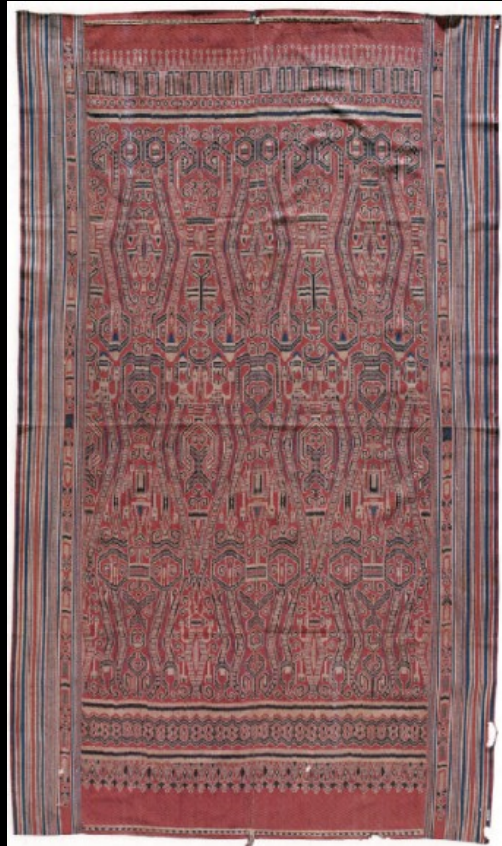
Pua Kumbu
Iban, Sarawak
A traditional patterned multi-colored ceremonial cotton clothing
Worn during Gawai and Dayak
Southeast Asian conception of the universe
Tripartite cosmological belief system of the universe
Tripartite conception
The world is resting on the back of a vast creature (turtle or serpent)
Below the earth, in depth of sea, are where malevolent spirits reside
Above the world, the heavens are inhabited by spirits

Kenyah ritual (wooden) post, belawing, with hornbill and dragon
Southern Borneo, Indonesia
Hornbill symbolizes male upper world
Dragon represents female lower world
Union of male and female as image of tree

Tau-tau
Ritual representation of the deceased

Forked peo post
Links: living and ancestors, male and female, individual and community, human and supernatural
Symbols of sun, moon, double-axe, and female

Tombstone of the Raja of Anakalang
Funeral monument
Female and male figures
Geometric designs
Iconographic references to lineage, wealth, and ritual precedence of the deceased

Ritual mask
Means of penetrating the spirit
Repels malevolent forces- used for exorcisms

Shiva as Lord of the Dance
Nataraja, India
Visualizes the cycles of creation
Linga
Phallic manifestation of Shiva

Krishna Govardhana
Vat Koh, Prei Kraba, Ta Keo, Cambodia
Hindu legend of god lifting Mount Govardhana to protect shepherds from torrential rian
Standing Hari-Hara
Pre-Angkor Cambodia
Union of Vishnu (Hari) and Shiva (HAra)
Garuda
Eagle-like transporter of Vishnu
Mount Meru
Sacred five-peaked mountain
Center of the universe
Home of spirits

Carving of Shiva Nataraja, the Dancing Shiva
The dancing Shiva symbolizes both the creation and destruction of the universe

Dancer from a pedestal from Tra Kieu, Champa
High relief sculpture
Proportionally large limbs
Anatomically impossible pose

Dewi Sri
Rice goddess
Symbolizes fertility
a base for offering
wedding ritual placed in front of bed
Stone sculpture of Ganesha
Central Java
God of new beginnings
Elephant head
Funan Kingdom
Southern Cambodia and Vietnam
4th-6th c
Javanese Kingdom
Java, Indonesia
Khmer Empire
Cambodia
9th-13th c
Expanded into Thailand, Northern Vietnam, and Malaya
Capital moved to Angkor
Late Kingdom
Decline of Khmer Empire
13th-16th c
Colonization and Independence
Muslim traders and European seafarers
Indonesia became Muslim (except for Bali)
Dutch, Portuguese, British, and French 16th - 19th c
Tantrism
East Java
Use of hand gestures, magic, and the worship of shaktis

Shivalinga Mudra
Cultivates a deep reservoir of energy within, warms the body, and increases the flow of healing energy

Vishnu. Prasat Kroh Bei (Damrei) Krap. N. Sanctuary, Phnom Kulen, Cambodia
Vishnu holding his most important attributes
Attributes of Vishnu
Conch: primordial sound of creation
Club: Vishnu’s divine power
Lotus: purity and perfection
Wheel: sun and universe

Durga Mahishasuramardini, Sambor Prei Kuk, sanctuary N 9, Kompong Thom,
Khmer feminine ideal & conquers the buffalo demon

Devi
Reinforces the impression of a specific identity
Older woman of experience and authority
Suryavarman II
The god of the sun
Built Angkor Wat
Angkor Wat
Five towers- mount Meru
Temple city
Walls covered in bas-reliefs of Hindu gods
Apsaras
Female spirit of the clouds and waters in Hindu and Buddhist culture
Indra
Hindu deity and king of heaven and gods
Lightening, storms, rain, river flow, and war
21
Vernal and autumn equinox
Twice a year, the rising sun aligns perfectly with the tip of the central tower
Earth
108
Basis of creation
Approximate relationships of the sun, earth, and moon
Chakravarti
Wheel-turning sacred king
Chakravala chakravarti
A king who rules over all four of the continents
Dvipa chakravarti
A ruler who governs only onw of those continents
Pradesha chakravarti
A monarch who leads the people of only one part of a continent
Bayon
Angkor temple built as a monument to Buddhism by Jayavarman VII