Genetics Test 2
 Call Kai
 Learn
Learn Practice Test
 Spaced Repetition
 Match
Match Flashcards
 Knowt Play
1/56

There's no tags or description
Looks like no tags are added yet.
Name | Mastery | Learn | Test | Matching | Spaced | Call with Kai | Chat |
|---|
No analytics yet
Send a link to your students to track their progress
57 Terms
mitosis
Eukaryotic chromosomes are only visible during
10-100 million bp in length
several 100-1000 genes interspersed throughout
origin og rep ~100,000 bp apart
telomeres have repetitive sequences at both ends
other repetitve sequnces near centromere and interspersed throughout

Centromere
recognition site for kinetochore microtubules
condense
during metaphase, chromosomes ____ 10,000 fold
in human nucleus, which is 5-10um, 46 chromo contain enough DNA to extend to more than 2 meters
Cpoiled chromatin fibers are compacted further into a chromatin ~700nm in diameter

proteins, octamers
Linear DNA interacts with ___, which affect the degree of chromosome compaction
Linear 2x stranded DNA wrap around an ___ of 2 copies each of 4 histones to form nucleosomes
H2A, H2B, H3, H4 are core histones
Histones
Basic, + charged proteins that play a critical role in chromatin
have a globular domain and a charged, flexible Histone Tail
Non-histones
are less + charged proteins
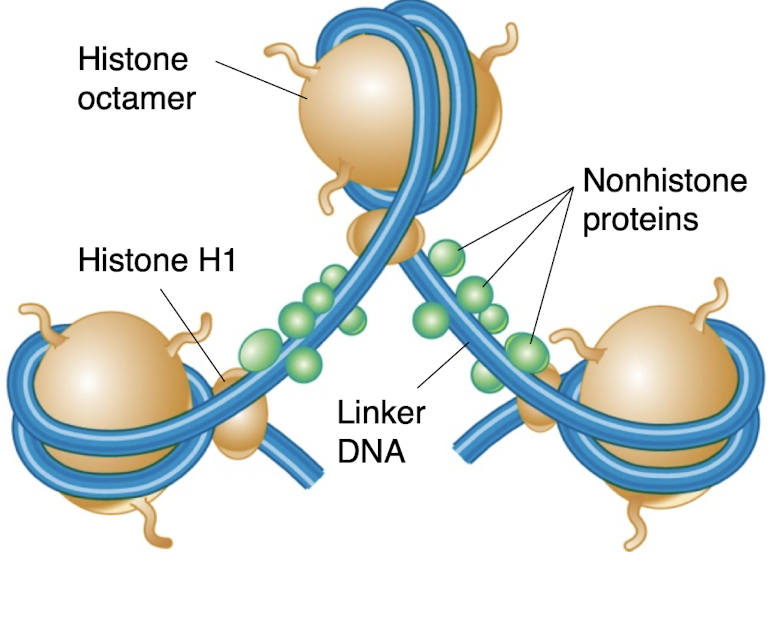
also bind the linker region and aid in chromatin compaction
they also may affect gene expression
Nucleosomes
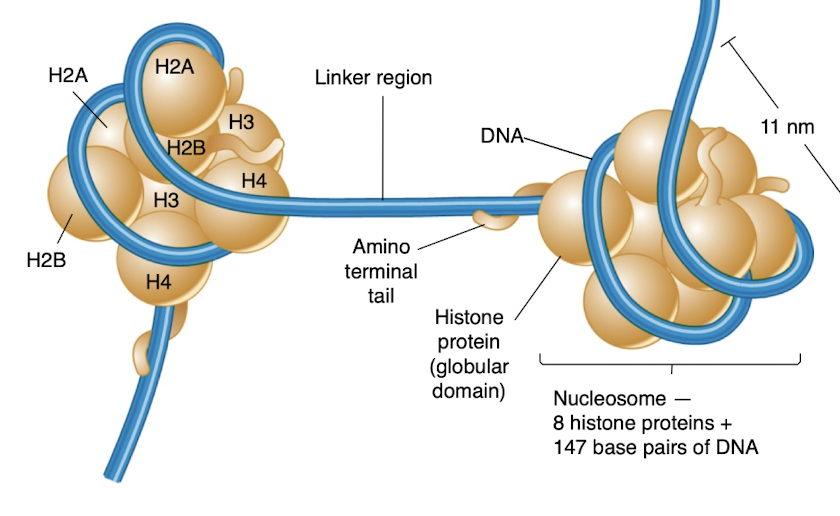
the repeating structural unit of chromatin and condense its structure by 7 fold
147 base pairs of DNA winds around histone otamer and resemble beads on a string
Histones have a globular domain and a charged, flexible Histone Tail
Closely associate with each other to form a 30nm solenoid that is compacted ~50fold
structure is characteristic of uncoiled chromatin fiber in interphase
going into metaphase, the 30nm structure folded into series of Loop Domains that are 300nm
H1
the linker histone that binds to spacer DNA between nucleosomes, but not as tightly as the core histones
nonhistone proteins also bind the linker region and aid in chromatin compaction
plays a key role in packing of chromatin
solenoid
Nucleosomes Closely associate with each other to form a 30nm ____ that is compacted ~50fold
structure is characteristic of uncoiled chromatin fiber in interphase
going into metaphase, the 30nm structure folded into series of Loop Domains that are 300nm

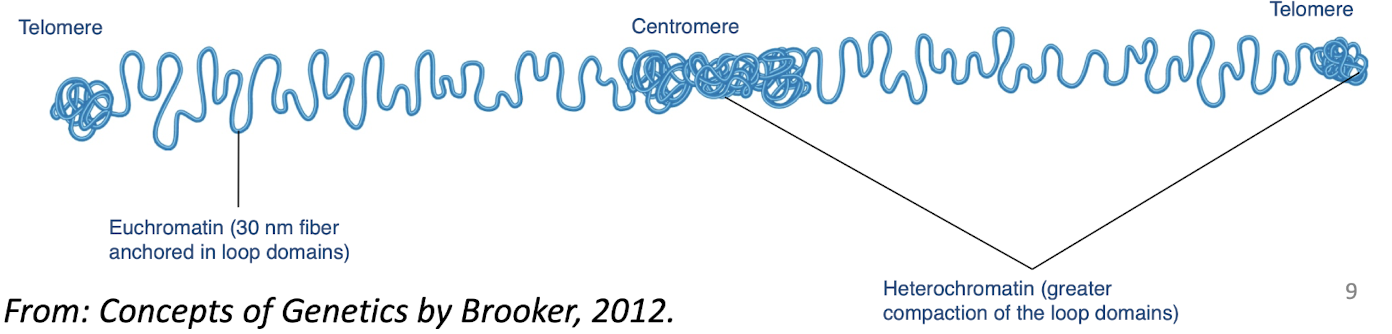
Euchromatin
NOT tightly coiled
less condensed regions of chromosomes are transcriptionally active

Heterochromatin
IS condensed
tightly compacted regions of chromosomes that are in general transcriptionally inactive
unique to eukaryotes
Replicates later during S phase than euchromatin
Important in maintaining the structural integrity of chromosomes
learned inactivated X chromo is condensed into heterochrmatic Barr body
Translocation of genes into heterochromatic regions can alter gene expression if too tightly wound, unable to be expressed
interphase
during ___ , eukaryotic chromosomes are not structurally uniform from end to end
Chromatin can be induced to change its struture via chromain remodoling
histone tails are targets for a variety of chem. modification that regulate chromatin folding and gene expression
acetylation, methylation, phosphorlyation of amino acids in histone tails
repetitive
Most of the human genome consists of ___ DNA and its function is unknown
Tandem
Middle repetitive sequences include ___ repeats and interspersed retrotransposons
Tandem repeats include: mutiple copy genes, VNTRs, STRs

Multiple copy genes
rDNA
clustered on the short arm of acrocentric chromosomes (13,14,21,22)
Variable Number of Tandem Repeats (VNTRs)
15-100 bp repeated sequences within & between genes that extend for 1-20kb in length
clusters of ___ throughout the genome are called minisatellites
Short Tandem Repeats STRs
Di-, tri-, tetra-, penta repeats (2-6bp long)
clusters of __ throughout the genome are called microsatellites
most common is (CA)n where n is 5-50 repeats
often used in DNA profiling

Transposable
___ sequences are interspersed and can relocate within the genome
SINEs and LINEs
Short interspersed elements (SINEs)
make up ~13% of genome
<500bp long present in 50,000+ times in human genome
best characterized is the Alu family which are 200-300 bp long and make up 5+% of human genome
Alu family is a group of closely related DNA sequences arising from single ancestral sequence
Long interspersed elements (LINEs)
make up ~21% of the genome
~6 kb long and present ~850,000 times in human genome
Single Nucleotide Polymorphisms (SNPs)
are the most common type of genetic variation
occur once in every 500-1000 bp
10 mill SNPs in the human genome
Most are between genes and have been used to identify genes in the human genome
are also used for personalized genomic meds
common type of genetic variation where a single DNA building block—called a nucleotide—differs between individuals at a specific position in a genome

DNA replication
makes DNA copies that are transmitted from cell to cell and from parent to offspring
Chromosomal DNA
stores information in units called genes
DNA does NOT directly participate in translation (protein synthesis), DNA is the blue print and stays behind

Transcription
produces an RNA copy of a gene
1st step in gene expression
involves the sythesis of mRNA that is complementary to the sequence of 1 of the 2 strands of DNA
occurs in the NUCLEUS of eukaryotic cells
mRNA is transported to the cytoplasm for translation
genetic info stored in DNA is transferred to mRNA, which directs synthesis of proteins
DNA does NOT directly participate in translation (protein synthesis), DNA is the blue print and stays behind

Messenger RNA
contains information to make a polypeptide
product of transcription is a single stranded primary ___ transcrpit
note the 5’-3’ orientation of the __ and nontemplate strand
they will be exactly the same sequence except for the T to U change

Translation
produces a polypeptide using information in mRNA
__ of mRNA is the polymerization of amino acids into a polypeptide chain
occurs on RIBOSOMES in the cytoplasm, each ribosome with 2 subunits composed of RNA and protein

Polypeptide
becomes part of a functional protein that contributes to an organism’s traits

Genetic Code
ATCG
written in linear form using ‘letters’ that designate the order of the purines/pyrimidines in mRNA
each ‘word’ in mRNA is 3 ‘letters’ so its a triplet code
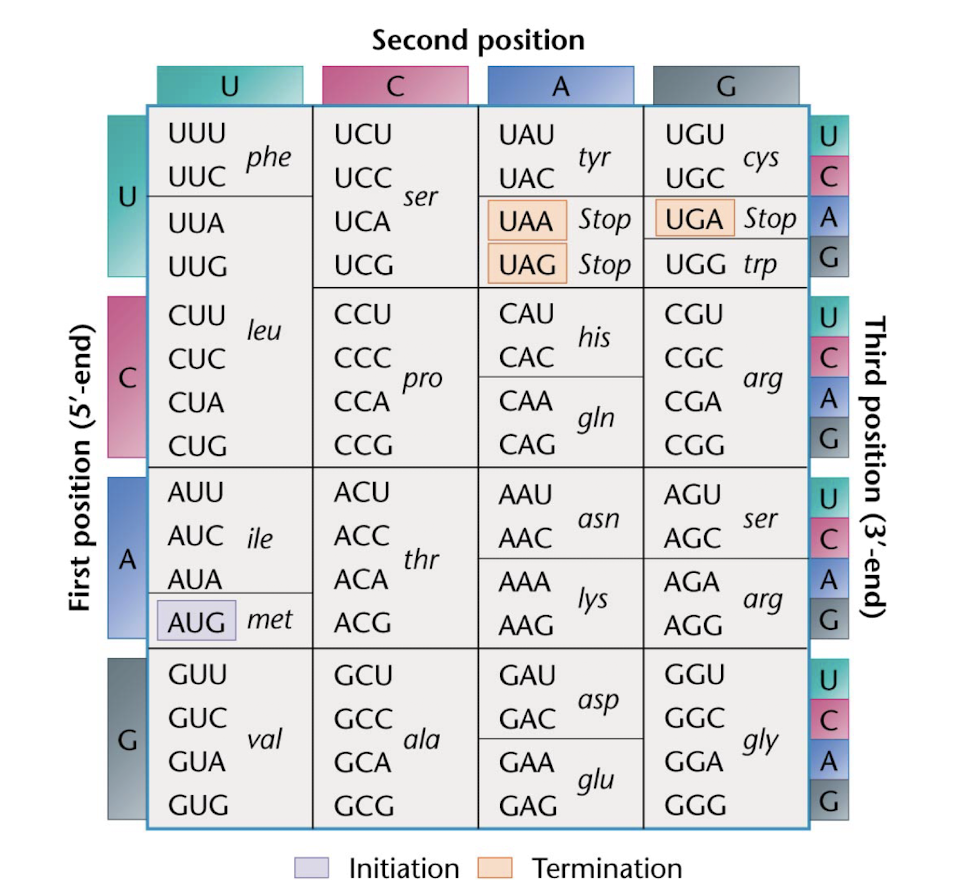
3 letters make up a CODON that specifies 1 amino acid
__ is unambiguous, non-overlapping & degenerate (multiple three-letter nucleotide combinations (codons) can code for the same single amino acid)
contains 1 start and 3 stop codons that initiate and terminate translation, resp.
___ is universal with some exception in mtDNA, a triplet always builds the same amino acids
no spaces between codons in reading frame
Degeneracy
3rd nucleotide in codon is in ‘wobble’ position
multiple 3 letter sequences can code for same amino acid
RNA polymerase
directs mRNA sythesis, using only 1 strand of DNA as a template
does NOT require a primer like DNA polymerase does during rep
Adds nucleotides in the 5’-3’ direction
promoter region is present

RNA polymerase I
transcribes genes that encodes rRNA
genes clusters (rDNA) are moderately repetitve DNA sequences near the ends of chromosomes 13, 14, 15, 21, 22
RNA polymerase II
transcribes genes that encode mRNA and snRNA
transcribes 1 strand of the double helix to generate 1 mRNA at any one time
RNA polymerase III
transcribe genes that encode tRNA and 5S rRNA
gene clusters are on chromosome 1
Template strand
DNA strand that is transcribed
Non-template/coding/sense/partner strand
DNA strand that is complement to strand transcribed, it is NOT transcribed
Chromatin remodeling
opening up of the genetic material
must occur so that RNA polymerase and transcription factors can bind to DNA
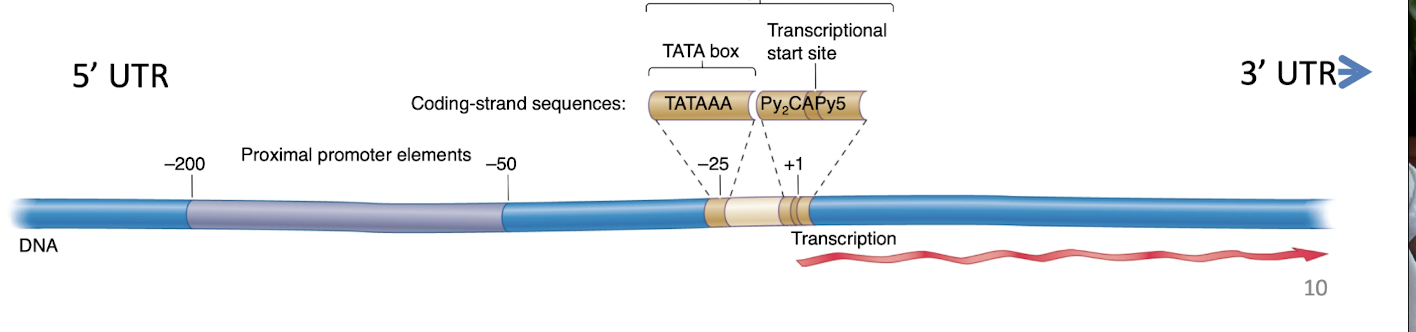
In addition to DNA sequences that code for the intended protein, eukaryotic genes have promoter sequences and regulatory elements in the 5’ and 3’ untranslated regions (UTR)
Promoters
sequences in the 5’ untranslated regions (UTRs) of genes that signal the inition of transcription
for most structural genes, __ include
The transcrption start site TSS
TATA box about 25 bases upstream from the TSS
Proximal promoter elements are further upstream
CORE ___ includes the TATA box and the TSS
Core ___ is cis acting element
Regulatory elements
short DNA sequences that affect the ability of RNA polymerase to recognize the promoter
Proximal promoter elements in the 5’UTR influence the level of basal transcription
Enhancers stimulate and silencers inhibit transcription
can be on either side of a gene or within a gene and quite distant from the start of transcpriton (100,000bp away)
enhancers are needed for max transcription and some are responsible for time and tissue specific gene expression

Cis acting
___ elements are DNA sequences that are located in and around eukaryotic genes to which regulatory proteins bind
Initiation
Transcpriton
occurs when the DNA strands begin to seperate and exposes a single stranded DNA template that will be transcribed into mRNA
elongation
fter a short RNA sequence has been transcibed, RNA polymerase leaves the promoter and enters into the ___ stage
termination
elongation continues until ___, ___ DNA sequences are in the 3’UTR
Stabilizing
___ mRNA
WHy
for safe travels out of the nucleus and into cytoplasm
How
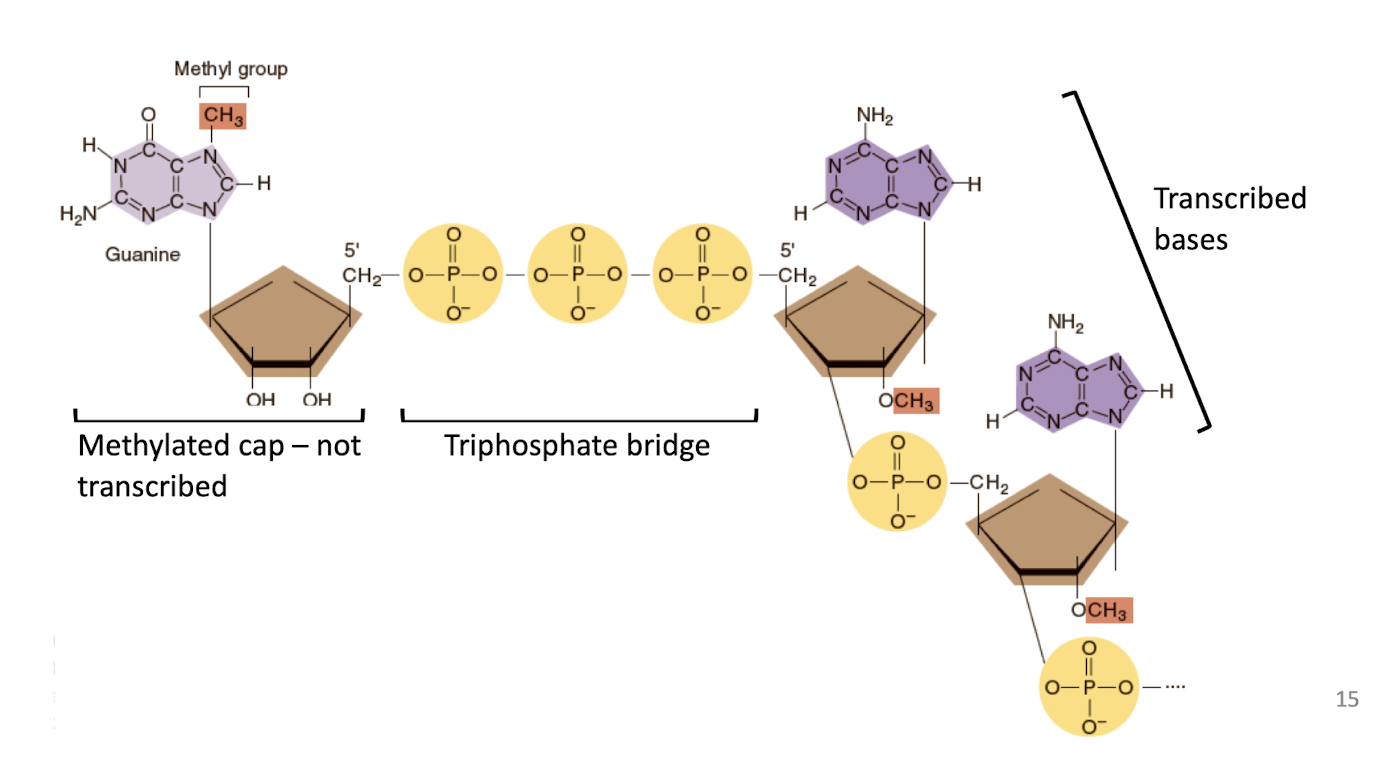
methyl cap on 5’
Poly A tail on 3’
splicing of introns (non coding regions of sequence)
methylated cap
mRNA have ___ on 5’ end
poly A tail
mRNA have a ___ on the 3’ end, not encoded by the gene
Ribonuclease cleaves the 3’ end at the sequence AAUAA before transcriptional termination
another enzyme adds 100-200 ribonucleotides containg adenine to 3’ end (__)


mRNA splicing
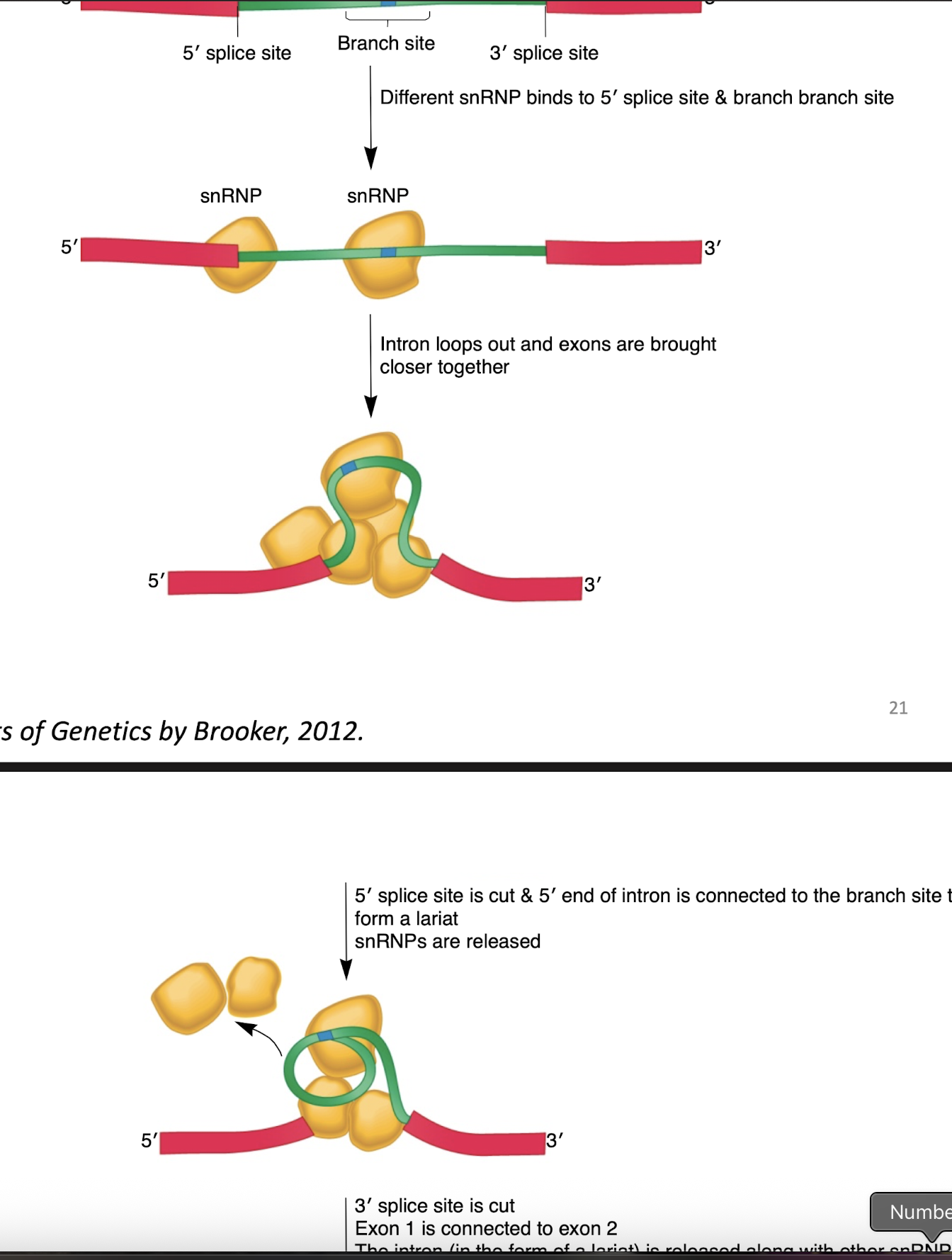
in eukaryotes, pre mRNA processing includes removing introns and linking exons together with phosphodiester bonds
Process is called ___
human dystrophin gene is an extreme example of ___ the largest known human gene


spliceosomes
In humans, excising introns requires ___
are large complexes composed of small nuclear riboproteins (snRNPs)
include small nuclear RNA (snRNA) and a set of proteins
They bind to an intron and precisely recognize intron/exon boundaries, holding mRNA in correct configuration
Enzymatic reactions remove introns and covalently link exons
Alternative Splicing
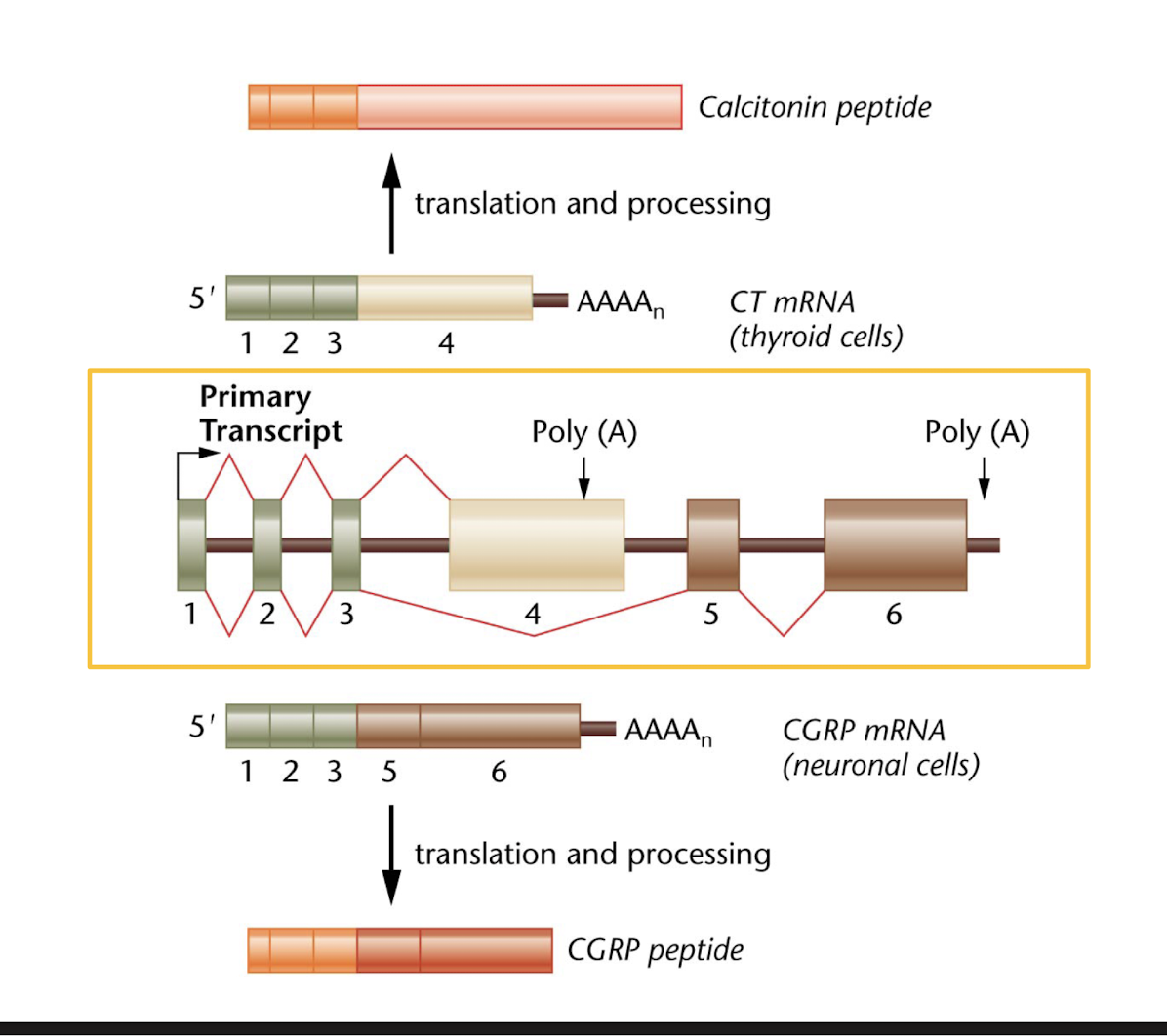
increases the number of proteins that can be made from a single mRNA transcript
number of proteins an organism can make is called its proteome
humans produce several hundred thousand different proteins from approximately 20,00 genes in the haploid genome by ___
Gene
specific sequence of nucleotides that contains the information required to build a protein or RNA molecule
types of __
structural __ encode proteins
rDNA encode rRNA and tRNA
Regulatory RNA control __ expression
are specific sequences of DNA bases (adenine, thymine, cytosine, and guanine) arranged on chromosomes.
Function: They act as instructions or "recipes" telling cells how to make proteins, which perform vital body functions.


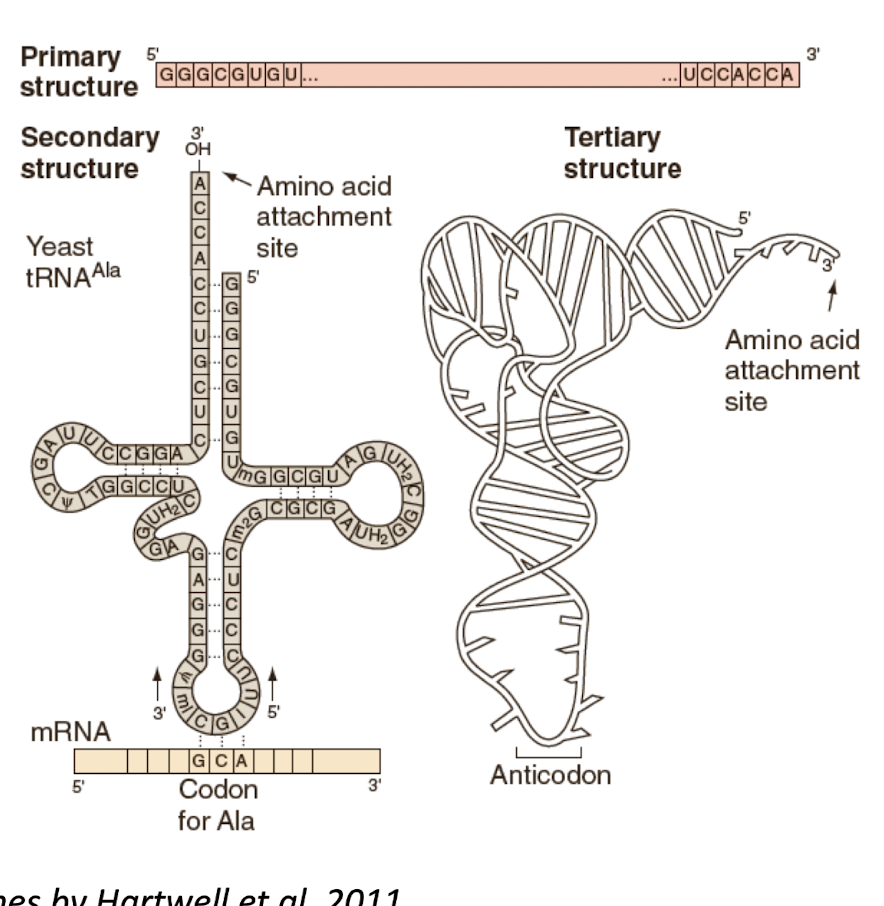
tRNA (transfer RNA)
molecule that matches a triplet codon with the correct amino acid
are short molecules with 75-90 base pairs
transcribed by RNA polymerase III
each __ has an anticodon complementary to a codon in mRNA
Charged __ have an amino acid covalently bound to the 3’ end
binding between the codon and anticodon of a charged __ directs the incorporation of amino acids into a growing polypeptide chain
3 levels of structure based on degree of folding,
Primary: linear sequence that is 75-80 nucleotide sequence
Secondary: cloverleaf shape with 3 stem loops is formed because of short complementary sequences within the __
Tertiary: L shape formed by 3D folding
Named acording to the amino acid they carry
Charging
Before translation can start, the tRNA molecules must be chemically linked to their respective amino acids, this activation process is called ___
occurs under the direction of enzymes called
aminoacyl tRNA sythetase
each synthetase recognizes ONE amino acid and the structural features of its corresponding tRNA, including its anticodon

codon, anticodon
Base pairing between an mRNA ___ and a tRNA ___ determines which amino acid is added to a growing polypeptide

AUG, start
___ codon sets the reading frame for all remaining codons

Large and small
Ribosomes have a __ and __ subunits
different parts of a ribosome have different functions
Sm. subunit binds to mRNA
RNA in the lg. subunit has peptidyl transferase activity
it is a ribozyme that catalyzes peptide bond formation between amino acids
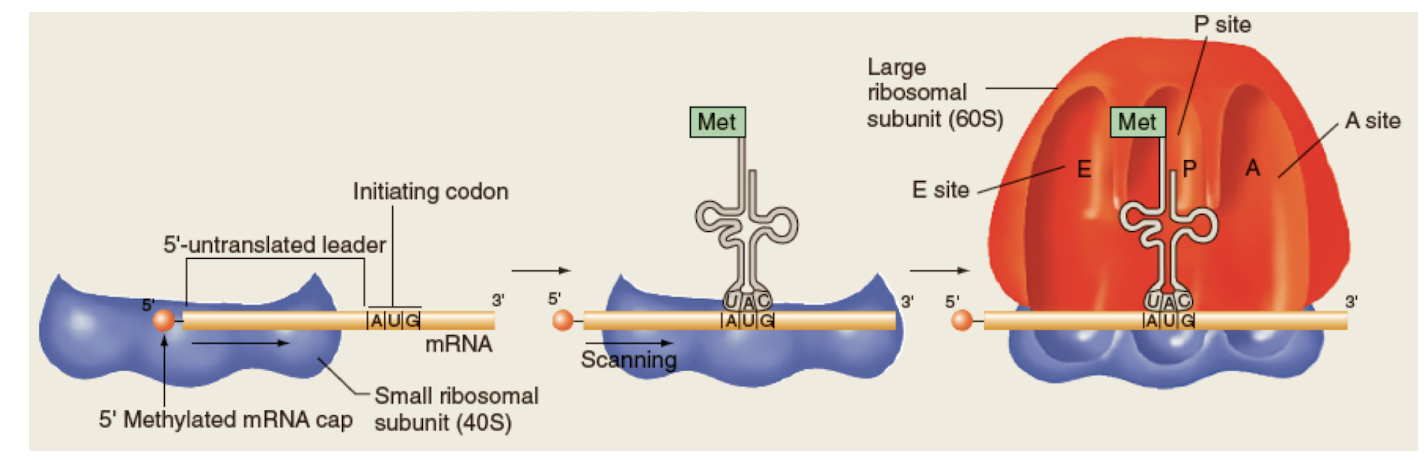
3 distinct binding sites: E P and A sites

Initiation factors (IFs)
Translation begins with initiation in eukaryotes and requires proteins called ___
__ bind to small subunit and 5’ untranslated leader sequences position the mRNA, which is scanned for the 1st AUG codon
tRNA with complementary anticodon loop binds mRNA
Large subunit joins the complec, positioing tRNA at P site
Peptide
During elongation, new tRNAs enter the A site and a __ bond is formed between the 1st and 2nd amino acids
Ribosomes move in a 5’ to 3’ direction along the mRNA
Elongation factors EFs are required
Uncharged tRNA to E site and the complex shifts for the tRNA containing hte polypeptide is now in the P site

Release factors
Termination occurs when a stop codon is in the A site
No tRNAs carry anticodons for stop codons
____ bind to the stop codon and the ribosomal subunits, mRNA, and polypeptide disassociate
