Public Health Terms Exam 1
 Call Kai
 Learn
Learn Practice Test
 Spaced Repetition
 Match
Match Flashcards
 Knowt Play
1/87

There's no tags or description
Looks like no tags are added yet.
Name | Mastery | Learn | Test | Matching | Spaced | Call with Kai | Chat |
|---|
No analytics yet
Send a link to your students to track their progress
88 Terms
Population
people in a specific place; requires more than on individual and individuals share 1 or more characteristics
Health
WHO says its a state of complete physical, mental, and social well-being not merely the absence of disease and infirmity; considered a fundamental human right
Public Health
CDC: science of protecting and improving the health of families and communities through the promotion of healthy lifestyles, research for disease and injury prevention, and the detection and control of infectious diseases; APHA: promotion and protection of the health of people and communities where they live, learn, work, and play
Population Health Science
is the study of the conditions that shape the distributions of health within and across populations and the mechanism through which these conditions manifest as health; common theme of group collaboration to keep people health
John Snow
investigated outbreak in 1854; traced 500 cholera deaths among people living close to Broad Street pump; conclusion is that it was contaminated and outbreak stopped
Joseph Lister
created the theory of antisepsis in 1860s; worked on chemical disinfection for surgery in 1865 and focused on vector-borne diseases
Louis Pasteur
French chemist who proved germ theory and invented pasteurization; invented rabies vaccine
Establishment of U.S. Public Health Service
established in 1912; named and charged with investigating infectious diseases, like tuberculosis, leprosy, and malaria in the U.S.; established National disease reporting system, Food and Drug Administration, Communicable Disease Center (aka Centers of Disease Control and Prevention
Core Functions of Public Health
Assessment, Assurance, and Policy Development
Assessment
collecting and analyzing data to identify emerging threats and track health outcomes
Assurance
enforcing policies, allocating resources for programs and services, and evaluating the outcomes of interventions
Policy Development
recommendations for interventions, programs, and policies that address identified health problems
10 Essential Public Health Services
provides a framework for public health to protect and promote the health of all people in all communities

10 Great Achievements in Public Health
Control of infectious disease
Decline in death from coronary heart disease and stroke
Family planning
Fluoridation of drinking water
Healthier moms and babies
Motor vehicle safety
Recognition of tobacco as a health hazard
Safer and healthier foods
Safer workplaces
Vaccination
Emerging Threat to Public Health
• Climate-related disasters (e.g. Hurricane Katrina)
• New infectious diseases (e.g. different strains of flu)
• Increasing anti-microbial resistance
• Increased number of food-born illness outbreaks
• SARs and other outbreaks highlight global health
• Increased chronic diseases
• Increased health disparities (differences in health)
Structure of U.S. Public Health System
divided into federal agencies, state and territorial health departments, local and regional health departments, tribal, non-profit; also includes CDC, NIH, FDA, HRSA; Alcohol, Drug Abuse and Mental Health Administration; Agency for Toxic Substances and Disease Registry
Federal Leadership Structure
secretary of the Department of Health and Human Services is chosen by the president of the U.S. and sits in their cabinet
Centers for Disease Control and Prevention (CDC)
main assessment and epidemiologic unit for the nation; directly serves the population as well as providing technical assistance to states and localities
Agency for Toxic Substances and Disease Registry
an assessment unit that focuses on environmentally related diseases; environmental factors contribute to 25% of diseases worldwide
National Institutes of Health (NIH)
primary research arm of the government; conducts research and supports research projects across the nation; funding (grants)
Food and Drug Administration (FDA)
directly tests and assesses safety of food, drugs, and a wide variety of consumer goods; sets standards for safe use of these items
Health Care Financing Administration
operates the Medicare and Medicaid programs; federal government directly finances health services for 68.8 million elderly Americans through Medicare; provides grants to the states through the medicaid program to assist them in financing health services for 71.1 million poor Americans
State
the principal governmental entity responsible for protecting the public’s health in the U.S.; conduct wide range of activities in health (collect and analyze information, conduct inspections, plan activities, programs and service, set policies and standards, carry out national and state mandates, manage and oversee environmental, educational, and personal health services, assure access to health care for underserved residents, involved in resources development, respond to health hazards and crises); carry out most of responsibilities through police power; different ways of allocating funds to public health
State Leadership
55 state health agencies in the country; each state agency is directed by a health commissioner or secretary of health
Local
front line of public health agencies; generally responsible for direct delivery of public health services to the population, specifclly by conducting communicable disease control programs, providing screening and immunizations, collecting health statistics, providing health education services and chronic disease control programs, conducting santitation, sanitary engineering, and inspection programs; running school health programs, delivering health care services; directed by either local health officer or an administration who works in cooperation; appointed by county supervisors, city and town councils, or mayor; funding is through state budget and grants
Disease
is a deviation from normal structure or function characterized by specific signs that may be observable or detectable using screening measures
Illness
a set of symptoms, such as pain, fatigue, or distress that often accompany disease
Disorder
a disturbance or disruption of normal functioning, even if there is not sufficient burden of symptoms to diagnose a specific disease
Disability
a condition of body or mind that makes it harder for a person to do certain activities and interact with the surrounding environment
Communicable Diseases
a disease that is infectious or transmittable from one person to another; can be bacterial infection (curable) or viral infection (treatable with no cure)
Non-Communicable Diseases
disease that cannot be transmitted; often called “chronic diseases”; most common cause of disability and death worldwide
Injuries
violence; examples are accidents, suicides, armed conflicts, poisoning, drug overdose
Disability Adjusted Life Use (DALYs)
universal metric that compares and contrasts health conditions across populations and timelines; primary metric used by Global Burden of Diseases; 1 of these means 1 year of healthy life lost; shift in leading causes of death and disability over time
Leading Causes of Death and Disability in the U.S. and World
COVID-19 stopped being the leading cause of death after 2021; worldwide, it is ischemic heart disease; in U.S. it is heart disease

Global Burden of Disease Study
continuous study that was developed in response to the fact that even though mortality rates were going down, disability rates are increasing and people are living with poorer health

World Health Organization (WHO)
global leader in health; coordinates the world’s response to health emergencies, promoters well-being, prevents disease, expands access to healthcare; team of 8000+ professionals; challenges are malnutrition
Malnutrition
deficiencies, excesses, or imbalances in energy/nutrition intake; 390 million people worldwide are underweight; 149 million children under 5 are stunted; 45 million children are too thin for their height; nearly half of deaths among children under 5 are linked to this; problem is worse by droughts, conflict, and poverty
Health Disparities
differences that occur by race/ethnicity, gender, education, income, disability, location, sexual orientation
Social Determinants of Health
non medical factors that determine health outcomes; includes socioeconomic status, physical environment, social and community context, health behaviors, government policies; education; culture; religion; gender; sexual orientation

Intersectionality
a framework for understanding how various social identities (race, gender, class, etc.) combine to create unique experiences of discrimination or privilege;
Health Equity
means to ensure that everyone has access to health, which often requires special attention to individuals who are at high risk of poor health outcomes because of social conditions

Health Equality
assumptions that everyone benefits from the same support

Healthy People 2030
U.S. national initiative that sets science based, measurable, and achievable objectives to improve the health and well-being of people across the nation; launched every decade since 1980
5 domains of SDOH
• Health care access and quality (ex. Access to healthcare and primary care)
• Neighborhood and built environment (ex. Housing, air and water quality)
• Social and community context (ex. Discrimination, workplace conditions)
• Economic stability (ex. Food security, housing stability)
• Education access and quality (ex. Enrollment in higher education)

Socieoeconomic Status
SODH; social standing or class of a person or group; usually based on a combination of education, income, and occupation; risk for so many disorders; can impact how people are percieved and treated by healthcare providers (ex. viewed as less intelligent, less responsible, less rational, less compliant)
Education
SODH; impacts health because it is linked to income and occupation (higher of this means better job that pays more and has benefits); doesn’t necessarily mean people will engage in health protective behaviors
Culture
SODH; encompasses customs, habits, and language a group of people share; influence on health behavior and can override a person’s knowledge and skills
Religion
SODH; important influence of health behavior and health outcomes; can impact contraceptive use, diet/nutrition, alcohol intake, medical treatment, circumcision, child marriage
Gender
SODH; men have lower life expectancy due to engaing in fewer health promoting behavior and more risk-taking behaviors; women are opposite
Sexual Orientation
SODH; LGBTQ+ youth are more elikely to be exposed to threats, dating violence, physical assault, more likely to have attempted suicide
Sustainable Development Goals
set of 17 interconnected goals adopted by the UN in 2015; universal call to action to end poverty, protect the plant, and ensure that all people enjoy peace and prosperity by 2030; address a broad range of global challenges, including poverty, hunger, inequality, climate change, and environmental degradation

One Health
approach that helps understand how systems involving health of environment, animals, and plants influence each other and how protecting one protects all
Zoonotic Disease
an infectious disease that spreads between animals and humans; can be caused by viruses, bacteria, parasites, fungi, or prions
Agent
refers to the biological pathogen that causes a disease, such as a virus, parasite, fungus, or bacteria; can refer to toxin or toxic chemicals that causes illness
Disease Reservoir
the natural habitat of an infectious agent that provides conditions for self sustainment (ex. shellfish for vibricholerae infections)
Ecosystem
stable arrangement of a population with mutual dependencies including all living and nonliving elements within an area
Endemic
when a disease is present or develops in a population or community but at a relatively low and stable rate
Epidemic
when a new disease or other health related event has increased in a defined geographic area, clearly in excess of the expected incidence rate of rates of new cases
Pandemic
epidemic occurring worldwide or over a wide area, often crossing international boundaries and affecting a large number of humans
Vector
living carrier (anthropod) that transports an infectious agent from an infected individual or its wastes to a susceptible host
Host
a living organism that provides food and logement to an infectious agent under natural conditions; agent may or may not cause a disease in this
Prevention
actions that ward off or forestall the occurrence of disease in populations; foundation of public health efforts and a core population health concept; a reason for increased life expectancy; 3 types of it (primary, secondary, tertiary)

Primary Prevention
actions that keep people from becoming ill or injured in the first place; ex. seat belt laws, vaccination, healthy diets, exercise, healthy behaviors, safe water, sanitation; for chronic diseases, some use primordial prevention that is before primary, which aims to prevent expression of a risk factor (challenging and unpractical though)
Secondary Prevention
aims to reduce the impact of a disease or injury in the earliest stages of occurrence; focus on detecting and treating subclinical diseases and injuries ASAP; can halt the disease course and restore person to full health; ex. pap smear, antigen blood measurements, colonoscopy, mammogram, cholesterol blood tests; most common are screenings
Teritary Prevention
actions that reduce the impact of an ongoing disease or injury once it has been diagnosed and treated; aims to manage diseases in a way that improves the person’s ability to function, enhances quality of life, and maximizes remaining lifespan; ex. (cardiac rehab after a heart attack, PT after surgery, weight loss programs for type 2 diabetes)
Screening
the presumptive identification of unrecognized disease in an apparently health, asymptomatic population by the means of tests, examinations, or other procedures that can be applied rapidly and easily to the target population; can be done for risk factors, risky behaviors, and observable functional and physiological changes is premised on the concept of early detection
Sensitivity
the ability of a screening test to correctly identify a person with disease or the percentage of persons with a disease that test positive; perfect screening test has 100% of this, which is never possible
False Positive Fraction
an error measured by the percentage of persons WITHOUT the disease that test POSITIVE
False Negative Fraction
an error measured by the percentage of persons WITH the disease that test NEGATIVE
Criteria for a Screening Test
Screening should be done only for diseases with serious consequences, so that screening tests could potentially have clear benefits for people’s health (Examples: Cancers, heart disease, diabetes)
Test must be reliable enough, and not harmful in itself (Examples: Exposure to harmful substances, risk of side effects)
There must be an effective treatment for the disease when detected at an early stage and there has to be scientific proof that treatment is more effective when started before symptoms occur (Example: HIV/AIDS, syphilis)
Factual information should be made available to the public to help people decide for themselves whether of not to have a screening test (pros and cons of screenings)
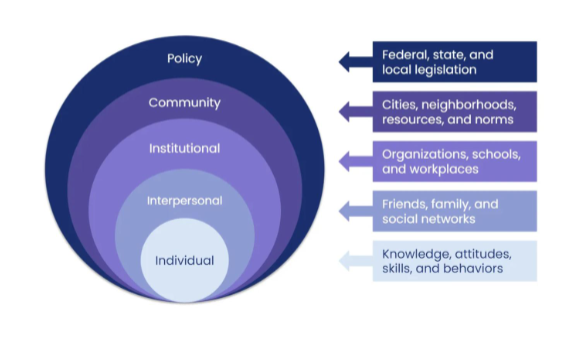
Social Ecological Perspective
population-level approach to understanding how health is produced; people are influenced by their environment and they influence their environment; explains health is produced through a variety of levels (levels of Influence)

Levels of Influence
levels that contribute to health;
• Individual: (personal); what kinds of things do individuals do that influence their health outcomes; health behaviors often result from awareness, knowledge, skills, attitudes, and beliefs
• Interpersonal: (family, friends); people’s behaviors are often influenced by those around them; can be positive or negative; sometimes interventions need to include individual and others around them
• Institutional: (work, school); includes schools, workplaces, places of worship, organizations; have their own unique cultures that can influence health behavior and risk (social norms)
• Community: (neighborhood, town, city); can be geographic but also be based on something in common, like chronic disease; similar to institutions because they have specific expectations for behavior; they provide access to the resources; food deserts is biggest example
• Policy: federal, state, and local laws/policies are fastest ways to impact health outcomes by regulating behaviors and environments (seatbelts, tobacco purchasing age, food production regulation)
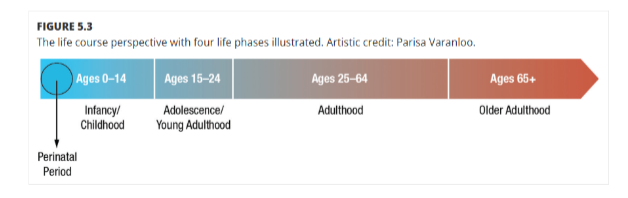
Life Course Perspective
framework in public health that says health is produced across our lives and our risks vary by age; split into 4 periods: infancy/childhood, adolescence/young adult, adulthood, older adult
Critical Periods
suggests that certain exposures, if they occur at a critical developmental moment, can strongly influence future health outcomes (ex. prenatal exposure to alcohol)
Sensitive Periods
periods in the life span where exposures have a greater impact (ex. substance use during adolescence)
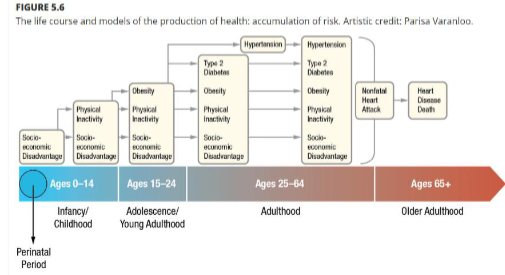
Accumulation of Risk Model
assumes the more times you are exposed to a health threat, the more likely you are to develop a disease or illness (lifestyle-related noncommunicable diseases like heart disease)
Chain of Risk Model
exposures that occur in a series creating a domino effect; ex: a child doesn’t have breakfast before school because their family is poor so can’t concentrate in school and falls behind, eventually dropping out, so only eligible for low wage jobs without insurance because no HS diploma, cant go to doctor because they can’t afford it and eventually get sick

Analytic Approach
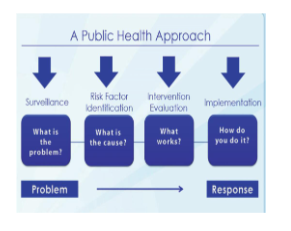
process that breaks down a problem into more manageable and solvable pieces; right approach must be applied in the right circumstance, since what works for one group might not work for another; two types (quantitative, qualitative)
Evidence-Based Approach
refers to a decision making approach that relies on scientific research and clinical practice to inform activities
Epidemiology
study of the distribution and determinants of health states/events in populations and its application to health problems; foundation to public health; ex. John Snow and London cholera outbreak
Biostatistics
focuses on understanding the variability in potential causes and outcomes in order to infer associations and relationships among them
Incidence
number of new cases of a condition in a specific time period
Prevalence
number of people in the population with the condition (new and existing cases)
Qualitative Methods
summary statistics on key variables in study sample (counts); measures of frequency (prevalence) and associations between exposure and outcomes (risk ratio)
Quantitative Methods
used to understand context, people, and relationships; ex. how do political factors affect health (context), how do people experience causes of health (people), and how all these interact to produce health (relationships)
Observational Study Designs
looks at the phenomena of interest (risk factors or outcomes); popular designs include case-control, cross-sectional, and cohort
Experimental Designs
manipulates the phenomena of interest using comparison groups to compare the outcomes of varying levels of exposure; includes randomized control trial
5 Actionable Steps for Population Health Science
Define the population: often groups of people who share a similar characteristic; need to understand the extent of the disease or the distribution of health outcomes in the population of interest
Define and measure the health outcomes and potential causes of health: must have this information to improve population health; there is no universal method; measures mortality from various health states/events, longevity, and quality of life; prevalence and incidence can be used, but multiple types of data are needed
Take a sample from the population for analysis: since can’t measure the entire population, you want to use a representative sample and make sure the people have the same characteristics of the majority of people in the population; sample needs to be large enough to be able to make confident statements and perform accurate tests; larger sample is better
Evaluate potential causes of population health: systematic and comprehensive approach; consider potential causes while aware of biases and different perspectives; find associations between exposure/risk factor and health outcomes
Identify targets for public health action: after identifying potential causes of population health, need to figure out what can be modifiable and how it will impact the population