Muscle, Connective, and Nervous Tissue
 Call Kai
 Learn
 Practice Test
 Spaced Repetition
 Match
 Flashcards
 Knowt Play
1/19

There's no tags or description
Looks like no tags are added yet.
20 Terms

Loose or Areolar CT
Loosely organized fibers
abundant blood vessels
empty space
Underlies all epithelia, connects skin to deep tissues, in serous membranes, between muscles, passageways for nerves and blood vessels
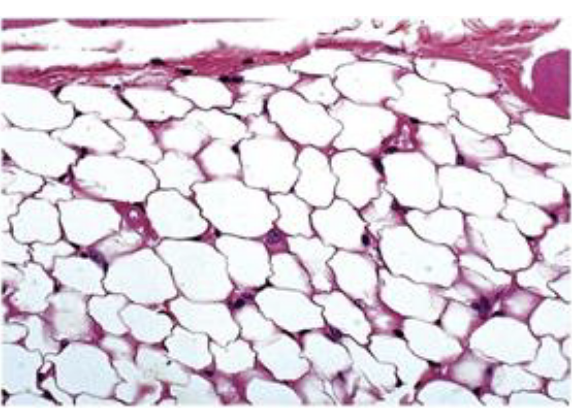
Adipose CT
Empty-looking cells with thin margins
nucleus pressed against cell membrane
Energy storage, insulation, cushioning
Subcutaneous fat and organ packing
Brown fat (hibernating animals) produces heat

Reticular CT
Mesh of reticular fibers and fibroblasts
Forms supportive stroma (framework) for lymphatic organs
Found in lymph nodes, spleen, thymus, and bone marrow


Dense Regular CT
Dense regular connective tissue
Densely packed, parallel collagen fibers
Compressed fibroblast nuclei
Elastic tissue/fibers, wavy sheets
Tendons attach muscles to bones and ligaments hold bones together


Dense Irregular CT
Densely packed, randomly arranged, collagen fibers and few visible cells
Withstands unpredictable stresses
Deeper layer of skin; capsules around organs

Hyaline Cartilage CT
Clear, glassy microscopic appearance because of unusual fineness of the collagen fibers
Usually covered by perichondrium
Articular cartilage, costal cartilage, trachea, larynx, fetal skeleton
Eases joint movement, holds airway open, moves vocal cords during speech


Elastic Cartilage CT
Cartilage containing elastic fibers
Covered with perichondrium
Provides flexible, elastic support
External ear and epiglottis
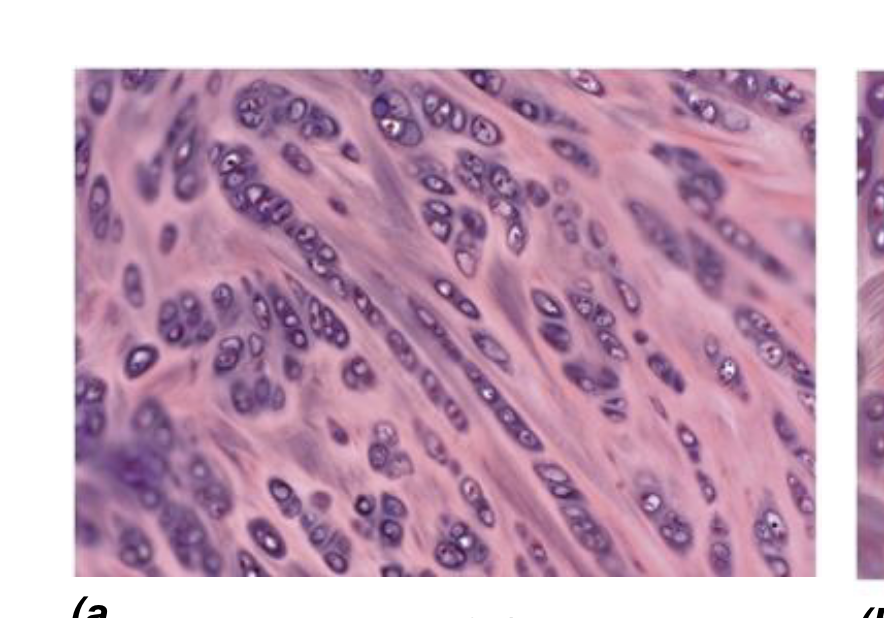
Fibrocartilage CT
Cartilage containing large, coarse bundles of collagen fibers
Never has perichondrium
Resists compression and absorbs shock
Pubic symphysis, menisci, and intervertebral discs

Bone CT
Compact bone is arranged in cylinders that surround central (haversian or osteonic) canals that run longitudinally through shafts of long bones Blood vessels and nerves travel through central canal
Bone matrix deposited in concentric lamella - onion like layers around each central canal

Fluid blood connective tissue
Transports cells and dissolved matter from place to place
Plasma—blood’s liquid ground substance
Formed elements—cells and cell fragments
Erythrocytes —red blood cells: transport O2 and CO2
Leukocytes —white bloodcells: defense against infection and other diseases
Thrombocytes (=platelets)— cell fragments involved in clotting and other mechanisms


Skeletal Muscle
Long, threadlike cells called muscle fibers
Most attach to bone
Contains multiple nuclei adjacent to plasma membrane
Striations—alternating dark and light bands
Voluntary—conscious control over skeletal muscles

Smooth muscle tissue
Lacks striations and is involuntary
Relatively short, fusiform cells (thick in middle, tapered at ends)
One centrally located nucleus
Visceral muscle—forms layers of digestive, respiratory, andurinary tract: propels contents through an organ, regulates diameter of blood vessels

Cardiac Muscle
Limited to the heart
Cardiac muscle fibers are shorter, branched, and blunted at ends
Contain one centrally located nucleus surrounded by light-staining glycogen
Intercalated discs join cardiocytes end to end
Provide electrical and mechanical connection
Striated and involuntary (not under conscious control)
Nervous tissue
specialized for communication by electrical and chemical signals
Consists of neurons (nerve cells)
Detect stimuli
Respond quickly
Transmit coded information rapidly to other cells
Neuroglia (glial)
Protect and assist neurons– “Housekeepers” of nervous system
Soma (cell body)
Houses nucleus and other organelles
Cell’s center of genetic controland protein synthesis
Dendrites
Multiple short, branched processes
Receive signals from other cells
Transmit messages to neurosoma
Axon (nerve fiber)
Sends outgoing signals to other cells
Can be more than a meter long

Nervous Tissue
