CEE 121 Quiz 1 Material
 Call Kai
 Learn
 Practice Test
 Spaced Repetition
 Match
 Flashcards
 Knowt Play
1/35

There's no tags or description
Looks like no tags are added yet.
36 Terms
What do we mean when we say transportation is a “derived demand?”
Travel is derived from the desire to pursue an activity at a destination, typically not an end in itself.
What do we mean by “utility” of a transportation alternative?
A measure of satisfaction or usefulness of that alternative
What are some major technical transportation engineering challenges?
(1) Infrastructure Crisis- pavements and bridges have exceed their design life (2) Congestion relief- new highways; new technologies, system operation techniques
With whom does the fundamental legal authority for most public highways rest?
The state holds most legal authority and control over public roads.
What act created the largest peacetime public works program in the history of the world, and what was the program called?
Federal Aid Highway Act of 1956; National System of Interstate and Defense Highways
What percentage of the construction cost of most of the US Interstate Highway System was covered by Federal funding? What about State funding?
Federal funds 90% & state funds 10%
What do electric vehicles have to do with highway financing?
They are exempt from the gas tax because they don’t require gas.
When was the US Department of Transportation created?
1967
Who is the California Secretary of Transportation?
Dr. Toks Omishakin
What is the minimum population of urbanized areas that mandates the presence of a Metropolitan planning Organization?
Minimum population of 50,000 for an MPO. They are responsible for land use, housing, and transportation planning
What are the Driver characteristics
(1) Physical (2) Sensory (3) Behavioral
Physical characteristic: What is the AASHTO highway design standard for drivers’ eyes above the roadway?
3.50 ft
What are Sensory Characteristics?
(1) Vision (2) Somatic equilibrium (3) Hearing
(1) Vision: If someone with 20/20 vision can just see a sign at 20ft, at how many feet can someone with 20/40 vision see it?
10 feet
(1) Vision: Where in a traffic tunnel would the lighting be more closely spaced and why?
Lighting would be closely spaced at the entrance because the eyes adapt from light to dark longer than from dark to light.
(1) Vision: How long is the AASHTO combined perception-reaction time (PRT) for braking (for design purposes)?
2.5 seconds until foot first touches the brake pedal
(1) Vision: At V = 60 mph, what is the braking Perception-Reaction distance:
d = (60 mi/hr) * ((5280 ft/mi) / (3600 sec/hr)) * (2.5 sec) = 220 ft
Which driver characteristic is “Good Driver Syndrome” and example of?
Behavioral characteristic; cognitive bias where people overestimate their own abilities
Why can designing traffic facilities for pedestrians be difficult?
Pedestrians are less predictable, slower and more vulnerable, prefer shortes route, might avoid crosswalks, etc.
What pedestrian walking speed is commonly used for traffic design purposes?
4 ft/sec
Approximate sidewalk capacity
12*(W-A); W = width (ft), A = 1.5 ft “dead with” = space between pedestrian path and building to make way for doors, steps, etc.
What two main factors govern the design of roadways?
(1) Vehicle capabilities = acceleration/deceleration, braking, cornering; (2) Human capabilities = perception/reaction times, vision
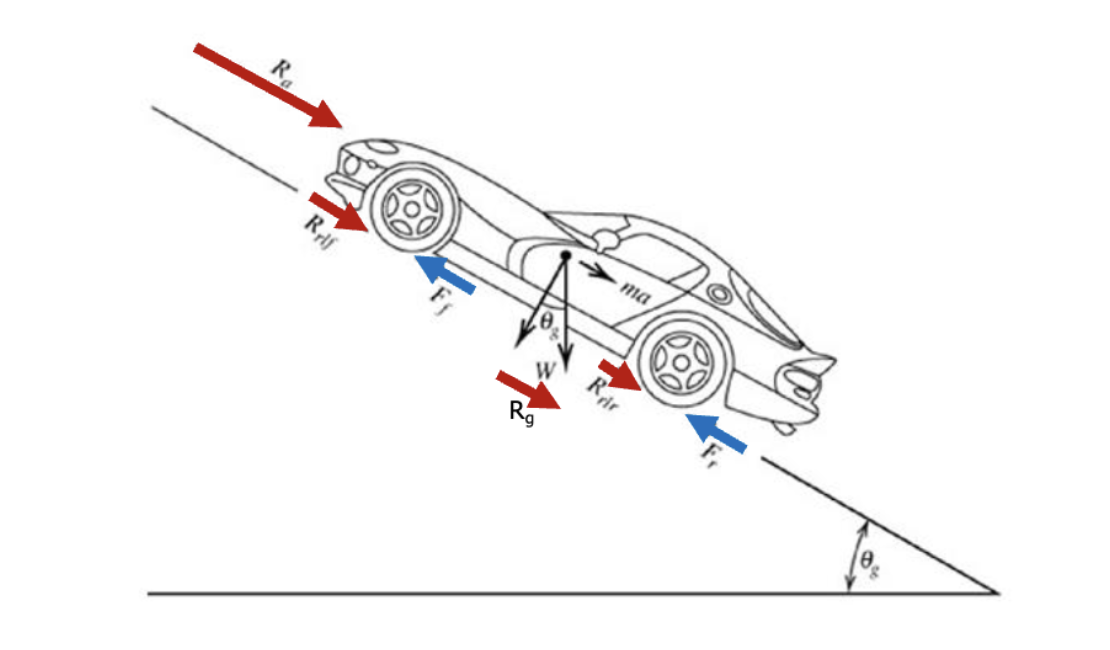
These are the two opposing forces that determine straight-line performance of road vehicles?
(1) Tractive effort (lb or N) = force available at the roadway surface to perform work in moving the vehicle in the desired direction; (2) Resistance (lb or N) = force impeding vehicle motion
What is used to determine the maximum engine power which a vehicle can utilize to overcome resistances?
The max engine power available to overcome resistance is limited by max tractive effort at road/tire interface
What are three major sources of vehicle resistance?
Aerodynamic, Rolling, and Gravitational
What are some sources of aerodynamic resistance?
Through (3%), Over (12%), and Around (85%)
Drag coefficient
is a term that implicitly accounts for all three of the aerodynamic resistances
Power
is the product of force and speed
One horsepower is equal to how many ft-lb/sec?
550 ft-lb/sec
Rolling resistance
resistance generated from a vehicle’s rolling mechanical friction
What accounts for 90% of vehicle rolling resistance?
deformation of the tire
Factors affecting rolling resistance
(1) Tire rigidity and roadway surface (2) Tire inflation pressure and temperature (3) Vehicle speed
What two components make up stopping distance?
(1) Perception/Reaction Time distance (2) Braking distance
For design purposes, the coefficient of friction used in calculating stopping signt distance assumes that the vehicle is:
f_rl = 0.01(1 + V/147); f_rl = 0.01(1 + V/44.73)
How many times greater is the design braking coefficient of friction for dry pavement compared to wet pavement?
f_dry = 2 * f_wet
Dilemma zone
an upstream section of roadway where the driver is too far away from the stopline to safely continue and too close to safely brake.