Biomechanics Exam 2

0.0(0)
Studied by 0 people
call kaiCall Kai
learnLearn
examPractice Test
spaced repetitionSpaced Repetition
heart puzzleMatch
flashcardsFlashcards
GameKnowt Play
Card Sorting

1/89

flashcard set

Earn XP

Description and Tags

UNT KINE 3050

90 Terms

1
New cards

Mechanical Work

check module 5

2
New cards

Muscle Actions and Direction of Work

3
New cards

Work-Energy Relationship

4
New cards

Kinetic vs Potential vs Strain Energy

5
New cards

Calc. KE and PE


6
New cards

Mechanical Energy Conservation


7
New cards

Power (Force/velocity relationship)

8
New cards

Torques

  • Tendency to produce a change in rotational motion 

  • Determined by: 

    • Magnitude of applied force 

    • Direction of applied force 

    • Location of applied force (off center) 

  • Force -> action that creates change in linear motion 

  • Torque is required to rotate an object 

    • (force upward-spins cc; force downwards-spins c) 

  • Created by force 

    • Depends on: 

      • Where the force is applied 

      • Point which the object rotates 

  • Examples: 

    • A door pushed at its handle will easily turn and open, but a pushed near its hinges will not move as easily 

    • Near hinges – requires more torque 

    • The force may be the same, but the torque is quite different 


Center of Rotation:

  • The point or line about an object turns is its center of rotation 

    • Ex: door’s center of rotation is at its hinges 

  • A force applied far from the center of rotation produces a greater torque than a force applied close to the center of rotation.

    • bigger the distance = bigger the torque


9
New cards

CCW and CW Torque

  • Vector quantity -> direction and magnitutde 

  • Signs: 

    • Counterclockwise torques -> positive 

    • Clockwise torques -> negative 


    • Torque (𝜏) created by a force equal to the lever arm (d) times the magnitude of the force (F). 

The conventional units: N/m 

  • Force is ALWAYS perpendicular  

  • Distance is the main determinant of the torque force 


<ul><li><p class="Paragraph SCXW26440605 BCX0" style="text-align: left;"><span style="line-height: 20.925px;">Vector quantity -&gt; <strong>direction and magnitutde</strong>&nbsp;</span></p></li></ul><ul><li><p class="Paragraph SCXW26440605 BCX0" style="text-align: left;"><span style="line-height: 20.925px;">Signs:&nbsp;</span></p><ul><li><p class="Paragraph SCXW26440605 BCX0" style="text-align: left;"><span style="line-height: 20.925px;">Counterclockwise torques -&gt; positive&nbsp;</span></p></li><li><p class="Paragraph SCXW26440605 BCX0" style="text-align: left;"><span style="line-height: 20.925px;">Clockwise torques -&gt; negative&nbsp;</span></p></li><li><p class="Paragraph SCXW26440605 BCX0" style="text-align: left;"></p></li><li><p class="Paragraph SCXW26440605 BCX0" style="text-align: left;"></p></li><li><p class="Paragraph SCXW26440605 BCX0" style="text-align: left;"><span style="line-height: 20.925px;">Torque</span><span style="line-height: normal;">&nbsp;(𝜏)&nbsp;</span><span style="line-height: 20.925px;">created by a force equal to the <strong>lever arm</strong> (d) times the <strong>magnitude of the force </strong>(F).&nbsp;</span></p></li></ul></li></ul><p class="Paragraph SCXW82090900 BCX0" style="text-align: left;"><span style="line-height: 20.925px;">The conventional units: <strong>N/m</strong>&nbsp;</span></p><ul><li><p class="Paragraph SCXW34859098 BCX0" style="text-align: left;"><span style="line-height: 20.925px;">Force is ALWAYS perpendicular&nbsp;&nbsp;</span></p></li></ul><ul><li><p class="Paragraph SCXW34859098 BCX0" style="text-align: left;"><span style="line-height: 20.925px;">Distance is the main determinant of the torque force&nbsp;</span></p></li></ul><p></p>
10
New cards

Line of Action

  • Torque is created when the line of action of a force DOES NOT pass through the center of rotation 

  • An imaginary line of indefinite length drawn along the direction of the force 

  • (sketch in the lever arm/distance -> axis of rotation to applied force) WRONG!!!! - force is at an angle!!!!!! 

  • CORRECT ANSWER -> the purple line 


<ul><li><p class="Paragraph SCXW177894426 BCX0" style="text-align: left;"><span style="line-height: 20.925px;">Torque is created when the line of action of a force <strong>DOES NOT </strong>pass through the center of rotation&nbsp;</span></p></li></ul><ul><li><p class="Paragraph SCXW177894426 BCX0" style="text-align: left;"><span style="line-height: 20.925px;">An imaginary line of indefinite length drawn along the direction of the force&nbsp;</span></p></li><li><p class="Paragraph SCXW177894426 BCX0" style="text-align: left;"><span style="line-height: 20.925px;">(sketch in the lever arm/distance -&gt; axis of rotation to applied force) <em>WRONG!!!! - force is at an angle</em>!!!!!!&nbsp;</span></p></li></ul><ul><li><p class="Paragraph SCXW256012902 BCX0" style="text-align: left;"><span style="line-height: 20.925px;"><strong><u>CORRECT ANSWER -&gt; the purple line</u></strong>&nbsp;</span></p></li></ul><p></p>
11
New cards

Moment Arms → Torques

A muscle with a small moment arm (MA) needs to produce more force to generate the same torque as a muscle with a larger moment arm B 

  • Shortest distance from a force’s line of action to the axis of rotation 

  • Always perpendicular to the line of action and passes through the axis of rotation 

  • The magnitude of the moment arm of the biceps muscle changes throughout the range of motion 


Picture

  • Attachment sites stay in same spots – only get closer due to joint angle 

  • 5 cm -> distance from center of rotation from attachment site (DOES NOT change) 

  • From axis of rotation to muscle – Moment arm (causes the angle to change – distance) 

Determined by: 

  • Distance d from axis of rotation to point at which force is applied 

  • Angle at which force is applied 


<p><span style="line-height: 20.925px;">A muscle with a <strong>small moment arm (MA)</strong> needs to <strong>produce more force </strong>to generate the <strong>same torque</strong> as a muscle with a larger moment arm B&nbsp;</span></p><ul><li><p><span style="line-height: 20.925px;"><strong>Shortest distance</strong> from a force’s line of action to the axis of rotation&nbsp;</span></p></li></ul><ul><li><p class="Paragraph SCXW199231490 BCX0" style="text-align: left;"><span style="line-height: 20.925px;"><strong>Always perpendicular </strong>to the line of action and passes through the axis of rotation&nbsp;</span></p></li><li><p class="Paragraph SCXW199231490 BCX0" style="text-align: left;"><span style="line-height: 20.925px;">The <strong>magnitude of the moment arm</strong> of the biceps muscle changes throughout the range of motion&nbsp;</span></p></li></ul><p class="Paragraph SCXW199231490 BCX0" style="text-align: left;"></p><p class="Paragraph SCXW199231490 BCX0" style="text-align: left;">Picture</p><ul><li><p class="Paragraph SCXW194313587 BCX0" style="text-align: left;"><span style="line-height: 20.925px;">Attachment sites stay in same spots – only get closer due to joint angle&nbsp;</span></p></li></ul><ul><li><p class="Paragraph SCXW194313587 BCX0" style="text-align: left;"><span style="line-height: 20.925px;">5 cm -&gt; distance from center of rotation from attachment site (DOES NOT change)&nbsp;</span></p></li></ul><ul><li><p class="Paragraph SCXW194313587 BCX0" style="text-align: left;"><span style="line-height: 20.925px;">From axis of rotation to muscle – Moment arm (causes the angle to change – distance)&nbsp;</span></p></li></ul><p class="Paragraph SCXW85307537 BCX0" style="text-align: left;"><span style="line-height: 20.925px;"><strong><u>Determined by:&nbsp;</u></strong></span></p><ul><li><p class="Paragraph SCXW85307537 BCX0" style="text-align: left;"><span style="line-height: 20.925px;">Distance d from axis of rotation to point at which force is applied&nbsp;</span></p></li></ul><ul><li><p class="Paragraph SCXW85307537 BCX0" style="text-align: left;"><span style="line-height: 20.925px;">Angle at which force is applied&nbsp;</span></p></li></ul><p></p>
12
New cards

Center of Mass

  • Point in a body or system where the entire mass may be assumed to be concentrated

    • an imaginary point in space

    • not a physical entity

    • not a fixed point

      • changes when parts of an object changes position

  • The force of gravity (Fg) acts downward through the center of mass


<ul><li><p>Point in a body or system where the entire mass may be assumed to be concentrated</p><ul><li><p>an imaginary point in space</p></li><li><p>not a physical entity</p></li><li><p>not a fixed point</p><ul><li><p>changes when parts of an object changes position</p></li></ul></li></ul></li><li><p>The force of gravity (Fg) <strong>acts downward</strong> through the center of mass</p></li></ul><p></p>
13
New cards

Equilibrum (sum of force and torque equals to zero)

14
New cards

Centric and Eccentric Forces

  • Centric Forces → act through COG and ONLY CAUSE linear motion


  • Eccentric Forces → act off-center producing both linear and rotational motion (torque)


15
New cards

Mechanical Advantage and Disadvantages

  • Mechanical advantage (MA) -> ratio of effort arm to resistance arm (EA:RA) 

  • A lever will either favor power or distance (ROM), but NOT BOTH

    • any advantage gained in power is lost in distance and vice versa


disadvantage!!! → is when the Load Arm is greater than the Effort Arm

  • sacrifices force for speed or ROM


16
New cards

Stability, balance, and agility

Stability

  • Directly proportional to the area of the base on which the body rests 

    • In a given direction is directly proportional to the horizontal distance of the center of gravity from that edge of the base toward the given direction of movement 

  • Directly proportional to the weight of the body 

  • Indirectly proportional to the distance of the body above the base 

    • Tippy toes – less stable 

    • Flat feet – more stable 


  • Depends on:

    • State of equilibrium: balance and forces are equal 

    • Gravity  

    • Gravitational force 

    • Center of gravity 

    • Base of support 

    • Line of gravity  

E is most stable while A is least stable


<p>Stability </p><ul><li><p class="Paragraph SCXW212963977 BCX0" style="text-align: left;"><span style="line-height: 20.925px;"><strong>Directly proportional</strong> to the <u>area of the base</u> on which the body rests&nbsp;</span></p><ul><li><p class="Paragraph SCXW212963977 BCX0" style="text-align: left;"><span style="line-height: 20.925px;">In a given direction is directly proportional to the horizontal distance of the center of gravity from that edge of the base toward the given direction of movement&nbsp;</span></p></li></ul></li></ul><ul><li><p class="Paragraph SCXW212963977 BCX0" style="text-align: left;"><span style="line-height: 20.925px;">Directly proportional to the <u>weight of the body</u>&nbsp;</span></p></li></ul><ul><li><p class="Paragraph SCXW212963977 BCX0" style="text-align: left;"><span style="line-height: 20.925px;">Indirectly proportional to the <u>distance of the body </u><strong><u>above</u></strong><u> the base</u>&nbsp;</span></p><ul><li><p class="Paragraph SCXW212963977 BCX0" style="text-align: left;"><span style="line-height: 20.925px;">Tippy toes – less stable&nbsp;</span></p></li><li><p class="Paragraph SCXW212963977 BCX0" style="text-align: left;"><span style="line-height: 20.925px;">Flat feet – more stable&nbsp;</span></p></li></ul></li></ul><p></p><ul><li><p class="Paragraph SCXW67247467 BCX0" style="text-align: left;"><span style="line-height: 20.925px;">Depends on:</span></p><ul><li><p class="Paragraph SCXW67247467 BCX0" style="text-align: left;"><span style="line-height: 20.925px;"><strong>State of equilibrium</strong>: balance and forces are equal&nbsp;</span></p></li><li><p class="Paragraph SCXW67247467 BCX0" style="text-align: left;"><span style="line-height: 20.925px;"><strong>Gravity&nbsp;</strong>&nbsp;</span></p></li><li><p class="Paragraph SCXW67247467 BCX0" style="text-align: left;"><span style="line-height: 20.925px;"><strong>Gravitational force</strong>&nbsp;</span></p></li><li><p class="Paragraph SCXW67247467 BCX0" style="text-align: left;"><span style="line-height: 20.925px;"><strong>Center of gravity</strong>&nbsp;</span></p></li><li><p class="Paragraph SCXW67247467 BCX0" style="text-align: left;"><span style="line-height: 20.925px;"><strong>Base of support</strong>&nbsp;</span></p></li><li><p class="Paragraph SCXW67247467 BCX0" style="text-align: left;"><span style="line-height: 20.925px;"><strong>Line of gravity&nbsp;</strong>&nbsp;</span></p></li></ul></li></ul><p class="Paragraph SCXW67247467 BCX0" style="text-align: left;">E is most stable while A is least stable</p><p></p>
17
New cards

Ways to improve/increase stability

18
New cards

Rotation and Leverage

  • The outcome of a torque is to produce a rotation about an axis 

  • Lever -> rigid rod that is rotated about a fixed point or axis 

  • Lever components: 

    • Resistance/load arm (RA or LA) 

    • Effort force (EF) 

    • Effort/load arm (EA/LA) 

    • Fulcrum arm (FA) 

  • Load motion and Effort motion are opposite of each other – Newton’s third law 

    • Effort is down and Load is up


<ul><li><p class="Paragraph SCXW229327922 BCX0" style="text-align: left;"><span style="line-height: 20.925px;">The outcome of a torque is to produce a <strong>rotation about an axis</strong>&nbsp;</span></p></li></ul><ul><li><p class="Paragraph SCXW229327922 BCX0" style="text-align: left;"><span style="line-height: 20.925px;"><strong>Lever -&gt;</strong> rigid rod that is rotated about a fixed point or axis&nbsp;</span></p></li><li><p class="Paragraph SCXW229327922 BCX0" style="text-align: left;"><span style="line-height: 20.925px;">Lever components:&nbsp;</span></p><ul><li><p class="Paragraph SCXW229327922 BCX0" style="text-align: left;"><span style="line-height: 20.925px;">Resistance/load arm (RA or LA)&nbsp;</span></p></li><li><p class="Paragraph SCXW229327922 BCX0" style="text-align: left;"><span style="line-height: 20.925px;">Effort force (EF)&nbsp;</span></p></li><li><p class="Paragraph SCXW229327922 BCX0" style="text-align: left;"><span style="line-height: 20.925px;">Effort/load arm (EA/LA)&nbsp;</span></p></li><li><p class="Paragraph SCXW229327922 BCX0" style="text-align: left;"><span style="line-height: 20.925px;">Fulcrum arm (FA)&nbsp;</span></p></li></ul></li></ul><ul><li><p class="Paragraph SCXW44874719 BCX0" style="text-align: left;"><span style="line-height: 20.925px;">Load motion and Effort motion are opposite of each other – Newton’s third law&nbsp;</span></p><ul><li><p class="Paragraph SCXW44874719 BCX0" style="text-align: left;"><span style="line-height: 20.925px;">Effort is down and Load is up</span></p></li></ul></li></ul><p></p>
19
New cards

Levers

  • A simple machine consisting of a relatively rigid bar-like body that can be made to rotate about an axis or fulcrum 

  • Classification depends on relative position of the force, applied force, resistance, and fulcrum 

    • 1st class 

    • 2nd class 

    • 3rd class 

  • Interaction between internal and external forces ultimately controls movement 

  • These forces interact through a system of bony levers, with the pivot point located at the axis of rotation of our joints

  • Through these systems of levers, the internal and external forces are converted to internal and external torques, which ultimately cause movement (or rotation) of our joints.

  • 3 masses of levers, each with different purpose and mechanical advantage 

  • Mechanical advantage (MA) -> ratio of effort arm to resistance arm (EA:RA) 

  • A lever will either favor power or distance (ROM), but NOT BOTH

    • any advantage gained in power is lost in distance and vice versa

  • Arrangement of the axis in relation to the force and the resistance determines the TYPE of lever 

    • Loner the FA, easier to move 

      • With longer the FA, the part will be easier to move but the FA will have to move a greater distance

    • Longer the RA, harder to move

      • with a longer RA, won;t have to move as far, but it will be harder to move


<ul><li><p class="Paragraph SCXW180175176 BCX0" style="text-align: left;"><span style="line-height: 20.925px;">A simple machine consisting of a relatively rigid bar-like body that can be made to rotate about an axis or fulcrum&nbsp;</span></p></li></ul><ul><li><p class="Paragraph SCXW180175176 BCX0" style="text-align: left;"><span style="line-height: 20.925px;">Classification depends on relative <strong>position of the force, applied force, resistance, and fulcrum</strong>&nbsp;</span></p><ul><li><p class="Paragraph SCXW180175176 BCX0" style="text-align: left;"><span style="line-height: 20.925px;">1<sup>st</sup> class&nbsp;</span></p></li><li><p class="Paragraph SCXW180175176 BCX0" style="text-align: left;"><span style="line-height: 20.925px;">2<sup>nd</sup> class&nbsp;</span></p></li><li><p class="Paragraph SCXW180175176 BCX0" style="text-align: left;"><span style="line-height: 20.925px;">3<sup>rd</sup> class&nbsp;</span></p></li></ul></li></ul><ul><li><p class="Paragraph SCXW180175176 BCX0" style="text-align: left;"><span style="line-height: 20.925px;">Interaction between <strong>internal and external forces</strong> ultimately controls movement&nbsp;</span></p></li></ul><ul><li><p class="Paragraph SCXW180175176 BCX0" style="text-align: left;"><span style="line-height: 20.925px;">These forces interact through a system of bony levers, with the pivot point located at the axis of rotation of our joints</span></p></li><li><p class="Paragraph SCXW180175176 BCX0" style="text-align: left;"><span style="line-height: 20.925px;">Through these systems of levers, the internal and external forces are converted to internal and external torques, which ultimately cause movement (or rotation) of our joints.</span></p></li></ul><ul><li><p class="Paragraph SCXW180175176 BCX0" style="text-align: left;"><span style="line-height: 20.925px;">3 masses of levers, each with different purpose and mechanical advantage&nbsp;</span></p></li></ul><ul><li><p class="Paragraph SCXW180175176 BCX0" style="text-align: left;"><span style="line-height: 20.925px;"><strong>Mechanical advantage (MA) -&gt; </strong>ratio of effort arm to resistance arm (EA:RA)&nbsp;</span></p></li><li><p class="Paragraph SCXW180175176 BCX0" style="text-align: left;"><span style="line-height: 20.925px;">A lever will either favor power or distance (ROM), but NOT BOTH</span></p><ul><li><p class="Paragraph SCXW180175176 BCX0" style="text-align: left;">any advantage gained in power is lost in distance and vice versa</p></li></ul></li></ul><ul><li><p class="Paragraph SCXW180175176 BCX0" style="text-align: left;"><span style="line-height: 20.925px;">Arrangement of the axis in relation to the force and the resistance determines the TYPE of lever&nbsp;</span></p><ul><li><p class="Paragraph SCXW180175176 BCX0" style="text-align: left;"><span style="line-height: 20.925px;">Loner the FA, easier to move&nbsp;</span></p><ul><li><p class="Paragraph SCXW180175176 BCX0" style="text-align: left;"><span style="line-height: 20.925px;">With longer the FA, the part will be easier to move but the FA will have to move a greater distance</span></p></li></ul></li><li><p class="Paragraph SCXW180175176 BCX0" style="text-align: left;">Longer the RA, harder to move</p><ul><li><p class="Paragraph SCXW180175176 BCX0" style="text-align: left;">with a longer RA, won;t have to move as far, but it will be harder to move</p></li></ul></li></ul></li></ul><p></p>
20
New cards

1st Class Lever

  • Fulcrum is located between the load and effort 

  • Examples: 

    • Teeter-totter 

    • Car jack 

    • Crowbar 

  • Very useful for lifting large loads with little effort 


<ul><li><p class="Paragraph SCXW260853278 BCX0" style="text-align: left;"><span style="line-height: 20.925px;">Fulcrum is located between the load and effort&nbsp;</span></p></li></ul><ul><li><p class="Paragraph SCXW260853278 BCX0" style="text-align: left;"><span style="line-height: 20.925px;">Examples:&nbsp;</span></p><ul><li><p class="Paragraph SCXW260853278 BCX0" style="text-align: left;"><span style="line-height: 20.925px;">Teeter-totter&nbsp;</span></p></li><li><p class="Paragraph SCXW260853278 BCX0" style="text-align: left;"><span style="line-height: 20.925px;">Car jack&nbsp;</span></p></li><li><p class="Paragraph SCXW260853278 BCX0" style="text-align: left;"><span style="line-height: 20.925px;">Crowbar&nbsp;</span></p></li></ul></li></ul><ul><li><p class="Paragraph SCXW260853278 BCX0" style="text-align: left;"><span style="line-height: 20.925px;">Very useful for lifting large loads with little effort&nbsp;</span></p></li></ul><p></p>
21
New cards

2nd Class Lever

  • Load is located between the effort and the fulcrum 

  • Ex: 

    • Wheelbarrow 

    • Bottle opener 

    • Oar 

  • Easier to move objects over distance 


<ul><li><p class="Paragraph SCXW62615227 BCX0" style="text-align: left;"><span style="line-height: 20.925px;">Load is located between the effort and the fulcrum&nbsp;</span></p></li></ul><ul><li><p class="Paragraph SCXW62615227 BCX0" style="text-align: left;"><span style="line-height: 20.925px;">Ex:&nbsp;</span></p><ul><li><p class="Paragraph SCXW62615227 BCX0" style="text-align: left;"><span style="line-height: 20.925px;">Wheelbarrow&nbsp;</span></p></li><li><p class="Paragraph SCXW62615227 BCX0" style="text-align: left;"><span style="line-height: 20.925px;">Bottle opener&nbsp;</span></p></li><li><p class="Paragraph SCXW62615227 BCX0" style="text-align: left;"><span style="line-height: 20.925px;">Oar&nbsp;</span></p></li></ul></li></ul><ul><li><p class="Paragraph SCXW62615227 BCX0" style="text-align: left;"><span style="line-height: 20.925px;">Easier to move objects over distance&nbsp;</span></p></li></ul><p></p>
22
New cards

3rd Class Lever

  • Effort is located between the load and the fulcrum 

  • Ex: 

    • Pair of tweezers  

    • Swinging a baseball bat 

    • Using your arm to lift something 

  • Make percise movements 


<ul><li><p class="Paragraph SCXW264549268 BCX0" style="text-align: left;"><span style="line-height: 20.925px;">Effort is located between the load and the fulcrum&nbsp;</span></p></li></ul><ul><li><p class="Paragraph SCXW264549268 BCX0" style="text-align: left;"><span style="line-height: 20.925px;">Ex:&nbsp;</span></p><ul><li><p class="Paragraph SCXW264549268 BCX0" style="text-align: left;"><span style="line-height: 20.925px;">Pair of tweezers&nbsp;&nbsp;</span></p></li><li><p class="Paragraph SCXW264549268 BCX0" style="text-align: left;"><span style="line-height: 20.925px;">Swinging a baseball bat&nbsp;</span></p></li><li><p class="Paragraph SCXW264549268 BCX0" style="text-align: left;"><span style="line-height: 20.925px;">Using your arm to lift something&nbsp;</span></p></li></ul></li></ul><ul><li><p class="Paragraph SCXW264549268 BCX0" style="text-align: left;"><span style="line-height: 20.925px;">Make percise movements&nbsp;</span></p></li></ul><p></p>
23
New cards
  1. Torque is generated by a turning effect called the ______________.


a) eccentric force

b) concentric force

c) centric force

d) extracentric force

A

24
New cards
  1. When performing a push‑up, which type of lever is formed by the body, and how are the fulcrum, internal force, and external force arranged?


a) 2nd class

b) 4th class

c) 1st class

d) 3rd class

A

25
New cards

3) Cole attempts a biceps curl using a 150 N dumbbell. The dumbbell’s moment arm about the elbow is 25 cm. His elbow flexor muscles produce 2000 N of force with a 2 cm moment arm. Based on these values, is Cole able to lift the weight?


 a) No — his muscle torque is equal to the dumbbell torque

b) Yes — but only if he increases the speed of the movement

c) No — his muscle torque is less than the dumbbell torque

d) Yes — his muscle torque exceeds the torque of the dumbbell

D

26
New cards
  1. When no external torque is acting, a decrease in the moment of inertia will cause which quantity to increase?


a) angular velocity

b) none of the above

c) both angular momentum and angular velocity

d) angular momentum

A

27
New cards
  1. Torque is the rotational counterpart of which linear quantity?


a) force

b) mass

c) impulse

d) momentum

A

28
New cards
  1. Which factors determine an object's moment of inertia?


a) M and v

b) T and t

c) m and k

d) F and d

C

29
New cards
  1. When a diver moves from a full layout position into a tuck, how does her angular velocity change?


a) remain the same

b) need more information

c) increases

d) decreases

C

30
New cards
  1. As a cyclist moves through a curve, in what direction does the centripetal force act on the rider?


a) on the cyclist's center of gravity

b) on the tires of the cycle

c) on the cycle's center of gravity

d) on the ground

A

31
New cards

Kinematics → Angular motion

  • Angular motion -> all parts of a body move through the same angle/axis.  

  • In studying the kinematics of rotational motion, the concepts are 

    • 1. Angular Displacement Δθ 

    • 2. Angular velocity ω 

    • 3. Angular acceleration α


32
New cards

Kinematics → Angles

  • Components 

    • 1. 2 lines or planes 

    • 2. Vertex or intersection 

  • Units: 

    • Degree -> 360 in a circle 

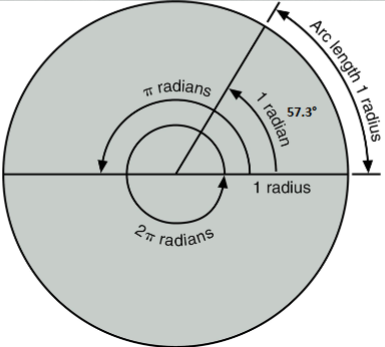
    • Radian -> 1 rad – 57.3 degrees 

      • Rotating angular and linear motion 

  • Revolution (turn, twist): complete 360 rotation 


Radian ( r )

The instantaneous position of the object executing a circular orbit of radius r is most conveniently specified in terms of an angle θ 𝜃 

 Describes the ratio between the arc length (s) and the radius (r) θ = s/r

  • Consider an arc length around the full circle 

  • Angular measure in radians would be... θ = s/r = 2πr/r= 2π

<ul><li><p class="Paragraph SCXW27377637 BCX0" style="text-align: left;"><span style="line-height: 20.925px;"><strong>Components</strong>&nbsp;</span></p><ul><li><p class="Paragraph SCXW27377637 BCX0" style="text-align: left;"><span style="line-height: 20.925px;">1. 2 lines or planes&nbsp;</span></p></li><li><p class="Paragraph SCXW27377637 BCX0" style="text-align: left;"><span style="line-height: 20.925px;">2. Vertex or intersection&nbsp;</span></p></li></ul></li></ul><ul><li><p class="Paragraph SCXW27377637 BCX0" style="text-align: left;"><span style="line-height: 20.925px;"><strong>Units</strong>:&nbsp;</span></p><ul><li><p class="Paragraph SCXW27377637 BCX0" style="text-align: left;"><span style="line-height: 20.925px;">Degree -&gt; 360 in a circle&nbsp;</span></p></li><li><p class="Paragraph SCXW27377637 BCX0" style="text-align: left;"><span style="line-height: 20.925px;"><strong>Radian -&gt; 1 rad – 57.3 degrees</strong>&nbsp;</span></p><ul><li><p class="Paragraph SCXW27377637 BCX0" style="text-align: left;"><span style="line-height: 20.925px;"><strong>Rotating angular and linear motion</strong>&nbsp;</span></p></li></ul></li></ul></li></ul><ul><li><p class="Paragraph SCXW27377637 BCX0" style="text-align: left;"><span style="line-height: 20.925px;">Revolution (turn, twist): complete 360 rotation&nbsp;</span></p></li></ul><p></p><p>Radian ( r )</p><p class="Paragraph SCXW37714769 BCX0" style="text-align: center;"><span style="line-height: 20.925px;">The <strong>instantaneous position</strong> of the object executing a circular orbit of <strong>radius r </strong>is most conveniently specified in terms of an <strong>angle </strong></span><span style="line-height: normal;">θ&nbsp;𝜃&nbsp;</span></p><p><span style="line-height: 20.925px;">&nbsp;Describes the <strong>ratio between the arc length (s)</strong> and the <strong>radius (r) </strong></span><span style="line-height: normal;">θ = s/r   </span></p><ul><li><p class="Paragraph SCXW37714769 BCX0" style="text-align: left;"><span style="line-height: 20.925px;">Consider an arc length around the full circle&nbsp;</span></p></li></ul><ul><li><p class="Paragraph SCXW37714769 BCX0" style="text-align: left;"><span style="line-height: 20.925px;">Angular measure in radians would be...&nbsp;</span><span style="line-height: normal;">θ = s/r = 2πr/r= 2π</span></p></li></ul><p></p>
33
New cards

Absolute Angles

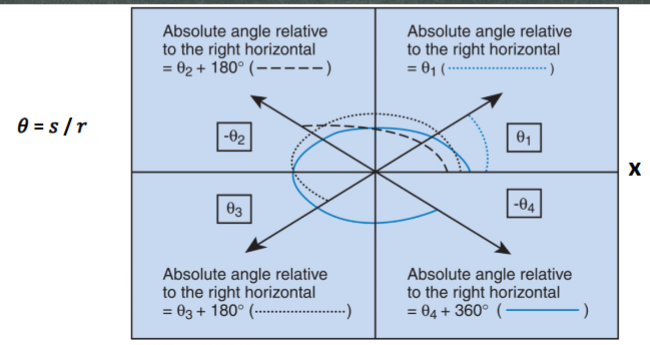
  • Measured from an external frame of reference 

  • The most usual convention is to measure the angle anti-clockwise from the right horizontal 

  • Quad – 2 and 4 (negative) 


Angular Position:

  • Absolute angular position 

    • One line or plane is fixed and immovable relative to the Earth

      • Orientation of a body part to the horizontal or vertical

Angular Displacement:

  • Change in absolute angular position experienced by a rotating line 

    • Angle between the final and initial angular positions 

      • Angular displacement = Δθ=θf−θi

    • Range of motion (ROM): anatomical displacement 

  • Specifying direction of angular displacement 

    • Clockwise (-) or counterclockwise (+)

    • Note: must specify view position as clarification

<ul><li><p class="Paragraph SCXW238248859 BCX0" style="text-align: left;"><span style="line-height: 20.925px;">Measured from an <strong>external frame of reference</strong>&nbsp;</span></p></li></ul><ul><li><p class="Paragraph SCXW238248859 BCX0" style="text-align: left;"><span style="line-height: 20.925px;">The most usual convention is to measure the angle <strong>anti-clockwise from the right horizontal</strong>&nbsp;</span></p></li><li><p class="Paragraph SCXW238248859 BCX0" style="text-align: left;"><span style="line-height: 20.925px;">Quad – 2 and 4 (negative)&nbsp;</span></p></li></ul><p class="Paragraph SCXW238248859 BCX0" style="text-align: left;"></p><p class="Paragraph SCXW238248859 BCX0" style="text-align: left;">Angular Position:</p><ul><li><p class="Paragraph SCXW138414094 BCX0" style="text-align: left;"><span style="line-height: 20.925px;">Absolute angular position&nbsp;</span></p><ul><li><p class="Paragraph SCXW138414094 BCX0" style="text-align: left;"><span style="line-height: 20.925px;">One line or plane is fixed and immovable relative to the Earth</span></p><ul><li><p class="Paragraph SCXW138414094 BCX0" style="text-align: left;">Orientation of a body part to the horizontal or vertical</p></li></ul></li></ul></li></ul><p class="Paragraph SCXW138414094 BCX0" style="text-align: left;">Angular Displacement:</p><ul><li><p class="Paragraph SCXW126860167 BCX0" style="text-align: left;"><span style="line-height: 20.925px;"><strong>Change in absolute angular position</strong> experienced by a rotating line&nbsp;</span></p><ul><li><p class="Paragraph SCXW126860167 BCX0" style="text-align: left;"><span style="line-height: 20.925px;">Angle between the final and initial angular positions&nbsp;</span></p><ul><li><p class="Paragraph SCXW126860167 BCX0" style="text-align: left;"><span style="line-height: 20.925px;">Angular displacement = </span><span style="line-height: normal;">Δθ=θf−θi</span></p></li></ul></li><li><p class="Paragraph SCXW126860167 BCX0" style="text-align: left;"><span style="line-height: 20.925px;">Range of motion (ROM): anatomical displacement&nbsp;</span></p></li></ul></li></ul><ul><li><p class="Paragraph SCXW126860167 BCX0" style="text-align: left;"><span style="line-height: 20.925px;">Specifying direction of angular displacement&nbsp;</span></p><ul><li><p class="Paragraph SCXW126860167 BCX0" style="text-align: left;"><span style="line-height: 20.925px;">Clockwise (-) or counterclockwise (+)</span></p></li><li><p class="Paragraph SCXW126860167 BCX0" style="text-align: left;"><span style="line-height: 20.925px;">Note: must specify view position as clarification</span></p></li></ul></li></ul><p></p>
34
New cards

Relative Angles

  • Relative angular position 

    • Both lines or planes are capable of moving 

    • Joint angle: angle between two body segments 


<ul><li><p class="Paragraph SCXW73722393 BCX0" style="text-align: left;"><span style="line-height: 20.925px;">Relative angular position&nbsp;</span></p><ul><li><p class="Paragraph SCXW73722393 BCX0" style="text-align: left;"><span style="line-height: 20.925px;">Both lines or planes are capable of moving&nbsp;</span></p></li><li><p class="Paragraph SCXW73722393 BCX0" style="text-align: left;"><span style="line-height: 20.925px;">Joint angle: angle between two body segments&nbsp;</span></p></li></ul></li></ul><p></p>
35
New cards

Kinematics → Right hand rule!!!! → Angular direction

  • The right-hand thumb rule is used to show the direction of angular motion 

  • Axis of rotation is always perpendicular to the plane of motion 

    • Align right thumb with axis of rotation in positive direction 

    • Fingers of right-hand curl in the + direction of rotation. 


<ul><li><p class="Paragraph SCXW102747929 BCX0" style="text-align: left;"><span style="line-height: 20.925px;">The right-hand thumb rule is used to show the direction of angular motion&nbsp;</span></p></li></ul><ul><li><p class="Paragraph SCXW102747929 BCX0" style="text-align: left;"><span style="line-height: 20.925px;">Axis of rotation is <strong>always perpendicular</strong> to the plane of motion&nbsp;</span></p><ul><li><p class="Paragraph SCXW102747929 BCX0" style="text-align: left;"><span style="line-height: 20.925px;">Align right thumb with <strong>axis of rotation in positive direction</strong>&nbsp;</span></p></li><li><p class="Paragraph SCXW102747929 BCX0" style="text-align: left;"><span style="line-height: 20.925px;">Fingers of right-hand curl in the + <strong><em>direction of rotation</em></strong>.&nbsp;</span></p></li></ul></li></ul><p></p>
36
New cards

Kinematics → Calc. angular distance/displacement and speed/velocity

  • For linear motion, a particle with a larger velocity undergoes a greater

    displacement

  • For uniform circular motion, a particle with a larger angular velocity will undergo a greater angular displacement, Δθ

  • Angular velocity is the angular displacement through which the particle moves each second [EXAM}

    • Uniform velocity = the sum of outside forces is ZERO!!!!


  • Pendulum example 

    • Small angular velocity -> small displacement 

    • Large angular velocity -> larger displacement 

    • Mass and weight is the same, same with the tension 

    • Which has the greatest velocity and why? 

      • Blue – greater angular displacement 

      • Black – lowest, least angular displacement 
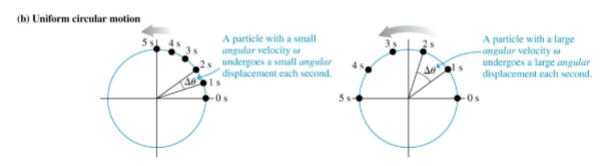

<ul><li><p>For linear motion, a particle with a larger velocity undergoes a greater</p><p>displacement</p></li><li><p>For uniform circular motion, a particle with a larger angular velocity will undergo a greater angular displacement, Δθ</p></li><li><p>Angular velocity is the angular displacement through which the particle moves each second [EXAM}</p><ul><li><p>Uniform velocity = the sum of outside forces is ZERO!!!!</p></li></ul></li></ul><p></p><ul><li><p class="Paragraph SCXW49456070 BCX0" style="text-align: left;"><span style="line-height: 20.925px;"><u>Pendulum example</u>&nbsp;</span></p><ul><li><p class="Paragraph SCXW49456070 BCX0" style="text-align: left;"><span style="line-height: 20.925px;"><u>Small angular velocity -&gt; small displacement</u>&nbsp;</span></p></li><li><p class="Paragraph SCXW49456070 BCX0" style="text-align: left;"><span style="line-height: 20.925px;"><u>Large angular velocity -&gt; larger displacement</u>&nbsp;</span></p></li><li><p class="Paragraph SCXW49456070 BCX0" style="text-align: left;"><span style="line-height: 20.925px;">Mass and weight is the same, same with the tension&nbsp;</span></p></li><li><p class="Paragraph SCXW49456070 BCX0" style="text-align: left;"><span style="line-height: 20.925px;">Which has the greatest velocity and why?&nbsp;</span></p><ul><li><p class="Paragraph SCXW49456070 BCX0" style="text-align: left;"><span style="line-height: 20.925px;">Blue – greater angular displacement&nbsp;</span></p></li><li><p class="Paragraph SCXW49456070 BCX0" style="text-align: left;"><span style="line-height: 20.925px;">Black – lowest, least angular displacement&nbsp;</span></p></li></ul></li></ul></li></ul><p></p>
37
New cards

Kinematics → Relationship between Linear and Angular motion (linear distance and speed)

  • A point farther from the axis of rotation travels a greater linear distance than a point closer to the axis 

  • Implements serve to lengthen body segments 


Ang. Position and Displacement

  • Angular position defines an object’s position relative to a defined spatial reference system 

  • Angular displacement defines the change in angular position 

  • Angular displacement is a vector.  

  • Mathematically ℓ =Δθr

  • Displacement -> change in position 

  • Distance -> how much ground an object had covered during its motion 
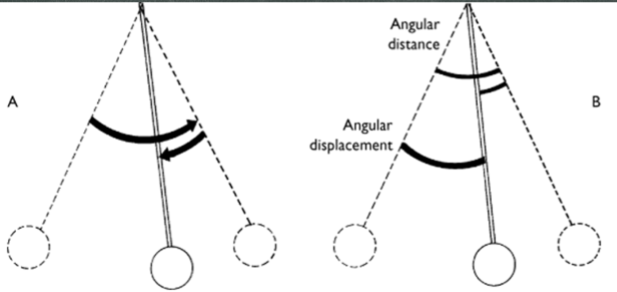

<ul><li><p class="Paragraph SCXW106412271 BCX0" style="text-align: left;"><span style="line-height: 20.925px;">A poin<strong>t farther </strong>from the axis of rotation travels a greater linear distance than a point closer to the axis&nbsp;</span></p></li></ul><ul><li><p class="Paragraph SCXW106412271 BCX0" style="text-align: left;"><span style="line-height: 20.925px;">Implements serve to lengthen body segments&nbsp;</span></p></li></ul><p class="Paragraph SCXW106412271 BCX0" style="text-align: left;"></p><p class="Paragraph SCXW106412271 BCX0" style="text-align: left;">Ang. Position and Displacement</p><ul><li><p class="Paragraph SCXW11167010 BCX0" style="text-align: left;"><span style="line-height: 20.925px;">Angular position defines an <strong>object’s position </strong>relative to a defined spatial reference system&nbsp;</span></p></li></ul><ul><li><p class="Paragraph SCXW11167010 BCX0" style="text-align: left;"><span style="line-height: 20.925px;">Angular displacement defines the <strong>change in angular position</strong>&nbsp;</span></p></li></ul><ul><li><p class="Paragraph SCXW11167010 BCX0" style="text-align: left;"><span style="line-height: 20.925px;">Angular displacement is a <strong>vector</strong>.&nbsp;&nbsp;</span></p></li></ul><ul><li><p class="Paragraph SCXW11167010 BCX0" style="text-align: left;"><span style="line-height: 20.925px;">Mathematically&nbsp;</span><span style="line-height: normal;">ℓ =Δθr</span></p></li></ul><ul><li><p class="Paragraph SCXW131589739 BCX0" style="text-align: left;"><span style="line-height: 20.925px;">Displacement -&gt; change in position&nbsp;</span></p></li></ul><ul><li><p class="Paragraph SCXW131589739 BCX0" style="text-align: left;"><span style="line-height: 20.925px;">Distance -&gt; how much ground an object had covered during its motion&nbsp;</span></p></li></ul><p></p>
38
New cards

Kinematics → Angular Velocity

  • Rate of change of angular position 

  • How fast the body is rotating (rads/s or °/s) → ϖ = (Δθ (Δt) (degrees/seconds) 


39
New cards

Kinematics → Angular and Linear Velocity

  • Points father from an axis of rotation travel greater linear path than points closer to an axis of rotation at the same time 

    • Father: greater distance (and greater displacement) 

  • Points farther from an axis of rotation travel at a greater linear speed (and greater instantaneous linear velocity) than points closer to an axis of rotation.  


Tangential Linear Velocity

  • Velocity -> vector (both mag and direction) 

  • Tangential linear veloicty of a rotating body 

    • Magnitude 

    • Direction 

  • How fast and in what direction the point is moving at an instant in time


40
New cards

Kinematics → Components of angular acceleration

  • Rate of change of angular velocity  

  • Starts, stop, speeding up, slowing down, changes of axis of rotation

  • Equation → α= Δω/Δt = (ωf−ωi)/(tf−ti) [rads/s²] or [degree/s²]


Direction specification follows the right-hand rule

  • Align right thumb with axis or rotation in positive direction

  • Fingers of right hand curl in the + direction of rotation


Speeding up or starting → Ang. acc is in the DIRECTION of angular motion

Slowing down or stopping → ang. acc is is the OPPOSITIE direction of angular motion

Sign of velocity and sign of acceleration the same → body is rotating faster (speeding up)

Sign of velocity and sign of acceleration the opposite → the body is slower (slowing down)


41
New cards

Kinetics → linear vs angular kinetic quantities

  • When ⍵ increases, the vT of points on the body increase

  • Tangential acceleration: component of linear acceleration tangential to the circular path

  • Centripetal (radial) acceleration: component of linear acceleration to the center (radius) of the circular path

  • Centripetal acceleration → change in the direction of tangential velocity

    • If ⍵ is constant, ar is directly proportional to the radius

    • If vT is constant, ar is inversely proportional to the radius

    • ar greater running on inside lane compared to the outside lane

      • There must be a force causing the change in linear velocity

        • Object on a circular path: centripetal force (toward the center)

  • Tangential acceleration → any change in the magnitude of the tangential velocity


42
New cards
  1. During sprinting, a knee angle measured at 85° from vertical represents what type of angle?


a) complimentary angle

b) relative angle

c) absolute angle

d) obtuse angle

C

43
New cards
<ol start="2"><li><p>Given the motion shown, what is the angular displacement if the initial angle is 25° from vertical and the final angle is 165° from vertical?</p></li></ol><p>&nbsp;</p><p>a) -190 degrees</p><p>b) 140 degrees</p><p>c) -140 degrees</p><p>d) 190 degrees</p>
  1. Given the motion shown, what is the angular displacement if the initial angle is 25° from vertical and the final angle is 165° from vertical?


a) -190 degrees

b) 140 degrees

c) -140 degrees

d) 190 degrees

B

44
New cards
  1. During elbow flexion, an athlete generates an angular velocity of 3 radians per second. If the movement lasts 0.8 seconds, what is the total change in angular position in degrees?


a) 137 degrees

b) 86 degrees

c) 172 degrees

d) 103 degrees

A

45
New cards
  1. Angular position (θ) can take any chosen value and is defined relative to an arbitrary reference direction.


True

 or

False

TRUE

46
New cards
  1. One full revolution contains how many radians?


a) 180

b) 6.28

c) 3.14

d) 360

B

47
New cards
  1. __________________ refers to motion in a straight line, while __________________ refers to motion along a curved path.


a) Angular motion; linear motion

b) Curvilinear motion; rectilinear motion

c) Linear motion; angular motion

d) Rectilinear motion; curvilinear motion

D

48
New cards
  1. The center of mass lies at the point where the three cardinal planes intersect.


True

 or

False

TRUE

49
New cards
<p>Kinetics → Angular Power</p>

Kinetics → Angular Power

  • the rate of change in angular work 

  • Power is a scalar quantity 

  • Units = watts (J/s) 

(torque and ang. Velocity)


Muscle Power (picture)

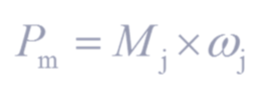
  • Determined by calculating net torque at the joint and angular velocity of the joint 

  • Pm – Watts (muscle power) 

  • Mj – net muscle moment (N*m) 

    • (torque pretty much...) 

      • ωj - is the joint angular velocity (rad/s) 

    • M x ω is the angular equivalent of (force x velocity) 


Segmental Method

  • Segmental method is the estimation of the location of the body’s total center of gravity 

  • Based on the concept that each individual segment has its own center of gravity 

  • A standard set of values of mass ratio and center of gravity for each body segment is used 

  • Cartesian coordinates are obtained for each segment 

    • Yellow is Center of Mass 

    • Red Dots are the anatomical landmarks 


<ul><li><p class="Paragraph SCXW261617190 BCX0" style="text-align: left;"><span style="line-height: 20.925px;">the <strong>rate</strong> of change in angular work&nbsp;</span></p></li></ul><ul><li><p class="Paragraph SCXW261617190 BCX0" style="text-align: left;"><span style="line-height: 20.925px;">Power is a <strong>scalar quantity</strong>&nbsp;</span></p></li></ul><ul><li><p class="Paragraph SCXW261617190 BCX0" style="text-align: left;"><span style="line-height: 20.925px;">Units = watts (J/s)&nbsp;</span></p></li></ul><p><span> (torque and ang. Velocity)</span></p><p></p><p><span>Muscle Power (picture)</span></p><ul><li><p><span style="line-height: 20.925px;">Determined by calculating net torque at the joint and angular velocity of the joint&nbsp;</span></p></li><li><p><span style="line-height: 20.925px;">P<sub>m</sub> – Watts (muscle power)&nbsp;</span></p></li></ul><ul><li><p class="Paragraph SCXW174705150 BCX0" style="text-align: left;"><span style="line-height: 20.925px;">M<sub>j </sub>– net muscle moment (N*m)&nbsp;</span></p><ul><li><p class="Paragraph SCXW174705150 BCX0" style="text-align: left;"><span style="line-height: 20.925px;">(torque pretty much...)&nbsp;</span></p><ul><li><p class="Paragraph SCXW174705150 BCX0" style="text-align: left;"><span style="line-height: normal;">ω<sub>j</sub> - </span><span style="line-height: 20.925px;">is the joint angular velocity (rad/s)&nbsp;</span></p></li></ul></li><li><p class="Paragraph SCXW174705150 BCX0" style="text-align: left;"><span style="line-height: 20.925px;">M x </span><span style="line-height: normal;">ω</span><span style="line-height: 20.925px;"> is the angular equivalent of (force x velocity)&nbsp;</span></p></li></ul></li></ul><p></p><p>Segmental Method</p><ul><li><p class="Paragraph SCXW187046268 BCX0" style="text-align: left;"><span style="line-height: 20.925px;">Segmental method is the <strong>estimation of the location of the body’s total center of gravity</strong>&nbsp;</span></p></li></ul><ul><li><p class="Paragraph SCXW187046268 BCX0" style="text-align: left;"><span style="line-height: 20.925px;">Based on the concept that each individual segment has its own center of gravity&nbsp;</span></p></li></ul><ul><li><p class="Paragraph SCXW187046268 BCX0" style="text-align: left;"><span style="line-height: 20.925px;">A standard set of values of mass ratio and center of gravity for each body segment is used&nbsp;</span></p></li></ul><ul><li><p class="Paragraph SCXW187046268 BCX0" style="text-align: left;"><span style="line-height: 20.925px;">Cartesian coordinates are obtained for each segment&nbsp;</span></p><ul><li><p class="Paragraph SCXW187046268 BCX0" style="text-align: left;"><span style="line-height: 20.925px;">Yellow is Center of Mass&nbsp;</span></p></li><li><p class="Paragraph SCXW187046268 BCX0" style="text-align: left;"><span style="line-height: 20.925px;">Red Dots are the anatomical landmarks&nbsp;</span></p></li></ul></li></ul><p></p>
50
New cards

Kinetics → moment of inertia (radius of gyration)

  • A body continues in a state of rest or uniform rotation about its axis unless acted upon by an external torque.  

    • Eccentric force: force applied off center 

    • Forces generated by muscle  

    • Angular inertia 

    • Mass distribution about an axis of rotation (i.e., joint) may be altered by changing the limb position (i.e., bringing the limb in closer to the axis rotation by flexing at a joint) 


  • Many concepts similar to linear kinetics 

  • Inertia ->  resistance of a body to changing motion 

  • Angular inertia ->  property of an object to resist changes in its angular motion 

  • Unlike linear inertia, not just dependent on mass 

  • Quantifies how an object’s mass is distributed relative to a specific axis of rotation 

    • Mass father from the axis -> more angular resistance 

    • Mass closer to the axis -> less angular resistance 

  • Considers each individual mass particle 

    • Ia=∑ mir2i

      • I = moment of inertia about an axis (a) 

      • r = radius 

      • Most impact = radius!!! 

  • Radius of gyration -> radial distance of that point, from the axis of rotation at which the whole mass of the body is supposed to be concentrated 

    • Simpliar approach to consider mass distribution 

  • Rotating body’s resistance to angular acceleration or deceleration is equal to: 

    • Product of the mass 

    • Square of its perpendicular distance from the axis of rotation 


Moment of Inertia

  • Moment of Inertia depends on: 

    • Mass 

    • Distribution of the mass 

  • Determines the torque needed for a desired angular acceleration about a rotational axis 

    • Distribution has a greater effect 

    • Doubles the mass = 2 x / (double) -> doubles the inertia 

    • Double the radius of gyration = 4 x / (quadruple) -> quadruples the inertia 


<ul><li><p class="Paragraph SCXW164424188 BCX0" style="text-align: left;"><span style="line-height: 20.925px;">A body continues in a state of <strong>rest or uniform rotation about its axis</strong> unless acted upon by an <strong>external torque.&nbsp;</strong>&nbsp;</span></p><ul><li><p class="Paragraph SCXW164424188 BCX0" style="text-align: left;"><span style="line-height: 20.925px;">Eccentric force: force applied off center&nbsp;</span></p></li><li><p class="Paragraph SCXW164424188 BCX0" style="text-align: left;"><span style="line-height: 20.925px;">Forces generated by muscle&nbsp;&nbsp;</span></p></li><li><p class="Paragraph SCXW164424188 BCX0" style="text-align: left;"><span style="line-height: 20.925px;">Angular inertia&nbsp;</span></p></li><li><p class="Paragraph SCXW164424188 BCX0" style="text-align: left;"><span style="line-height: 20.925px;">Mass distribution about an axis of rotation (i.e., joint) may be altered by changing the limb position (i.e., bringing the limb in closer to the axis rotation by flexing at a joint)&nbsp;</span></p></li></ul></li></ul><p class="Paragraph SCXW99275556 BCX0" style="text-align: left;"></p><ul><li><p class="Paragraph SCXW164424188 BCX0" style="text-align: left;"><span style="line-height: 20.925px;">Many concepts similar to linear kinetics&nbsp;</span></p></li></ul><ul><li><p class="Paragraph SCXW164424188 BCX0" style="text-align: left;"><span style="line-height: 20.925px;"><strong>Inertia -&gt;&nbsp;</strong> resistance of a body to changing motion&nbsp;</span></p></li></ul><ul><li><p class="Paragraph SCXW164424188 BCX0" style="text-align: left;"><span style="line-height: 20.925px;"><strong>Angular inertia -&gt;&nbsp;</strong> property of an object to <strong>resist changes </strong>in its <strong>angular motion</strong>&nbsp;</span></p></li></ul><ul><li><p class="Paragraph SCXW164424188 BCX0" style="text-align: left;"><span style="line-height: 20.925px;"><u>Unlike linear inertia, not just dependent on mass</u>&nbsp;</span></p></li></ul><ul><li><p class="Paragraph SCXW164424188 BCX0" style="text-align: left;"><span style="line-height: 20.925px;">Quantifies how an object’s mass is distributed relative to a specific axis of rotation&nbsp;</span></p><ul><li><p class="Paragraph SCXW164424188 BCX0" style="text-align: left;"><span style="line-height: 20.925px;">Mass father from the axis -&gt; more angular resistance&nbsp;</span></p></li><li><p class="Paragraph SCXW164424188 BCX0" style="text-align: left;"><span style="line-height: 20.925px;">Mass closer to the axis -&gt; less angular resistance&nbsp;</span></p></li></ul></li></ul><ul><li><p class="Paragraph SCXW164424188 BCX0" style="text-align: left;"><span style="line-height: 20.925px;">Considers each individual mass particle&nbsp;</span></p><ul><li><p class="Paragraph SCXW164424188 BCX0" style="text-align: left;"><span style="line-height: normal;">I<sub>a</sub>=∑ m<sub>i</sub>r<sup>2</sup><sub>i</sub></span></p><ul><li><p class="Paragraph SCXW164424188 BCX0" style="text-align: left;"><span style="line-height: 20.925px;">I = moment of inertia about an axis (a)&nbsp;</span></p></li><li><p class="Paragraph SCXW164424188 BCX0" style="text-align: left;"><span style="line-height: 20.925px;">r = radius&nbsp;</span></p></li><li><p class="Paragraph SCXW164424188 BCX0" style="text-align: left;"><span style="line-height: 20.925px;">Most impact = radius!!!&nbsp;</span></p></li></ul></li></ul></li></ul><ul><li><p class="Paragraph SCXW164424188 BCX0" style="text-align: left;"><span style="line-height: 20.925px;"><strong>Radius of gyration -&gt; </strong>radial distance of that point, from the axis of rotation at which the whole mass of the body is supposed to be concentrated&nbsp;</span></p><ul><li><p class="Paragraph SCXW164424188 BCX0" style="text-align: left;"><span style="line-height: 20.925px;">Simpliar approach to consider <strong>mass distribution</strong>&nbsp;</span></p></li></ul></li></ul><ul><li><p class="Paragraph SCXW164424188 BCX0" style="text-align: left;"><span style="line-height: 20.925px;"><u>Rotating body’s resistance to angular acceleration or deceleration is equal to:</u>&nbsp;</span></p><ul><li><p class="Paragraph SCXW164424188 BCX0" style="text-align: left;"><span style="line-height: 20.925px;"><u>Product of the mass</u>&nbsp;</span></p></li><li><p class="Paragraph SCXW164424188 BCX0" style="text-align: left;"><span style="line-height: 20.925px;"><u>Square of its perpendicular distance from the axis of rotation</u>&nbsp;</span></p></li></ul></li></ul><p class="Paragraph SCXW164424188 BCX0" style="text-align: left;"></p><p class="Paragraph SCXW164424188 BCX0" style="text-align: left;">Moment of Inertia</p><ul><li><p class="Paragraph SCXW187716497 BCX0" style="text-align: left;"><span style="line-height: 20.925px;">Moment of Inertia depends on:&nbsp;</span></p><ul><li><p class="Paragraph SCXW187716497 BCX0" style="text-align: left;"><span style="line-height: 20.925px;">Mass&nbsp;</span></p></li><li><p class="Paragraph SCXW187716497 BCX0" style="text-align: left;"><span style="line-height: 20.925px;">Distribution of the mass&nbsp;</span></p></li></ul></li></ul><ul><li><p class="Paragraph SCXW187716497 BCX0" style="text-align: left;"><span style="line-height: 20.925px;">Determines the torque needed for a desired angular acceleration about a rotational axis&nbsp;</span></p><ul><li><p class="Paragraph SCXW187716497 BCX0" style="text-align: left;"><span style="line-height: 20.925px;"><u>Distribution has a greater effect</u>&nbsp;</span></p></li><li><p class="Paragraph SCXW187716497 BCX0" style="text-align: left;"><span style="line-height: 20.925px;"><u>Doubles the mass = 2 x / (double)</u> -&gt; doubles the inertia&nbsp;</span></p></li><li><p class="Paragraph SCXW187716497 BCX0" style="text-align: left;"><span style="line-height: 20.925px;"><u>Double the radius of gyration = 4 x / (quadruple)</u> -&gt; quadruples the inertia&nbsp;</span></p></li></ul></li></ul><p></p>
51
New cards

Moment of Inertia about Eccentric Axes

  • Not all rotation occurs around the center of gravity 

    • Eccentric axis -> implement axis not passing through the COG 

  • Performer holds “grip” or “end” of implements, not COG 

    • Bat, hammer, stick, racket 

  • New axis is called -> parallel axis 

  • Mass farther from AOR means Inertia is greater  


<ul><li><p class="Paragraph SCXW247705968 BCX0" style="text-align: left;"><span style="line-height: 20.925px;">Not all rotation occurs around the center of gravity&nbsp;</span></p><ul><li><p class="Paragraph SCXW247705968 BCX0" style="text-align: left;"><span style="line-height: 20.925px;"><strong>Eccentric axis -&gt; </strong>implement axis not passing through the COG&nbsp;</span></p></li></ul></li></ul><ul><li><p class="Paragraph SCXW247705968 BCX0" style="text-align: left;"><span style="line-height: 20.925px;">Performer holds “grip” or “end” of implements, not COG&nbsp;</span></p><ul><li><p class="Paragraph SCXW247705968 BCX0" style="text-align: left;"><span style="line-height: 20.925px;">Bat, hammer, stick, racket&nbsp;</span></p></li></ul></li></ul><ul><li><p class="Paragraph SCXW247705968 BCX0" style="text-align: left;"><span style="line-height: 20.925px;">New axis is called -&gt; <strong>parallel axis</strong>&nbsp;</span></p></li></ul><ul><li><p class="Paragraph SCXW247705968 BCX0" style="text-align: left;"><span style="line-height: 20.925px;">Mass farther from AOR means Inertia is greater&nbsp;&nbsp;</span></p></li></ul><p></p>
52
New cards

Moment of Inertia in Human body

  • Three principal axes in the human body 

    • Anteroposterior (cartwheel) 

    • Transverse (somersault) 

    • Langitudinal (twist) 

  • The moment of Inertia around each axis depends on the position or oreintation of the limbs relative to the axis


manipulating MOI of the Human Body (picture)

  • Altering the relative angle at a joint or joints changes/by changing the mass distribution around a joint axis

    • Example – sprint and their take off (blocks)

  • Altering the reative angle at many joints changes the Icg by changing the mass distibution around the cg. 

    • Arm use by figure skaters when spinning (tucking vs spreading arms out) 

    • Tuck vs layout positions of divers and gymnastics in somersualts 

(guy has more inertia, girl has less)

<ul><li><p class="Paragraph SCXW266741158 BCX0" style="text-align: left;"><span style="line-height: 20.925px;">Three principal axes in the human body&nbsp;</span></p><ul><li><p class="Paragraph SCXW266741158 BCX0" style="text-align: left;"><span style="line-height: 20.925px;">Anteroposterior (cartwheel)&nbsp;</span></p></li><li><p class="Paragraph SCXW266741158 BCX0" style="text-align: left;"><span style="line-height: 20.925px;">Transverse (somersault)&nbsp;</span></p></li><li><p class="Paragraph SCXW266741158 BCX0" style="text-align: left;"><span style="line-height: 20.925px;">Langitudinal (twist)&nbsp;</span></p></li></ul></li></ul><ul><li><p class="Paragraph SCXW266741158 BCX0" style="text-align: left;"><span style="line-height: 20.925px;">The moment of Inertia around each axis depends on the position or oreintation of the limbs relative to the axis</span></p></li></ul><p class="Paragraph SCXW266741158 BCX0" style="text-align: left;"></p><p class="Paragraph SCXW266741158 BCX0" style="text-align: left;">manipulating MOI of the Human Body (picture)</p><ul><li><p class="Paragraph SCXW241843522 BCX0" style="text-align: left;"><span style="line-height: 20.925px;">Altering the relative angle at a joint or joints changes/by changing the mass distribution around a joint axis</span></p><ul><li><p class="Paragraph SCXW241843522 BCX0" style="text-align: left;"><span style="line-height: 20.925px;">Example – sprint and their take off (blocks)</span></p></li></ul></li></ul><ul><li><p class="Paragraph SCXW241843522 BCX0" style="text-align: left;"><span style="line-height: 20.925px;">Altering the reative angle at many joints changes the Icg by changing the mass distibution around the cg.&nbsp;</span></p><ul><li><p class="Paragraph SCXW241843522 BCX0" style="text-align: left;"><span style="line-height: 20.925px;">Arm use by figure skaters when spinning (tucking vs spreading arms out)&nbsp;</span></p></li><li><p class="Paragraph SCXW241843522 BCX0" style="text-align: left;"><span style="line-height: 20.925px;">Tuck vs layout positions of divers and gymnastics in somersualts&nbsp;</span></p></li></ul></li></ul><p><span> (guy has more inertia, girl has less)</span></p>
53
New cards

MOI and Linear Velocity

  • Tangential velocity (vT) greater with longer radius 

  • Moment of Inertia (I) greater with longer radius 

  • Trade-off when choosing length of swinging implement 

    • Ease of swing vs effectivenessof velocity acheived

      • bat, stick, racket, hammer

  • Equipment design changes (length, mass, distrubition)

  • Technique changes (choking up)


54
New cards

Kinetics → angular momentum conservation

  • Vector quantity → magnitude and direction

    • Magnitude: Iω (units: kg∙m2/s)

    • Direction: same as direction of ω

      • Follows right-hand rule conventions

  • Note

    • Ha will change because of changes in either or both of I and ω

      • Unlike linear momentum where v varies, m constant in human movement


  • Angular Momentum of the Human Body 

    • Frequently, many limbs rotating at different ωs

      • Ha of body is the sum of angular momenta of individual segments


55
New cards

Newton’s Laws on Angular Interpretation

First Law:

  • Angular momentum of an object remains constant unless a net external torque acts on it

    • If Is are constant, ω is constant

  • For a rigid projectile, gravity is the only external force

    • Weight acts through the cg

      • Weight has no moment arm around the cg

        • No external force on body

    • Weight creates no external torque on a projectile

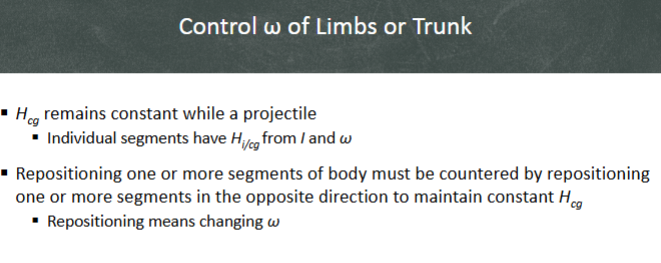
  • H (product of I and ω) remains constant unless a net external torque acts on the rotating body

  • Human body is a system of rigid links with modifiable I

  • With H constant (no external torque applied)

    • Increase in I, there must be a proportional decrease in ω

    • Decrease in I, there must be a proportional increase in ω

  • For faster spin, reduce I (tuck, arms in)

  • For slower spin, increase I (layout, arms out)


Second Law:

  • If a net external torque acts on a body, the body will angularly accelerate in the direction of the net external torque

    • Acceleration will be:

      • Directly proportional to the torque

      • Inversely proportional to its moment of inertia

  • Similar to Newton’s second law for linear motion

  • Angularly accelerate = change in angular momentum

  • The change in angular momentum of an object is proportional to the net external torque exerted on it, and the change is in the direction of the net external torque

    • Torquea and ωa have same sign: Ha increases

    • Torquea and ωa have opposite sign: Ha decreases

  • If I changes when T applied, change in ω is greater


Third Law:

  • For every torque exerted by one object on another, the other object exerts an equal torque back on the first object but in the opposite direction

    • Equal but opposite

  • Torque on each body is of equal magnitude, not the effect

    • ang. acc = Ta/Ia


<p><strong>First Law:</strong></p><ul><li><p>Angular momentum of an object remains constant <strong>unless</strong> a net external <strong>torque</strong> acts on it</p><ul><li><p>If <em>I</em>s are constant, ω is constant</p></li></ul></li><li><p>For a rigid projectile, gravity is the only external force</p><ul><li><p>Weight acts through the cg</p><ul><li><p>Weight has no moment arm around the cg</p><ul><li><p>No external force on body</p></li></ul></li></ul></li><li><p>Weight creates no external torque on a projectile</p></li></ul></li><li><p>H (product of I and ω) remains constant unless a net external torque acts on the rotating body </p></li><li><p>Human body is a system of rigid links with modifiable I </p></li><li><p>With H constant (no external torque applied)</p><ul><li><p>Increase in I, there must be a proportional decrease in ω</p></li><li><p>Decrease in I, there must be a proportional increase in ω</p></li></ul></li><li><p> For faster spin, reduce I (tuck, arms in)</p></li><li><p>For slower spin, increase I (layout, arms out)</p></li></ul><p></p><p><strong>Second Law:</strong></p><ul><li><p>If a net external torque acts on a body, the body will <strong>angularly accelerate </strong>in the <strong>direction of the net external torque</strong></p><ul><li><p>Acceleration will be:</p><ul><li><p>Directly proportional to the torque</p></li><li><p>Inversely proportional to its moment of inertia</p></li></ul></li></ul></li><li><p>Similar to Newton’s second law for linear motion</p></li><li><p>Angularly accelerate = change in angular momentum </p></li><li><p>The change in angular momentum of an object is proportional to the net external torque exerted on it, and the change is in the direction of the net external torque</p><ul><li><p>Torque<sub>a</sub> and ω<sub>a</sub> have same sign: H<sub>a</sub> increases</p></li><li><p>Torque<sub>a</sub> and ω<sub>a</sub> have opposite sign: H<sub>a</sub> decreases</p></li></ul></li><li><p>If I changes when T applied, change in ω is greater</p></li></ul><p></p><p><strong>Third Law:</strong></p><ul><li><p>For every torque exerted by one object on another, the other object exerts an <strong>equal torque back</strong> on the first object but in the opposite direction</p><ul><li><p>Equal but opposite</p></li></ul></li><li><p>Torque on each body is of equal magnitude, <em>not</em> the effect</p><ul><li><p>ang. acc = T<sub>a</sub>/<em>I</em><sub>a</sub> </p></li></ul></li></ul><p></p>
56
New cards

Kinetics → angular impulse and change in angular momentum

57
New cards

1) When calculating the moment of inertia, changes in mass influence the result more strongly than changes in the radius of gyration.


True or False

False

58
New cards

2) A baseball player with a mass of 82 kg is swinging a bat with a radius of gyration of 0.75 m. His angular velocity is 720°/s. What is his angular momentum?


a) 604 kg·m²/s

b) 384 kg·m²/s

c) 452 kg·m²/s

d) 724 kg·m²/s

(figure out) - not A

59
New cards

3) Angular momentum remains __________ unless changed by a __________.


a) not conserved, internal torque

b) increased, internal torque

c) used, external torque

d) conserved, external torque

D

60
New cards

4) Centripetal force is associated with which of the following factors?


a) both radial and tangential acceleration

b) radial acceleration

c) none of the above

d) tangential acceleration

B

61
New cards

5) When knee flexion increases, how does the leg’s moment of inertia about the hip change?


a) remains the same

b) need more information

c) increased

d) decreased

D

62
New cards

6) Which term describes the amount of angular motion a body possesses?


a) angular acceleration

b) angular velocity

c) angular momentum

d) angular displacement

C

63
New cards

7) Which factor is responsible for causing a change in angular momentum?


a) moment of inertia

b) none of the above

c) torque

d) angular impulse

D

64
New cards

8) The idea that a rotating object continues its angular motion unless an external torque intervenes refers to which principle?


a) Newton's second law of acceleration

b) None of these answers is correct

c) Newton's third law of action/reaction

d) Newton's first law of inertia

D

65
New cards

Definitions and Equations for Stress and Strain

  • Stress -> intensity of force per unit area of the tissue 

    • Normal stress -> Intensity of the internal force acting perpendicular to a plane.  

    • Compressive or tensile 

  • Strain -> extent of deformation relative to its initial condition 

    • Normal strain -> ratio of change in length to original length 

    • Two Types:

      • Linear strain → change in object’s length

      • Shear strain → change in orientation of object’s molecules

        • ex: friction - blisters


<ul><li><p class="Paragraph SCXW199984410 BCX0" style="text-align: left;"><span style="line-height: 20.925px;">Stress -&gt; <strong>intensity of force</strong> per unit area of the tissue&nbsp;</span></p><ul><li><p class="Paragraph SCXW199984410 BCX0" style="text-align: left;"><span style="line-height: 20.925px;"><strong>Normal stress</strong> -&gt; Intensity of the internal force acting <strong>perpendicular</strong> to a plane.&nbsp;&nbsp;</span></p></li><li><p class="Paragraph SCXW199984410 BCX0" style="text-align: left;"><span style="line-height: 20.925px;">Compressive or tensile&nbsp;</span></p></li></ul></li></ul><ul><li><p class="Paragraph SCXW199984410 BCX0" style="text-align: left;"><span style="line-height: 20.925px;">Strain -&gt; <strong>extent of deformation</strong> relative to its initial condition&nbsp;</span></p><ul><li><p class="Paragraph SCXW199984410 BCX0" style="text-align: left;"><span style="line-height: 20.925px;"><strong>Normal strain</strong> -&gt; ratio of change in length to original length&nbsp;</span></p></li><li><p class="Paragraph SCXW199984410 BCX0" style="text-align: left;"><span style="line-height: 20.925px;">Two Types:</span></p><ul><li><p class="Paragraph SCXW199984410 BCX0" style="text-align: left;">Linear strain → change in object’s length</p></li><li><p class="Paragraph SCXW199984410 BCX0" style="text-align: left;">Shear strain → change in orientation of object’s molecules</p><ul><li><p class="Paragraph SCXW199984410 BCX0" style="text-align: left;">ex: friction - blisters</p></li></ul></li></ul></li></ul></li></ul><p></p>
66
New cards

definitions and deformations with stress!!!

  1. Tension

  2. Compression

  3. Shearing

  4. Bending

  5. Torsion


<ol><li><p>Tension</p></li><li><p>Compression</p></li><li><p>Shearing</p></li><li><p>Bending</p></li><li><p>Torsion</p></li></ol><p></p>
67
New cards

Differences between axial and transverse stress (examples)

68
New cards

Differences between uniaxial and multiaxial stress (+examples)

69
New cards

Which type of internal structures can best/least able to withstand stress (bone, ligaments, tendon, muscle)

70
New cards

Functions of Skeletal System + components of axial and appendicular skeleton

Bones constitute rigid links

 Connected at joints (articulation)

 Allow specific movements

 Acted on by muscles

 Produce force

 Creates torque


Anitsotropic

  • Strength properties are different for each major direction of loading

  • Higher loads in the longitudinal direction [highest k value]

    • Ex: long bones -> depth jump (landing) force on long bones on longitudinal loads 

  • Lesser quantity of load when applied over the bone surface

    • Ex: transverse -> vulnerable to injury (fractures) shear stresses/forces [weakest/lowest k value] 
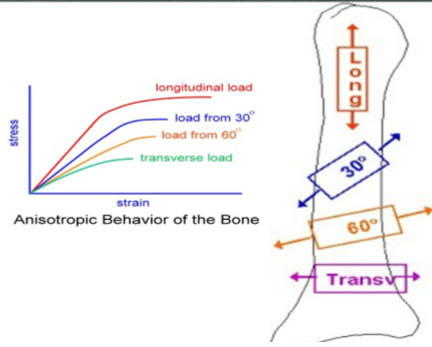

<p>Bones constitute rigid links</p><p> Connected at joints (articulation)</p><p> Allow specific movements</p><p> Acted on by muscles</p><p> Produce force</p><p> Creates torque</p><p></p><p><strong>Anitsotropic</strong></p><ul><li><p>Strength properties are different for each major direction of loading</p></li></ul><ul><li><p> Higher loads in the longitudinal direction [highest k value]</p><ul><li><p><span style="line-height: 20.925px;">Ex: long bones -&gt; depth jump (landing) force on long bones on longitudinal loads&nbsp;</span></p></li></ul></li></ul><ul><li><p>Lesser quantity of load when applied over the bone surface</p><ul><li><p><span style="line-height: 20.925px;">Ex: transverse -&gt; vulnerable to injury (fractures) shear stresses/forces [weakest/lowest k value]&nbsp;</span></p></li></ul></li></ul><p></p>
71
New cards

Makeup of bones and characteristics

  • Bone Cells 

    • Osteogenic cells -> progenitor cells that arise from mesenchymal stem cells in bone marrow 

    • The starting unit for each of the other cells (where it all begins) 

    • Osteocytes -> transport metabolites, communication 

    • Osteoblasts -> creates bone 

    • Osteoclasts -> resorb bone 


72
New cards

Loading of Bone

  • Subjected to a variety of loads 

  • Bone adapts to changes in loading -> Wolf’s law 

    • Higher density -> resistance train to allow bone to adapt to the training 

  • High rate of loading -> injury risk 

  • Muscle forces can play an important role in bone loading 


73
New cards

compare and contrast characteritistics of cortical and trabecular bone

  • Material properties of the two types of bone differ 

    • Cortical bone stiffer than cancellous bone 
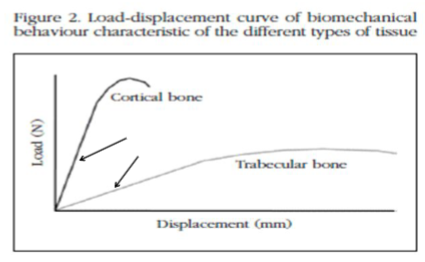

<ul><li><p class="Paragraph SCXW251143821 BCX0" style="text-align: left;"><span style="line-height: 20.925px;">Material properties of the two types of bone differ&nbsp;</span></p><ul><li><p class="Paragraph SCXW251143821 BCX0" style="text-align: left;"><span style="line-height: 20.925px;"><strong>Cortical bone stiffer</strong> than cancellous bone&nbsp;</span></p></li></ul></li></ul><p></p>
74
New cards

bone growth occurs throughout the lifespan

  • Bone Modeling 

    • Bones shaped or reshaped by independent action of osteoblast and osteoclasts 

    • Defines skeletal development and growth 

    • Continues throughout life 

  • Bone Remodeling 

    • Lifelong process 

    • Mature bone tissue is removed and new bone tissue formed 

    • Controls the reshaping or replacement of bone following injuries 

  • EQUAL amount of activity compared to the modeling and remodeling of bones!!! 

  • Modeling of Bone 

    • Responsive to mechanical forces that are placed on bone (Wolf’s law) 

      • Bone will adapt to the loads under which it’s placed 

    • Dependent on the activity of osteoblasts and osteoclasts 

    • Two characteristics:  

      • Age dependent  

      • Bone gain mainly sub-periosteal 

  • Remodeling of Bone 

    • Occurs to produce and maintain biomechanically and metabolically component tissue 

    • Coordinated activity of a group of highly specialized cells, bone-remodeling or basic multi-cellular unit 

    • Bone formed is almost always very equal to the amount that is removed 


<ul><li><p class="Paragraph SCXW54804555 BCX0" style="text-align: left;"><span style="line-height: 20.925px;"><strong>Bone Modeling</strong>&nbsp;</span></p><ul><li><p class="Paragraph SCXW54804555 BCX0" style="text-align: left;"><span style="line-height: 20.925px;">Bones shaped or reshaped by independent action of osteoblast and osteoclasts&nbsp;</span></p></li><li><p class="Paragraph SCXW54804555 BCX0" style="text-align: left;"><span style="line-height: 20.925px;">Defines skeletal development and growth&nbsp;</span></p></li><li><p class="Paragraph SCXW54804555 BCX0" style="text-align: left;"><span style="line-height: 20.925px;">Continues throughout life&nbsp;</span></p></li></ul></li></ul><ul><li><p class="Paragraph SCXW54804555 BCX0" style="text-align: left;"><span style="line-height: 20.925px;"><strong>Bone Remodeling</strong>&nbsp;</span></p><ul><li><p class="Paragraph SCXW54804555 BCX0" style="text-align: left;"><span style="line-height: 20.925px;">Lifelong process&nbsp;</span></p></li><li><p class="Paragraph SCXW54804555 BCX0" style="text-align: left;"><span style="line-height: 20.925px;">Mature bone tissue is removed and new bone tissue formed&nbsp;</span></p></li><li><p class="Paragraph SCXW54804555 BCX0" style="text-align: left;"><span style="line-height: 20.925px;">Controls the reshaping or replacement of bone following injuries&nbsp;</span></p></li></ul></li></ul><ul><li><p class="Paragraph SCXW54804555 BCX0" style="text-align: left;"><span style="line-height: 20.925px;"><u>EQUAL amount of activity compared to the modeling and remodeling of bones!!!</u>&nbsp;</span></p></li></ul><ul><li><p class="Paragraph SCXW54804555 BCX0" style="text-align: left;"><span style="line-height: 20.925px;"><strong>Modeling of Bone</strong>&nbsp;</span></p><ul><li><p class="Paragraph SCXW54804555 BCX0" style="text-align: left;"><span style="line-height: 20.925px;">Responsive to mechanical forces that are placed on bone (Wolf’s law)&nbsp;</span></p><ul><li><p class="Paragraph SCXW54804555 BCX0" style="text-align: left;"><span style="line-height: 20.925px;">Bone will adapt to the loads under which it’s placed&nbsp;</span></p></li></ul></li><li><p class="Paragraph SCXW54804555 BCX0" style="text-align: left;"><span style="line-height: 20.925px;">Dependent on the <strong>activity of osteoblasts and osteoclasts</strong>&nbsp;</span></p></li><li><p class="Paragraph SCXW54804555 BCX0" style="text-align: left;"><span style="line-height: 20.925px;">Two characteristics:</span> <span style="line-height: 20.925px;">&nbsp;</span></p><ul><li><p class="Paragraph SCXW54804555 BCX0" style="text-align: left;"><span style="line-height: 20.925px;">Age dependent&nbsp;&nbsp;</span></p></li><li><p class="Paragraph SCXW54804555 BCX0" style="text-align: left;"><span style="line-height: 20.925px;">Bone gain mainly sub-periosteal&nbsp;</span></p></li></ul></li></ul></li></ul><ul><li><p class="Paragraph SCXW212764983 BCX0" style="text-align: left;"><span style="line-height: 20.925px;"><strong>Remodeling of Bone</strong>&nbsp;</span></p><ul><li><p class="Paragraph SCXW212764983 BCX0" style="text-align: left;"><span style="line-height: 20.925px;">Occurs to produce and maintain <strong>biomechanically and metabolically component tissue</strong>&nbsp;</span></p></li><li><p class="Paragraph SCXW212764983 BCX0" style="text-align: left;"><span style="line-height: 20.925px;">Coordinated activity of a group of highly specialized cells, bone-remodeling or basic multi-cellular unit&nbsp;</span></p></li><li><p class="Paragraph SCXW212764983 BCX0" style="text-align: left;"><span style="line-height: 20.925px;">Bone formed is almost always <strong>very equal</strong> to the amount that is removed&nbsp;</span></p></li></ul></li></ul><p></p>
75
New cards

how stress impacts bone growth and diff. exercises impact bone mineral density

76
New cards

Osteoporosis + factos affecting development and what is most suspectiable to the disease?

77
New cards
<p>Functions of Joint and Facors affecting joint mobility and stability</p>

Functions of Joint and Facors affecting joint mobility and stability

  • Porous-elastic biological material that allows the distribution of mechanical loads and joint movements 

  • Deforms its solid matrix and modifies the fluid hydrostatic pressure within 

    • Displaces in the fluid matrix and deforms the solid 

  • Does NOT have: 

    • Intrinsic blood vessels 

    • Nerves 

    • Lymph vessels 

  • Thin layer of specialized connective tissue with unique viscoelastic properties 

  • Principal functions: 

    • Provide a smooth, lubricated surface 

      • Low friction articulation 

    • Facilitate the transmission of loads to underlying subchondral bone 


Load

  • Most common mechanical test performed on cartilage is the indentation test 

    • Load is applied to the surface of the cartilage and the creep recorded 

    • Load is then removed an instantaneous recovery is time dependent one 


Functions

  • Exception lubricating properties and low coefficient of friction that greatly assists its function in synovial joints 

  • For healthy bone and cartilage!!!! 


78
New cards

makeup of connective tissue and characerisitc of componenets

79
New cards

three types of connective tissue

  • Oreintation, density, and vascularity of each

  • overall strength/stiffness of each tissue type

  • be able to match internal structure to tissue type


80
New cards

specific makeup of tendons and ligaments - how they differ

81
New cards

Definition, symbol, and calc for STRAIN

Strain → extent of deformation

  • relative to its initial condition

  • Normal strain → ratio of change in length to original length

Strain = change in L/ OG heght

symbol → (ε)

<p>Strain → extent of deformation</p><ul><li><p>relative to its initial condition</p></li><li><p>Normal strain → ratio of change in length to original length</p></li></ul><p>Strain = change in L/ OG heght</p><p>symbol → (ε)</p>
82
New cards

Definition, symbol, and calc for STRESS

Stress → intensity of force per unit area of the tissue

  • Normal stress → intensity of the internal force acting perpendicular to a plane

  • Stress = Force/Area

symbol → (σ) N/m2

<p> Stress → intensity of force per unit area of the tissue</p><ul><li><p>Normal stress → intensity of the internal force acting perpendicular to a plane</p></li><li><p>Stress = Force/Area</p></li></ul><p>symbol → (σ) N/m2</p>
83
New cards

diff between elastic and plastic behavior

Elastic Behavior

  • Material deforms and returns to original length when unloaded 

  • Elastic modulus/Young’s modulus (E) -> incline of stress-strain curve 

  • E = Δσ/Δε


Plastic Behavior

  • Elastic limit → the yield point for a material on the σ/ε curve

  • Stress above this point causes permanent deformation of material

  • Plastic behavior → material does NOT return to original shape

  • Mechanical strength of a material

    • Maximum stress a material can withstand before failure


84
New cards

Stress/Strain Curve

  • Toe Region → tissues are wavy and must be drawn taut 

  • Elastic Region → healthy and relatively young structure, if strained will return to original length 

    • Normal physiologic range 

    • Elastic deformation 

  • (between elastic and plastic = point of no return) - tissue elongated beyond normal physiologic range

  • Plastic Region → over-stretched/over-compressed tissue 

    • Microscopic failure 

    • Plastic deformation

  • Failure → tissue rupture


  • Stress (σ ) 

    • Force applied to deform a structure 

    • Force per unit area 

    • Measures in N/m2 or Pascals 


    • Strain (ε) 

  • Deformation caused by applied stress 

  • Elastic/Young’s modulus (k) 

  • Stiffness of a material  

  • k = stress/strain = σ/ε


<ul><li><p>Toe Region → <span style="line-height: 20.925px;">tissues are wavy and must be drawn taut&nbsp;</span></p></li><li><p>Elastic Region → <span style="line-height: 20.925px;">healthy and relatively young structure, if strained will return to original length&nbsp;</span></p><ul><li><p><span style="line-height: 20.925px;">Normal physiologic range&nbsp;</span></p></li><li><p><span style="line-height: 20.925px;">Elastic deformation&nbsp;</span></p></li></ul></li><li><p>(between elastic and plastic = point of no return) - tissue elongated beyond normal physiologic range</p></li></ul><ul><li><p>Plastic Region → <span style="line-height: 20.925px;">over-stretched/over-compressed tissue&nbsp;</span></p><ul><li><p><span style="line-height: 20.925px;">Microscopic failure&nbsp;</span></p></li><li><p><span style="line-height: 20.925px;">Plastic deformation</span></p></li></ul></li></ul><ul><li><p>Failure → <span style="background-color: rgba(0, 0, 0, 0); line-height: 20.925px;">tissue rupture</span></p></li><li><p></p></li><li><p></p></li><li><p><span style="line-height: 20.925px;"><strong>Stress (</strong></span><span style="line-height: normal;"><strong>σ&nbsp;</strong></span><span style="line-height: 20.925px;"><strong>)&nbsp;</strong></span></p><ul><li><p><span style="line-height: 20.925px;"><strong>Force applied</strong> to deform a structure&nbsp;</span></p></li><li><p><span style="line-height: 20.925px;">Force per unit area&nbsp;</span></p></li><li><p><span style="line-height: 20.925px;">Measures in N/m<sup>2</sup> or Pascals&nbsp;</span></p></li><li><p></p></li><li><p><span style="line-height: 20.925px;"><strong>Strain (</strong></span><span style="line-height: normal;"><strong>ε</strong></span><span style="line-height: 20.925px;"><strong>)&nbsp;</strong></span></p></li></ul></li></ul><ul><li><p class="Paragraph SCXW154409592 BCX0" style="text-align: left;"><span style="line-height: 20.925px;"><strong>Deformation</strong> caused by applied stress&nbsp;</span></p></li></ul><ul><li><p class="Paragraph SCXW154409592 BCX0" style="text-align: left;"><span style="line-height: 20.925px;">Elastic/Young’s modulus (k)&nbsp;</span></p></li></ul><ul><li><p class="Paragraph SCXW154409592 BCX0" style="text-align: left;"><span style="line-height: 20.925px;"><strong>Stiffness</strong> of a material&nbsp;&nbsp;</span></p></li><li><p class="Paragraph SCXW154409592 BCX0" style="text-align: left;"><span style="line-height: 20.925px;">k = stress/strain = </span><span style="line-height: normal;">σ/ε</span></p></li></ul><p></p>
85
New cards
<p>Young’s Elastic modulus</p>

Young’s Elastic modulus

  • Calc?

  • where does it occur on Stress/Strain curve

  • large vs small modulus

  • how it changes on tissue types


  • Material deforms and returns to original length when unloaded 

  • Elastic modulus/Young’s modulus (E) -> incline of stress-strain curve 

  • E = Δσ/Δε

  • Elastic Limit → the yield point for material on the curve


Stiff material -> less strain per unit of stress (large E) 

Pliant material -> more strain per unit of stress (low E) 

  • Examples: 

  • Bone is stiffer than ligaments or tendons 

  • Tendons and ligaments are more pliant than bone 


<ul><li><p>Calc?</p></li><li><p>where does it occur on Stress/Strain curve</p></li><li><p>large vs small modulus</p></li><li><p>how it changes on tissue types</p></li></ul><p></p><ul><li><p class="Paragraph SCXW118749242 BCX0" style="text-align: left;"><span style="line-height: 20.925px;">Material deforms and returns to <strong>original length</strong> when unloaded&nbsp;</span></p></li></ul><ul><li><p class="Paragraph SCXW118749242 BCX0" style="text-align: left;"><span style="line-height: 20.925px;">Elastic modulus/Young’s modulus (E) -&gt; incline of stress-strain curve&nbsp;</span></p></li><li><p><span style="line-height: normal;">E = Δσ/Δε</span></p></li><li><p><span style="line-height: normal;">Elastic Limit → the yield point for material on the curve</span></p></li></ul><p><span style="line-height: 20.925px;">&nbsp;</span></p><p><span style="line-height: 20.925px;"><strong>Stiff material</strong> -&gt; less strain per unit of stress (large E)&nbsp;</span></p><p><span style="line-height: 20.925px;"><strong>Pliant material </strong>-&gt; more strain per unit of stress (low E)&nbsp;</span></p><ul><li><p class="Paragraph SCXW263485430 BCX0" style="text-align: left;"><span style="line-height: 20.925px;"><strong>Examples:</strong>&nbsp;</span></p></li></ul><ul><li><p class="Paragraph SCXW263485430 BCX0" style="text-align: left;"><span style="line-height: 20.925px;">Bone is stiffer than ligaments or tendons&nbsp;</span></p></li></ul><ul><li><p class="Paragraph SCXW263485430 BCX0" style="text-align: left;"><span style="line-height: 20.925px;">Tendons and ligaments are more pliant than bone&nbsp;</span></p></li></ul><p></p>
86
New cards

def of yield strength, ultimate strenth, and failure strength (where they occur on SS curve)

  • Yield Strength: Located at the end of the linear elastic region. This is the transition point where the material stops behaving like a spring (elastic deformation) and begins to permanently bend or stretch (plastic deformation). [1, 2, 3, 4]

  • Ultimate Strength: Located at the highest peak of the entire curve. Also known as Ultimate Tensile Strength (UTS), this represents the maximum amount of stress the material can withstand. Once the material passes this peak, it begins "necking" (visibly thinning out at its weakest spot). [1, 2, 3, 4, 5, 6]

  • Failure Strength: Located at the absolute endpoint of the curve. Also known as the fracture or breaking point, this is the exact moment the material physically ruptures or splits apart.


<ul><li><p><span><strong>Yield Strength:</strong> Located at the <strong>end of the linear elastic region</strong>. This is the transition point where the material stops behaving like a spring (elastic deformation) and begins to permanently bend or stretch (plastic deformation).</span> [1, 2, 3, 4]</p></li><li><p><span><strong>Ultimate Strength:</strong> Located at the <strong>highest peak of the entire curve</strong>. Also known as Ultimate Tensile Strength (UTS), this represents the maximum amount of stress the material can withstand. Once the material passes this peak, it begins "necking" (visibly thinning out at its weakest spot).</span> [1, 2, 3, 4, 5, 6]</p></li><li><p><span><strong>Failure Strength:</strong> Located at the <strong>absolute endpoint of the curve</strong>. Also known as the fracture or breaking point, this is the exact moment the material physically ruptures or splits apart.</span></p></li></ul><p></p>
87
New cards

Creep (def and graphical depictions associated with the viscoelastic properties)

Indicates increasing deformation under constant load 

<p><span style="line-height: 20.925px;">Indicates increasing deformation under constant load&nbsp;</span></p>
88
New cards

Stress-relaxation (def and graphical depictions associated with the viscoelastic properties)

  • (holding it for 10 minutes compared to creep which is 30 sec) 

  • Decrease in stress over time when a material is elongated to a set length 


<ul><li><p class="Paragraph SCXW104154738 BCX0" style="text-align: left;"><span style="line-height: 20.925px;">(holding it for 10 minutes compared to creep which is 30 sec)&nbsp;</span></p></li></ul><ul><li><p class="Paragraph SCXW104154738 BCX0" style="text-align: left;"><span style="line-height: 20.925px;">Decrease in stress over time when a material is elongated to a set length&nbsp;</span></p></li></ul><p></p>
89
New cards

Hysteresis (def and graphical depictions associated with the viscoelastic properties)

  • Property of viscoelastic materials of having a different unloading response than its loading response  

  • Measure of the amount of energy lost 

  • Occurs when the length-tension characteristics differ during loading (imposition of an external force) and unloading 
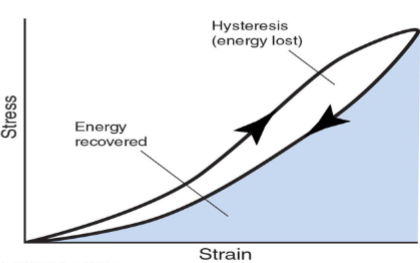

<ul><li><p class="Paragraph SCXW9379566 BCX0" style="text-align: left;"><span style="line-height: 20.925px;">Property of viscoelastic materials of having a different unloading response than its loading response&nbsp;&nbsp;</span></p></li></ul><ul><li><p class="Paragraph SCXW9379566 BCX0" style="text-align: left;"><span style="line-height: 20.925px;">Measure of the amount of <strong>energy lost</strong>&nbsp;</span></p></li></ul><ul><li><p class="Paragraph SCXW9379566 BCX0" style="text-align: left;"><span style="line-height: 20.925px;">Occurs when the length-tension characteristics differ during loading (imposition of an external force) and unloading&nbsp;</span></p></li></ul><p></p>
90
New cards

how mechanical characteristics of tissue (ex: young’s modulus, maximal strength, stiffness, fiber orientation, cross-sectional area, collagen composition) may change with exercise, aging and immobilization.