⭐ NAUT SCI FINAL STUDY GUIDE
 Call Kai
 Learn
 Practice Test
 Spaced Repetition
 Match
 Flashcards
 Knowt Play
1/183

There's no tags or description
Looks like no tags are added yet.
184 Terms
What are the 5 modes of Transportation?
Railroad, Trucking, Pipeline, Air, Water.
Air Transportation
Most expensive. Usually transports high value cargo, and is fast.
Ship Transportation
80-90 percent of cargo worldwide. While slow, it is the most fuel efficient, carries a lot of stuff, and is cheap.
Train Transportation
Most land efficient. Spends most of its time unloading and loading. Slow and cheap.
Truck Transportation
Most flexible. Usually the last stop in intermodal transportation.
Pipelines
Ships liquid cargo. Used for crude oil products. It is initially costly to set up, but transportation prices are cheap.
The 11 design factors for Merchant Ships
Cargo Deadweight, Type of Cargo, Density of Cargo, Number of Passengers, Speed at Sea, Type of Machinery, Type of Fuel, Maximum Ship Dimensions, Number of Crew Required, Range, Safety Requirements for a Particular Trade, and Economical Speed.
TEU (Twenty-foot Equivalent Unit)
8.5ft high x 8ft wide x 20ft long for a standard container
Tramp
No regular schedule but instead travel to any place cargo is available and transport it to any desired destination.
Liner
Published schedule of port calls and have a published schedule of tariffs.
Chief Mate
In charge of the deck department operations and maintenance work, and is in charge of cargo loading, stowage planning, and discharge
Second Mate
Main navigational officer and is responsible for maintaining the charts, the gyro compass
Third Mate
Responsible for maintaining the ship's firefighting and lifesaving equipment
Bosun
Leading seaman of the Deck Department, supervises the maintenance and repair of cargo gear, anchor equipment, lifeboats, accommodation ladder, mooring lines, cleaning of cargo tanks, and painting of the ship's exterior
Chief Engineer
In charge of the Engine Department and engine personnel. Responsible for all ship's machinery and control systems.
First Assistant Engineer
Responsible for the daily activities of the engine room personnel.
Second Assistant Engineer
Responsibility for the boiler and boiler water on a steam ship, and other auxiliary equipment
Third Assistant Engineer
Responsibility for the freshwater evaporators, lube oil system, and other maintenance as assigned by the "First"
QMED (Qualified Member of the Engine Department)
He/she must be able to perform all unlicensed work in the engine room and be capable of operating the automated engine room console
Pumpman
Helps with the discharge of cargo, ballasting the ship, and cleaning the tanks. Also responsible for maintaining the cargo pumps, pipes, valves, and associated control systems
Master
Responsible for all ship function including navigation, cargo maintenance, state of the vessel, ship's business, crew payroll, and compliance with maritime laws, rules and regulations.
How many inches in circumference is SMALL STUFF?
1 ¾ inches or less
How many inches in circumference is LINE?
Manufactured in ¼ inch gradations starting at 2-inch circumference.
How many inches in circumference is HAWSER?
5 inches and larger
What are some natural fiber lines?
Manila, Sisal, Hemp, Cotton.
What are some synthetic fiber lines?
Nylon, Polyester, Polypropylene, Aramid.
What is the danger of Nylon fiber lines?
stronger than natural fibers, but elasticity created a greater snap-back hazard if a line parted
What do knots do to the line?
reduce the strength of a line
What’s a heaving line?
The mooring hawser is too heavy to be thrown ashore from the ship, so a smaller rope called a heaving line is first thrown ashore as the ship approaches the pier

What is a Chock?
The mooring line is lead through the Chock.

What is a Bitt?
Used to make a line fast

What are Bollards?
The eye or bight of a mooring line is passed around the horns of this fitting that is mounted on the pier.

What are Fairleads?
Redirects a mooring line on deck

What is 1?
CONTROLLER

What is 2?
BRAKE

What is 3?
WILDCAT

What is 4?
DEVIL’S CLAW STOPPER

What is 5?
RIDING PAWL

What is 6?
RIDING CHOCK

What is 7?
HAWSEPIPE

What is 8?
TO CHAIN LOCKER

What is 9?
SPILLPIPE

What is 1?
RING

What is 2?
SHANK

What is 3?
FLUKE

What is 4?
BILL
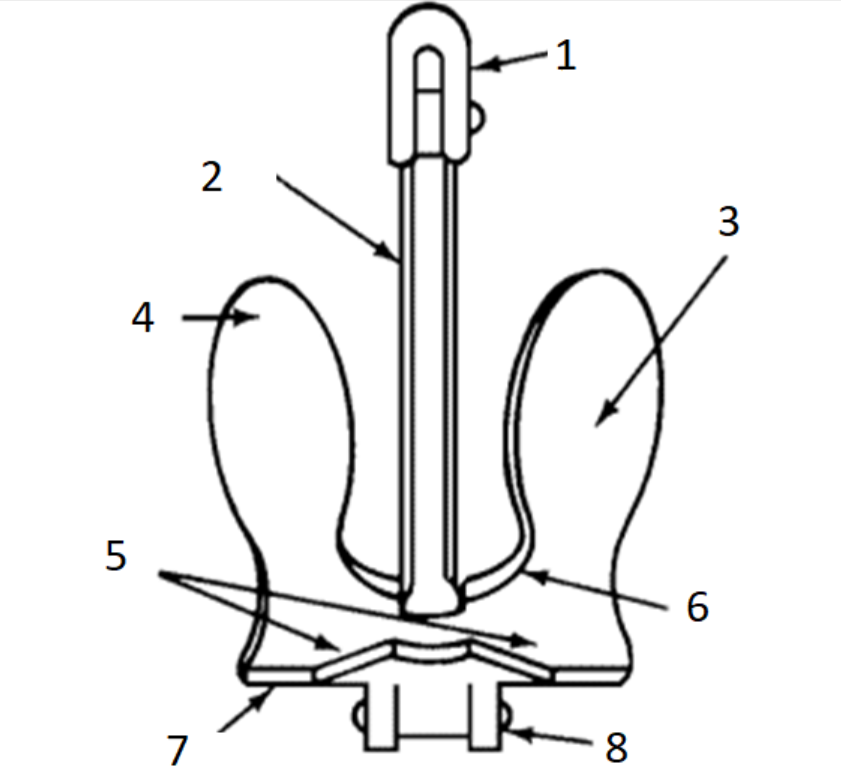
What is 5?
ARMS
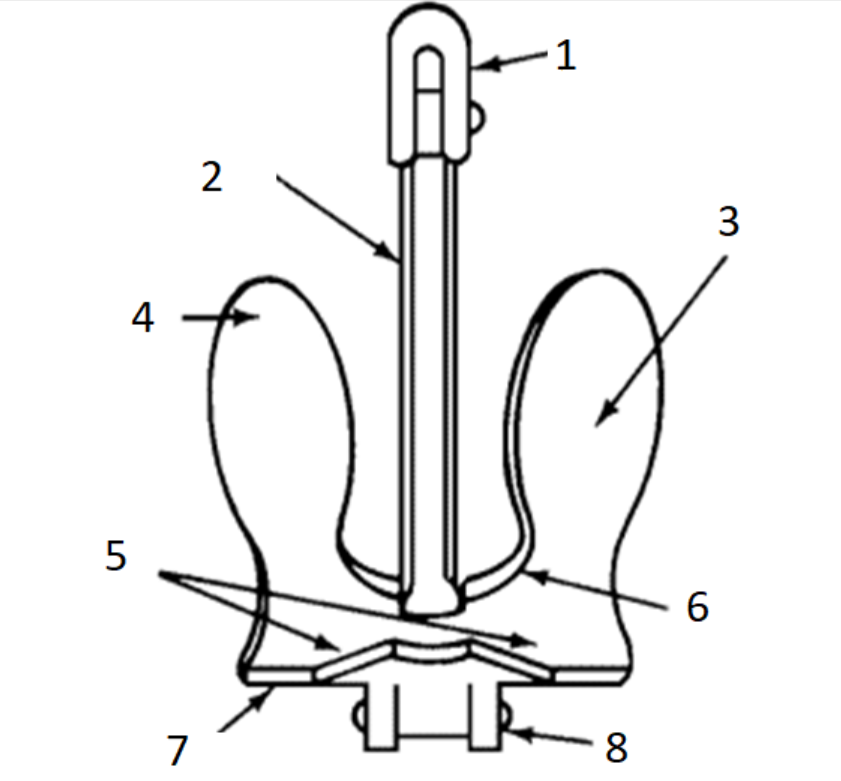
What is 6?
THROAT
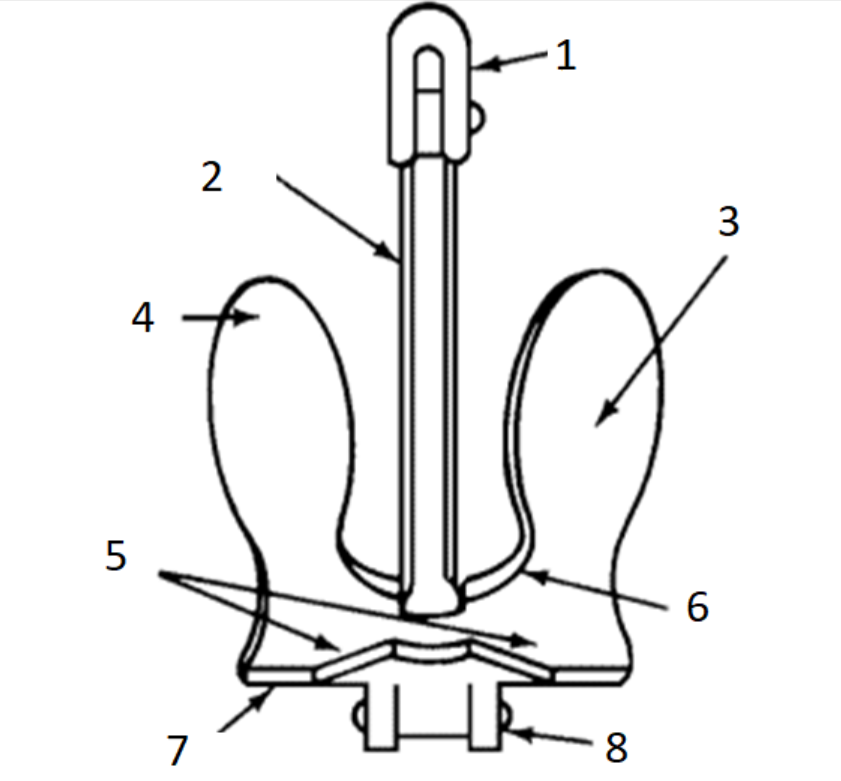
What is 7?
BLADE
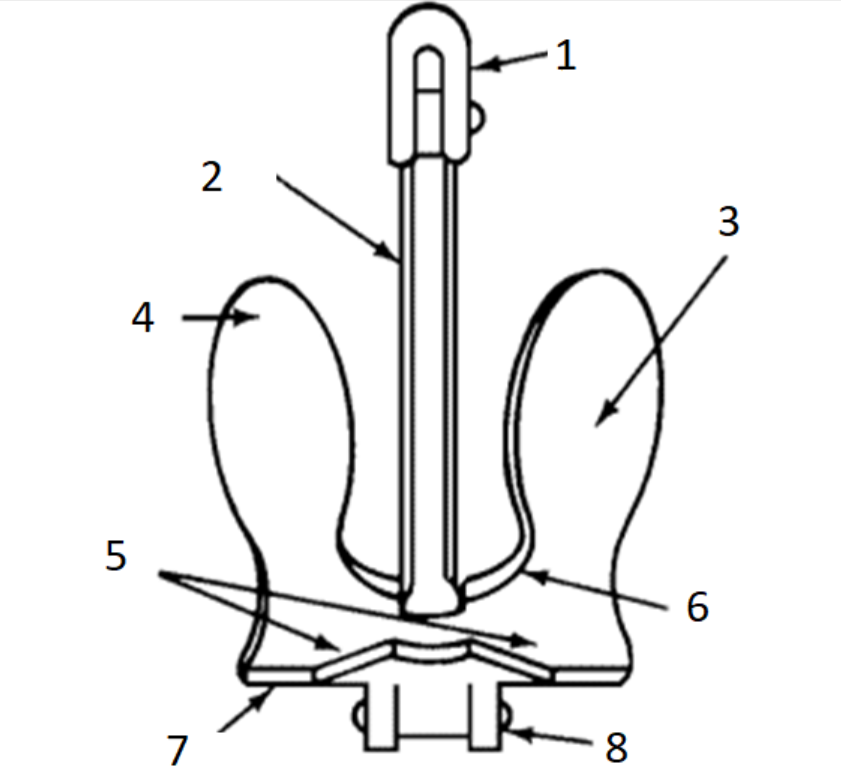
What is 8?
CROWN
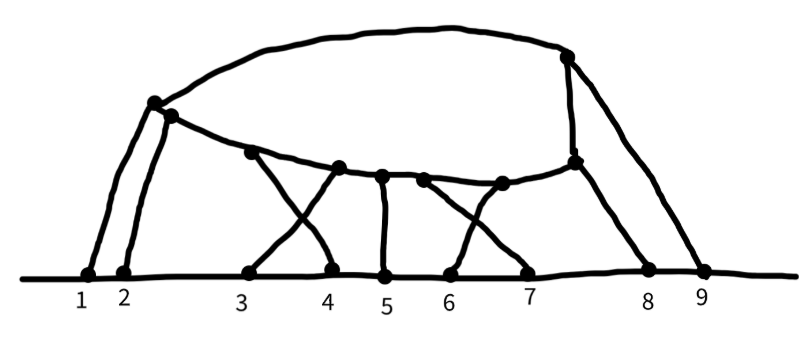
What is 1?
Offshore Bow Line

What is 2?
Inshore Bow Line

What is 3?
Bow Cross Spring Line

What is 4?
Forward Spring Line

What is 5?
Breast Line

What is 6?
Aft Spring Line

What is 7?
Stern Cross Spring Line

What is 8?
Inshore Stern Line

What is 9?
Offshore Stern Line
What are the Steps to Anchoring?
1-2 knots astern.
Check that we have enough power.
Get the crew a safety brief and assign jobs.
Make sure everyone has proper PPE.
Check that the brake is set.
Engage clutch.
Remove devil’s claw.
Remove the buckler plate.
Disengage brake.
Pay out anchor to the water line.
Engage brake.
Disengage clutch.
Veer anchor.
How long should the Anchor chain be?
5-7 times the water depth
How many feet are in a shot of anchor chain?
90 feet
What are shots connected by?
Detachable links
If there are 4 white links on either side of the chain, how many shots of anchor chain are out?
4 shots
What kind of link prevent kinking?
Studded link
What kind of link allows the anchor to twist at the end of the chain so it does not get bound up in one direction?
Swivel link
What color is the warning shot? (2nd to last 90 feet)
Yellow
What color is the last shot? (last 90 feet)
Red
Carbon Steel must be protected from what?
Fouling and Corrosion.
What happens if a ship is poorly painted and maintained?
It wastes time, money, and manpower and may be subject to more frequent inspections and breakdowns due to rusted equipment. It may also threaten the ship’s structural integrity and could result in leaks, cracks, or breaking up and a total loss of the ship.
What is Fouling?
Marine organism such as barnacles, mussels and marine grasses that often attach themselves to the underwater surfaces of the hull.
what climate is Fouling most common in?
Tropical waters. Fouling most often occurs at the waterline, where sunlight and water meet. They grow more densely on vessels that are moored for long periods of time.
How much can Fouling slow down a ship?
Up to 15%, with increased fuel consumption.
Fouling can also damage the hull paint, thus allowing corrosion of the steel hull. What can be done to stop this?
Special anti-fouling hull paints. Either paint with copper mixed in that act as a biocide, or a self-polishing paint, such that as the ship moves through the water, the outer layer of the coating slowly dissolves, taking marine organisms with it.
What happens when uncoated carbon steel is exposed to salt, water, and oxygen?
It turns into iron oxide (Fe2O3), better known as rust. This weakens and wastes away the steel.
What kind of reaction is Corrosion? How does it take place?
Electrochemical. It is caused when a cathode (-), and anode (+) form. Corrosion occurs at the anode (+). The potential difference between these two points determines how fast corrosion takes place.
What is a sacrificial anode?
It is the use of an impressed current applied to the hull. An example of this is zinc or aluminum anodes being welded to the hill under the propeller, with is made of bronze. Over time, the zinc gives up its ions to the bronze in an electrolytic exchange, increasing protection to the propeller.
What is a Binder?
The main film forming resin system.
What are pigments?
Particulate solids imparting specific properties such as color, mechanical properties, and anticorrosion properties.
What are additives?
Ingredients added at low level ~0.1-5% level, which impart properties such as rheological control, in-can stability, and UV resistance.
What is a Solvent?
The carrier for the system, it dissolves the binder and allows the paint to be applied. Should not be present in the dry film.
What is a coating plan?
Most ships have a paint schedule or a coating plan in which the primer, top coating, bottom paint, and boot topping are from the same manufacturer and are designed to work well together to form a coating system for the entire ship.
What is a pretreatment Coating?
A phosphoric acid that is used remove all remaining rust. This often gives off flammable and harmful fumes.
What are primers?
Paints designed to cover steel surfaces that have been prepared by removing all dirt, grease, old loose paint, and rust from the applying area.
What are Topside Paints?
After the steel surface has been coated with the primer, it is coated with a topside paint. The topside paint uses a pigment of inorganic zinc silicate, and it acts as the anode (+) and changes the steel into the cathode (-), thus preventing the corrosion of steel.
What are bottom paints?
Applied in drydock, the bottom paints have an epoxy-based vehicle, the outer layer being anti-fouling.
What is boot-topping paints?
The area of the hull near the waterline is subject to waves and greatest fouling due to sunlight. Better quality paint and more frequent paint is required here.
What PPE should one have when painting?
Goggles, Gloves and Overalls, Hat, and Respirator. If painting in an enclosed space, it should also be well ventilated.
How should paint be stored safely?
Paint should be stored in a paint locker, which is usually located in the forecastle. It should be equipped with natural and forced mechanical ventilation, a fire detection system, and a CO2 fixed firefighting system.
Does painting over rust stop corrosion?
Nope.
What are some good tips for painting?
Never paint over rubber gaskets for watertight doors, hatches and scuttles. Never paint over screw threads, name plates, air screens or zinc anodes. Never paint over letters or numbers. Never put on a thick coat. Allow paint to dry before applying more.
How does Alkyd paint dry?
Chemical drying.
How do Acrylic and Vinyl paint dry?
physical drying.
What role does the International Maritime Organization (IMO) play?
It creates the bulk of maritime rules.
What two kinds of pollution does MARPOL address?
Accidental pollution, and intentional pollution (operationally required discharges such as ballast, bilges and trash).
What are the six MARPOL Annexes?
1 = Oil; 2 = Noxious Liquid Substances; 3 = Harmful Substances in Packaged Form; 4 = Sewage; 5 = Garbage; 6 = Air Pollution.
What is the difference between operational waste and cargo waste?
Operational waste comes from running the ship; cargo waste comes from the cargo being carried.
Which U.S. law relates to Annex 1?
The Oil Pollution Act of 1990 (OPA).
What is Grey Water?
Water from sinks, washing machines, showers, etc.