LE amputations
 Call Kai
 Learn
 Practice Test
 Spaced Repetition
 Match
 Flashcards
 Knowt Play
1/4

There's no tags or description
Looks like no tags are added yet.
5 Terms
pain
handled by PT
anatomy
the more proximal an amputation is, the more extreme it is; it’s going to be tougher to get full function
AKA, above the knee (transfemoral)
maintaining the function of the knee is very helpful for function + prosthetics
having a prosthetic that also has to have a synthetic knee is more complicated and difficult, making an AKA less preferable
BKA, below the knee (transtibial)

positioning: wheelchair safety
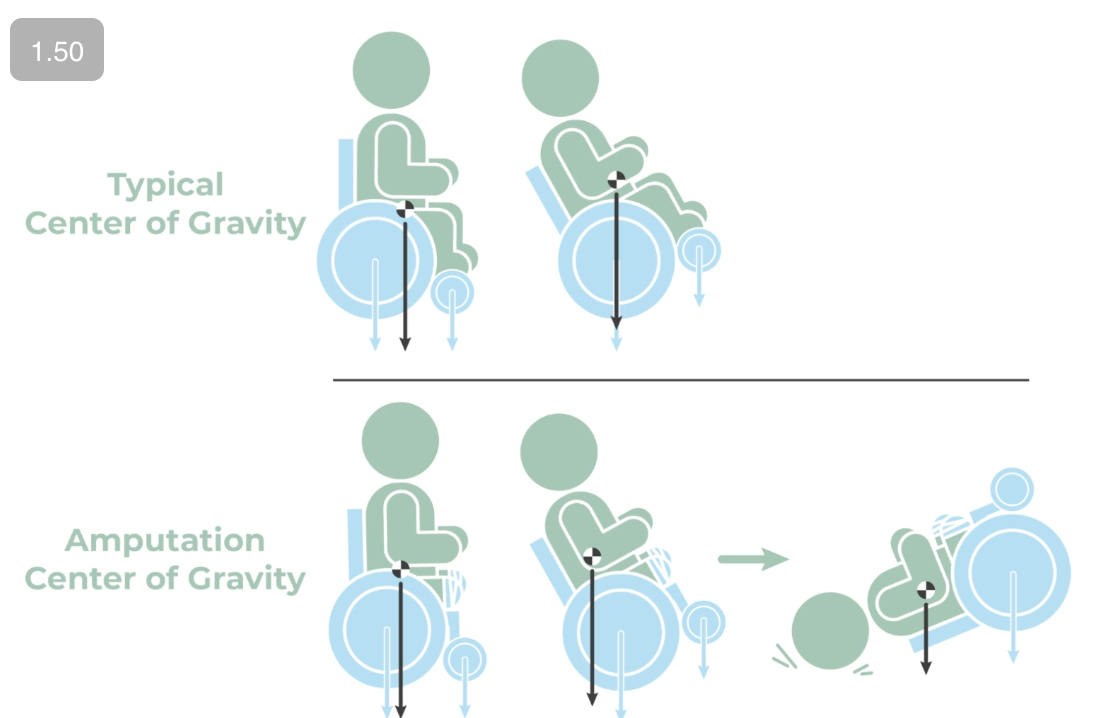
legs shift your center of gravity (COG) forward, allowing you to do leans; someone with a LE amputation will not have this front-weight, making their COG shifted back
a person with an amputation leaning back (outside their base of support) is more at risk for falling
to address tipping risk…
anti-tippers
extensions off the chair that have little wheels/bumpers that will hit the ground and prevent tipping when someone leans out of their COG
shift COG forward
using some sort of cushion, so that a person is sitting more forward, shifting their COG forward as well
or, manually adapt the chair so that the either…to make sure COG is further away from the back wheel
back wheel is further back or
chair part is further forward
positioning: limb positioning
risk of flexion contracture, so we want to promote knee extension
—> residual limb support
performance— AE
problem: shower transfers
problem: toilet transfers
problem: bed mobility
problem: mobility
problem: ADLs/IADLs
problem: fatigue
problem: shower transfers
—> solution: tub bench, shower chair, grab bars
problem: toilet transfers
—> solution: raised toilet seat, 3-in-1 commode
problem: bed mobility
—> solution: bed rails, trapeze bar
problem: mobility
—> solution: 2-wheeled walker
problem: ADLs/IADLs
—> solution: reacher, roller cart, loose pants
problem: fatigue
—> solution: energy conservation techniques (e.g., kitchen stool)