BCEM 3201 - Foundations
 Call Kai
 Learn
 Practice Test
 Spaced Repetition
 Match
 Flashcards
 Knowt Play
1/48

There's no tags or description
Looks like no tags are added yet.
49 Terms
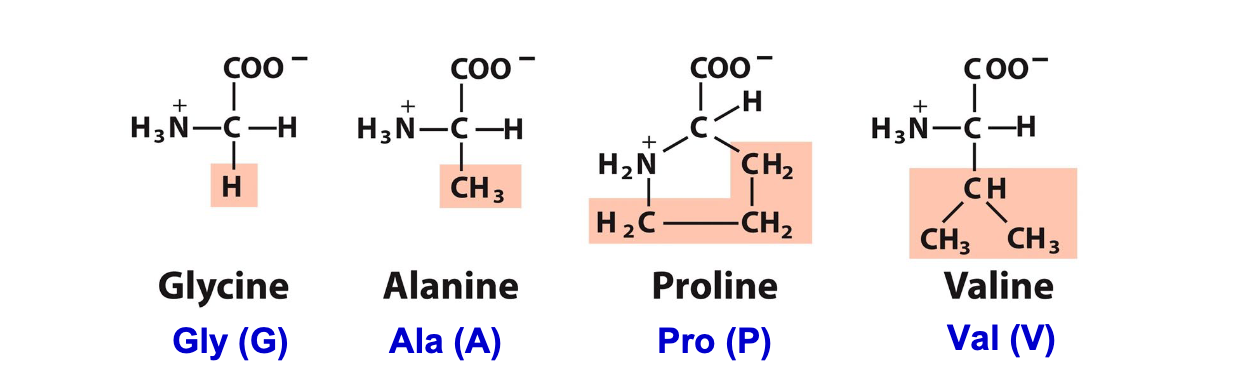
Nonpolar R groups increase in hydrophobicity with..?
increasing number of carbon atoms
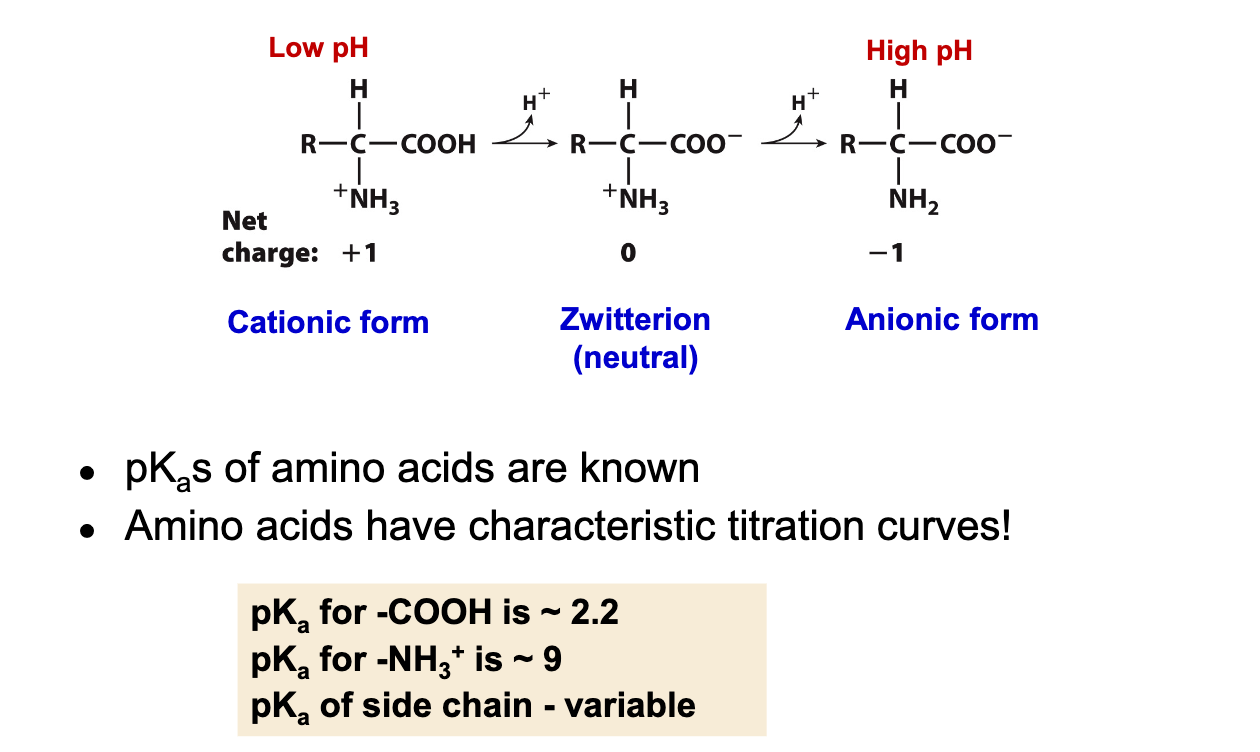
pH < pKa
protonated
pH > pKa
deprotonated
At a neutral pH, amino acids exist as..?
zwitterions
zwitterion
can act as acid (proton donor) or base (proton acceptor) with net zero charge

Ampholytes
substances with dual acid-base nature
Protonic equillibria
Titration curve example

worst pH regions for buffering power
endpoints and equivalence points
Isoelectric point (pI)
pH where molecule had zero net charge
pI = (pKa1+pKa2)/2 (except for basic AAs)

pI in acidic AAs
average of pKa1 and pKaR
pI in basic AAs
pKaR and pKa2
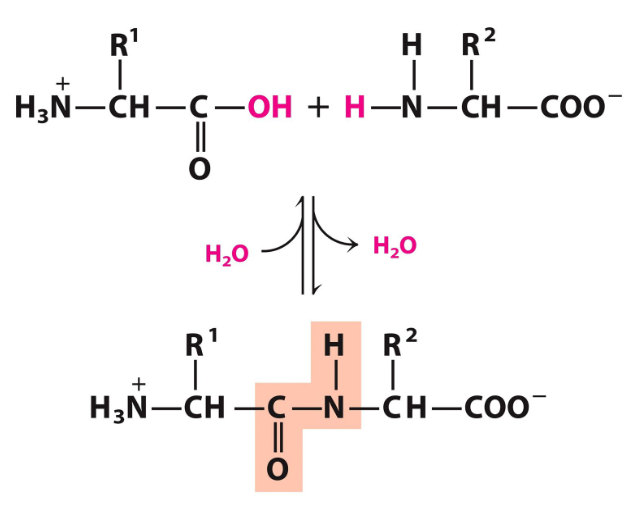
Peptide bonds are formed through which reaction?
Condesation reaction (removal of water)
Breaking of peptide bonds is called…?
Hydrolysis
What are the 4 levels of protein structure?
Primary, secondary, tertiary and quarternary
Primary structure
linear amino acid sequence from N to C termini, dictates structure and function of proteins
Secondary structure
Repetitive conformation along short sections of polypeptide
Formed by H-bonding between carbonyl group of one peptide bond and amino group of another

In secondary structure, the irregular arrangement of the polypeptide chain is called a..?
random coil
α-Helix
Stabilized by H-bonding, side chain groups point outwards from helix
Right-handed helix with 3.6 residues (5.4 Å) per turn
Which residues are strong helix formers?
Small hydrophobic residues
Helix breakers
Proline (rotation around N-C bond is impossible, no amino-H for H-bonding)
Glycine (tiny R group supports other conformations)
alpha helix models

β-Sheets
sheet like arrangement of backbone, side chains protrude from sheet alternating in up/down direction
Held together by H-bonding of amide and carbonyl group of peptide bond from opposite strands

β-Sheet orientations
Antiparallel and Parallel

Antiparellel B-sheets are ____ than parallel
stronger, due to possessing linear H-bonds rather than bent
B-Turns
Connecting elements allow polypeptide chain to reverse direction
Stabilized by H-bond from carbonyl oxygen to amide hydrogen three residues down sequence

Which residues are often found in turns?
Proline and Glycine
psi (Ψ) angle around alpha carbon
carbonyl carbon bond (C-Ca)

phi (Φ) angle around alpha carbon
amide nitrogen bond (N-Ca)

Rotation around the pepide bond (C-N) is..?
not permitted, due to resonance structure
Though peptide bonds cannot rotate, they can..?
flip between cis and trans (trans is more stable)

In a fully extended polypeptide, bot phi and psi are…?
180°
Ramachandran plot
Each amino acid has a phi and psi angle, and each secondary structure has its own preferred phi and psi angle

Circular dichroism (CD) spectroscopy
measures secondary structure;
measures difference in absorption between left and right-handed polarized light

Tertiary structure
overall 3D structure of polypeptide chain
interacting AA’s not next to eachother in primary sequence
Tertiary structure determined by..?
Hydrophobic interactions
disulfide bridges
hydrogen bonds
ionic/electrostatic interactions
Structural motifs
specific arrangement of 2 or more secondary structure

Domain
combination of different motifs
Independent folding units in a tertiary structure of a protein

Classes of proteins in tertiary structure
Globular and fibrous proteins
globular proteins
polypeptide chain coiled into compact
spherical shape
soluble in water
mobile within cells
Fibrous proteins
polypeptide chains arranged side by side in long filaments
mechanically strong, water insoluble
Structural and protective Functions
a-Keratin
key structural material of hair
moist heat stretches hair from a-helix to B-sheet
Quarternary structure
organization of subunits in protein with multiple subunits
Subunits held together by non-covalent interactions
protein folding
Driven by need to “bury” hydrophobic AA’s from aqueous environment
Can be spontaneous or occur with help of molecular chaperones
Protein denaturation
destruction of protein conformation (loss of function), disruption of forces that stabilize 2o, 3o and 4o structures

Denaturing agents
acids/bases
metal cations
salts
organic solvents
high temperatures
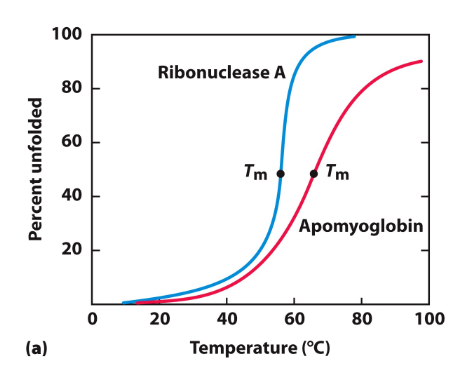
Tm (melting temperature)
midpoint of temperature range where denaturation occurs
Chaotropic agents
denaturing agent, breaks H-bonds
Protein renaturation
