The Market: Demand, Supply, Equilibrium
 Call Kai
 Learn
 Practice Test
 Spaced Repetition
 Match
 Flashcards
 Knowt Play
1/34

Earn XP
Description and Tags
Topic 2- Economics
35 Terms
The Market
a social institution in which goods and services and factors of production are freely exchanged. It is not always a physical place, but there is market where an exchange takes place e.g shopping centre or a phone call
Interveners- it is necessary that there are 2 agents..
the paintiffs and the bidders
Demanders or buyers
go to the market to acquire the goods and/or services that satisfy their needs, or the productive factors they require to produce
The suppliers or sellers
make the goods and services they have produced or the factors they own available on the market to buyers
How does the exchange take place?
buyers and sellers carry out their transactions using money as a means of payment
money
simplifies transactions, translating the value of each item in monetary units
Price
element that makes it possible to bring buyers and sellers in a market into agreement. It is defines as the number of monetary units that must be paid to obtain a physical unit of a good/service
The tourist market
the good being exchanged is tourism, it is an economic activity and forms a very complex sector where many economic activities converge
What are the different types of market classifications
The type of good/service, competence, regulation
Depending on the type of good/ service: Markets for goods and services
(what to produce) or markets for factors of production (how and for whom to produce)
According to the degree of competence- Competitive markers
the number of participants is very large and no one has the power to influence prices and quantities
According to the degree of competence- Non-competitive markets
they have some power over certain pricing and/or quantity decisions
Depending on the degree of regulation- free markets
when no authority controls market conditions. Participants buy and sell freely
Intervened or regulated markets
when prices or quantities are determined by someone outside the market (spanish electricity market)
Individual demand curve
collects the different quantities that a consumer wants to demand for each price
Market demand curve
the sum of the individual demands that make it up
The law of demand says…
that when the price of a good increases, without any other variables changing, individuals demand a smaller quantity of that good
The law of demand implies that the demand curve has a
negative slope, the higher the price of a good, the less consumers want to buy it
What are the 2 types of movement in the demand curve
shifts OF the demand curve and movements ALONG the demand curve

A shift OF the demand curve
is a change in the quantity demanded at any given price, which is represented by a movement of the original demand curve to a new position, defined by a new demand curve
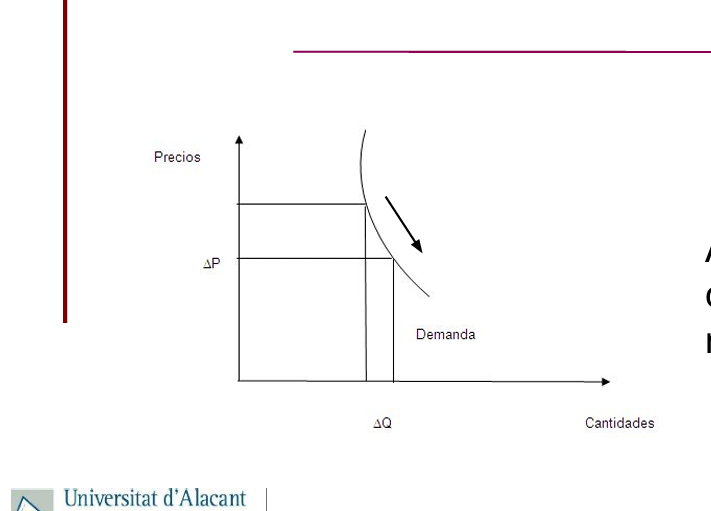
A movement ALONG the demand curve
is a change in the quantity demanded of a good as a result of a change in the price of that good
What are the factors that explain the shift of the demand curve
Changes in the prices of related goods, income changes, changes in consumer preferences, and changes in expectations
supply scheduele
shows how much of a product producers are willing to offer at different prices. It can be represented in a table
supply curve
a graphical representation of a supply scheduele, which reflects how much of a good/ service producers want to supply at any given price. The quantity offered is the actual quantity that producers are willing to offer at a given price
The individual offer table
shows the different quantities a company is willing to offer at each given price
The market offer table
collects the different quantities that producers want to sell for each price. The sum of the individual bids
The law of supply says that
the higher the price of a good/service, the more profitable its production can be and therefore the greater its supply will be
The law of supply implies that the supply curve has a
positive slope, the higher the price of a good, the greater the quantity that producers wish to offer
What are the 2 movements in the supply curve
shifts OF the supply curve and movement ALONG the supply curve

A shift OF the supply curve
a shift of the supply curve is a change in the quantity of a good/service at any given price level. It is represented by a shift of the original demand curve to a new position, represented by a new supply curve
A movement ALONG the supply curve
is a change in the quantity supplied of a good as a result of a change in the price of that good

What are the main factors of shifts in supply curves
changes in the prices of factors of production, changes in technology, changes in expectations
Shift in supply curve- Changes in the prices of the factors of production
An increase in the price of the factors of production implies a reduction in supply e.g if oil rises plane tickets get more expensive
Shift in supply curve- Changes in technology
When a better technology becomes available, capable of reducing the cost of production, supply grows for any price, and the curve shifts to the right
Shift in supply curve- Changes in expectations
the expectations that the price will be higher in the future may cause the supply to fall today for any given price, but if the expectation is that the price will fall, the supply may grow today