Biochem CH 8-12
 Call Kai
 Learn
 Practice Test
 Spaced Repetition
 Match
 Flashcards
 Knowt Play
1/158

Earn XP
Description and Tags
finish
159 Terms
Polysaccharides are..
long chains of monosaccharides linked by glycosidic bonds, serving as energy storage or structural components in organisms.
sometimes, the repeating units of polysaccharides are modified. The polymers can be either linear or branched. The physical and chemical properties of polysaccharides (rigidness, solubility in water, etc.) depend on their structure
Homopolysaccharides
contain only one type of monosaccharides
Heteropolysaccharide
more than one monosaccharide type constitutes the polymer,
Structural Polysaccharides
provide rigidness for cells and tissues
Storage Polysaccharides
serve as secondary energy sources
Signaling Polysaccharides
attached to membrane proteins and lipids and participate in intercellular recognition events
____ and ____ are the most widely spread structural polysaccharides on Earth.
Cellulose, chitin
Heteropolysaccharide vs. Homopolysaccharide

____ is the structural component of plant cell walls. It accounts for about __ of all plant dry matter. It is also produced by algae and bacteria
Cellulose, 33%
Cellulose represents a linear chain of glucose residues connected via ___________
β-1,4-glycosidic bonds

Cellulose is a homodimer of ______
D-glucose
Why is cellulose insoluble in water?
Despite the hydrophilicity of cellulose fibers, this polymer is insoluble in water due to the rigidity and tightness of the fibrils’ structure. This occurs because the intermolecular hydrogen bonds between the cellulose chains create a strong structural matrix, preventing water from penetrating the fiber.
_____is the process of breaking down cellulose into smaller polysaccharides cellodextrins and into glucose.
Cellulolysis
Because cellulose molecules bind strongly to each other, cellulolysis is relatively difficult compared to the breakdown of other polysaccharides.
____ is a long-chain linear homopolymer consisting of N-acetylglucosamine units connected via β-1,4-glycosidic bonds It is a chemical analog of cellulose with the only structural difference in the replacement of OH group at C2 by N-acetylamino group.
Chitin

___is the structural component of cell wall of fungi and of exoskeletons of crustaceans, insects and spiders.
Chitin
Due to its flexibility, strength, and ability to be degraded in the human body, chitin is used as surgical thread in medicine.
In addition, chitin is known to accelerate wound healing.
In agriculture, it is used as a fertilizer, which stimulates the immune system of plants.
Starch is a principal energy source produced by plants. It is composed of glucopyranose monomers linked by ____ bonds. It is a mixture of two glucose polymers: ________ and ________
α-glycosidic, α-amylose (20–25%), amylopectin (75–80%)
______ is a linear polymer of up to a thousand glucose molecules joined by α-1,4-glycosidic bonds
α-Amylose
structural isomer of cellulose with the only difference in the configuration at the anomeric centers
due to this configuration, the polymeric chain of α-amylose assumes a helical rather than a linear structure
presence of this helical structure in starch accounts for its blue staining in reaction with iodine solution, a well-known test for starch
Amylopectin is a branched glucose polymer. Its linear fragments are ___glucose polymers, while in the branching points glucose units are connected via _____ bonds. The branching usually occurs every 24–30 units. The resulting tree-like structure has only one hemiacetal anomeric carbon, which is called the ______ ___
a(1→4), α-1,6-glycosidic, reducing end.

To digest starch obtained from the diet, humans and other animals have special enzymes called _____ which hydrolyzes α(1→4) glycosidic bonds.
amylases
______ which enables long-term energy storage in animals, is a more branched structural analog of amylopectin. The branch points occur every 8–12 glucose units.
Glycogen
________ also known as mucopolysaccharides, are unbranched heteropolysaccharides that consist of disaccharide repeating unit. The repeating unit is composed of a residue of uronic or iduronic acids, while the other is a glucosamine or galactosamine residue
Glycosaminoglycans

_______ ____ (hyaluronate or hyaluronan) is a major structural component of connective, epithelial, and neural tissues. It consists of D-glucuronic acid and D-N-acetylglucosamine linked via alternating β(1→4) and β(1→3) glycosidic bonds.
Hyaluronic acid

________ ______ differs from hyaluronic acid only in that N-acetylglucosamine residue is replaced with N-acetylgalactosamine residue, and its either C4 or C6 hydroxyl group is sulfated
Chondroitin sulfate
Long chains (over 100 monomeric residues) of chondroitin sulfate with OH groups sulfated at variable positions are usually found attached to proteins as part of proteoglycans.


______ _____contains residues of iduronic acid, which is an epimer of glucuronic acid found in chondroitin sulfate, and N-acetylgalactosamine-4-sulfate residues
This glycosaminoglycan takes part in blood coagulation and wound repair.
Dermatan sulfate
_____ a variably and heavily sulfated glycosaminoglycan. It contains an average charge of 2.5 sulfate groups per disaccharide unit, which is composed of sulfated iduronate and glucosamine residues. It has the highest negative charge density of any known biological molecule
Heparin
naturally-occurring anticoagulant, which acts by preventing the formation of clots and extension of existing clots in blood. Its properties make it be used in medicine for anticoagulation.

the structure determination of a polysaccharide following aspects have to be elucidated:
nature and molar ratios of the monosaccharide building blocks;
positions of the glycosidic linkages;
distinction of furanosidic and pyranosidic forms;
anomeric configuration;
monomer sequences and identification of repeating units;
position and nature of OH–modifications such as O–phosphorylation or O–sulfation.
Heat de-denatured DNA exhibits _____ UV absorbance, which is called the _____
increased; hyperchromic effect
40% increase
The DNA helix is stabilized by
hydrogen bonds between complementary bases, stacking interactions, and favorable electrostatic interactions (presence of counterions)
The sugar pucker is ___ in the ___ form
C2’-endo for pyrimindes and C3’-endo for purines: Z-DNA
Which of the following ‘assays’ would be most specific for a particular protein?
Radioimmunoassay
Which of the following amino acids would be last to elute at pH 8.0 from an anion-exchange column?
glutamic acid
The pK1, pK2, and pKR of the amino acid histdine are 1.8, 9.3, and 6.0, respectively. The pK1, pK2, and pKR of the amino acid arginine are 1.8, 9.0, and 12.5, respectively. You have a mixture of histidine and arginine, how would you try to separate these two amino acids?
cation exchange chromatography at pH 9
Which of the following substances cannot be used to cleave peptide bonds in polypeptides?
2-mercaptoethanol
The positive charge on proteins in electrospray ionization mass spectrometry is the result of
protonated side chains of Arg, His and Lys residues
You have purified a new peptide hormone. To determine its amino acid sequence you have digested the polypeptide with trypsin and in a separate reaction you have cleaved the polypeptide with cyanogen bromide.
Cleavage with trypsin yielded 5 peptides that were sequenced by Edman degradation as shown in the following.
Ser─Leu
Asp─Val─Arg
Val─Met─Glu─Lys
Ser─Gln─Met─His─Lys
Ile─Phe─Met─Leu─Cys─Arg
Cleavage with cyanogen bromide yielded 4 peptides that were sequenced by Edman degradation:
His─Lys─Ser─Leu
Asp─Val─Arg─Val─Met
Glu─Lys─Ile─Phe─Met
Leu─Cys─Arg─Ser─Gln─Met
Determine the identity of the N-terminal amino acid after reconstructing the intact protein.
Asp
In vivo DNA is synthesized in the process of ___ ______
DNA Replication
performed by DNA polymerase which use a single-stranded DNA as a template for the synthesis of the complementary strand
DNA polymerases, elongate a primer, which synthesized by primase
2 new new DNA molecules (replicas) are obtained as a result of the replication
semi-conservative replication mode
the newly synthesized double-stranded DNAs contain one strand from the parent molecule and one new strand
DNA synthesis begins at the ____→ AT-rich to facilitate melting of the double helix
Separation of the two DNA strands at the origin is accomplished by __ ______
_________ relieve topological stress in the helical DNA structure created upon separation of the DNA strands
Unwound strands are kept single-stranded through their binding by special _______________
The ends of the single-stranded loop formed at the origin are called replication forks
Synthesis of both daughter strands is _________
DNA synthesis begins at the origins → AT-rich to facilitate melting of the double helix
Separation of the two DNA strands at the origin is accomplished by DNA helicases
Topoisomerases relieve topological stress in the helical DNA structure created upon separation of the DNA strands
Unwound strands are kept single-stranded through their binding by special single-stranded DNA binding proteins
The ends of the single-stranded loop formed at the origin are called replication forks
Synthesis of both daughter strands is semicontinuous
leading strand
the strand that is synthesized continuously
lagging strand
strand that is synthesized discontinuously
the synthesis of of the daughter strands is semicontinuous what does that mean?
It means that one strand (the leading strand) is synthesized continuously, while the other strand (the lagging strand) is synthesized in short fragments (Okazaki fragments) that are later joined together.
Why does a “nick” occur in DNA replication?
A “nick” occurs in DNA replication due to the process of joining Okazaki fragments on the lagging strand, where the enzyme DNA ligase seals the gaps between fragments that remain unconnected
_______ allows DNA replication to be very accurate
proof-reading
removal of mispaired nucleotides after incorporation
removal of mispaired nucleotides after replication
Cellular RNA are synthesized by _____
transcription
the info about RNA nucleotide sequence is stored in a ___
gene
Only 1 strand of __ is transcribed during a single transcription process
DNA
DNA dependent RNA polymerase
enzyme that govern RNA synthesis in vivo; the transcription of RNA from a DNA template, synthesizing RNA strands complementary to the DNA sequence
Prokaryotes have __ type of RNA polymerase and Eukaryotes have _ types of RNA polymerases
1; 3
Why is transcription less accurate than replication?
Transcription is less accurate than replication because RNA polymerase has a lower fidelity than DNA polymerase, resulting in a higher rate of errors when synthesizing RNA from a DNA template - there is also no proofreading
What makes up the RNA secondary structure?
The RNA secondary structure is formed by base pairing between nucleotides, creating structures such as hairpins, loops, and bulges, which help stabilize the RNA molecule.
What makes up the RNA tertiary structure?
The RNA tertiary structure is composed of the overall three-dimensional arrangement of nucleotides that results from interactions between the RNA's secondary structure elements, including hydrogen bonding, stacking interactions, and metal ion coordination, leading to its functional conformation.
mRNA (messenger RNA)
transfer the genetic information stored in DNA to the ribosomes, the “factories” for protein synthesis
rRNA (Ribosomal RNA)
are the components of ribosomes
tRNA (transfer RNA)
Transfer RNAs (tRNA) deliver amino acids to a growing polypeptide chain at the ribosomal site during protein synthesis
miRNA (Micro RNA)
post-transcriptional regulators that bind to complementary sequences of mRNA and inhibit translation
siRNA (small interfering RNA)
participate in regulation of gene expression,
spliceomes
post-translational modification of mRNA
Bacterial ribosomes contain _ rRNAs
3
What makes up the 50s subunit of rRNA
5s rRNA (120 nucleotides), 23s rRNA (2900 nucleotides)
What makes up the 30s subunit
16s rRNA (1540 nucleotides)
Double stranded RNA form a ___
helix
11 BP per turn
3.1 nm pitch
16.7º
2º structure of tRNA
76-90 nucleotides long, cloverleaf

Force stabilizing nucleic acid structures
Hydrogen bonds, base stacking interactions, and ionic interactions
Why are G-C rich DNA more thermally stable?
cations shield the negative charges of nucleic acids
Nucleic acids that are rich in guanine are capable of forming 4-stranded structures called ____
G-quadruplexes
the ability of RNA molecules to store transmit, and duplicate genetic information, as well as biocatalysts and regulators of gene expression (riboswitches) provides some basis for ______
RNA world theory
early stages of evolution and pre-cellular life depended on RNA
B-DNA
right handed
10 base pairs per turn
3.4 nm pitch (rise per turn)
major groove: 2.2 nm
minor groove: 1.2 nm
A DNA
right handed
11.6 base pairs per turn
3.4 nm pitch (rise per turn)
Z DNA
left-handed
12 base pairs per turn
4.4 nm pitch (rise per turn)
C3’ endo/syn → purines
C2’ endo/anti→ pyrimindines
formed by alternating purine/pyrimidine sequences: (Gc)n, (AC)n, (GT)n
Linking number formula
L = T + W
twist (T)
the number of helical turns in a DNA double strand
writhing number (W)
the number of superhelical turns
linking number (L)
the number of time one DNA strand winds around a complementary strand
T is __ for right-handed turns
positive
W<0 for ____ DNA + right-handed superhelical turns
negative super coiled DNA
L is constant for ____ circles
closed
defined only for a DNA with fixed ends, is an integer #
supercoiled DNA is more ____ so it has greater mobility in gel
compact
DNA transformations that alleviate topological constraints in (-) supercoiled DNA
melting of DNA fragments
cruciform structure formation
formation of short stretches of Z-DNA
B-DNA→Z-DNA unwinds (-) superhelical turns
Find L in relaxed DNA w/ 2080 base pairs
L = 200
Biological functions of proteins
include catalysis, structural support, transport, regulation, and antibodies
what does the binding site in a protein do?
allow protein to bind to other proteins, nucleic acids, or small molecules
it’s formed when the protein is folded (3D structure)
Gel filtration
is a chromatography technique used to separate molecules based on size. It allows larger molecules to pass through while smaller ones are retained in the gel matrix, enabling the separation of proteins, nucleic acids, and other biomolecules.

To further separate the protein of interest from other proteins, which is the most laborious part of the protein purification process, various types of _______ are used. These procedures take advantage of the difference in the proteins’ size, charge, and binding affinity to some ligands
Chromatography
Ion exchange chromatography
separates proteins according to their charge
If the protein of interest has overall negative charge, a resin that contains positively charged groups is used
To retain positively charged proteins, a negatively charged resin is employed.
proteins with lower charge move through column faster + have higher affinity to resin, require higher salt concentration to be eluted from resin
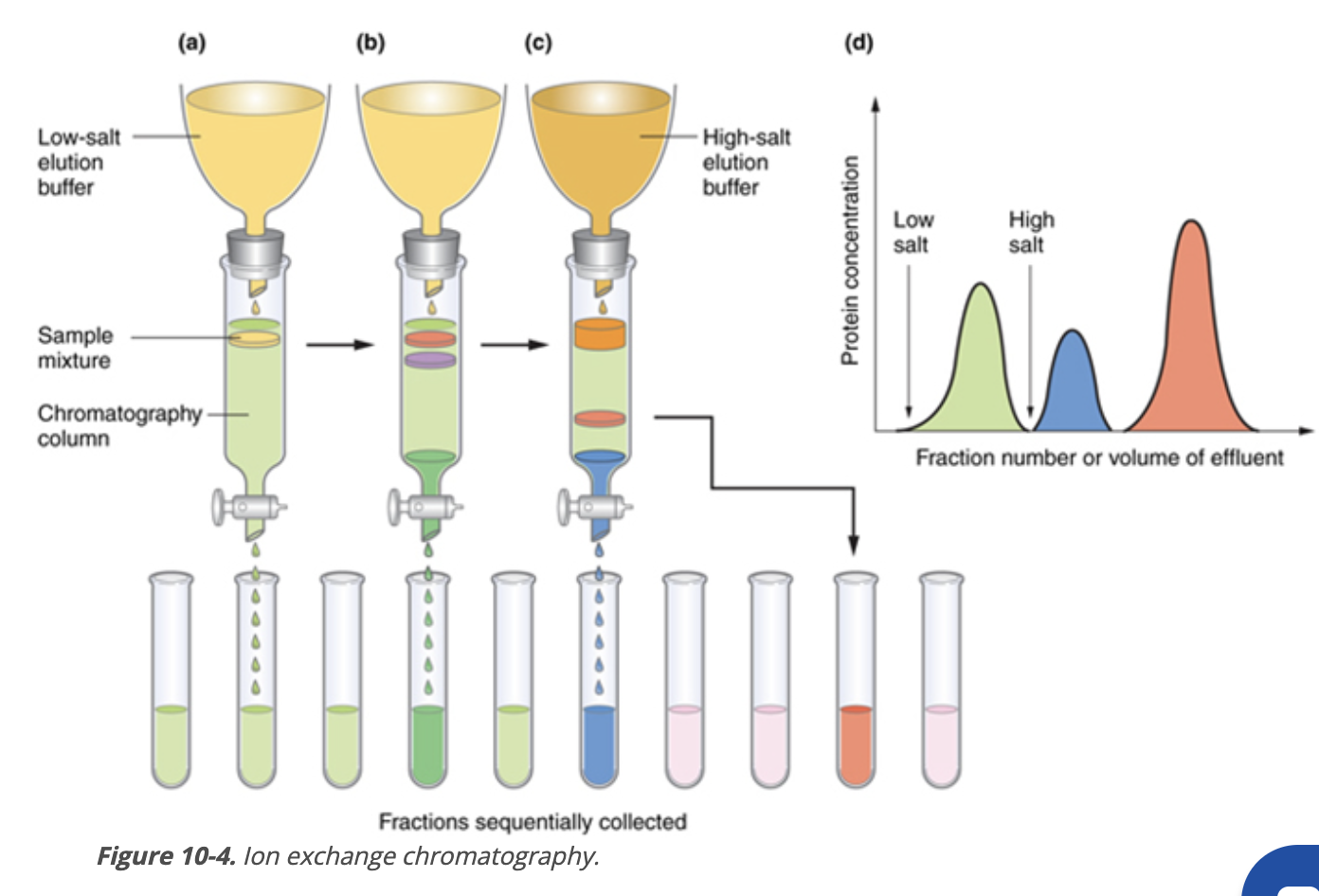
what are the most commonly used resin for exchange chromatography?
anion → Q-resin, DEAE-resin
cation → S-resin, CM resin
resins are chosen based on the charge of the protein

Affinity Chromotography
Based on the ability of the protein of interest to bind specific ligands with high affinity
The target molecules become entrapped on a stationary phase, while other proteins, which do not possess the affinity to the immobilized ligand, freely pass through the column.
The entrapped protein of interest is then recovered from the immobilized ligand using a high salt concentration, buffers with low pH, or a denaturing agent (e.g., 8 M urea). The effluent is removed by dialysis.

immobilized metal affinity chromatography (IMAC)
A technique that uses metal ions immobilized on a resin to selectively bind proteins that have affinity for these metals. Commonly utilized for purifying histidine-tagged proteins.
A commonly used approach involves introduction of 6–8 histidine residues into the C-terminal fragment of the protein by means of genetic engineering prior to the cloning of the protein gene in a bacterial or yeast culture.
The polyhistidine tag of the protein has an affinity for such metal ions as nickel and cobalt. The protein containing the tag is retained in the column with immobilized nickel ions, while all untagged proteins freely pass through the column.
Beer Lambert Law
A=ε×C×l
where A is absorbance, ε is the molar absorptivity, C is the concentration of the solution, and l is the path length of the light through the sample.
if nucleic acid contamination of the protein sample is possible, to estimate the protein concentration in the sample the absorbance at both 280 and 260 nm is taken into account using the following formula:
C(mg/ml) = 1.55 x A280 - 0.76 x A260
Bradford Essay
A method for determining protein concentration via color change, resulting from the binding of Coomassie Brilliant Blue dye to proteins. The intensity of the color is measured spectrophotometrically
To enable proteins to have identical charge per a mass unit and to fractionate them by size only, a technique of denaturing electrophoresis called ______________________ is employed.
sodium dodecyl sulfate polyacrylamide gel electrophoresis (SDS-PAGE)
Gel Electrophoresis
For protein electrophoresis mostly polyacrylamide gels are used
Positively charged proteins will migrate from the positively charged electrode (anode) to the negatively charged electrode (cathode) in the electric field. Negatively charged proteins (e.g., pepsin) will migrate in the opposite direction.
Rf
which is determined as the distance travelled by a protein divided by the gel length, has a linear correlation with the logarithm of its molecular mass.
avg mw of an amino acid
110 Da
#of amino acids in a protein
MW of protein/110 Da
capillary electrophoresis
carried out in a very thin tube filled with electrolytes
fast and high efficiency due to high voltages
both positive and negative ion travel though the capillary drive by electroosmotic fluid, typically directed toward (-) charged cathode
deteteced ions are peaks on the electophoreogram.
isoelectric focusing (IEF)
is a technique for separating proteins based on their isoelectric point (pI). It involves creating a pH gradient in a gel or solution, causing proteins to migrate until they reach the pH where their net charge is zero.
2D gel electrophoresis
Combines IEF and SDS-PAGE
2 stages of protein separation
IEF first, then gel tube (contains proteins separated by pI) is placed on top o f an SDS-containing polyacrylamide gel slab, and the proteins are fractionated by size
for large-scale studies of proteins
Edman’s degradation
amino acids are sequentially cleaved off from the peptide starting from the N-terminus
done by PITC or Edman’s reagant w/ an uncharged terminal amino group
PTC derivative → thiazoline derivative → PTH derivative
peptide sequenators accelerate the procedure
lager proteins must be cleaved into smaller fragments before the ED
