CogPsych Exam 3 (Units 8- )
 Call Kai
 Learn
 Practice Test
 Spaced Repetition
 Match
 Flashcards
 Knowt Play
1/90

There's no tags or description
Looks like no tags are added yet.
91 Terms
Reminiscence Bump
enhanced memory for adolescence and young adulthood in people over 40
Self-Image Hypothesis
memory is enhanced for events that occur as a person’s self-image or life identity is being formed
Ss asked to write “I am” statements they felt defined them as a person and average age assigned to the origin of these statements was 25
Cognitive Hypothesis
periods of rapid change that are followed by stability cause stronger encoding of memories

Cultural Life Script Hypothesis
distinguishes between a person’s life story, which is all of the events that have occurred in a person’s life, and a cultural life script, which is the culturally expected events that occur at a particular time in the life span
events in one’s life become easier to recall when they fit the cultural life script for that person’s culture
What is the relationship between emotional memories and neutral, encoding memories?
they’re located in different segments of the brain
subjects with unilateral damage to the medial temporal lobe showed significant impairment in gist memory under the emotional, but not the neutral, encoding condition
How does cortisol impact memory?
it can improve memory (cortisol and amygdala activity = better memory of it) but can also impair it (ss more likely to say they remember negative pictures than neutral, but this does not give them enhanced detail of it. in fact, sometimes, it reduces detail because the brain is overwhelmed and primarily focuses on one threatening detail)
Flashbulb Memory
memory for circumstances surrounding shocking, highly charged events (but shock value isn’t a precondition)
refers to memory for the circumstances surrounding how a person heard about an event, not memory for the event itself
According to the repeated recall procedure, did flashbulb memories change over time?
yes, they decay just like regular memories, but people maintain their original confidence about them
Narrative Rehersal Hypothesis
flashbulb memories seem highly vivid and salient, but potentially due to news coverage and rehearsal following the event
Ss asked if they saw the video where Princess Diana died, and 20/45 said yes. There is no video lol
How is a memory constructed?
what actually happened + person’s knowledge + experiences + expectations
Source Monitoring
process of determining the origins of our memories, knowledge, or beliefs
Monitoring Errors / Source Misattribution
misidentifying the source of a memory (very common)
Cryptoamnesia
unconscious plagiarism of the work of others
What would increase the presence of memory errors (misremembering or misattribution)?
a delay between learning the info and being tested on it
Repeated Reproduction
at longer intervals (after first reading), reproductions were shorter than original and contained many omissions and inaccuracies, tended to reflect Ss own culture
Pragmatic Inference
occurs when reading a sentence leads a person to expect something that is not explicitly stated or implied by the sentence
inferences are based on knowledge gained through experience
Schema
one’s knowlege about some aspect of the environment
Ss included things that were not in the office but seemed to fit into their office schema, like books
Script
conception of the sequence of actions that usually occurs during a particular experience
Ss would include material that wasn’t presented but was part of a script (false recall, like thinking you saw the world sleep on a list of related words
How can flexible reconstructed memory be useful?
constructive properties allow us to understand language, solve problems, and make decisions
fill in the blanks when there is incomplete info based on knowledge and experience
otherwise there would be an overload of info and we can use cognitive resources for other tasks
What is it like to have exceptional memory?
exhausting!! you remember way too much (system overload)
not good at reasoning that involved drawing inferences or “filling in the blanks” based on partial information
struggled with creativity and other types of memories
Misinformation Effect / Misleading Post-Event Information (MPI)
misleading information presented after a person witnesses an event can change how the person describes the event later
Creating False Memories for Early Events in People’s Lives
after being told a false memory and given some delay time, Ss thought they genuinely remembered events that never existed
Eyewitness Testimony
testimony by a person who was present at the crime about what they saw during commission of the crime
people are not always entirely accurate and others wrongly serve time do to inaccuracies
source monitoring errors based on familiarity
Post-Identification Feedback Effect
increase in confidence due to confirming feedback after making an identification
Conceptual Knowledge
knowledge that enables us to recognize objects and events and make inferences about their properties
Concepts
mental representation of a class or individual; the meaning of objects, events, and abstract ideas
Categories
includes all possible examples of a particular concept, like different dog breeds
Categorization
process by which things are placed in categories
Definitional Approach to Categorization
decide whether something is a member of a category by determining whether a particular object meets the definition
Why don’t definitions work for categories?
not all members of categories have the same features and some concepts don’t meet the definition of a certain category-variation is the norm
Family resemblance
thigns in a particular category resemble one another in numerous ways
Prototype Approach to Categorization
membership in a category is determined by comparing the object to a prototype that represents the category
Prototype
“typical” member of the category
not an actual member of a category; an average representation of diverse instances of a category

High Typicality
category member closely resembles category prototype
Low Typicality
category member does not closely resemble category prototype
Sentence Verification Technique
an experimental procedure in cogpsych used to measure how quickly and accurately people process category membership
typicality effect
Typicality Effect
high typicality objects > low typicality objects for categorization speed
Which one would be named first: high typicality objects, low typicality objects, or the prototypical objects?
prototypical objects (ex. apple before pomegranate)
Prototype Theory/Approach
rosch — concepts are organized around a central prototype rather than strict, binary checklists of defining features
AKA, a category name does not activate a generic checklist of criteria or structural fragments. Instead, hearing a category name causes the brain to automatically generate a highly specific mental representation reflecting the prototype
Rosch 1975 Priming Experiment
priming resulted in faster judgements for prototypical colors than non-prototypical colors
facilitation and inhibition effects
Rosch — The Facilitation Effect
when primed with “fruit” and then shown “apple-apple,” participants responded significantly faster than they did in unprimed conditions.
The prime facilitated their response because the mental representation of “fruit” naturally activated highly typical examples like apples
Rosch — The Inhibition Effect
when primed with “fruit” and then shown “pomegranate-pomegranate,” participants actually took longer to respond than in unprimed trials.
The prime inhibited their response beacuse the mental image generated by the word “fruit” did not match the unexpected target
Exemplar Approach to Categorization
involves determining whether an object is similar to other objects by thiking of exemplars of that category
similar support to the prototypical approach
Exemplar
actual members of the category that a person has encountered in the past
What’s are advantages of using the exemplar approach rather than the prototype?
by using real examples, it can more easily take into account atypical cases such as flightless birds
deals more easily with variable categories like games
better for smaller categories
Is there a psychologically “privileged” level of category?
rosch provided evidence that the basic level is "“psychologically privileged” because going above it to global results results in a large loss of info and going below it results in little gain of info
AKA, faster RTs for basic level words/objects
HOWEVER, that “special” level is not hte same for everyone—people with more expertise and familiarity with certain category focus more on specific info

Semantic Network Approach
concepts are arranged in networks
networks consists of nodes connected by links, which represents a category of concepts, and related concepts are connected
Collins and Quillian’s Hierarchical Network Model
consists of levels arranged so that more specific concepts at the bottom and more general concepts at higher levels
Superordinate Level: living thing
Basic Level: plant, animal, tree, flower, bird, fish
Subordinate Level: canary, robin, oak, rose, etc.
Nodes: words that represent specific concepts or categories
Links: “is” statements
**To save mental storage space, general properties are stored at the highest possible level rather than repeated for every single item. For example, “can move” and “has skin” are stored at the animal node, so the brain doesn’t need to re-store “has skin” individually under canary, robin, salmon, etc.
Statements that required further travel away from “canary” resulted in longer RTs

Activation — Collins and Quillian’s Hierarchical Network Model
activity that spreads out along any link that is connected to an activated node
also spreads to other nodes in the network

Lexical Decision Task — Activation in Hierarchy
when words were closely related (bread and wheat), faster to say yes both are words
retrieving one word from memory triggered a spread of activation to nearby locations in a network
What’s a criticism of the Collins and Quillian model?
it can’t explain the typicality effect
“A canary is a bird” is verified more quickly than “an ostrich is a bird”, but the model predicts equally fast RTs
Connectionism
a computational framework that models human mental processes using artificial neural networks
Parallel Distributed Processing (PDP) Model (Connectionism)
propose that concepts are represented by activity that is distributed across a network
some units can be activated by stimuli in the environment (input), some by signals received from other units (input units —> hidden units —> output units)
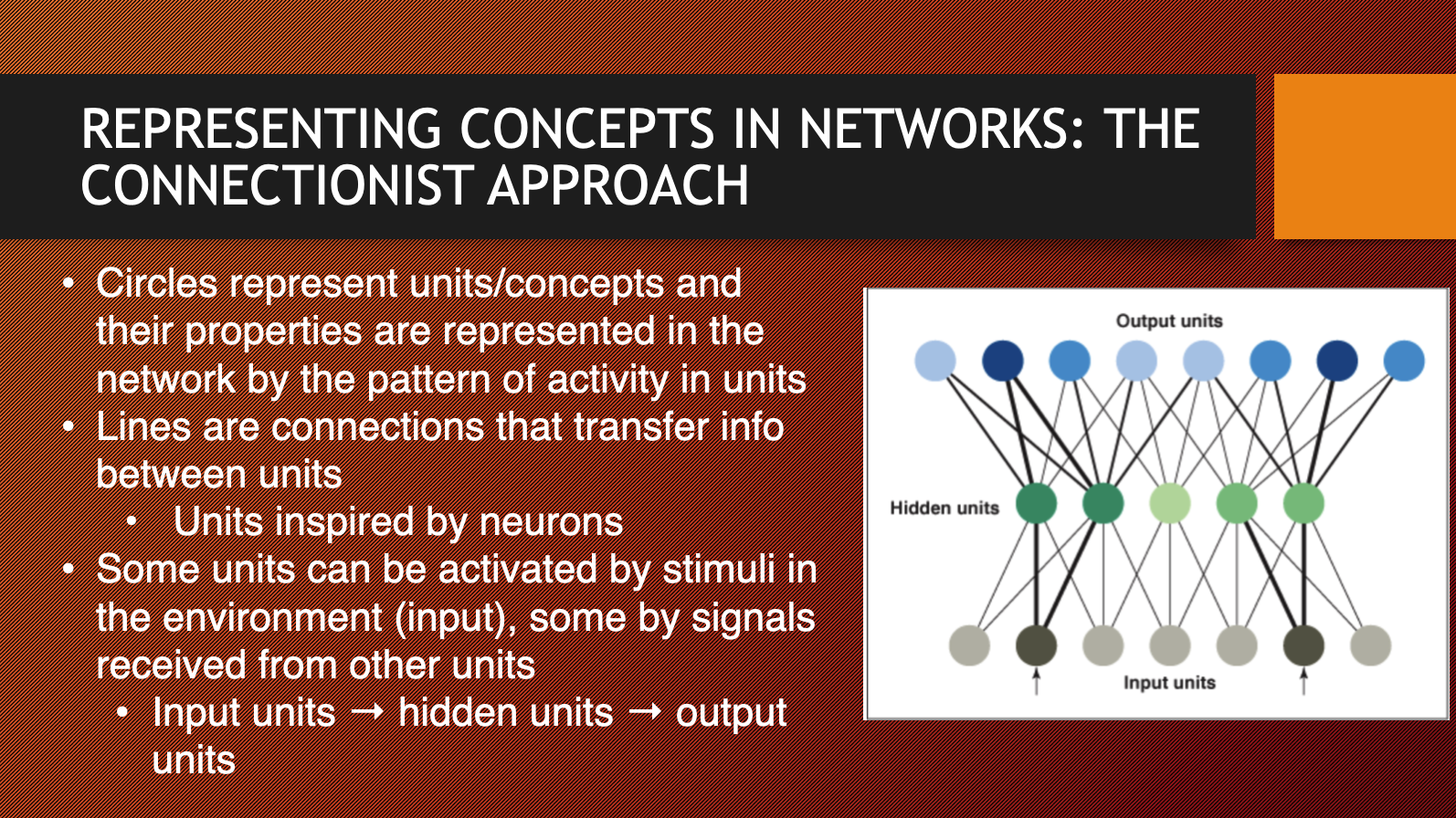
Connection Weight
determines how signals from one unit either increase or decrease activity of the next unit (along with the specific type of signal that originates form the input units)
Activation of Hidden Units — Connectionism
activation in hidden units activate similar words (canary—grow, move, fly, and sing) property units
Learning Process — Training a Network
erroneous responses in property units cause an error signal to be sent back through the network by back propagation (then the weight is adjusted)
What are the pros of connectionism?
operation of connectionist networks is not totally disrupted by damage (because the info is distributed)
connectionist networks can explain generalization of learning (training a system to recognize the properties of one concept also provides info about other related concepts)
Mental Imagery
the ability to recreate the sensory world in the absence of physical stimuli
also occurs in senses other than vision
Visual Imagery
seeing in the absence of a visual stimulus
Image[less] Thought Debate
is thought possible without an image? / are perception and imagery different from each other?
Galton 1883 observed that people who had difficulty forming visual images (aphantasia) were still capable of thinking
Think in words, concepts, or other non-visual information
Why was research in imagery stalled?
behaviorism told people nothing mental and unobservable can be reliably studied
How does visualization influence performance?
athletes who visualize their performance beforehand tend to perform better than those who do not visualize
Mental Chronometry
moving an object through space in mind (like the mental rotation study)
easier to remember concrete than abstract nouns
Conceptual Peg Hypothesis
concrete nouns (high-imagery) create images that abstract nouns (low-imagery) can hang onto
ex. “dog-book” —> imagining a dog sitting on a book
Kosslyn
analog (spatial/pictorial) positioning… mental images are represented in “quasi-pictorial” depective format rather than abstract language-like descriptions
What experiment did Kosslyn run?
he asked Ss to study a picture of a boat and then imagine it afterward. longer distances took longer mental scanning times
How did Lea criticize Kosslyn’s experiment?
as participants scanned, they may have encountered other interesting parts, such as the cabin, and this distraction may have increased their reaction time
Pylshyn
starts the imagery debate: is imagery based on spatial mechanisms, or mechanisms related to language (called propositional)?
Who would agree with the sentence “imagery and perception form a double dissociation”?
Kosslyn
Spatial Representation
different parts of an image can be described as corresponding to specific locations in space (Kosslyn)
Epiphenomenon
something that accompanies the real mechanism but it’s not actually part of the mechanism (Pylshyn)
ex. lights flashing as a computer mainframe does calculations—lights indicate that something is going on inside the computer, but not necessarily what is actually happening
Propositional Representation
relationships can be represented by abstract symbols such as an equation or statements (Pylshyn)
ex. discursive sentences, simplified network maps, and computer icons
Depictive Representation
representations that are like realistic pictures of an object, so that the parts of the representation correspond to parts of the object (Kosslyn)
Tactic Knowledge Explanation
we unconsciously use knowledge about the world when making judgments
Pylshyn proposed that Ss are responding to Kosslyn’s tasks based on what they know about what usually happens when they' are looking at a scene
ex. when you look for a friend in the crowd, you imagine their face first, and that mental image influences what you notice
What experiment was used to argue against tactic knowledge?
dot & arrows — took longer to respond for greater distances between the arrow and the dot
Ss wouldn’t ahve had time to memorize the distances between the arrow and dot before making judgments, so it is unlikely they used tactic knowledge
Mental Walk Task
observe or imagine an entity (car, elephant, rabbit, etc), and estimate when they experienced “overflow” (when image filled visual field or edges became fuzzy
Ss moved closer for smaller animals tan larger ones; answered questions about rabbit faster when it filled more of visual field
this proves kosslyn’s spatial theory because visual or mental, the items were still fixed in a field of view
Perky (1910)’s Banana Experiment
a banana was flashed on a screen Ss could not see through, but Ss said they saw a banana anyway
supports Kosslyn’s theory because it links visual and mental images
How should we gather information for the imagery debate?
instead of relying on behavioral experiments, we should investigate how the brain responds to visual imagery
we can’t completely rule out the tactic knowledge explanation because previous knowledge may be impacting perception
What neuroimaging evidence do we need for the imagery debate?
fMRI, TMS, EEG, and case studies

What is this graph of imagery neurons suggesting for the imagery debate?
perception and imagery fires roughly the same for the same stimulus
Which part of the brain area lit up for both perception and imagery? Which part didn’t?
for both = frontal lobe
perception > imagery = occipital lobe
How was TMS used in the imagery debate?
”are the stripes in Q3 longer than those in Q2?”
when TMS was applied to visual cortex, both perception and imagery were stalled
AKA, brain activation in response to imagery is not an epiphenomenon, visual cortex plays a causal role in both
What two effects happened when part of the visual cortex was removed?
decreases image size
distance in mental walk task increased (reduced field of view)
How does perception interact with imagery through damage?
perceptual problems are accompanied by problems with imagery
people who lose the ability to see color also unable to create colors through imagery
Unilateral Neglect
ignore objects in one half of the visual field due to parietal lobe damage

Visual Agnosia
could recognize features of objects but couldn’t integrate them into a meaningful whole
What suggests a separation between perception and imagery in studies?
some people can perceive objects in front of them (perception) but can’t draw from memory (imagery)
other people can draw from memory (imagery) but can’t recognize what the object is after a delay (perception; visual agnosia)
Behrmann et al. on the imagery debate
overlap
visual perception begins as bottom-up and eventually meets imagery, which moves top-down

Conclusions from the Imagery Debate
imagery and perception are closely related and share some, but not all, mechanisms
perception is stable, imagery is fragile
harder to manipulate mental images than perceptual images
Method of Loci
things to be remembered are placed at different locations in a mental image of a spatial layout
(to help remember a dentist appointment, you could visually “place” a pair of teeth in your living room)
Pegword Technique
visualizing images by associating them with concrete words
(ex. shoe-milk —> think of a shoe filled with milk —> remember to buy milk at the store)