Bio Lecture 15 Gymnosperms & Angiosperms
 Call Kai
 Learn
 Practice Test
 Spaced Repetition
 Match
 Flashcards
 Knowt Play
1/32

There's no tags or description
Looks like no tags are added yet.
33 Terms
When did Earth dry and warm?
Devonian Period
Oldest Gymnosperms
Middle Devonian about 390 MYA
Gymnosperms diversified when?
Triassic 251-200 MYA
Gymnosperm favors over bryophyta
seeds
pollen
reduced need for water
wood and secondary growth
Extant Gymnosperm Divsions
oniferophyta: Conifers
Ginkgophyta: Ginkgos
Cycadophyta: Cycads
Gnetophyta: Gnetophytes
Cycadophyta arrival
Carboniferous [320 MYA]
Abundant in Mesozoic [251-66 mya] Age of Cycads and dinosaurs
Synapomorphy of Cycadophyta
Possess simple aerial trunk that lacks lateral branching

Characteristics of Cycadophyta
Large, planated megaphylls (fronds)
Biflagellate sperm
Large male & female cones (Dioecious) (strobili)

Arrival of Ginkgophyta
Permian [280MYA]
Synapomorphies of Ginkgophyta
possess bi-lobed leaves
Possess dichotomous leaf venation

Ginkgophyta Characteristics
Deciduous
Dioceious (stinky female cones)
Motile, biflagellate sperm
Unique architecture of the tree

Coniferophyta arrival
late Carboniferous [290 mya]
Synapomorphies of Coniferophyta
Possess nonmotile sperm cells
Possess simple, highly-lignified leaves
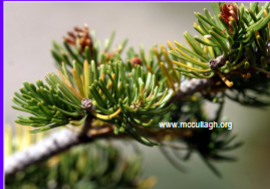
Why are Coniferophyta drought-tolerant
Thick cuticles
Needle-like leaves
Leaves with small SA
Stomata in deep pits

Characteristics of Coniferophyta
Typically evergreen
Monoecious, but w/ separate male & female cones
Among tallest organisms 110 m tall
know the genera Pinus, Picea,
Tsuga (Pinaceae), and Juniperus and Thuja (Cupressaceae) and Araucareaceae (Araucaria) If the
sperm cells are biflagellate, and these are members of embryophyte, what is are the a=ributes
of these sperm in terms of number of flagellae and the condi?on of their flagellar roots? What
is the fleshy cone called?
1
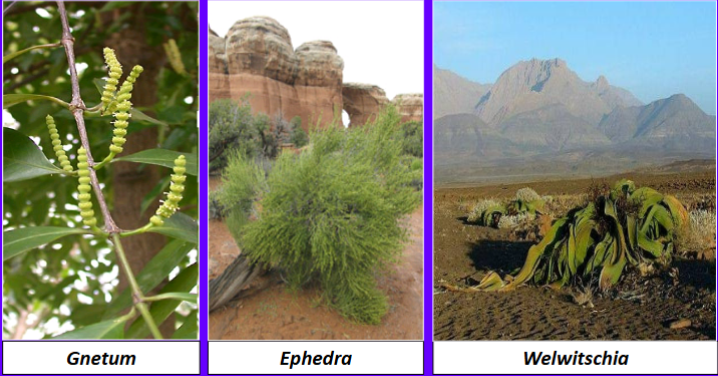
Gnetophyta extant genera
Gnetum
Ephedra
Welwitschia

Synapomorphies of Gnetophyta
Possess striate pollen
Possess vessel elements with porose perforation plates

Anthophyta Synapomorphies
Possess flowers and fruits
Possess double integumented ovules
Double fertilization, 1) diploid zygote 2) multi-nucleate endosperm
Possess sieve tube members
Greatly reduced male and female gametophytes
Anatomy of Flower

4 whorls of flower
Calyx
Corolla
Androecium
Gynoecium
Complete flower
All four layers present
Perfect flower
Male and female reproductive organs present
Symmetry of flowers
Radial (regular)
Bilateral (irregular)

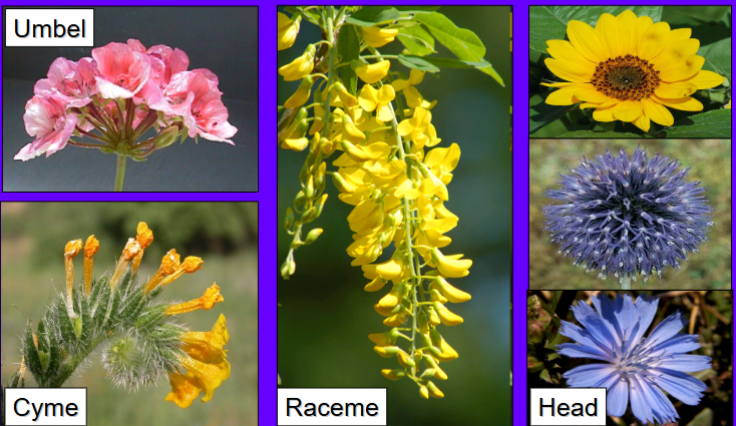
Inflorescence types
Umbel
Cyme
Raceme
Head
Epigynous Flower
Inferior ovary (apomorphic)

Hypogynous flower
Superior ovary (Plesiomorphic)

Plesiomorphic (ancestral) flowers
Flower parts spirally arranged
Many carpels
Showy parts
Free, unfused parts
radial symmetry
superior ovary

Apomorphic (derived) flowers
Flower parts per whorl reduced
Fusion of parts
inferior ovary
bilateral symmetry
complex inflorescences-

Angiosperm life cycle
Double Fertilization [ Explain] 1 sperm fertilizes egg → zygote - 1 sperm cell joins w/ polar nuclei to make endosperm

Liliopsid (monocots) synapomorphies
Possess embryos w/ single cotyledon
Possess parallel leaf venation
Possess atactostele
Possess fibrous roots lacking tap roots
Possess pollen grains single opening
Possess flower parts in multiples of 3
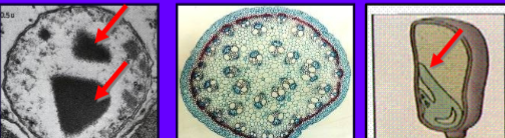
Class Hamamelidopsida: Eudicots synapomorphies
Possess embryos with two cotyledons
Possess netlike venation in leaves
Possess steles arranged in rings
Possess taproots
Posses pollen grains w/ three openings
Possess flower parts in multiples of 4 or 5-
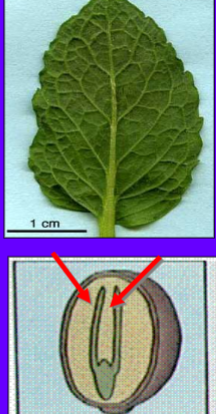
Anthophyta ovule stuff-
