Unit 3 Photosynthesis and Cellular Respiration
 Call Kai
 Learn
 Practice Test
 Spaced Repetition
 Match
 Flashcards
 Knowt Play
1/160

Earn XP
Description and Tags
161 Terms
What is metabolism?
all of an organism’s chemical reactions
What are metabolic pathways?
a series of reactions catalyzed by specific enzymes resulting in an end product
What is biosynthesis?
the body’s ability to make things
What is the difference between catabolic and anabolic pathways?
catabolic pathways help break down molecules for energy (ex. Cellular respiration), and anabolic pathways build up molecules, which requires energy (ex. Protein synthesis)
What is kinetic energy?
energy of movement
What is potential energy?
stored energy
What is thermodynamics?
the study of energy transformations
What is the first law of thermodynamics?
energy is transferred/transformed, but cannot be created nor destroyed
What is the second law of thermodynamics?
the transfer of energy is not fully efficient (since some is lost in heat energy), so it increases entropy in the universe
What does Free energy (G) measure?
measures a portion of a system’s energy that can perform work
What is the formula for a change in free energy?
ΔG = Gfinal - Ginitial
Exergonic reactions (release/absorb) free energy.
release
What are some traits of exergonic reactions?
occur spontaneously, ΔG is negative
What process is an example of exergonic reaction?
cellular respiration
C6H12O6 +O2 → 6CO2 +6H2O
Δ G = -686 kcal/mol
The greater the decrease in free energy, the (less/more) work the reaction can perform.
more
Endergonic reactions (release/absorb) free energy.
absorb
What are some traits of exergonic reactions?
do not occur spontaneously, products have more energy than reactants, ΔG is positive
What does a positive ΔG mean in a reaction?
an input of energy is required to start the reaction
What is an example of an endergonic reaction?
photosynthesis
6CO2 + 6H2O → C6H12O6 + O2
ΔG = +686 kcal/mol
What is activation energy (EA)?
energy needed to start reactions
What pathways (catabolic/anabolic) involve exergonic reactions?
Catabolic
What pathways (catabolic/anabolic) involve endergonic reactions?
endergonic
How do enzymes speed up chemical reactions?
by lowering activation energy
Why do living things require a constant input of energy?
all cell processes require energy
Is the hydrolysis of ATP exergonic or endergonic, and how do you know?
exergonic, the removal of phosphate groups releases energy
What are the two high energy electron carrier molecules?
NADH and FADH2
List the 4 steps of cellular respiration.
Glycolysis
Pyruvate oxidation
Krebs cycle
Oxidative phosphorylation (electron transport chain)
Where does cellular respiration take place?
mitochondria
What are the three main types of work that cells use ATP for?
chemical, transport, and mechanical
What is ATP coupling?
the reactions that take place together to produce an overall reaction that is exergonic/spontaneous
ex. the energy released by the hydrolysis of ATP > energy required for the exergonic reaction
What are endotherms?
organisms that can regulate their own body temperature
What are ectotherms?
cold-blooded organisms (cannot regulate their own body temps)
How is torpor used by certain organisms and what is its purpose?
A state of reduced metabolic rate, heart rate, breathing, and body temperature used by organismsto conserve energy during times of food scarcity/extreme temperatures
What type of energy is activation energy supplied by?
heat energy
What are enzymes?
proteins that act as catalysts in cells and organisms
How do enzymes (and catalysts in general) speed up chemical reactions?
by reducing activation energy needed in a reaction
Enzymes are ________ which are made of monomers called ________.
proteins, amino acids
The reactant an enzyme binds to is called:
substrate
The region on the enzyme where the substrate binds to is called the _____________.
active site
the binding of the enzyme and substrate forms an:
enzyme-substrate complex
The binding of a substrate to the active site creates an _________.
induced fit

a.
substrate

b.
active site

c.
enzyme
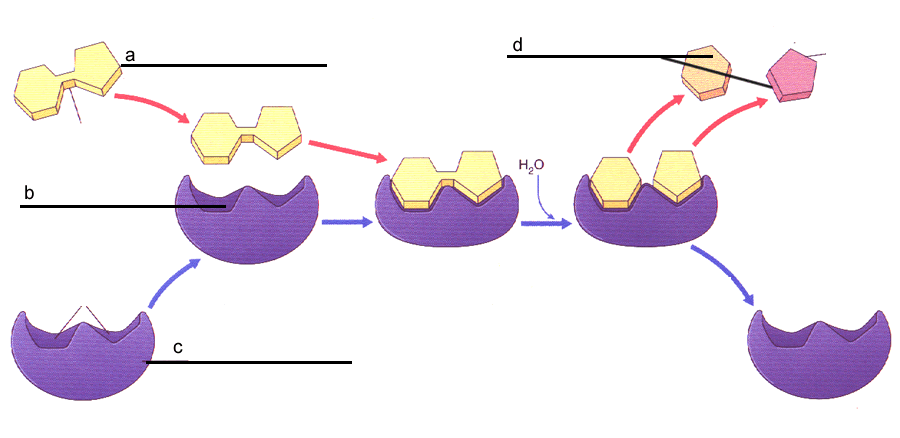
d.
products
How does the previous diagram (of a substrate binding to an enzyme) demonstrate an induced fit?
the active site in the enzyme was originally rounded, but because the substrates were hexagonal, it was molded to the shape of the substrate
True/False: “Enzymes can only control very specific reactions.” Why?
True, there are specific shapes of substrates and active sites
True/False: “enzymes speed up chemical reactions by providing energy to reactions.” Why?
False, enzymes speed up reactions by lowering activation energy
True/False: “the rate of reaction is faster when the activation energy is lower.” Why?
True, requiring less energy allows the reaction to proceed faster
True/False: “Enzymes bind to substrates by forming strong covalent bonds with the substrate.” Why?
False, substrates bind to enzymes through weak interactions such as ionic bonds, hydrogen bonds, and polar/nonpolar interactions
What does a suffix of -ase mean?
it is the substrate the enzyme binds to or the type of reaction they catalyze.
ex. lactase catalyzes the hydrolysis of lactose into glucose and galactose
How can the rate of enzyme activity be sped up?
increasing substrate concentration
Create a graph showing the effect of substrate concentration on reaction rate. Label the axes.
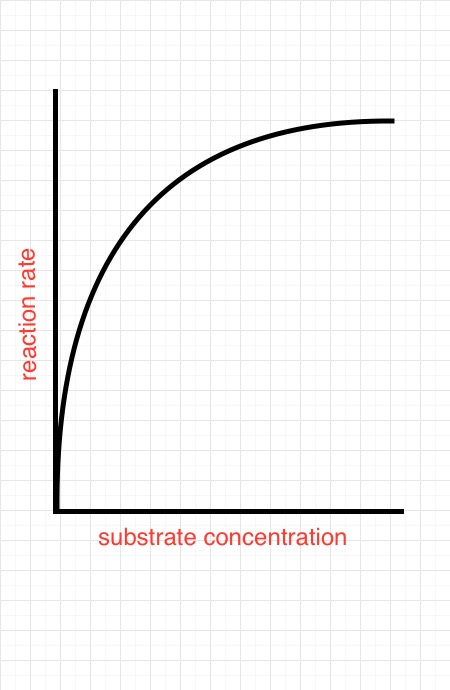
Identify the trend of the substrate concentration-reaction rate graph.
as reaction rate increases, substrate concentration also increases.
Why does the rightmost part of the graph flatten?
all of the enzymes have been bonded (saturated) with substrates
If the structure of an enzyme’s active site is altered, what happens?
its ability to bind to substrates and catalyze a chemical reaction is also affected.
What is enzyme denaturation?
the loss of an enzyme’s ability to do work
What are the factors that affect a protein’s ability to function?
pH and temperature
What is the optimal temperature of most human enzymes?
35-40°C, close to human body temperature
What is the optimal pH of pepsin, a digestive enzyme in the stomach? (hint: the stomach is acidic)
2
What happens if an amino acid found in the active site of an enzyme is changed?
the enzyme’s ability to bind to a substrate is also changed
What are cofactors?
non-protein helpers that help enzymes catalyze reactions
What are some examples of inorganic cofactors?
metal ions (zinc, iron, copper)
What are some examples of organic cofactors/coenzymes?
vitamins
What are enzyme inhibitors used for?
reducing reaction rate
How do are competitive inhibitors work?
by binding directly to the enzyme’s active site and blocking substrates
How do noncompetitive inhibitors work?
by binding to the enzyme that is not at the location of the active site, to change shape and thus preventing the enzyme’s active site from binding normally
What is allosteric regulation?
the term used to describe any case in which a protein’s function at one site is affected by binding of a regulatory molecule at another site
What is allosteric activation?
A form of allosteric regulation that stimulates (increases) enzyme activity
What is allosteric inhibition?
a form of allosteric regulation that inhibits enzyme activity
What does noncompetitive inhibition mean?
the regulatory molecule binds to the enzyme away from the active site
Why do cells compartmentalize?
to isolate certain reactions to different areas (compartments) of the cell, which increases the efficiency of the cell
What are redox reactions (oxidation reduction)?
transfer of electrons during chemical reactions
OIL RIG
oxidation is loss, reduction is gain
What are the traits of a compound being oxidized?
loses electrons, proportion of oxygen increases, proportion of hydrogen decreases
What are the traits of a compound being reduced?
gains electrons, proportion of oxygen decreases, proportion of hydrogen increases
NAD+ and FAD are examples of _____________.
coenzymes
What is the main purpose of glycolysis?
split sugars
What are the products of glycolysis?
2 Pyruvate, 2 ATP and 2 NADH
What are the components of G3P?
½ glucose molecule, +1 phosphate
What is released by fermentation into the bread?
CO2
What is substrate-level phosphorylation?
when an enzyme transfers a phosphate molecule from a substrate molecule to ADP
(basically the enzyme makes ATP)
What happens in pyruvate oxidation?
pyruvate loses electrons (OIL RIG) and Coenzyme-A is added to the molecules forming 2 acetyl CoA
When there is no oxygen left for cellular respiration, what process happens instead?
fermentation
What kind of fermentation happens in humans?
lactic acid
What is the main purpose of the Krebs Cycle?
creating high energy electron carriers for electron transport chain
What is Chemiosmosis?
the flow of H+ through ATP synthase (enzyme) to create ATP
What molecule is needed to keep the electron transport chain going and why?
O2, because it is the most electronegative
How many times is the krebs cycle run?
2 times, because there is 2 Acetyl CoA
How many ATP is made from electron transport chain?
26
Where does glycolysis occur?
in the cytoplasm
Where does the Electron Transport Chain take place?
mitochondria
What kind of respiration happens when you are doing strenuous exercise? What happens if oxygen is scarce?
Aerobic cellular respiration, switches to anaerobic after long period of time
What is another name for electron transport chain?
oxidative phosphorylation
What type of feedback is more common: negative or positive?
negative because maintaining homeostasis
How many ATP are made from fermentation?
2
What is produced in fermentation?
Ethanol, CO2, and 2 ATP
What would happen if yeast is not able to convert pyruvate to ethanol?
glycolysis would stop occuring
What is beta oxidation?
a metabolic sequence that breaks down fatty acids for cellular respiration
What organisms can undergo glycolysis?
all organisms