Particle Physics
 Call Kai
 Learn
Learn Practice Test
 Spaced Repetition
 Match
Match Flashcards
 Knowt Play
1/61

There's no tags or description
Looks like no tags are added yet.
Name | Mastery | Learn | Test | Matching | Spaced | Call with Kai | Chat |
|---|
No analytics yet
Send a link to your students to track their progress
62 Terms
Equation for specific charge?
And the units?
Specific charge = Charge / Mass
Coulombs/kilogram = Coulombs / Kilograms
Isoptope
Atoms with the same number of protons but a different number of neutrons. All isotopes of an element have the same chemical properties but different physical properties.
What is the Strong Nuclear Force?
The force that hold the nucleus together.
At what distances is the SNF attractive and repulsive?
Attractive between 0.5fm and 3.0fm. Repulsive when less than 0.5fm.
After 3fm the force becomes very small
What is alpha radiation?
α Is made of 2 protons and 2 neutrons has a relative Q of 2+. It has a high ionizing power and a low penetrating power.
What is beta minus radiation?β
β- Is a high energy electron and has a relative Q of 1-. It has a medium ionizing power and a medium penetration power.
What is gamma radiation?
γ Is an electromagnetic wave with a relative Q of 0. It has a low ionizing power and a high penetrating power.
What causes α decay?
When the nucleus has over 82 protons. The nuclei of these atoms are too big for the strong force to keep them stable.
What is α decay?
The atom loses 2 protons ans 2 electrons which are fired off in an α particle.
What causes β- decay?
The nuclei is ‘neutron rich’.
What is β - decay?
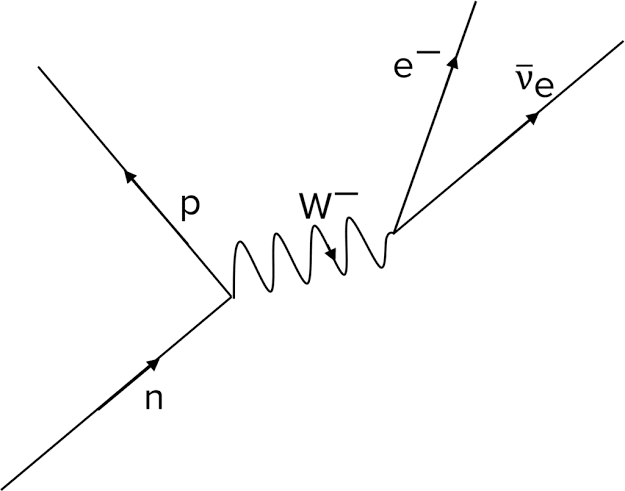
The atom gains a proton and a high energy electron is fired off alongside an antielectron neutrino.
What causesβ+ decay?
When a nucleus is ‘proton rich’.
What is β+ decay?
When a proton decays into a neutron and a positron and an electron neutrino.
What causes γ decay?
When a nucleus has too much energy.
What is γ decay?
An electromagnetic wave is emitted by the nucleus. It follows α or β emission.
How was the neutrino discovered?
The kinetic energy of β particles emitted from the same isotope was expected to all be the same but there was a spectrum of energies. So it was theorised that there must be an unkown particle that carries the energy away.
What speed do electromagnetic waves travel at?
The speed of light, c. (3.0x10⁸)
What is the wave speed equation?
Wavespeed = Frequency x Wavelength
c = fλ
When are electromagnetic waves emitted?
When a fast moving electron is stopped, slowed or changes direction.
An electron in an electron shell of an atom moves to a shell with a lower energy
What are electromagnetic waves released in and who theorised it?
Max Planck theorised theat they are emitted in discrete packets or quanta. However Albert Einstein suggested that theh can only exist is discrete packets and named them photons
Whats the equation for photon energy?
E = h * f
Energy = Plancks constant * frequency
What is the equation that dictates energy mass exchange?
E=mc2
Energy = mass * the speed of light in a vacuo squard
What does E=mc2 mean?
Energy and mass are equivalent
Mass can be turned into energy
Energy can be turned into mass
What is an electron volt?
The kinetic energy gained by an electron that had been accelerated through a P.D of 1 volt.
How many joules is an electron volt?
1eV=1.6⋅10−19 J
What is an antiparticle?
An antiparticle is equal to its regular particle in mass and rest energy but has opposite charge and strangeness. Theh also have the same half-life.
When are antiparticles found?
In high energy collision experiments, interactions with cosmic rays and radioactive decay
What is pair production?
When enough energy ,that equals the sum of masses of the particles interacting, gets converted into mass both antimatter and regular matter are produced.
What happens when a photon has a very high energy?
It can produce an electron - positron pair. This tends to occur near the nucleus of an atom.
What is proton collison?
When protons with a high kinetic energy collide there is a high energy at the point of impact. This energy is converted into mass and 3 protons and 1 antiproton are produced.
What is annhilation?
When a particle and an antiparticle meet they annihilate. The total mass is converted into energy ,with a 100% energy efficiency, this energy is released in two EM waves.
What are exchange particles?
They are how forces act between particles. They are virtual particles.
What is meant by a virtual particle?
A particle that exists for a short period of time.
What are the four fundamental forces?
The electromagnetic force
The weak interaction
The strong interaction
Gravity (not examined)
What is the gauge boson for the electromagnetic force?
Virtual photon
What is the gauge boson for the weak interaction?
W+ or W− Bosons. They also carry s charge.
What is the gauge boson for the strong interaction?
Pions (π0 , π+ , π−)
What is the gauge boson for gravity?
Graviton (theorised)
What particles does the electromagnetic force affect?
Any charged particle.
What particles does the weak interaction affect?
Any particle.
What particles does the strong interaction affect?
Hadrons
What particles does gravity affect?
Anything with mass.
How is the range of an exchange particle determined?
Its determined by the mass of the boson.
Rules for drawing Feynman diagrams?
Gauge bosons are represented by wiggly lines
Other particles are represented with straight lines and arrows to show direction
Incoming particles start at the bottom
Baryons stay on one side
All conservation laws must be applied
y-axis is time
x-axis is space
Antiparticles can be represented with their regular particle but the arrow going in the opposite direction.
W bosons carry charge from one side to another
What does β− Feynman diagram look like?
What does β+ Feynman diagram look like?

What is electron capture?
Sometimes in a proton rich nucleus a proton ‘captures’ an electron from its shell and turns it and the proton into a neutron through the weak interaction. The proton does the work.
What is the Feynman diagram for electron capture?

What happens during an electron, proton collison and whats the difference between it and electron capture?
Electron, proton collisons are when a proton and high energy electron collide producing a neutron and an electron neutrino. The difference is that in electron capture protons do the work but in the electron, proton collison the electron does the work thus it uses the W− boson instead of the W+ boson
What is a hadron?
Anything made up of quarks.
What is a baryon and an anti-baryon?
A baryon is a hadron made from three quarks.
Anti-baryons are made from three antiquarks.
What are mesons?
Mesons are hadrons made of a quark, antiquark pair.
Properties of baryons?
All baryons are unstable except the free proton and decay via the weak interaction.
Properties of mesons?
All mesons are unstable and all expirience the strong interaction.
What are quarks?
They are fundamental particles that make up hadrons, quarks cannot exist on their own.
What is meant by the term fundamental particle?
A particle that as of our current knowledge cannot be broken down any further.
What is a baryon number and which particles have what baryon number?
A baryon number is a number assigned to all particles to identify wheather or not they are a baryon. All baryons have a baryon number of +1. All anti-baryons have a baryon number of -1. All other particles have a baryon number of 0.
What is strangeness?
Strangeness is a fundamental property of the strange quark. For each strange quark its particle has a strangness of -1. For each antistrange quark its particle has a strangeness of +1.
What are the six quarks required to know?
up (u)
anti-up (u)
down (d)
anti-down (d)
strange (s)
anti-strange (s)
What baryons are required to know?
proton (p)
anti-proton (p)
neutron (n)
anti-neutron (n)
What is the quark composition for a proton and antiproton?
proton = up, up, down (uud)
anti-proton opposite of proton