Digital Divide Lecture 5
 Call Kai
 Learn
 Practice Test
 Spaced Repetition
 Match
 Flashcards
 Knowt Play
1/30

There's no tags or description
Looks like no tags are added yet.
31 Terms
What is digital health about?
=field of knowledge + practice (gadgets, professions, ways of working) associated with the development and use of digital technologies to improve health
How can you divide digital health?
software-based: mobile health app, telemed platforms, health data systems
device-based: wearables, surgical robots, imaging equipment, implantable devices
What are the 3 foundations for adoption?
service delivery infrastructure
social & demographic readiness
data infrastructure (standardization & interoperability, governance & trust, security & accessibility)
What is service delivery infrastructure about?
are primary care & local health services able to adopt digital tools? (e.g. telemedicine, overreliance on tertiary hospitals instead of local ones), is it distributed equally?

What is social & demographic readiness about?
(generation differences: trust in apps): without readiness, the adoption is impossible > public trust in culture can make or break adoption
in many advanced economies, ageing populations are very common: more treatment for older adults with chronic diseases needed > these adults are least likely to accept new digital technologies (high demand but low acceptance)
digital literacy differs between generations
cultural acceptance is needed

What is data infrastructure about?
telemedicine works good in Seoul but not in rural areas
standardization & interoperability
governance & trust
security & accessibility
What is standardization & interoperability about (data infrastructure)?
systems need to speak a common language > data exchange + integration:
o formats and terminology of reports should be the same across providers/institutions
o international standards should be used

What is governance & trust about (data infrastructure)?
rules of privacy & sharing, trust of government, providers and patients
o legal and institutional frameworks for safe data sharing
o health data should be seen as a public good

What is security & accessibility about (data infrastructure)?
access for all groups to close infrastructure gaps (required: broadband internet + device availability), cybersecurity
What is the “Information and knowledge Learning Health System”?
public health data: births, deaths, demographics
health care data: hospital/emergency care
long-term care data: nursing home care
social care data: support to live at home, transport services
contextual data: social, economic environment

What are the strengths of Korea’s health infrastructure?
good administrative + claims data through the national health insurance (includes almost everyone), HIRA: reviewing health insurance + assessment service
advanced digital initiatives: e.g. chronic disease management systems, “My Healthway”
High ICT readiness: good broadband penetration + most people have smartphones
good data availability + governance
What are the limitations of Korea’s health infrastructure?
overconcentration in metropolitan tertiary hospitals (Seoul), including adoption of technology
ageing population (chronic disease management), low digital literacy among older adults
data issue: many hospitals use different electronic medical records, that can’t be interpreted by others> weak interoperability
regulatory tension: privacy laws are interpreted very strictly > slows innovation
What are some future directions for Korea’s Healthcare System?
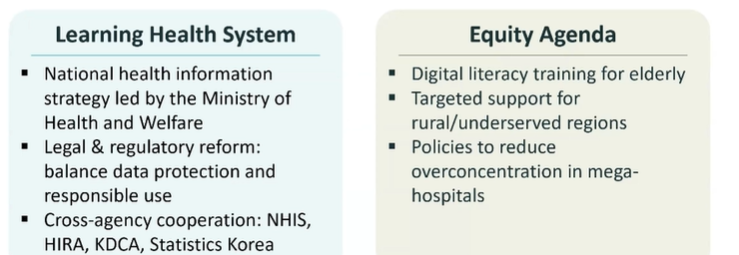
learning health system: national strategy by the health ministry, legal & regulatory reform for data protection, cross-agency cooperation
equity agenda: digital literacy training for elderly, support for rural/underserved regions, reducing overconcentration
What does “AI in health” mean? What roles can AI take on in health care?
=AI (machine/deep learning, NLP) in medical contexts
two roles: assistive tool and autonomous decision-making
What is assistive/decision support AI?
supporting clinicians by providing analysis/recommendations (final decision > physician! = safer because of required human oversight)
o e.g. AI interprets X-rays > physician confirms diagnosis
What is autonomous AI? What issues arise?
AI makes diagnostic/treatment decisions without physician involvement
o problems: accountability (who is liable if issues arise?), ethical + legal debates (patient consent, trust, safety concerns)
→ ADOPTION LIMITED
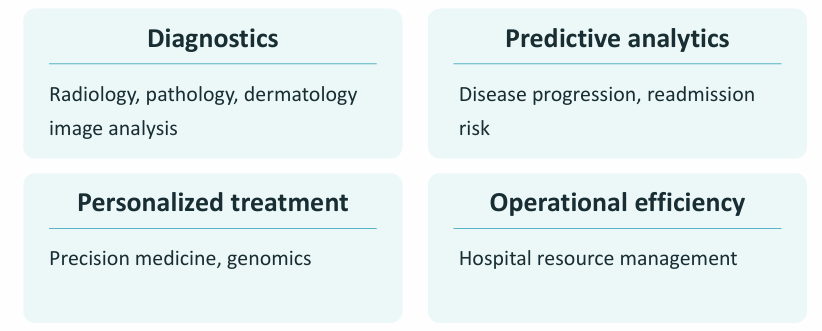
How can AI be used in health specifically?
diagnostics: radiology
personalized treatment
predictive analysis: disease progression
operational efficiency: hospital resource management
What are the benefits of AI in health?
better diagnostic accuracy & speed
early disease detection
less administrative burden
more access in resource-limited settings
What are the risks of AI in health?
· bias: algorithms trained on non-representative data
· transparency: black box AI decision-making
· accountability: who’s responsible if AI makes an error
· trust & adoption: patients + providers are hesitant
What are some future directions for AI in health?
robust, diverse datasets (representative)
transparent AI
clear governance frameworks
embed AI into learning health systems with continous evaluation
How can you define “Telemedicine”?
=delivering healthcare services through technology (ICT=information and communication technology)
What are the three forms of telemedicine?
synchronous: real-time interactions (video/phone consultations)
asynchronous: store-and-forward (sending images, test results > x-ray)
remote monitoring: wearable devices that continuously send patient data to healthcare providers
What are some growth drivers for telemedicine?
advances in ICT infrastructure (broadband, smartphones)
rising demand for chronic disease management
need for more efficient health care delivery (less waiting times + travel costs)
support for remote areas
> COVID-19 increased the need + trend of telemedicine, healthcare while reducing infection risk
What are the benefits of telemedicine?
· accessibility: reach rural/mobility-limited patients (elderly)
· convenience: saves time + reduces travel
· continuity of care: for chronic diseases
· high patient satisfaction (needs met with less hassle)
· providers: able to see more patients
What are the risks of telemedicine?
quality: effectiveness (disease management + follow-up care comparable to in-person visits) + safety (risk of misdiagnosis/medical accidents)
healthcare access: vulnerable groups have low digital literacy + limited ability to use telemedicine, prescription rules online
cost-effectiveness: telemedicine is expensive, overuse can raise costs (if telemedicine is so convenient, patients may use it more often)
healthcare delivery system: patients mainly visit large metropolitan hospitals rather than primary/community care
accountability: who is responsible for accidents/bad practice
What impact does telemedicine have on health inequality?
higher uptake: younger, urban, higher-educated people
lower uptake: older adults, poorer, rural areas
telemedicine can increase existing inequalities!
How does it look on the korean side of things?
during COVID-19, Korea allowed telemedicine (phone consultations) temporarily
in 2023, the authorization ended + MOWH introduced a pilot telemedicine program for follow-up patients and those with limited access
2025: telemedicine was legalized in korea (telemedicine is complementary, not substitute > cannot run an online-only hospital)
What are “wearables”?
=devices + softwares that track, monitor, support health (Apple Watch, Samsung Galaxy Watch) > fitness trackers, smartwatches, contact lenses
What are some growth drivers for wearables?
self-care trend, industry/platform ecosystems, ageing population leads to more need for healthcare, demand for 24h monitoring
What are some benefits of wearables?
patients can self-track and get feedback
anomalies can be detected early
improved patient-doctor communication
supports preventive healthcare
What are some challenges associated with wearables?
access gap: device affordability, required digital literacy
data accuracy & reliability: consumer vs. medical-grade
privacy concerns (sensitive data collected by private companies)
health disparities: younger, urban users benefit most