(22) Adrenergic Antagonists - PART 1: basic pharmacology and propranolol
 Call Kai
 Learn
 Practice Test
 Spaced Repetition
 Match
 Flashcards
 Knowt Play
1/22

There's no tags or description
Looks like no tags are added yet.
23 Terms
β-Blockers
Antagonists that block epinephrine (EPI) and norepinephrine (NE).
β-Blockers
Receptors they block
Receptor | When blocked | Result |
|---|---|---|
β1 — Heart | ↓ HR, ↓ contraction | ↓ BP systolic |
β2 — Lungs | ↓ Airway relaxation | Bronchoconstriction (asthma/copd risk) |
β2 — Blood vessels | α1 still active | Vasoconstriction → Cold extremities |
β2 — Metabolism | ↓ Glucose mobilization | ↑ Hypoglycemia risk (Masks tachycardia) |
β-Blocker warnings to memorize:
Abrupt withdrawal → rebound angina/arrhythmia; taper over 1–2 weeks per lecture.
Traditional β-blockers can worsen lipids; ISA/mixed agents have less adverse lipid effects.
β-Blockers
Medications - overview
Propranolol
Nadolol
Timolol
Just look at structures and chart in end!
Propranolol
topic overview
Classification
STRUCTURE — MUST DRAW
SAR — Why is it an antagonist?
Physiological effects
Therapeutic uses
Adverse effects
Metabolism — STRUCTURE
PK
Propranolol
Classification
Competitive, nonselective β1/β2 blocker.
Propranolol
STRUCTURE — MUST DRAW
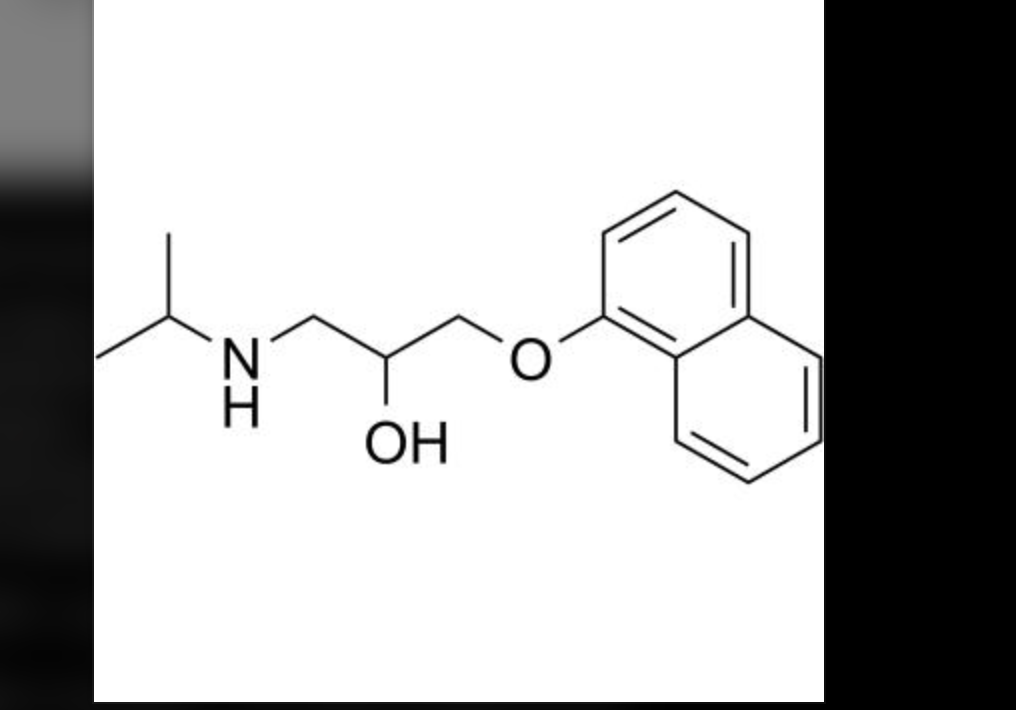
Naphthalene = 2 fused benzene rings.
Ether oxygen (–O–).
Longer side chain.
β-OH group.
Secondary amine.
N-isopropyl group.
Propranolol
SAR — Why is it an antagonist?
Longer chain than epinephrine.
No catechol OH groups → Loses important H-bonds.
Naphthalene → Hydrophobic interactions.
Protonated amine + β-OH → Retain receptor binding.
Bulky N-substituent → β-directed activity.
Propranolol
Physiological effects

Kidneys | Na⁺ + water retention → Compensatory BP increase |
🚨 Hypoglycemia: β-blockers can mask tachycardia/palpitations, especially concerning for patients taking insulin.
Propranolol
Therapeutic uses
Stable angina, NOT acute angina.
Glaucoma → ↓ Aqueous humor.
Hypertension → ↓ BP.
Stable angina → ↓ Oxygen demand.
Arrhythmia/tachycardia → ↓ HR.
Myocardial infarction → ↓ Cardiac workload.
Migraine → Prevention.
Hyperthyroidism → Blocks adrenergic effects.
Propranolol
Adverse effects
Abrupt discontinuation → Severe arrhythmias.
High doses → Anesthetic-like effect.
↑ Triglycerides, ↓ HDL.
Sexual dysfunction → ED, decreased libido.
CNS effects → Anxiety, depression, sleep disturbance (crosses BBB).
Propranolol
Adverse effects: Abrupt discontinuation → Severe arrhythmias.
Why?
Chronic β-blockade → Receptor upregulation → Sudden withdrawal causes excessive EPI/NE stimulation.
SKIP
Propranolol
Metabolism


Notice: Glucuronidation is not shown in this picture. It's the third metabolic pathway on your professor's slide.
Propranolol
PK
100% absorbed orally; 25% reaches circulation due to first-pass metabolism.
90% protein bound.
Half-life 3–6 hours.
S-isomer = 100× more potent than R; metabolized more slowly.
Nadolol
Topics
Classification
structure
Fun Facts
Nadolol
Classification
Nonselective β1/β2 antagonist.
Nadolol
STRUCTURE — RECOGNIZE

Two additional OH groups.
N-tert-butyl group (not isopropyl).
Partially saturated fused ring system.
Long β-blocker side chain.
Nadolol
Fun Facts
Extra OH → More hydrophilic → Less BBB penetration → Fewer CNS effects.
Added OH groups are NOT epinephrine's catechol OH group
Longer duration of action.
Timolol
Topic Overview
Classification
Structure
Fun Facts
Contraindications:
Timolol
Classification
Nonselective β1/β2 antagonist.
Timolol
STRUCTURE — RECOGNIZE

Thiadiazole ring → N + S.
Morpholine ring → N + O.
Long β-blocker side chain.
N-tert-butyl substituent.
Timolol
Fun Facts
More polar than propranolol → Reduced CNS penetration.
Glaucoma → ↓ Aqueous humor.
Also treats systemic hypertension.
No local anesthetic activity noted.
Timolol
Contraindications:
Severe asthma/COPD.
2nd/3rd-degree AV block.
Cardiogenic shock.
Compare the drugs
Propranolol | Nadolol | Timolol | |
|---|---|---|---|
Receptors | β1 + β2 | β1 + β2 | β1 + β2 |
Key structure | Naphthalene | Extra OH | Thiadiazole + morpholine |
Polarity | Lower | Higher | Higher |
CNS effects | More | Less | Less |
Remember |
| Longer duration | Glaucoma |
🧠 More polar = Less BBB penetration = Fewer CNS effects.