CHEM 133 Ch. 06-08
 Call Kai
 Learn
 Practice Test
 Spaced Repetition
 Match
 Flashcards
 Knowt Play
1/95

There's no tags or description
Looks like no tags are added yet.
96 Terms
Thermodynamics
is the study of energy and its transformations
Thermochemistry
is the study of the relationships between chemical reactions and energy changes involving heat
Kinetic Energy
is the energy an object possesses by virtue of its own motion
K.E. = ½ mv2
Potential Energy
is the energy and object possesses by virtue of its position of chemical composition
P.E. = mgh
Energy
is the capacity to do work or transfer heat
Work
is the energy used to cause an object with mass to move
w = F x d
Thermal Energy
is kinetic energy associated with the random motion of atoms and molecules
Temperature
is a quantitative measure of “hot” or “cold”

Heat (q)
is the transfer of thermal energy between two bodies at different temperatures
heat flows from high temperature to low temperature

Most Substances Expand and Contract when…
as their temperature increases and contract as their temperature decreases

System
the portion of the universe that we single out to study
Example: if we are interested in the interaction between hydrogen and oxygen in a cylinder, then the H2 and O2 in the cylinder form a system

Surroundings
are the rest of the universe (here, the cylinder, piston and eveythign beyond)

Types of Systems
A system may be open, closed, or isolated
open system: both matter and energy may be exchanged with the surroundings
closed system: energy, but not matter, may be exchanged with the surroundings
isolated system: neither matter nor energy may be exchanged with the surroundings

First Law of Thermodynamics
The first law of thermodynamics states that energy cannot be created or destroyed
The first law of thermodynamics is the law of conservation of energy
△EUNIVERSE = △ESYSTEM + △ESURROUNDINGS = 0
That is, the energy of system + surrounding is constant
Thus, any energy transferred from a system must be transferred to the surroundings (and vise versa)
Energy can be converted from one form to another
Internal Energy
The total energy, E, of a system is called the internal energy
It is the sum of all the kinetic and potential energies of all components of the system
Absolute internal energy cannot be measured, only changes in internal energy
Changes in internal energy: △E = Efinal - Einitial
Thermodynamic quantities such as △E always have three parts:
a number
a unit
and a sign that gives direction
Example: a mixture of H2(g) and O2(g) has a higher internal energy than H2O(g)
Going from H2(g) and O2(g) to H2O(g) results in a positive change in internal energy, indicating that the system has gained (absorbed) energy from the surroundings: 2H2O(g) → H2(g) + O2(g) △E > 0, Efinal > Einitial

Changes in Internal Energy Relating △E to Heat and Work
When energy is exchanged between the system and the surroundings, it is exchanged as either heat (q) or work (w)
That is, from the first law of thermodynamics:
△E = q + w
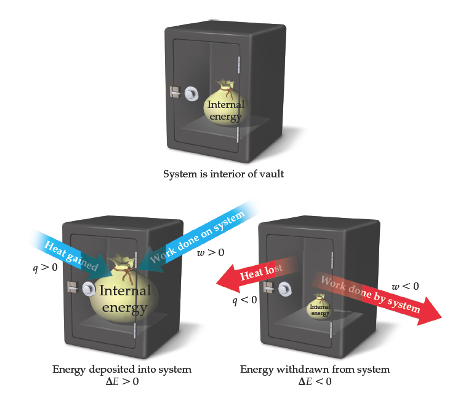
△E, Q, W, and their Signs
Heat
Heat flowing from the surroundings to the system is positive, q > 0
Heat flowing from system to surroundings is negative, q < 0
Work
Work done by the surroundings on the system is positive, w > 0
Work done by the system on the surroundings is negative, w < 0

Exchange of Heat Between System and Surroundings
When heat is released by the system into the surroundings, the process is exothermic. An exothermic reaction feels hot.
When heat is absorbed by the system from the surroundings, the process is endothermic. An endothermic reaction feels cold.

State Functions (1)
Usually, we have no way of knowing the internal energy of a system; finding that value is simply too complex a problem
However, we do know that the internal energy of a system is independent of the path by which the system achieved that state. A state function depends only on the initial and final states of a system.
Internal energy is a state function
It depends only on the present state of the system, not on the path by which the system arrived at that state
Therefore, △E depends only on Efinal and Einitial
Example: In the system below, the water could have reached room temperature from either direction. The internal energy of 50 g of H2O (l) at 25℃ does not depend on whether we cool 50 g of H2O (l) from 100℃ to 25℃ or heat 50 g of H2O (l) at 0℃ to 25℃

State Functions (2)
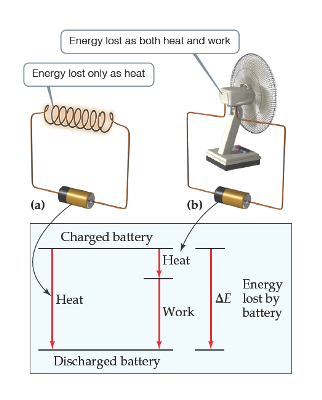
However, q and w are not state functions
Whether the battery is shorted out or is discharged by running the fan, its △E is the same, but q and w are different in the two cases
Enthalpy of Reaction
The change in enthalpy, △H, is the enthalpy of the products minus the enthalpy of the reactants:
∆Hrxn = Eproducts – Ereactants
This quantity, ∆Hrxn is called the enthalpy of reaction, or the heat of reaction
Consider the thermochemical equation for the combustion of hydrogen:
2H2(g) + O2(g) → 2H2O(g) ∆H = – 483.6 kJ
The equation tells us that 483.6 kJ of energy is released to the surroundings when water is formed
∆H noted at the end of the balanced equation depends on the number of moles of reactants and products associated with the ∆H value
These equations are called thermochemical equations
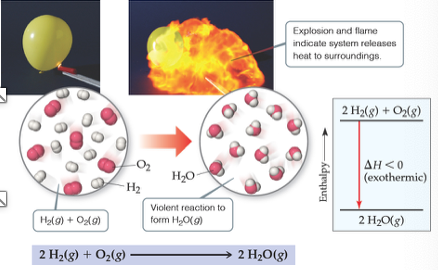
Enthalpy Diagram
are used to represent enthalpy changes associated with a reaction
in the enthalpy diagram for the combustion of hydrogen the reactants, H2(g) and O2(g), have a higher enthalpy than the product, H2O
Thus the reaction is exothermic

Endothermic and Exothermic
Chemists use a property known as enthalpy (H) to describe the thermodynamics of chemical and physical processes
Heat transferred from the surroundings to the system has a positive enthalpy (i.e., ∆H > 0 for an endothermic reaction)
Heat transferred from the system to the surroundings has a negative enthalpy (i.e., ∆H < 0 for an exothermic reaction
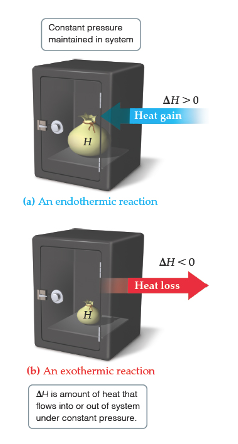
The Truth About Enthalpy
Enthalpy is an extensive property
Therefore, the magnitude of enthalpy id directly proportional to the amount of reactant consumed
Example: CH4(g) + 2O2(g) → CO2(g) + 2H2O(l) ∆H = –890 kJ
If one mol of CH4 is burned in oxygen to produce CO2 and water, then 890 kJ of heat is released to the surroundings. If two mol of CH4 is burned, then 1780 kJ of heat is released.
The sign ∆H depends on the direction of the reaction
The enthalpy change for a reaction is equal in magnitude to, but opposite in sign from, ∆H for the reverse reaction
Example: CH4(g) + 2O2(g) → CO2(g) + 2H2O(l) ∆H = -890 kJ,
But CO2(g) + 2H2O(l) → CH4(g) + 2O2(g) ∆H = +890 kJ.
Enthalpy change depends on state of the products and reactants
2H2O(g) → 2H2O(l) ∆H = –88 kJ
Heat Capacity and Specific Heat
The amount of energy required to raise the temperature of a substance by 1℃ (1 degree Celsius) is its heat capacity, C. If the amount of the substance heated is one gram, it is the specific heat, s. If the amount is one mole, it is the molar heat capacity.

Calorimetry
Since we cannot know the exact enthalpy of the reactants and products, we measure ∆H through calorimetry, the measurement of heat flow.
The instrument used to measure heat flow is called a calorimeter.
By carrying out a reaction in aqueous solution in a simple calorimeter, the heat change for the system can be found by measuring the heat change for the water in the calorimeter.
The specific heat for water is 4.184 J/g℃. We use this value for dilute solutions.
We can calculate q for the reaction with this equation: q = ms∆T.
Be careful with the sign of q.

Heat Capacity and Specific Heat (2)
We can determine the amount of heat, q, entering or leaving the substance by measuring the temperature change before and after the heat is gained or lost.
We can calculate q with this equation:
q = (mass of substance) x (specific heat) x (temperature change)
q = m x s x (Tfinal –Tinitial)
q = m x s x ∆ T
Be careful with the sign of q.
Heat Capacity is defined mathematically as: C = m x s

Hess’s Law
ΔH is well known for many reactions, and it is inconvenient to measure ΔH for every reaction in which we are interested.
However, we can calculate ΔH using published ΔH values and the properties of enthalpy.
Hess’s law: If a reaction is carried out in a series of steps, ΔH for the overall reaction equals the sum of the enthalpy changes for the individual steps.
Because H is a state function, for a particular set of reactants and products, ΔH is the same whether the reaction takes place in one step or in a series of steps.
The total change in enthalpy is independent of the number of steps.
This is true because enthalpy is a state function!

Standard Enthalpies of Formation
A standard enthalpy of formation, ΔHf°, is defined as the enthalpy change for the reaction in which 1 mol of compound is made from its constituent elements in their elemental forms and are measured under standard conditions (25 °C and 1.00 atm pressure).
∆H°f values for selected substances are tabulated in Table 6.2.
A large majority of ∆H°f values tabulated in Table 6.2 are negative, meaning that most formation reactions are exothermic.
The standard enthalpy of formation of the most stable form of an element is zero.

Hess’s law! Calculation of ΔHrxn
We can use Hess’s law in this way: the standard enthalpy of reaction is the sum of the standard enthalpies of formation of the products minus the sum of the standard enthalpies of formation of the reactants.
where Σ means “sum of” and n and m are the stoichiometric coefficients from the balanced chemical equation

The Quantum Mechanical Model of the Atom
Light is a form of electromagnetic radiations, a type of energy
that travels through space at a constant speed of C = 3.00 × 10⁸
m/s.
Electron Energy Levels
A rainbow forms when light passes through water droplets.

Electromagnetic Radiation
We experience electromagnetic radiation in different forms, such as light, the colors of a rainbow, or when we have an X-ray taken.
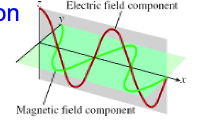
Electromagnetic radiation consists of energy particles that move as waves of energy.
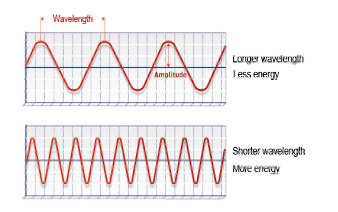
Low-energy radiation has longer wavelengths.
High energy radiation has shorter wavelength.

Electromagnetic Radiation (2)
All waves have a characteristic wavelength, λ (lambda), which is the distance between two peaks or troughs in a wave. The unit of λ is usually nm.
The frequency, ν (nu), of a wave is the number of cycles that pass a point in one second. The unit of ν is hertz (1 Hz = 1 s–1).
The amplitude of a wave is the height of the crest (or depth of the trough). For an electromagnetic wave, the amplitude is related to the intensity of the radiation, or its brightness in the case of visible light


Light is Electromagnetic Radiation
Emission and transmission of energy in the form of electromagnetic waves. Red light with the wavelength of 750nm has the longest wavelength where as Violet light shorter wavelength 400 nm
The presence of color in white light is responsible for the colors we see in our everyday vision. A red color shirt is red because it reflects red light.
Our eyes see only the reflected light
Light is Electromagnetic Radiation (2)
Visible light makes up a tiny portion of the entire electromagnetic spectrum which includes all wavelengths of electromagnetic radiation.
Main region of electro magnetic spectrum , ranging in wavelength
10-15 m gamma rays to 10-5 m radio waves.
Shorter wavelength : higher frequency and high energy ( right side)
Longer wavelength : lower frequency and lower energy ( left side)
Shortest : wave : Gamma rays: can damage biological molecules.
X rays: medical use, can pass through many substances that block visible light and therefore used to take images of bones and internal organs.
UV light : main component of sun and responsible for skin cancer and sunburn.
visible light (violet : shorter wavelength – red: longer wavelength)
infrared light: All warm objects including human body emit IR light.
Microwave: used for radar and micro ovens. Low energy waves
Radio wave:( longest wavelength): to transmit the signals responsible for AM and FM radio, cellular phones and other forms of communications.

Amplitude and Wavelength
We characterize a wave by its amplitude and wavelength. Amplitude of wave is the vertical height of a crest(or depth of the trough).The amplitude of the wave in light determines the light intensity or brightness- the greater the amplitude, the greater the brightness.

Photon
A particle of light is called a Photon
Photon is a single packet of light energy and the amount of energy carried in a packet depends on the wavelength of the light.
Shorter the wave length= greater the energy
Violet light (shorter wavelength) carries more energy per photon than red light energy( longer wavelength)
The frequency and energy of electromagnetic radiations are inversely related to its wavelength.

Electromagnetic Radiation (3)
Einstein assumed that light traveled in energy packets called photons.
• The energy of one photon is: image
h = 6.626 ´ 10–34 Js is (Planck’s constant )
c = 3.00 x 10⁸ m/s (speed of light )
Electromagnetic Radiation Exhibits Wave and Particulate Properties

Each Element Has Its Own Atomic Emission Spectrum of Light
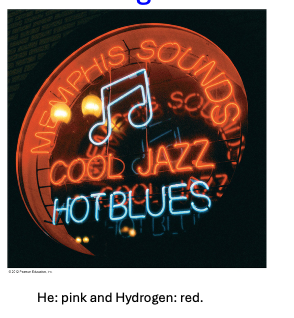
Neon atoms inside a glass tube absorb energy in the form of heat, light or electricity, then re-emit the energy as light. For example:
Neon sign composed of two or more glass tubes filled with neon gas. When electric current is passed through the tube, the neon gas absorb some of the electrical energy and reemit it as red color. If the atoms in the tube are different, they emit light of different color.
Mercury atoms emit light that appears blue.
Exciting Gas Atoms to Emit Light with Electrical Energy

Emission Spectra
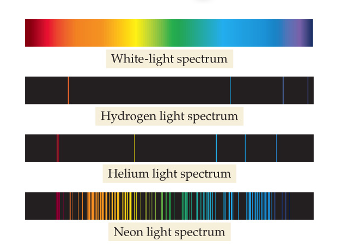
A white-light spectrum is continuous, with some radiation emitted at every wavelength.
The emission spectrum of an individual element includes only certain specific wavelength and produces its own, unique and distinctive emission spectrum. They consists of bright spots or lines at specific wavelengths with complete darkness in between.
Continuous Spectrum
A spectrum is produced when radiation from a polychromatic source is separated into its component wavelengths. This rainbow of colors, containing light of all wavelengths, is called a continuous spectrum.
For atoms and molecules, one does not observe a continuous spectrum, as one gets from a white light source. Only a line spectrum of discrete wavelengths is observed.
(a) A continuous spectrum containing all wavelengths of visible light.
(b) The hydrogen line spectrum contains only a few discrete wavelengths.


Line Spectra
One of the biggest scientific mysteries in the early twentieth century involved the emission spectra observed from energy emitted by atoms and molecules. A line spectrum shows only certain colors or specific wavelengths of light. When atoms are heated, they emit light. This process produces a line spectrum that is specific to that atom. The emission spectra of three elements are shown on the left of this slide.


The Bohr Model
To explain the line spectrum of hydrogen, Bohr assumed that electrons in hydrogen atoms move in circular orbits around the nucleus.
Bohr noted the line spectra of certain elements and assumed that electrons were confined to specific energy states. These were called orbits.
Bohr’s model is based on three postulates:
In his model, Bohr used Planck’s and Einstein’s ideas about quantized energy and proposed three postulates:
The H atom has only certain energy levels, which Bohr called stationary states. Each state is associated with a fixed, circular orbit of the electron around the nucleus. The higher the energy level, the farther the orbit is from the nucleus.
The atom does not radiate energy while in one of its stationary states. Even though it violates principles of classical physics, the atom does not change its energy while the electron moves within an orbit.
The atom changes to another stationary state (the electron moves to another orbit) only by absorbing or emitting a photon. The energy of the photon (hv) equals the difference in the energies of the two states:
Ephoton =∆Eatom = Efinal - Einitial = hv
In 1913, Neils Bohr, a Danish scientist, set down postulates to account for:
The stability of the hydrogen atom.
The line spectrum of the atom.


The Bohr Model (2)
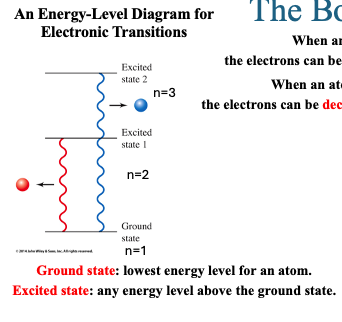
When an atom absorbs energy, the electrons can be promoted to higher energy levels
When an atom emits energy, the electrons can be decayed to a lower energy level.
When an atom absorbs energy, an e- in one of these fixed orbits is excited and promoted to the higher energy level farther away from the nucleus.
However, in this new configuration, the atom is less stable and the electron quickly fall back to the lower energy level,
As it does so, It releases a photon of light containing precise amount of energy- the Quantum of energy- that correspond to the energy difference between the two orbits.
Hydrogen Emission Lines
When an atom absorbs energy, an electron in one of these orbits is excited and promoted to the orbit that is farther away from the nucleus and therefore higher in energy. In this configuration, an atom is less stable and the electron quickly falls back to a lower energy orbit and emits photon of light containing precise amount of energy- quantum of energy equal to the difference between the two levels.

Hydrogen Emission Lines (2)
The amount of energy in a photon is directly related to its wavelength.
The light emitted by an excited electron in an atom consist of
Specific lines at specific wavelengths, each corresponding to a specific transition between two orbits.

The Bohr Model (3)
Limitations of the Bohr Model
The Bohr Model has several limitations:
It cannot explain the spectra of atoms other than hydrogen.
Electrons do not move about the nucleus in circular orbits.
However, the model introduces two important ideas:
The energy of an electron is quantized: electrons exist only in certain energy levels described by quantum numbers.
Energy gain or loss is involved in moving an electron from one energy level to another.

Line Spectra and the Rydberg Equation
Spectroscopists studying atomic hydrogen identified several series of spectral lines in different regions of the electromagnetic spectrum. Figure: shows the spectral lines in the ultraviolet, visible, and infrared regions
Using data, not theory, the Swedish physicist Johannes Rydberg (1854–1919) developed a relationship, called the Rydberg equation, that predicts the position and wavelength of any line in a given series: (image)
where λ is the wavelength of the line, n1 and n2 are positive integers with n2>n1, and R is the Rydberg constant 1.096776×10⁷m−1.

Quantum Mechanics
In 1924, the French physicist Louis de Broglie suggested a surprising hypothesis: All matter exhibits both particulate and wave properties.
The wavelength of a particle of mass, m (kg), and velocity, v (m/s), is given by the de Broglie relation: λ = h/mν
In 1926, Erwin Schrödinger, an Austrian physicist, building on de Broglie’s work developed an equation, now know as Schrödinger’s wave equation, that incorporates both the wave-like behavior of the electron and its particle like behavior. Solving the wave equation leads to wave functions, or orbitals, that describe the electron in an atom and are designated with a lowercase Greek letter psi ψ. Psi-squared, ψ 2, gives us the probability of finding the particle within a region of space. Wave functions ψ are also called orbitals. Electron density is another way of expressing probability. A region of high electron density is one where there is a high probability of finding an electron.
This theory, known as quantum mechanics, allows one mathematically describes the wave properties of subatomic particles, and to calculate the probability of finding an electron in space

Quantum-Mechanical Orbitals
In the quantum-mechanical model, a number and a letter specify an orbital (or orbitals).
The lowest-energy orbital (ground state) in the quantum-mechanical model is called the 1s orbital.
Quantum numbers: (image)

Quantum-Mechanical Orbitals (2)
In the quantum-mechanical model, a number and a letter specify an orbital (or orbitals).
The lowest-energy orbital (ground state) in the quantum-mechanical model is called the 1s orbital.
It is specified by the number 1 and the letter s.
The number is called the principal quantum number (n) and specifies the principal shell of the orbital.
The letter indicates the subshell of the orbital and specifies its shape.
The possible letters are s, p, d, and f, each with a different shape
The number of subshells in a given principal shell is equal to the value of n.

Sublevels
With in each principal shell, are subshells. The number of subshells in a principal shell is equal to the value of its quantum number, n.
Energy levels are subdivided into sublevels (l). Each subshell is identified with a one-letter label:
s, p, d, f,
n = 1 : the subshell 1. The orbital is 1S
n = 2 : the subshell 2: The orbitals are 2s, 2p.
n = 3 : the subshell 3: the orbitals are 3s, 3p, 3d.
n = 4 : the subshell 4: the orbitals are 4s, 4p, 4d and 4f.

Quantum Numbers, Their Properties, and Significance

Orbitals and Quantum Numbers
The Bohr model was a one-dimensional model that used one quantum number to describe the distribution of electrons in the atom. The only information that was important was the size of the orbit, which was described by the n quantum number.
Schrödinger's model allowed the electron to occupy three-dimensional space. It therefore required three coordinates, or three quantum numbers, to describe the orbitals in which electrons can be found.
The three coordinates that come from Schrödinger's wave equations are:
the principal quantum number (n=1,2,3,4,…),
the angular momentum quantum number (l=0,1,…(n-1)), and
the magnetic quantum number (ml= -l,…0,…+l).
These quantum numbers are related to the size (energy), shape, and orientation in space respectively of the orbitals on an atom.

The s Orbitals
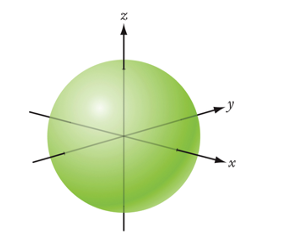
• All s orbitals are spherical.
• As n increases, the s orbitals get larger.
•n orbitals hold a maximum of two electrons

The p Orbitals
There are three p orbitals: px, py and pz.
The three p orbitals lie along the x-, y-, and z-axes of a Cartesian system.
The letters correspond to allowed values of ml of -1, 0, and +1.
The orbitals are dumbbell shaped; each has two lobes.
As n increases, the p orbitals get larger.
All p orbitals have a node at the nucleus.
6 total electrons can occupy the three p orbitals of a subshell.

The d Orbitals
There are five d orbitals.
The letters correspond to allowed values of ml of -2, -1, 0, +1 and +2.
Three of the d orbitals lie in a plane bisecting the x-, y-, and z-axes.
Two of the d orbitals lie in a plane aligned along the x-, y-, and z-axes.
Four of the d orbitals have four lobes each.
One d orbital has two lobes and a collar.
10 total electrons can occupy the five d orbitals of a subshell.

The f Orbitals
There are seven f orbitals.
The letters correspond to allowed values of ml of -3,-2, -1, 0, +1, +2 and +3.
14 total electrons can occupy the seven f orbitals of a subshell.


Spin Quantum Number, ms
The Stern- Gerlach experiment
In 1921, it was discovered that two electrons in the same orbital do not have exactly the same energy.
The “spin” of an electron describes its magnetic field, which affects its energy.
This led to a fourth quantum number, the spin quantum number, ms.
The spin quantum number has only 2 allowed values: +1/2 and −1/2.

Energy Levels of Electrons
Quantum Shell Summary
With each new principal quantum shell, a new subshell type is introduced
n: gives the shell
l: gives the subshell
ml: gives the orbital

Atomic Structure - Electron Configuration
There are several methods of depicting atomic structures of atoms:
1) An Electron Configuration shows the distribution of all electrons in an atom.
Each component consists of nl#
A number denoting the energy level,
A letter denoting the type of orbital,
A superscript denoting the number of electrons in those orbitals.
Maximum Electrons in Subshells
An s subshell, with one orbital, can hold a maximum of 2 electrons.
A p subshell, with three orbitals, can hold a maximum of 6 electrons.
A d subshell, with five orbitals, can hold a maximum of 10 electrons.
An f subshell, with seven orbitals, can hold a maximum of 14 electrons

Electron Configuration
Distribution of electrons among the various atomic orbitals in an atom (help us understand and predict properties of elements)
Aufbau principle: “Fill up” electrons in lowest energy orbitals

Electron Filling
The colored areas of elements show the different subshells that are filling with those elements.
We fill orbitals in increasing order of energy.
Different blocks on the periodic table (shaded in different colors in this chart) correspond to different types of orbitals


Electron Configuration (2)
Energy order of atomic subshells:
1s < 2s < 2p < 3s < 3p < 4s < 3d < 4p
Arrange all electrons in an atom from the lowest energy level to the higher energy levels.
(Ground State Electron Configuration)

General Properties of gases
You have learned that matter can exist in three phases; solid, liquid, and gas.
In the gas phase, gas molecules:
Have an indefinite volume
Have an indefinite shape
Have low densities
Have high kinetic energies
Four factors affect the properties of gases:
1)P = pressure
2)T = Kelvin temperature
3)V = volume
4)Number of gas molecules
when the gas is released, the pressure of the air escaping from the neck propels the balloon in a rapid irregular flight. If the balloon is inflated until it bursts, the gas escaping all at once causes an explosive noise.

Pressure dependence on the number of molecules and the temperature:
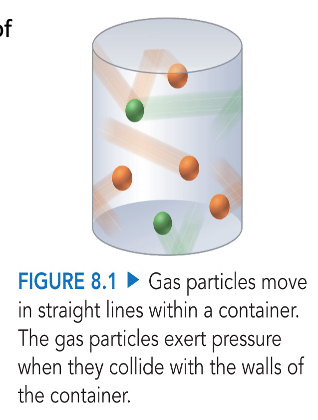
Gas particles are extremely small and move rapidly. When they hit the walls of the container, they exert a pressure. At specific temperature and volume, the number of collision depends on the number of gas molecules present. The number of collision can be increased by increasing the number of molecules.
Pressure is directly proportional to the number of molecules of gas present.
The pressure of a gas in a fixed volume also varies with temperature.
When the temperature is increased, the kinetic energy of the molecules increases, causing more frequent and more energetic collisions of the molecules with the walls of the container. This results in the increase in pressure of the gas.
Kinetic Molecular Theory: A Model For Gases
Gas particles move in straight lines in all directions, colliding frequently with one another or with the walls of the container. As a result they fill the entire container.
Gases consist of tiny particles and they have no attraction for one another. Particles are very far apart from each other.
There is a lot of space between gas particles compared with the size of the particles themselves. As a result gases have low density.
Gas particles have kinetic energy that increases with an increase in temperature.
Atmospheric Pressure
Atmospheric pressure:
It is the pressure exerted by a column of air from the top of the atmosphere to the surface of Earth produces pressure on each of us of about 1 atm at sea level.
It decreases as altitude increases because there are fewer particles of gases in the air.

Pressure
Pressure: The pressure exerted by a gas
Sample is defined as the force per unit area that results from the collision of air particles with surrounding surfaces.
P= force / Area
At a pressure of exactly 1 atmosphere (atm), A mercury column in a inverted tube would be exactly 760 mm high, at a temperature of 0°C In the barometer, the pressure rises or falls with the changes in pressure.
Air pressure is measured in many units.
1 atm = 760 mmHg
760 mmHg = 760 torr (exact)
1atm = 101,325 Pa or 101.3KPa = 1.013 bar = 14.69 psi.
The mercury barometer was invented by the physicist E. Torricelli for whom the unit of torr was named.

Barometer
A mercury barometer can be prepared by completely filling a long tube with pure dry mercury and inverting the open end into a open dish of mercury.
It measures the pressure exerted by the gases in the atmosphere which is equal to the downward pressure of the mercury column in a closed glass tube.
Convert
740. mmHg to
1) torr
2) atmospheres.

Gas Laws
By studying the gas laws, we can understand the behavior of a gas with respect to its volume, temperature and pressure as well as the number of moles.

Boyle’s Law
At constant temperature (T), the volume (V) of a fixed mass of a gas is inversely proportional to the pressure (P)
where V is the volume, P is the pressure and k is a proportionality constant that would depend on the number of moles of gas and the temperature.

Boyle's Law (2)
As the volume decreases, there is a decrease in the surface area of the container. The air particles are crowded together, more collision occurs, and the pressure increases with in the container.


Calculations using Boyle’s Law
Freon-12, CCl2F2, was used in refrigeration systems. What is
the new volume of an 8.0L sample of Freon gas initially at
550 mmHg after its pressure is changed to 2200 mmHg at
constant temperature and moles?
SOLUTION:
STEP 1 Organize the data in a table of initial and final
conditions.
Temperature and moles remain constant.
STEP 2 Rearrange the gas law equation to solve for the unknown quantity.
P1V1 = P2V2 Boyle’s law
To solve for V2, divide both sides by P2.
STEP 3 Substitute values into the gas law equation and calculate.

Charles’ Law
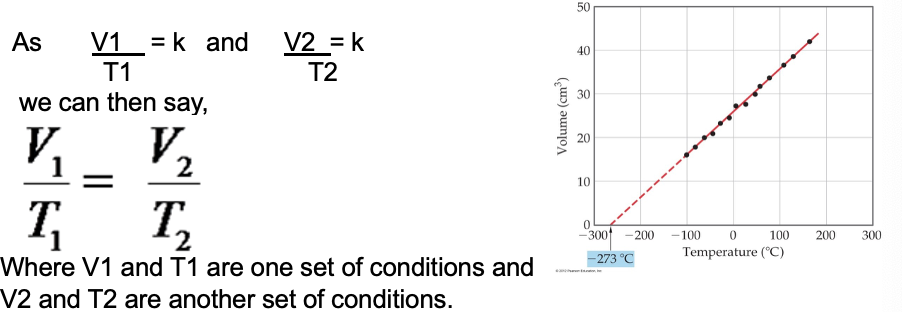
Charles’ Law states that, at constant pressure, the volume of a gas is directly proportional to the absolute temperature.
Mathematically, we would write: V ∝ T
or V = kT or V = k ( at constant pressure)
T
where V is the volume, T is the temperature and k is a proportionality constant that would depend on the number of moles of gas and the pressure. If the pressure and amount of gas is constant, and the gas experiences a change in temperature, we can use Charles’ Law to predict the new volume.
Charles’ Law (2)
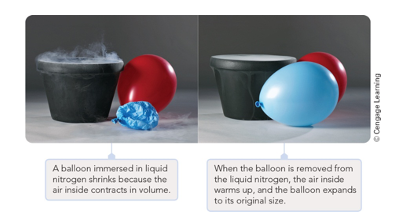
When the gas is heated, the molecules move faster, and their K.E. energy increases, causing increase in the number of collision .This action should increase the pressure. With the external pressure constant , The net result is in increase in volume due to an increase in temperature.
If we increase the temperature of a gas sample, the volume of the gas container must increase. If the temperature of the gas is decreased , the volume of the container must also decrease when the pressure and amount of gas are not changed.
All temperatures used in gas law calculations must be converted to their corresponding Kelvin (K) temperatures.


Calculations using the Charles’s Law
A balloon has a volume of 785 mL at 21o C. If the temperature drops to 0°C , what is the new volume of the balloon at constant pressure and moles?
SOLUTION:
STEP 1 Organize the data into a table of initial and final conditions.
Pressure and moles remain constant
All temperatures used in gas law calculations must be converted to their corresponding Kelvin (K) temperatures.
STEP 2 Rearrange to solve for unknown quantity, V2.
STEP 3 Substitute the values into the gas law
equation and calculate.

Charles’ Law (3)
As the temperature rises , the particles of the gas move faster and hit the walls of the container more often and with greater force. If volume and amount of gas do not change, the pressure would increase.

Avogadro’s Law
Avogadro’s law, which states that the volume of a gas is directly related to the number of moles of a gas when temperature and pressure do not change.
Equal volumes of different gases at constant T and P contain the same number of molecules.
Mathematically, this means V = kn or V ∝ n


Calculations using Avogadro’s Law
If 0.75 mole of helium gas occupies a volume of 1.5 L, what volume (in liters) will 1.2 moles of helium occupy at the same temperature and pressure?
A. 0.94 L
B. 1.8 L
C 2.4 L
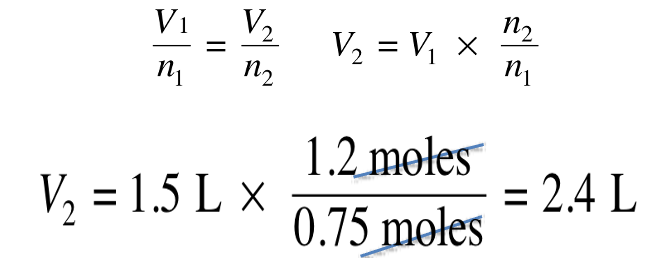
If 0.75 mole of helium gas occupies a volume of 1.5 L, what volume (in liters) will 1.2 moles of helium occupy at the same temperature and pressure?
STEP 2 Rearrange to solve for unknown quantity, V2.
STEP 3 Substitute the values into the gas law equation and calculate.
The answer is C.
VOLUME AND MOLES :Avogadro’s Law
Using Avogadro’s law, we can say that any two gases will have equal volumes if they contain same number of moles of gas at the same temperature and pressure (STP)
STP is Standard Temperature and Pressure conditions. Standard temperature (T ) is 0° C (or 273 K); and standard pressure (P ) is 1 atm (760 mmHg).
At STP, one mole of any gas occupies a volume of 22.4 L which is same as about the volume of three basket balls. This volume,
22.4 L of any gas is called the molar volume.
1 mole of gas = 22.4 L.(STP)

Mole/Mass/Volume Relationships
Standard Molar Volume: 1 mole of any gas occupies at STP a molar volume of 22.4 L. Standard temperature and pressure (STP) for reporting properties of gases:
273.15 K and 1 atm.
Molar volume can be used as a conversion factor if the
mass and volume occupied by a gas are known.


Gay-Lussac’s Law
At constant volume (V), the pressure (P) of a fixed mass of a gas is directly proportional to the absolute temperature (T)
No change in volume and amount of gas
All temperatures used in gas law calculations must be converted to their corresponding Kelvin (K) temperatures.


Calculations using Gay- Lussac’s law
A gas has a pressure at 2.0 atm at 18°C . What is the new pressure when the temperature is 62o C ? (Volume and moles remain constant.)
SOLUTION:
STEP 1 Organize the data in a table of initial and final
conditions.
Volume and moles remain constant.
A gas has a pressure at 2.0 atm at 18°C . What is the new pressure when the temperature is 62o C ? (Volume and moles remain constant.)
STEP 2 Rearrange to solve for unknown quantity, P2.
Solve Gay-Lussac’s law for P2:
STEP 3 Substitute the values into the gas law equation and calculate.

Combined Gas Laws
A combination of Boyle’s, Charles’s, and Gay-Lussac’s Laws.
Used in problems involving changes in P, T, and V with a constant amount of gas.
The volume of a fixed quantity of gas depends on the temperature and pressure.
It is not possible to state the volume of gas without stating the temperature and pressure.
Standard Temperature and Pressure (STP):
0.00 °C (273.15 K) and 1 atm (760 torr)


Calculations using Combined gas laws
A gas has a volume of 675 mL at 35°C and 646 mmHg pressure. What is the volume (in milliliters) of the gas at −95o C and a pressure of 802 mmHg? (n is constant.)
SOLUTION:
STEP 1 Organize the data into a table of initial and final conditions.
A gas has a volume of 675 mL at 35° C and 646 mmHg pressure. What is the volume (in milliliters) of the gas at −95o C and a pressure of 802 mmHg? (n is constant.)
STEP 2 Rearrange to solve for unknown quantity, V2.
STEP 3 Substitute the values into the gas law equation
and calculate.

Ideal-Gas Equation
So far, we’ve seen that
V ∝ 1/P, constant at constant T and n (Boyle’s law)
V ∝ T , constant at constant P and n (Charles’s law)
V ∝ n , constant at constant P and T (Avogadro’s law)
Combining these, we get (image)


Ideal-Gas Equation (2)
The constant of proportionality is known as R, the gas constant.

Ideal Gas Law (3)
A single equation relating all properties of a gas.

Ideal Gas Law and Molar Mass
The ideal gas law can also be written in terms of molar mass of a gas.
then substitute the “n” into the ideal gas law: PV = nRT

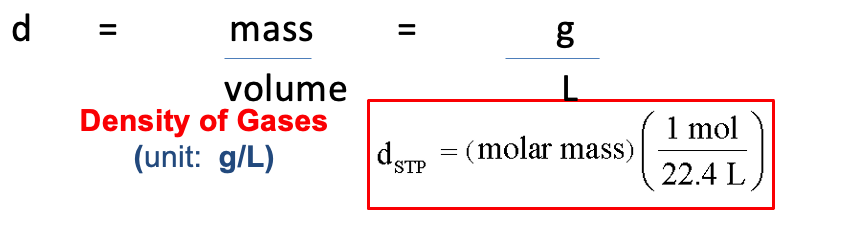
Density of gases:
The density d, of a gas is its mass per unit volume.
Dalton’s Law of Partial Pressures
The total pressure of a mixture is the sum of the partial pressures of the different gases in the mixture.
Ptotal = P1 + P2 + P3 …
In the equation Ptotal is the total pressure of a mixture of gases, P1 is the partial pressure of gas 1; P2 is the partial pressure of gas 2; P3 is the partial pressure of gas 3; and so on.
Each gas behaves independently in the mixture.
Each gas obeys the Ideal Gas law.

Dalton’s Law of Partial Pressures (2)
Using the Ideal Gas Law:

Gas Stoichiometry Solution Map
At STP: the molar volume can be used as a conversion factor to convert between moles and volume.
Non STP Conditions: use the ideal gas law to convert between moles and volume.
