benzene
 Call Kai
 Learn
Learn Practice Test
 Spaced Repetition
 Match
Match Flashcards
 Knowt Play
1/11

There's no tags or description
Looks like no tags are added yet.
Name | Mastery | Learn | Test | Matching | Spaced | Call with Kai | Chat |
|---|
No analytics yet
Send a link to your students to track their progress
12 Terms
structure of benzene
molecular formula: C6H6
empirical formula: CH
unsaturated hydrocarbon
cyclohexatriene
also known as ‘Kekulé structure’
alternating double bonds and single bonds

physical evidence for benzene
bond lengths: x-ray diffraction shows that all carbon-carbon bonds in benzene are the same length (C
number of isomers: kekulé structure predicts 1,2-disubstituted isomers because substituents could be attached across either a single or a double bond, however only one 1,2-disubstituted isomer exists - this supports delocalised structure of benzene
chemical evidence for benzene (thermochemical data)
enthalpy of hydrogenation used to provide evidence
cyclohexene (1 double bond) enthalpy of hydrogenation is −119 kJ mol⁻¹
Kekulé (3 double bonds) enthalpy of hydrogenation is −119 kJ mol⁻¹ x 3 = −357 kJ mol⁻¹
benzene enthalpy of hydrogenation is only −207 kJ mol⁻¹, more stable than Kekulé by 150 kJ mol⁻¹ due to delocalised electrons
chemical evidence for benzene (reaction type)
if benzene had alternate double and single bonds, it should undergo addition reactions as an unsaturated compound (like alkenes)
instead benzene more commonly undergoes substitution
true structure of benzene
hexagonal planar structure
each carbon atom forms 3 single bonds with 3 of its electrons
4th electron of each carbon atom overlaps with neighbouring carbon atoms to form a continuous delocalised pi-bond, 6 p-electrons give the molecule extra stability
bond order (number of covalent bonds between 2 atoms) is 1.5
benzene is the simplest aromatic hydrocarbon compound (contains a ring of delocalised electrons)
unsaturated
functional group is phenyl
compounds that contain a ring of delocalised electrons are called arenes
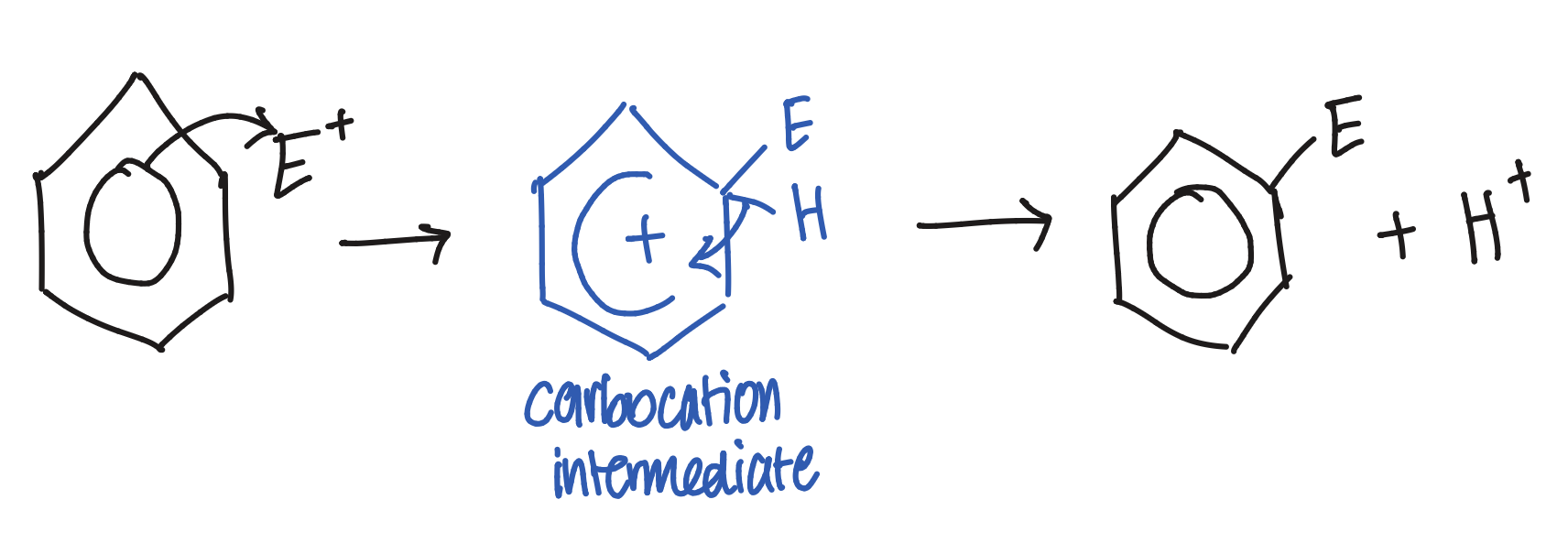
electrophile
a positive or slightly positive species that can accept a pair of electrons in formation of a dative covalent bond
electrophilic substitution
nitration of benzene

halogenation of benzene

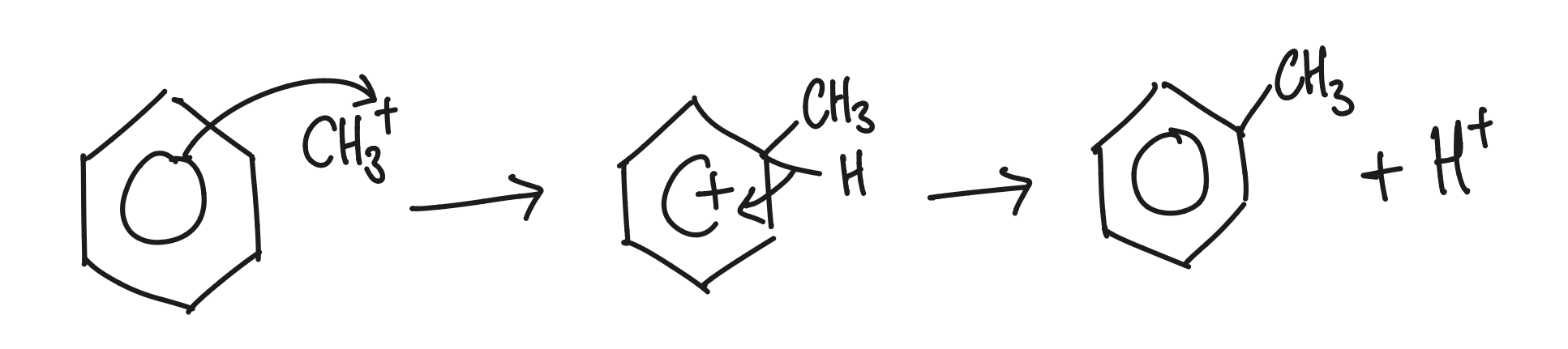
alkylation of benzene
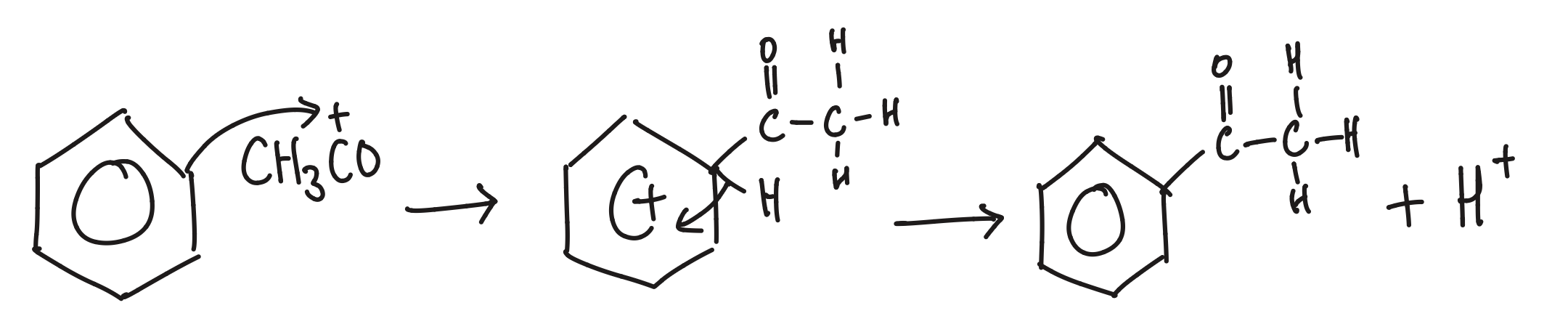
acylation of benzene