Exam 1: Chapter 3/4 notes
 Call Kai
 Learn
Learn Practice Test
 Spaced Repetition
 Match
Match Flashcards
 Knowt Play
1/429

There's no tags or description
Looks like no tags are added yet.
Name | Mastery | Learn | Test | Matching | Spaced | Call with Kai | Chat |
|---|
No analytics yet
Send a link to your students to track their progress
430 Terms
the human body need oxygen binding protein: hemoglobin (in ____) and myoglobin (in ____)
blood; muscle
______ consist of single polypeptide and a heme group
myoglobin
Most of myoglobins amino acids participate in _______ helical structures, what is the significance of this?
a-helices
α-helices are amphipathic (containing both hydrophylic and hydrophobic portions)
Q: Where is the heme group located in myoglobin?
A: Tucked between the E helix and F helix.
Q: Does myoglobin contain disulfide bonds?
A: No. Myoglobin has no disulfide bonds.
Q: What forces maintain myoglobin’s structure?
A: Noncovalent forces only.
Q: What is hemoglobin composed of?
A: Four polypeptide chains, each with its own heme group.
Q: Where is hemoglobin found?
A: Only in erythrocytes (red blood cells/RBCs).
Q: What is the major adult hemoglobin (HbA)?
A: ~97% of adult hemoglobin; contains 2 α chains + 2 β chains (α₂β₂).
Q: What is the minor adult hemoglobin (HbA₂)?
A: ~2–3% of adult hemoglobin; contains 2 α chains + 2 δ chains (α₂δ₂).
Q: What is fetal hemoglobin (HbF)?
A: The major hemoglobin during pregnancy/fetal life; contains 2 α chains + 2 γ chains (α₂γ₂).
Q: How are the different hemoglobin chains structurally related?
A: The α, β, γ, and δ chains are structurally related, and each subunit folds into a shape similar to myoglobin.
Q: How are hydrophobic and hydrophilic amino acids arranged in hemoglobin?
A: Hydrophobic residues → core; hydrophilic residues → surface.
Q: Does hemoglobin contain disulfide bonds?
No
Q: What holds hemoglobin's subunits together?
A: Noncovalent interactions.
Q: What is the heme group?
A: An oxygen-binding prosthetic group required in oxygen-binding proteins.
Q: What is the heme group composed of?
A: Protoporphyrin IX + ferrous iron (Fe²⁺) chelated in the center.
Q: What does protoporphyrin IX contain?
A: Four 5-membered pyrrole rings and conjugated double bonds.
Q: What is the significance of the conjugated double bonds in protoporphyrin IX?
A: They absorb visible light, contributing to hemoglobin's color.
Q: What color is oxygenated hemoglobin? Q: What color is deoxyhemoglobin?
Red; Blue
The heme groups contains what groups?
Vinyl, methyl, propionate, Fe2+
Q: What is the most important part of the heme group?
A: Ferrous iron (Fe²⁺).
Q: What type of bonds can ionized iron form?
A: Coordinate bonds.
Q: How is iron bound within the heme group?
A: It is bound to the nitrogen atoms of the four pyrrole rings.
Q: What forms the fifth bond with heme iron?
A: A nitrogen of the proximal histidine.
Q: What two oxidation states can heme iron exist in?
A: Ferrous (Fe²⁺) and ferric (Fe³⁺).
Q: How are Fe²⁺ and Fe³⁺ interconverted?
A: Fe²⁺ → Fe³⁺: loses an electron (oxidation).
Fe³⁺ → Fe²⁺: gains an electron (reduction).
Q: What is the predominant state of heme iron in hemoglobin and myoglobin?
A: The ferrous (Fe²⁺) state.
Q: What form of iron is present in normal hemoglobin (Hb)?
A: Ferrous iron (Fe²⁺).
Q: Can normal hemoglobin (Fe²⁺) bind oxygen?
A: Yes. Fe²⁺ binds O₂.
Q: What form of iron is present in methemoglobin (MetHb)?
A: Ferric iron (Fe³⁺).
Q: Can methemoglobin (Fe³⁺) bind oxygen?
A: No. Fe³⁺ cannot bind O₂.
Q: What happens to hemoglobin when Fe²⁺ is oxidized to Fe³⁺?
A: It becomes methemoglobin (MetHb) and loses its ability to bind oxygen.
_____ = Fe²⁺ → binds O₂
_____ = Fe³⁺ → cannot bind O₂.
Hb
MetHb
Q: What is methemoglobin (MetHb)?
A: The nonfunctional, oxidized form of hemoglobin.
Q: What oxidation state is iron in methemoglobin?
A: Ferric iron (Fe³⁺).
Q: How is methemoglobin formed?
A: By oxidation of heme iron from Fe²⁺ → Fe³⁺.
Q: How much of total hemoglobin is normally methemoglobin?
A: Less than 1%.
Q: What chemicals can increase methemoglobin levels?
A: Oxidizing chemicals, including:
Aniline dyes
Aromatic nitro compounds
Inorganic nitrites
Organic nitrites
Q: How can methemoglobinemia be treated?
A: Methylene blue, which reduces Fe³⁺ → Fe²⁺.
Q: Why does reducing Fe³⁺ to Fe²⁺ restore functional hemoglobin?
A: Fe²⁺ can bind O₂, while Fe³⁺ cannot.
Q: What conformation is deoxyhemoglobin in?
A: T (tense) conformation.
Q: What stabilizes the T (tense) conformation of hemoglobin?
A: 8 salt bonds, hydrogen bonds, and other noncovalent interactions.
Q: What conformation is oxyhemoglobin in?
A: R (relaxed) conformation.
Q: What happens to the bonds when hemoglobin changes from T → R?
A: Salt bonds break and new hydrogen bonds form.
Q: Which conformation has a higher affinity for oxygen: T or R?
A: R conformation — it binds O₂ 150–300× more tightly than the T conformation.
Q: What happens to hemoglobin's conformation as O₂ binds?
A: O₂ binding progressively shifts hemoglobin from the T (tense) → R (relaxed) conformation.
Q: What are allosteric proteins?
A: Proteins with higher-order (quaternary) structures that can undergo conformational changes.
Q: What does an oxygen-binding curve describe?
A: The fractional saturation of heme groups at different oxygen pressures (pO₂).
Q: Which binds oxygen more tightly: myoglobin or hemoglobin?
A: Myoglobin binds O₂ more tightly than hemoglobin.
Q: Why is myoglobin’s higher O₂ affinity important?
A: It facilitates O₂ transfer from the blood (hemoglobin) → tissues (myoglobin).
Q: What is the shape of myoglobin’s oxygen-binding curve?
A: Hyperbolic.
Q: What is the shape of hemoglobin’s oxygen-binding curve?
A: Sigmoidal (S-shaped).
Q: What does an oxygen-binding curve describe?
A: The fractional saturation of heme groups at different O₂ partial pressures (pO₂).
Q: What is P₅₀?
A: The O₂ partial pressure at which 50% of the heme groups are oxygenated.
Q: What is the P₅₀ of myoglobin?
A: ~1 torr.
Q: What is the P₅₀ of hemoglobin?
A: ~26 torr.
Q: What does a lower P₅₀ indicate?
A: Higher O₂ affinity (binds oxygen more tightly).
Q: Which has a higher O₂ affinity: myoglobin or hemoglobin?
A: Myoglobin — it has a much lower P₅₀ and therefore binds O₂ more tightly.
Q: Why does myoglobin bind O₂ more tightly than hemoglobin?
A: This facilitates O₂ transfer from blood (hemoglobin) → tissues (myoglobin).
Q: What shape is myoglobin’s O₂-binding curve?
Hyperbolic
Q: What shape is hemoglobin’s O₂-binding curve?
A: Sigmoidal (S-shaped).
Q: What is positive cooperativity in hemoglobin?
A: Binding of one O₂ increases the O₂ affinity of the remaining heme groups.
Q: What is the benefit of positive cooperativity in hemoglobin?
A: It improves hemoglobin’s efficiency in transporting oxygen.
Compare the saturation in the hemoglobin in the lungs bs the muscle
in lungs - mostly saturated
in muscle - slightly saturated
Q: How does the difference in hemoglobin saturation between the lungs and muscle help O₂ transport?
A: Hemoglobin loads O₂ in the lungs (~96% saturated) and releases O₂ to muscle (~33% saturated).
Q: What is 2,3-Bisphosphoglycerate (BPG)?
A: A small organic molecule in RBCs, present at about 5 mmol.
Q: Where does BPG bind to hemoglobin?
A: In hemoglobin’s central cavity.
Q: What is the binding stoichiometry of BPG to hemoglobin?
A: 1 BPG : 1 hemoglobin molecule.
Q: Which hemoglobin conformation does BPG bind?
A: The T (tense) conformation, but not the R (relaxed) conformation.
Q: How does BPG affect hemoglobin's O₂ affinity?
A: It decreases O₂-binding affinity, promoting O₂ release to tissues.
Q: What type of allosteric effector is BPG?
A: A negative allosteric effector.
Q: What is a heterotropic effect?
A: An interaction between different ligands, such as BPG and O₂.
Q: What is a homotropic effect?
A: An interaction between identical ligands, such as the cooperative binding of O₂ to hemoglobin.
Q: What happens to BPG concentration during hypoxic conditions?
A: BPG increases, helping hemoglobin release more O₂ to tissues.
Q: What effect does BPG binding have on hemoglobin's conformation?
A: BPG stabilizes the T (tense) conformation.
Q: How does BPG affect the T ⇌ R equilibrium?
A: It shifts the equilibrium toward the T conformation.
Q: What is the O₂ affinity of the T conformation?
A: Low O₂ affinity.
Q: What is the O₂ affinity of the R conformation?
A: High O₂ affinity.
Q: What happens to the T ⇌ R equilibrium in the absence of BPG?
A: The equilibrium favors the R (relaxed) conformation.
Q: How does BPG ultimately affect oxygen binding?
A: BPG → stabilizes T state → ↓ O₂ affinity → promotes O₂ release.
Q: How does BPG affect hemoglobin’s oxygen-binding affinity?
A: ↑ BPG → ↓ O₂ affinity, promoting O₂ release to tissues.
Q: How does BPG affect the oxygen-binding curve?
A: ↑ BPG → right shift of the curve.
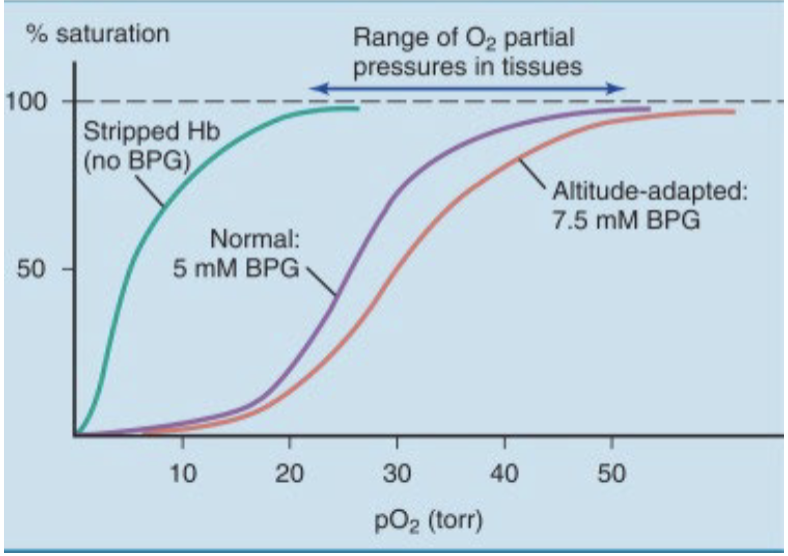
Q: What happens to hemoglobin’s O₂ affinity when BPG is absent?
A: O₂ affinity increases, causing a left shift.
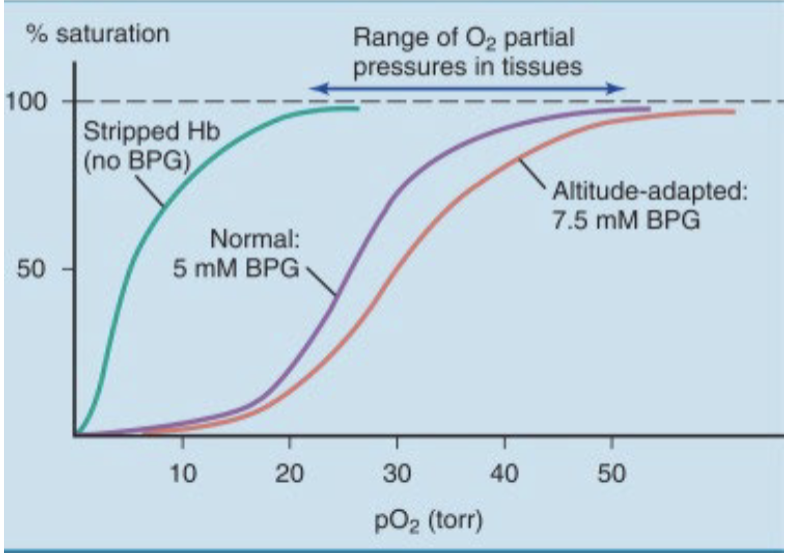
Q: What happens to BPG at high altitude?
A: BPG increases to ~7.5 mM, decreasing hemoglobin’s O₂ affinity and increasing O₂ delivery to tissues.
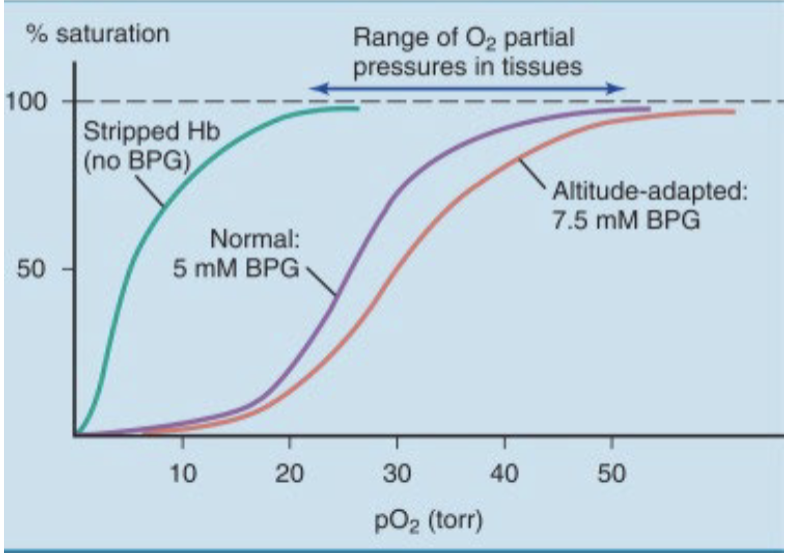
Q: How does altitude adaptation affect the O₂-binding curve?
A: ↑ BPG → right shift → ↓ O₂ affinity → ↑ O₂ release to tissues.

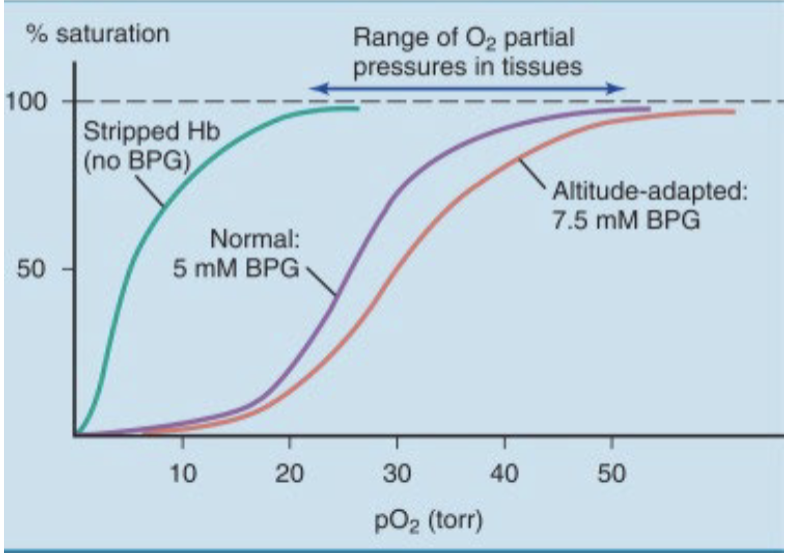
Q: What is “stripped hemoglobin”?
A: Hemoglobin with no BPG; it has higher O₂ affinity and a strongly left-shifted curve.

More BPG = ___ shift = Release O₂.
Right
The binding of oxygen to hemoglobin is known as ______, and is reversible
oxygenation
The ____ group is the oxygen-binding site of hemoglobin and myoglobin
heme
____ iron is the oxidized form whereas ____ iron is the reduced form
Ferric; ferrous
Q: What is the Bohr effect?
A: Low pH decreases hemoglobin’s O₂-binding affinity, promoting O₂ release to tissues.
Q: Why can pH decrease in metabolically active tissues?
A: CO₂ can form carbonic acid, and lactic acid can increase in exercising muscle.
Q: Which is more acidic: oxygenated or deoxygenated hemoglobin?
A: Oxygenated hemoglobin is more acidic than deoxyhemoglobin.
Q: What happens to H⁺ when O₂ binds hemoglobin?
A: O₂ binding causes hemoglobin to release H⁺:
Hb + O₂ ⇌ HbO₂ + H⁺
Q: How does increased H⁺ (low pH) affect this equilibrium?
A: It shifts the equilibrium toward deoxyhemoglobin + O₂, promoting O₂ release.
Q: What is the major consequence of the Bohr effect?
A: It facilitates oxygen delivery to tissues.
↓ pH → ↓ Hb affinity for O₂ →
↑ O₂ release.
Q: How does CO₂ affect hemoglobin’s O₂ affinity?
A: CO₂ decreases hemoglobin’s O₂ affinity, promoting O₂ release to tissues.
Q: Where does CO₂ bind on hemoglobin?
A: CO₂ binds covalently to amino groups on hemoglobin.