Period 3
 Call Kai
 Learn
 Practice Test
 Spaced Repetition
 Match
 Flashcards
 Knowt Play
1/49

Earn XP
50 Terms
Structure of Element for Sodium
Giant metallic
Structure of Element for Magnesium
Giant metallic
Structure of Element for Aluminium
Giant Metallic
Structure of Element for Silicon
Macromolecular
Structure of Element for Phosphorus
Molecular (P4)
Structure of Element for Sulfur
Molecular (S8)
Structure of Element for Chlorine
Molecular (Cl2)
Structure of Element for Argon
Atomic
What is the trend in melting points for period 3
Giant structures such as the metals and silicon have higher melting points, increasing going across the group
Molecular structures have lower melting points, decreasing going across the group
The melting points of Sulfur, Phosphorus and chlorine are dependent on the number of electrons in each of the structures for Van Der Waals forces
S8>P4>Cl2
What is the trend in atomic radii going across period 3
Atomic radius decreases as there is a similar level of shielding and an increase in nuclear charge, drawing the electrons in with greater strength
What is the tend in first ionisation energy
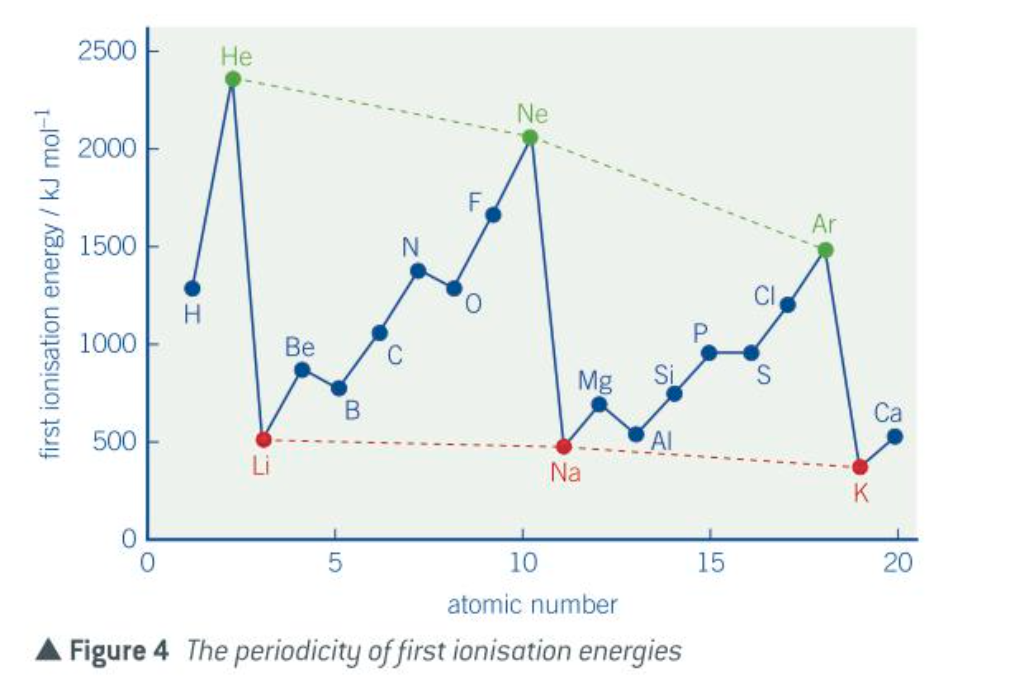
General trend:
Increases going across a period as the number of protons in the nucleus increases however there is a similar level of shielding
Drop between Mg and Al:
Mg loses an electron in the 3s orbital
Al loses an electron in the 3p orbital
The electron lost from the 3p orbital is in a higher energy level than the s electron therefore less energy is needed to remove it
Drop between P and S
Phosphorus has no paired electrons in the p orbital (Each p electron is in a different orbital
Sulfur has two electrons paired in a p orbital, one of these will be easier to remove than an unpaired one due to the repulsion of the other electron in the same orbital
Reaction of Magnesium with Water
Mg(s) + 2H2O(l) → Mg(OH)2(aq) + H2(g)
Reaction of Magnesium with Water observations
Very slow reaction at room temperature
Only a few bubbles of hydrogen are formed
weaker alkaline solution is formed
Reaction of Sodium with water
2Na(s) + 2H2O(l) → 2NaOH(aq) + H2(g)
Reaction of Sodium with water observations
Sodium floats on surface of water
Rapid fizzing
pH indicator will show that an alkali solution has been formed
Sodium melts because of the heat energy released by the reaction
Reaction of Magnesium with steam
Mg(s) + H2O(g) → MgO(aq) + H2(g)
Reaction of Magnesium with steam observations
Bubbling
Much more rapid than reaction with water
Reaction of Sodium with oxygen
2Na(s) + ½O2(g) → Na2O(s)
Reaction of Magnesium with oxygen
2Mg(s) + O2(g) → 2MgO(s)
Reaction of Magnesium with oxygen observations
Magnesium strip burns with bright white flame
White powder is produced
Flame is more intense if the burning magnesium is lowered into a gas jar of oxygen
Reaction of Aluminium with oxygen
4Al(s) + 3O2(g) → 2Al2O3(s)
Reaction of Aluminium with oxygen observations
Burns brightly in air
White powder (Aluminium oxide) is formed
(Al powder is heated then lowered into a gas jar of oxygen)
Reactivity of Aluminium
Aluminium is always coated with a strongly bonded surface layer of oxide
Protects the aluminium from further reaction
As a result of this aluminium appears to be unreactive
(Used for saucepans, garage doors, window frames)
Reaction of Silicon with oxygen
Si(s) + O2(g) → SiO2(s)
Reaction of Phosphorus with oxygen
4P(s) + 5O2(g) → P4O10(s)
(If oxygen is limited, phosphorus trioxide is also formed)
Reaction of Phosphorus with oxygen observations
White phosphorus:
White smoke is given off (Phosphorus pentoxide)
Red phosphorus vs White phosphorus
Red phosphorus must be heated before it will react with oxygen
White phosphorus spontaneously reacts with air
They are allotropes of phosphorus (Same element with differently arranged atoms)
Reaction of Sulfur with oxygen
S(s) + O2(g) → SO2(g)
Reaction of Sulfur with oxygen observations
When sulfur powder is heated and lowered into a gas jar of oxygen it burns with a blue flame and forms a colourless gas
Covalent Character of Aluminium oxide
Aluminium oxide is ionic but has some covalent character
Aluminium forms small ion with large positive charge.
Aluminium ion has a high charge density
The aluminium can approach the Oxygen and distort the electron cloud
Structure of the period 3 metal oxides
Sodium, magnesium and aluminium oxides all form giant ionic lattices
Aluminium oxide is ionic but has some covalent character
Melting point of the period 3 metal oxides
Sodium magnesium and aluminium oxides all have high melting points as a result of the giant ionic lattices formed, as bonding extends throughout the compound
Structure of the period 3 non-metal oxides
Silicon oxide - macromolecular structure
Phosphorus and sulfur oxides - separate covalently bonded molecules
States of matter of the period 3 non-metal oxides
Sulfur dioxide and Sulfur Trioxide are gases at 298 K
Phosphorus oxides are solids at 298 K, but have relatively low melting points as a result of their weak VDW forces and PDP-PDP forces
Reaction of Sodium oxide with water
Na2O(s) + H2O(l) → 2Na+(aq) + 2OH-(aq)
Reaction of magnesium oxide with water
MgO(s) + H2O(l) → Mg(OH)2(s)
Which oxides are insoluble in water
Aluminium oxide and Silicon Dioxide
Reaction of phosphorus pentoxide with water equation
P4O10(s) + 6H2O(l) → 4H3PO4-(aq)
Stages of ionisation of H3PO4(aq)
H3PO4(aq) ⇌ H+(aq) + H2PO4-(aq)
Reaction of phosphorus pentoxide with water is
quite violent and produces an acidic solution
Reaction of sulfur dioxide with water
SO2(g) + H2O(l) → H2SO3(aq)
Dissociation of Sulfurous acid
H2SO3(aq) ⇌ H+(aq) + HSO3-(aq)
Reaction of sulfur trioxide with water → Further reaction by product
SO3(g) + H2O(l) → H2SO4(aq) → H+(aq) + H2SO4-(aq)
What is the general trend in pH of solutions of the oxides of the elements
from alkaline to acidic across the period
What is the acidic/basic nature of sodium oxide (+ Reaction with H2SO4)
Acts as a base
Sodium oxide + Acid → Salt + Water
Na2O(s) + H2SO4(aq) → Na2SO4(aq) + H2O(l)
What is the acidic/basic nature of magnesium oxide (+Reaction with HCl)
Acts as a base
Magnesium oxide + Acid → Salt + Water
MgO(s) + 2HCl(aq) → MgCl2(aq) + H2O(l)
What is the acidic/basic nature of aluminium oxide
Aluminium oxide is amphoteric (Reacts with both acids and alkalis)
Aluminium oxide + Alkali → Salt + Water
Aluminium oxide + Acid → Salt + Water
What is the acidic/basic nature of silicon dioxide
Acts as a weak acid
Reacts with strong bases
Silicon dioxide + Strong Base → Salt + Water
What is the acidic/basic nature of phosphorus pentoxide (+ Reaction with sodium hydroxide)
Phosphorus pentoxide reacts with water to form phosphoric (V) acid
Reacts with a base (Such as sodium hydroxide) in three stages
Reaction of Phosphoric acid with Sodium hydroxide
H3PO4(aq) + NaOH(aq) → NaH2PO4(aq) + H2O(l)
NaH2PO4(aq) + NaOH(aq) → Na2HPO4(aq) + H2O(l)
Na2HPO4(aq) + NaOH(aq) → Na3PO4(aq) + H2O(l)
Overall Equation:
H3PO4(aq) + 3NaOH(aq) → Na3PO4(aq) + 3H2O(l)
What is the acidic/basic nature of sulfur dioxide (Reaction with sodium hydroxide)
Initial reaction:
SO2(aq) + NaOH(aq) → NaHSO3(aq)
(Product is called sodium hydrogensulfate (IV))
Reaction is followed by:
NaHSO3(aq) + NaOH(aq) → Na2SO3(aq) + H2O(l)
(Product is called sodium sulfate (IV))