Politics- Uk politics: Political parties
 Call Kai
 Learn
 Practice Test
 Spaced Repetition
 Match
 Flashcards
 Knowt Play
1/64

There's no tags or description
Looks like no tags are added yet.
65 Terms
Party function: representation
Succesful:
wide range of parties exist that represent the full range of political opinion from reform on the right to the greens and your party on the left, as well as nationalist parties like SNP and Plaid Cymru
new parties are always being created to represent new political ideas, in 1993 the Maastricht Treaty provoked Eurosceptics to form UK Independence Party (UKIP) to campaign for Brexit, Nigel Farage founded the Brexit party (2019) later named Reform in 2021, in 2025 Corbyn and Zarah Sultana launched Your Party on the left
Unsuccessful:
the success of Margaret Thatcher in the 1980’s forced Labour under Blair to abandon many socialist policies spectrum in order to become electable, this led to accusations that Labour has abandoned its traditional supporters
Party function: participation
succesful:
In 2015 Labour let supporters join for just £3, its membership grew to over 500,000 and many new, often younger, members becoming active. But by the end of 2025 Labour membership had fallen to about 265,000 while reform UK (claiming 270,000+) and the green (225,000+ by April 2026) grew rapidly
All political parties offer the public ways of participating in politics other than voting, For example, members of political parties are highly active during elections participating in activities such as leaflieting, canvassing and attending rallies the the candidates
unsuccessful:
in recent decades party conferences have been televised and this has led them to change from being arenas of passionate policy debates to public relations spectacles concerned with projecting an image of public unity. As a byproduct ordinary members have had their influence on party policies reduced with all the key decisions now being made by party elites behind closed doors
party functions: recruiting office holders
succesful:
Parties provide the majority of candidates for seats in the Uk’s local and national legislature, serving as a local councillor is usually where most political careers begin. E.g Jeremy Corbyn served as Labour councillor on Haringey Council before being selected by the local labour party in Islington North to stand as a candidate for parliament
Once in parliament MP’s in the two main parties compete for places in the Cabinet (if in gov) or in shadow cabinet (if in opposition). the leaders of the parties select the most talented Mp’s to serve in their cabinets and promote them to important roles, such as Home secretary, foreign secretary or Chancellor if they perform well
unsuccesful:
not all public representatives are members of political parties, they are known as independents. The election of independent MP’s used to be fairly common with 11 being elected in 1945. None won a seat between 2010-2023 when in 2024 when five independents were elected including Jeremy Corbyn for Islington North
Party functions: policy formulation
succesful:
parties produce a platform of detailed policies before every election called a manifesto, manifestos distill the wide range of political opinions within each party into a coherent and practical plan for government. usually a minister or key advisor is given the responsibility for writing the manifesto. E.g the much criticised 2017 Conservative manifesto was written by Nick Timothy a close advisor of Theresa May
unsuccessful:
parties have limited processes for involving party members in policy formulation, the annual party conference has largely lost its policy-making role, the main way members can influence the ideological direction of their party is through leadership elections, e.g 2015 labour members voted Jeremy Corbyn in order to see the party embrace more left wing policies such as increased taxes on businesses
party policy not always created by party members, sometimes policies developed by think tanks are adopted by parties. e.g in 2010 the conservative manifesto included a policy called ‘big society’ which called for greater role for the volunteer organisation in the provision of public services, this idea was developed by the ResPublica think tank led by Philip Blond
party function: providing government and opposition
succesful:
when parties are in government they appoint MP’s to support each secretary of state. These ministers work closely with the Secretary of State and stand ready to take over from them in the case of a shuffle or a resignation. e.g when Sajid Javid resigned as Chancellor a few weeks before the 2020 budget the prime minister was able to appoint his deputy, Rishi Sunak in his place
Opposition parties bring continuity to government by organising ‘shadow cabinets’ that ensure experienced people are able to replace ministers in the case of a change of power. For example, Wes Streeting was Labours shadow health Secretary from 2021 and became health secretary as soon as Labour won the 2024 general election. Now in opposition, the conservatives shadow every department e.g Andrew Griffith became shadow Chancellor in September 2026 to scrutinise Chancellor John Healey
unsuccessful:
Divided partis can bring instability to government by forcing the prime minister to resign. e.g Margaret Thatchers colleagues lost confidence in her because of her stubborn commitments to policy such as the poll tax. Thatcher faced a leadership challenge and lost. John Major and Theresa May were other politicians forced out by leadership contests. in 2026 Keir Starmer resigned under pressure from Labour MP’s
state funding of parties: short money
paid to the opposition parties (requiring at least 2 seats or 1 seat + 150,000 votes from prior general election) in the commons to support their work in scrutinising the government
opposition lack civil service which gov has access too
state funding of parties: policy development Grants
paid to all parties (only eligible if have at least 2 sitting MP’s in gov who have taken oath of allegiance) with representatives in parliament to support development of policies that eventually appear in their election manifestos
only to be used on developing policy
total pot of £2 million shared between all parties, 1 million shared equally and rest shared based on things like geographical location
Where does the majority of party funding come from?
membership fees
commercial activity (e.g selling tickets to annual party conferences)
donations (from individuals and organisations) - donations under £500 can be made from anyone but ones over then there are restrictions. e.g must be on the UK electoral register
Since the 2022 Elections Act. British citizens living abroad can register to vote no matter how long they have lives abroad and so can also donate
Why are some donations controversial?
come from ‘impermissible donors’ such as foreign citizens
impression of bribery e.g Labours ‘cash for honours’ scandal in 2026
donation caps
still no cap on donations, past attempts stalled because the conservatives wanted Labour to agree to cap donation from trade unions too but they didn’t want to
In september 2026, after reform received 72 million from 2 donors in 2 days , the labour gov did not introduce a cap but set up a task force on ‘mega donors’
Legislation on party funding?
Political parties, Elections and Referendums Act 2000 (PPERA), created an independent Electoral commission and required all parties to report cash and non-cash donations on a quarterly basis
Political parties must report all donations over £11,180 (raised from £7,500 in 2024)
The representation of the People Bill (CHECK) going through parliament in 2026, would can donations from British citizens living abroad at £100,000 a year, pause donations in cryptocurrency and bring in tougher ‘know your donor’ checks
Examples of Party income (2024)
Labour : £90,748,000 (win election), winning 412 seats
Conservative : £50,174,000, winning 121 seats
Lib Dem: £12,580,154, winning 72 seats
Reform: £10,832,716
SDLP: £475,061
demonstrating higher funding leads to greater chance of being elected
Conservative party funding
donations: £28,137,000
membership fees: £2,079,000
others (fundraising, legacy ect): £10,769,000
Labour Party funding?
donations: £39,427,000
membership fees: £18,321,000
other: £10,527,000
Reform party funding
donations: £5,861,950
membership fees: £4,344,371
others: £391,577
Cash for honours scandal
2006 Labour
large secret loans made to party before the 2005 election
at this point loans not considered to be donations and so not subject to same transparency rules as for donations
some of the lenders had subsequently been made lords
Labour fundraiser Lord Levy and Tony Blair were questioned during investigations
no charges made
Frank Hester scandal
Frank Hester gave conservatives at least £15 million in 2023-4
In march 2024 it was reported that he made racist remarks about Diane abbot, first black female MP
Sunak called the comments racist and wrong but the party did not return the money
Reform 2026 donation scandal
In september 2026, crypto billionares Ben Delo and Christopher Harborne gave reform UK £36 million each over two days, largest donation in British history
Harborne lives in Thailand but is a British citizen on Uk electoral register
Also emerged that Farage had been given a personal gift of £5million by him which he had not declared
Reasons for increasing state funding of parties
parties play a crucial role in representative democracy, so deserve public funding
public funding would remove the great disparity available to different sized parties, in 2024 labour raised over 7 times as much as lib dems
if state matched donations by party members, it might encourage public participation and recruitment to parties
curb the possibly corrupt influence of private backers on party policy, boost levels of trust in political parties, e.g after two crypto billionaires gave reform £72 million in sep 2026
electoral committee reports on funding after an election, so voters go to polls without knowing where the money for campaign came from
Reasons against state funding parties
is state funding was introduced then other public services would have to be cut, additional costs in monitoring and administering the new system
It was be politically controversial if the EC was responsible for deciding how much funding opposition parties get
public funding could isolate parties from the wishes of the voters, better to have a ‘free market’ in ideas with competition between parties for public support
taxpayers would resent compulsory contributions to parties of which they disprove
the better supported parties raise more money, it would be undemocratic to give less popular parties more mone
Founding of the Conservative Party
founded in 1884 by Robert Peel
arose as an organised defence of traditional institutions like the monarchy and the church after the French Revolutions of 1789 and 1830
the pragmatic conservatives (aka traditional conservatism) led by Peel and inspired by ideas from Edmund Burke (MP who criticised the French Revolution)
not supporters of autocracy but horrified by the French revolutionaries lack of respect for tradition
they pursued a policy of ‘reform to conserve’ and accepted principles like the Great Reform Act 1832 which the tories had originally opposed
traditional conservatives influenced by principles such as human imperfection and the support for a heriachal system
Impact of the Industrial Revolution on the conservatives
the Industrial Revolution created economic and social turmoil leading to massive inequality developing
Conservative leader Benjamin Disraeli ended up believing that the poverty stricken masses ought to be helped not just to stop revolution but also because this win power had a moral responsibility to help them
This paternalistic conservatism (aka one nation conservatism) placed emphasis on principles like organicism and noblest oblige (privileged have to help those less fortunate than themselves)
Conservatives post WW2
One nation ideas shaped how they responded to the welfare state
After WW2 conservative leaders (e.g Churchill, Macmillen) largely accepted the welfare state, the NHS and most of the industries that had been nationalised under Labour, they realised that this is what people wanted as Labour won a landslide victory after WW2
This all became known as the ‘post-war consensus’ and lasted until the 1970’s, upheld regardless of who was in power
Conservatism post 1970’s
while paternalistic conservatism represents the evolutionary change from pragmatic conservatism the emergence of the ‘new right’ was much more radical change
when the economy slowed in the 1970’s the conservatives embraced libertarian conservatism of the new right
under Thatcher the Conservative Party dropped its organic view of society and embraced individualism
the new right combined the two strands: Neo-liberalism, which wanted a free market and smaller state and the neoconservatism: which wanted strong state to uphold law and order, traditional morality and national identity
Conservative Party development timeline
1834: Robert Peel, accepts the 1832 reform act (pragmatic/traditional)
1868 and 1874-80: Benjamin Disraeli, social reforms e.g public health act (paternalistic)
1945-70’s: Churchill, Eden and Macmillan, conservatives accept the welfare state, NHS and nationalised industries
1979-90: Thatcher, NEW RIGHT, free market, privatisation and lower taxes (Neo-liberal) and tough law and order and nationalism (Neo-conservatism)
2010-today: Cameron to Badenoch, both traditions compete, Cameron and May drew on the one nation idea, Truss and Badenoch on the New Right, Boris and Sunak mixed of both
nobless oblige
a duty to care for those less fortunate, liked with Disraelies idea that the uk was becoming a two nation with the rich and the poor, developed into one nation conservatism
Conservatives: the new right
developed in the 70’s and 80’s
fused Neo-liberal economics with Neo-conservative social values
How has conservatism endured?
guided by pragmatism rather than fixed principle, reinterpreted traditional value under new circumstances
first accommodating mass democracy and then the welfare state and state intervention under the post war consensus and campaigning to ‘roll back the state’ under new right
this political flexibility has allowed them to endure
criticism of conservatism
socialists argue it comes to little more than ruling class ideology, by insisting change be resisted it sanctifies existing inequality and serves in the interest of the privileged
the gulf between One nation conservatism and the new right has become so wide that they are no longer incoherent
policies of Thatcherism: deregulation of business
got rid of a lot of banking regulations in 1986, financial sector grew so fast after it was called the cities big bang
tariffs on foreign goods fell from 4.7% in 79 to 1.2% in 86
corporate tax fell 17% across Thatchers terms
policies of Thatcherism: reduced public spending
annual NHS spending increases under Thatcher was 3.2% compared to 3.7% average every give since its starting
reduced spending by uncoupling child benefit from inflation and ending the income link to unemployment benefits
dramatically reduced state subsidy of business fell from 5bn/y in 79 to 0.3bn/y in 90
policies of Thatcherism: nationalism in foreign policy
vigorously defended British borders e.g Falkland island in was against Argentina
protected parliamentary sovereignty from eu integration e.g demanded a rebate on EEC funding and opposed the creation of the euro
opposed demands from Scottish, Irish and welsh nationalists for devolution
policies of Thatcherism: tough law and order
responded to the IRA hunger strikes plea for better treatment with the statement ‘crime is a crime’
when terrorists seized the Iranian embassy in London 1980, she refused to negotiate and authorises SAS to storm the building, five of six gunmen killed
used police to break the pickets used by the national union of mineworkers to enforce their coal mine strike
Policy under David Cameron
economy: Austerity budget cuts to reduce the budget deficit, Chancellor George Osborn cut the top rate of income tax from 50% to 45% 2013, Royal Mail privatised (2013) new right
welfare and public services: benefit cap and Universal Credit introduced, ‘cut the deficit not the NHS’: NHS budget ring fenced from cuts, Labours Building schools for the Future programme was cancelled One nation
law and order, immigration: police budgets cut as part of austerity. Pledged to cut net migration to the ‘tens of thousands’ a target that was never met new right
foreign affairs, EU and Brexit: military intervention in Libya, 2011. Lost a commons vote on airstrike in syria. held the EU referendum in 2016 and led the remain campaign resigned after Leave won one nation
social issues: same sex marriage act 2013. Promoted the ‘big society’ a bigger role for charities and volunteers in public services one nation
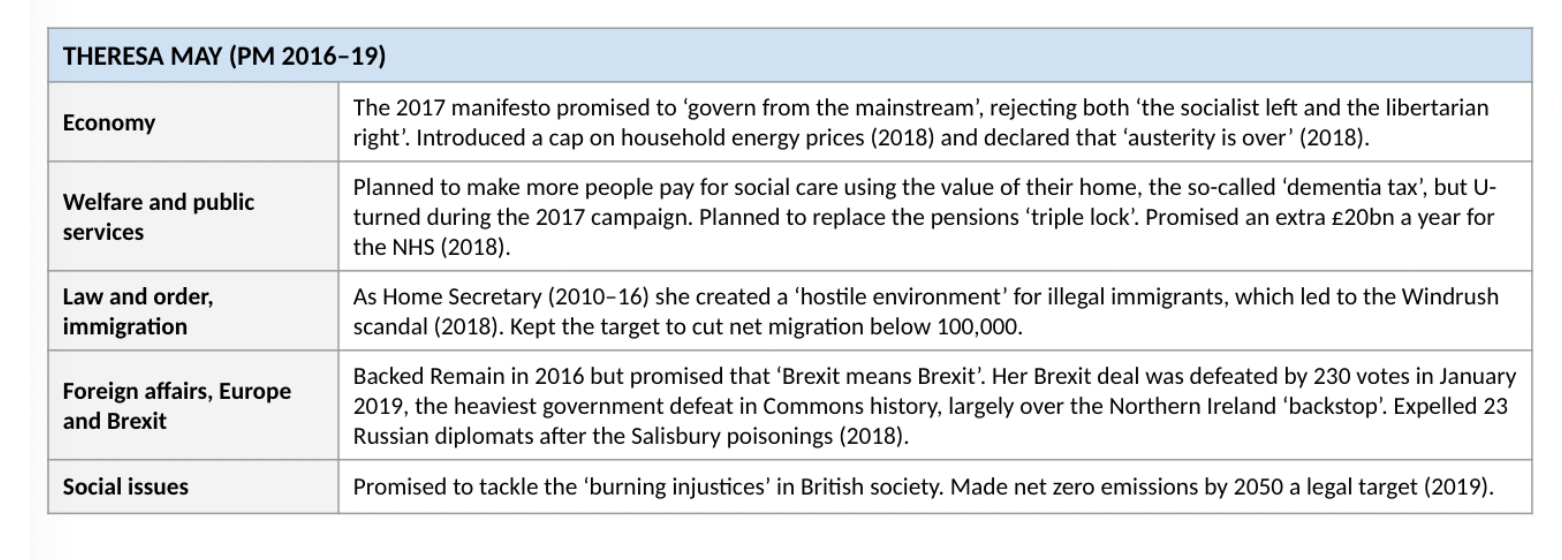
Policy under Theresa May
policies under Boris Johnson

policies under Liz Truss

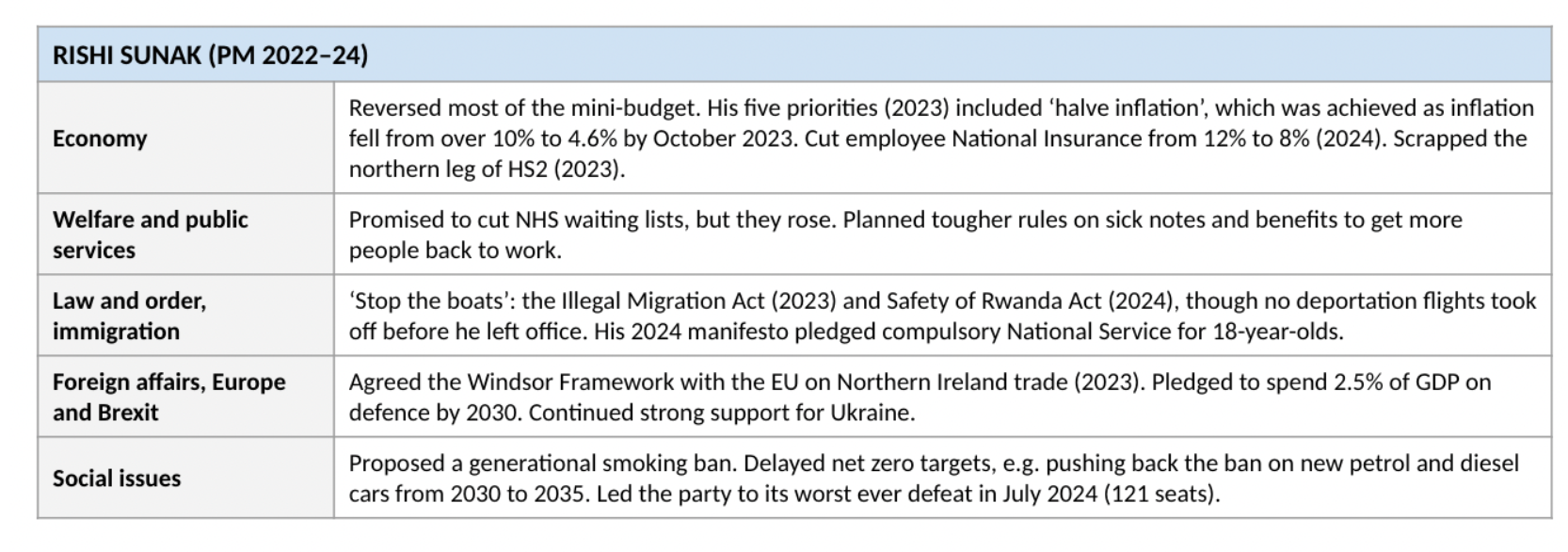
policies under Rishi Sunak
policies under Kemi Badenoch

Conservative political spectrum: Sunak
one nation + nobeless oblige : during covid he gave loans of £330bn to businesses and spent £14bn/month on the furlough scheme
Keynesian economics : supported hospitality sector through covid with 50% subsidies on food and drink (eat out to help out)
paternalistic: waiting lists for NHS rose by 100,000 in August compared to July, blamed the NHS strikes in early 2023
one nation: pledged to re-direct funds cut from the HS2 rail project to a range of northern transport projects nicknamed ‘network north’ and remained committed to net 0 by 2050
Conservative political spectrum Badenoch?
New right: halve employer national insurance for workers aged 21-24, scrap Labours VAT on private school fees, repeal the Climate Change Act (2008) which sets the UK’s net zero target
Neo-conservatism: 10,000 more police officers, triple the use of stop and search and build 50,000 prison places (law and order)
ant-electoral pragmatism: rejected any unite the right packs with reform
Conservative seat losses?
May 2025, they lost control of every council they were defending in the local election
May 2026, the party came fourth in the local election, behind reform, Labour and the Lib Dems
Conservative factions: new conservatives group
formed in 2023 by MP’s first elected in 2019
led by Miriam Cates and Danny Kruger
warned party to return to their 2019 manifesto, including cutting migration below 200,000 a year and banning ‘gender ideology’ in schools
all but three members lost their seats in 2024
Cates was defeated and Kruger defected to reform in 2025, group no longer exists
conservative factions: common sense group
socially conservative group based around culture war issues
chaired by Tory backbencher John Hayes
136 page policy booklet sets out ideas on everything from immigration to legal system and family life, contributed to by 16 MP’s
survived 2024 but 6 members defected to reform and president Sir Edward Leigh has called for the party to ‘unite the right’
conservative factions: European research group
model for other factions
set up in 1993, gradually moving from being the voice of eurosceptics to Brexit hardliners
hugely influential in the commons revolt that saw off Mays Brexit deal compromises and then ejected her from Downing Street
quite quiet now as most members have moved on to other pressure groups
conservative factions: tory reform group
around for 47 years
challenged Thatchers stance on apartheid, championed gay marriage, called for more support for Hong Kong nationals and more recently warned against leaving the ECHR
growing in strength since the fall of Truss, nearly 100 tory MP’s supporting it
conservative factions: northern research group
led by former northern powerhouse minister Jake Berry
geographical faction aimed at boosting spending and investment in the north of England, North Wales and the Scottish border
more than 50 members
hit hard in 2024 when the party lost most of its northern ‘red wall’ seats leaving around only 5 members
Berry lost his seat and later defected to reform
Conservative Party division: Cameron
The party was united on economic policy with austerity accepted by the whole party. There were significant rebellions when Cameron asked Tory MPs to back Lib Dem policies like Same Sex Marriage and an elected House of Lords. Brexit divided the Party in terms of policy and two Tory MPs defected to UKIP but Cameron’s leadership was not seriously questioned. He voluntarily took the decision to resign after the Remain campaign lost.
Conservative Party division: May
Faced heavy criticism from within the party after she failed to win the 2017 election. After the 2017 vote, journalist Tim Montgomerie said of May’s leadership: “A change is coming, It is just a case of when, not if”. She faced a confidence vote in December 2018 but won 200-117. Then in January 2019 she suffered the heaviest defeat in Commons history when Tory rebels led by the European Research Group joined with Labour to defeat her Brexit deal with a majority of 230 votes. Leading ministers like Boris Johnson, the Foreign Secretary, resigned to oppose May’s Brexit deal. At the opposite end of the party, in February 2019 Anna Soubry resigned from the Conservative Party entirely, along with fellow Tory MPs Heidi Allen and Sarah Wollaston, and joined the cross-party Independent Group, later Change UK. Soubry stated that "the right wing, the hard-line anti-EU awkward squad" had hijacked the Conservative Party from top to toe”. Authority ebbed away and she resigned in June
Conservative Party division: Johnson
Johnson faced opposition within his party from a group of MPs, nick-named the ‘Gaukeward Squad’ after their leader David Gauke, who feared he would take the UK out of the EU without a trade deal. They supported Labour in passing the Benn Act which required Johnson to seek an extension to negotiations if the UK and EU failed to reach a trade deal before the deadline for talks to have been completed. To punish the rebels Johnson withdrew the whip from 21 members of the ‘Gaukeward Squad’. Ten of whom later had the whip restored and won re-election at the 2019 election. None of the 11 that remained suspended won their seats. Johnson’s victory in 2019 with an 80 seat majority made him the darling of the party but there were always a small group of Johnson critics who feared that he was too sparse with the truth and too willing to put his own career above the national interest. When the Pinchergate scandal broke Chancellor Sunak quit writing in his resignation letter that: “the public rightly expect government to be conducted properly, competently and seriously.” Johnson did not want to resign and it took 100 ministerial resignations to force him from power.
Conservative Party division: Truss
Truss did not include any of the leading supporters of her main rival - Rishi Sunak - in her cabinet. This allowed those in the centre of the Party to leap on her mistakes in economic policy. On the day before she resigned, Charles Walker, a widely respected backbench Tory MP who served on the Privileges Committee that later suspended Johnson for 90 days, called the Truss ministry "a shambles and a disgrace... utterly appalling", commenting on Truss supporters, he said that he had "had enough of talentless people".
Conservative Party division: Sunak
Sunak became leader unopposed in October 2022 and at first brought calm after the Truss chaos, appointing ministers from different wings of the party. But divisions grew as the party trailed badly in the polls. Johnson loyalists like Nadine Dorries criticised his role in bringing down the former prime minister, and in June 2023 Johnson resigned as an MP after the Privileges Committee found he had misled Parliament over Partygate. In November 2023 Sunak sacked Home Secretary Suella Braverman, who accused him of a ‘betrayal’ on immigration. The Rwanda plan split the party: Immigration Minister Robert Jenrick resigned in December 2023, saying the bill was too weak, and in January 2024 60 Conservative MPs rebelled to try to toughen it. Two deputy party chairmen resigned to join the rebellion and one of them, Lee Anderson, defected to Reform UK in March 2024. Sunak called an early election for July 2024 and led the party to its worst ever defeat.
Conservative Party division: Badenoch
Badenoch won a long and divided leadership contest in 2024, beating Robert Jenrick in the members’ ballot. Since then the party’s biggest division has been over how to respond to Reform UK. After heavy losses in the May 2025 local elections, some MPs and local association chairmen discussed removing her, but the 1922 Committee had raised the threshold for a confidence vote to a third of Conservative MPs and no challenge came. Defections continued. Danny Kruger left for Reform in September 2025, and in January 2026 badenoch sacked Jenrick for plotting to defect. He joined Reform the same day, following within two weeks by Andrew Rosindell and Suella Braverman. Some MPs such as Sir Edward Leigh, have called for a pact with Reform, which Badenoch has ruled out. However, with her main rivals gone, her position looked more secure by mid-2026, and her ratings among Conservative voters reached a record high.
Labour Party strands
old labour = social democracy
new labour = third way
Labour Party founding
The growth of the franchise coupled with the decline in living conditions of the urban poor prompted the trade union movement, together with socialist societies such as the Fabians, to set up the Labour Representation Committee in 1900. It was renamed the Labour Party in 1906.
Labour Party ideology
The Labour Party’s ideology is socialism, which is a critique of and alternative to capitalism. At its heart is the belief in equality, human cooperation, collectivism, class and common ownership.
What type of socialism has the Labour Party avoided?
revolutionary socialism
the socialism of Karl marx
aimed to revolt and start a socialist society
Old labour ideology
The Labour Party is a democratic party and for much of its history it has advocated a form of socialism called social democracy. This is the ideology of what was known as ‘Old Labour’ following the rebranding of the party as ‘New Labour’ in the 1990s. Social democracy advocates a mix of publicly-owned and privately owned business and a comprehensive welfare state. Social democrats do not believe in eradicating all differences in wealth and status, instead they support the use of state power to ensure an equality of welfare which secures a minimum standard of living for all.
new labour ideology
New Labour ideology broke with the top-down economic policies of nationalised industries and embraced an alternative creed called the ‘Third Way’, influenced by the sociologist Anthony Giddens, which as the name suggests, tried to plot a course between state-led socialism and free market economics. New Labour also broadened the party’s appeal beyond the working class and loosened its ties with the trade unions. Blairites support expanding equality of opportunity e.g. by widening access to university education, but are not supporters of economic redistribution as social democrats and communists.
origins of socialism : a reaction against industrial capitalism
Socialism emerged in early nineteenth-century Europe as a reaction against the social and economic conditions created by industrial capitalism. Rapid industrialisation produced a new and growing working class who endured long hours, low wages, slum housing and periodic unemployment, while a small class of factory owners grew rich. Early ‘utopian’ socialists such as Robert Owen, who built a model community for his workers at New Lanark, imagined more co-operative ways of organising society. In 1848 Karl Marx and Friedrich Engels published The Communist Manifesto, offering a ‘scientific’ analysis of history which predicted that capitalism would be overthrown by the working class. In Britain socialism developed in a more moderate direction, through the trade unions, Christian and ethical socialists, and the Fabian Society (founded in 1884), whose members, including Sidney and Beatrice Webb, believed in ‘the inevitability of gradualness’: socialism would be achieved step by step, through Parliament. These traditions came together to create the Labour Party.
socialism: human nature and society
Socialists take an optimistic view of human nature. Human beings are essentially social creatures, bound together by a common humanity; as the poet John Donne put it, ‘No man is an island’. Crucially, socialists argue that human behaviour is shaped more by nurture than by nature: people are moulded by the society in which they live. If people under capitalism appear selfish and competitive, this is because capitalism rewards greed and self-interest, not because these qualities are fixed. Change the economic system and human beings can become more co-operative and caring. Socialists therefore prefer co-operation to competition and collectivism to individualism: they believe that people achieve more by working together, whether through trade unions, co-operatives or the state, than by pursuing their own interests alone. This collective spirit is often described as fraternity, meaning a bond of brotherhood and sisterhood between people.
socialism: equality and class
For many, equality is the defining value of socialism. Socialists argue that inequality is not natural but is created by an unjust economic system, in which wealth and power are concentrated in the hands of those who own property. Social equality is therefore a matter of social justice: it ensures everyone’s basic needs are met, promotes social cohesion and gives people the real freedom to develop their potential. As R. H. Tawney argued in Equality (1931), a society with vast differences of wealth cannot be a society of free and equal citizens.
Socialists disagree, however, about how much equality is desirable. Communists seek absolute equality of outcome, with private property abolished altogether. Social democrats aim for equality of welfare, using taxation and the welfare state to guarantee a decent minimum standard of living while accepting some differences in reward. Supporters of the Third Way focus on equality of opportunity, giving everyone a fair start through education and training. Closely linked is the idea of class: socialists have traditionally seen society as divided between those who own wealth and those who must sell their labour, and the socialist movement has historically sought to represent the working class and to reduce or abolish class divisions.
socialism: revolution or reform, fundamentalism or revisionist socialism
Socialism contains many rival traditions. One division concerns the means of achieving socialism. Revolutionary socialists, such as Marx and Rosa Luxemburg, believed that the existing state served the interests of the ruling class and that socialist could only be introduced by its overthrow. Evolutionary or democratic socialists believed instead in ‘socialism through the ballot box’, accepting liberal democracy, elections and party competition. A second division concerns the ends of socialism. Fundamentalist socialism aims to abolish capitalism and replace it with a qualitatively different system based on common ownership. Revisionist socialism aims to reform capitalism rather than abolish it. The German socialists Eduard Bernstein began this revision in Evolutionary Socialism (1899), and in Britain Anthony Crosland argued in The Future of Socialism (1956) that ownership of industry mattered less than equality, which could be achieved by a well-managed mixed economy and a generous welfare state. This revisionist tradition produced social democracy and later, Anthony Giddens’ Third Way (1998), which inspired new labour.
fundamentalist socialism
abolish capitalism and replace with common ownership
evolutionary/ democratic socialism (abolish capitalism)
revisionist socialism
accept capitalism in the market and reform it to make society
social democracy (don’t abolish capitalism)
third way (new labour)