CPA Audit - A4
 Call Kai
 Learn
 Practice Test
 Spaced Repetition
 Match
 Flashcards
 Knowt Play
1/43

There's no tags or description
Looks like no tags are added yet.
44 Terms
Revenue Cycle - Sales IC
1) *Preparation of Sales Order:* Receipt of customer purchase order by sales department
2) *Credit Approval:* Send copy of approved sales order to shipping department, billing department, and accounting
3) *Shipment:* Bill of lading prepared and sent to customer
4) *Billing:* Prepares sales invoice; Match invoices, shipping docs and sales orders
5) *Accounting:* Sale is entered into sales journal and receivable is recorded
Revenue Cycle - Accounts Receivable IC
1) *Sales:* Record receivable in general ledger and subsidiary ledger
2) *Collection of Cash Receipts*
3) *Uncollectible Receivables:* Treasurer approves write offs
4) *Sales Returns:* Credit memos should not be prepared by individuals who collect or receive cash payments on AR; this would be inadequate *segregation of duties*
5) *Sales Discounts*
Revenue Cycle - Cash Receipts IC
*prime area for fraud if proper controls not in place* *(ARC)*
- incoming mail must be opened by person who does not have access to AR ledger
- *three copies* of receipt should be distributed to:
1) *Cashier:* Receives actual receipts and prepares *bank deposit*
2) *AR Department:* Enters *receipts into AR subsidiary ledger*
3) *Accounting Department:* Enters receipts into *AR control account*
Revenue Cycle - Obtaining Evidence
*Existence* is generally a *more relevant* assertion than completeness when auditing the *revenue cycle*
Risk that AR and sales will be overstated (existence) is high
Revenue Cycle - Auditing Sales Transactions
- Completeness: Auditor should trace a sample of shipping documents to sales invoices, and to the sales journal and AR subsidiary ledger; TRACE
(shipping doc --> invoice --> sales journal)
- Cutoff: Compare sample of sales invoices from shortly before and after year-end
- Valuation, Allocation and Accuracy: Compare pricing
- Existence and Occurrence: Vouch a sample of sales transactions from sales journal to sales invoice back ot the customer order and shipping docs
(invoice <-- sales journal)
- Understandability and Classification: Examine invoices for proper classification
segregation of duties = authorization (sales order, treasurer), record keeping (billing/A/R/ accting), custody(wearhouse + shipping)
Revenue Cycle - Auditing AR
- Completeness: Obtain aged trial balance of AR and trace the total to the general ledger
( AR aging --> GL)
- Valuation, Allocaiton, Accuracy: Examine confirmations and allowance for doubtful accounts for accuracy
- Existence and Occurrence: *Confirm* a sample of AR
- Rights and Obligations: Review bank confirms and debt agreements for liens on receivables; Auditor should also inquire management and review debt agreements and board minutes
AR Confirmations
Confirmation of AR is a required GAAP unless:
1) receivables are immaterial
2) confirmation would be ineffective
3) inherent and control risks (RMM) are very low and other procedures can reduce audit risk to a low level
Positive AR Confirmations
Should be used when:
1) there are large individual accounts
2) there are expected errors or items in dispute
3) when internal control is weak
Auditors should consider the types of info respondents will be readily able to confirm:
- single transactions
- individual invoices
- client-prepared statement of account
Confirmations provide evidence regarding:
- *Existence* and
- *Rights and Obligations*
- NOT valuation or completeness
Negative AR Confirmations
May be used when:
1) combined assessed level of inherent risk and control risk is low (RMM low)
2) large number of small account balances are being confirmed
3) there is no reason to expect that the recipients will ignore the requests
Confirmation Exceptions
1) Timing Differences: Occurs when there is a delay int he recording fo the transaction by the client or their customer
2) Misstatements: fictitious sale, goods sent to wrong customer, incorrect price/quantity, etc.
Revenue Cycle - Auditing Presentation and Disclosure
- Completeness: ensure all required disclosures related to AR and sales have been included in the notes to the FS
- Valuation, Allocation and Accuracy: Read over footnotes to ensure accuracy
- Rights and Obligations, and Occurrence: Determine whether any receivables have been discounted, pledged, assigned, etc. and decide if disclosure is necessary
- Understandability and Classification: make sure disclosure are understandable
(Inspecting a sales order is not good enough) m
Expenditure Cycle - Purchases IC
1) Purchase Requisition: Department in need of the asset or services sends a *properly approved,* *serially numbered* requisition to purchasing department
2) Purchase Orders: Purchasing department finds best price from suppliers; Once properly approved, purchase order is created; Copies are sent to - requisitioning department, vendor, receiving department, and accounting department
3) Receipt of Goods or Services: Receiving department receives *blind copy* from purchasing department; receiving report prepared by receiving department and sent to accounting while goods are sent to requisitioning department
completness
Expenditure Cycle - Accounts Payable IC
1) Recording the Payable: Copy of purchase order indicates to accounting department there will be a cash disbursement; Accounting department records the goods as received in inventory and records a payable
2) Approving Invoice for Payment and Recording Payment: Accounting department matches - receiving report, purchase order, and invoice
Expenditure Cycle - Cash Disbursements IC
- Functions of approving the payment and signing the checks should be *segregated*
- Approved voucher packets *(invoice, PO, receiving report, and requisition)* prepared by accounting department are received by treasurer, who prepares, signs, and mails the checks; Then cancels all documents
Expenditure Cycle - Obtaining Evidence
*Completeness* and *accuracy* are generally a *more relevant* assertion than existence and rights and obligations when auditing the *revenue cycle*
Risk that over understatement is high
Expenditure Cycle - Auditing Accounts Payable (B/S)
*Completeness* and *Accuracy* are more relevant because of possible *understatement*
- Completeness: Auditor should perform following procedures:
1) Agree AP listing to GL
2) Obtain a sample of vendor statements and agree to vendor accounts
3) *Perform a search for unrecorded liabilities*
Review disbursements made after year end
Identify disbursements related to expenses incurred before YE
Examine open vouchers, invoices, etc. for a period after YE; Confirm YE liability
- Valuation, Allocation, and Accuracy: Auditor should perform following procedures:
1) Obtain AP listing, foot the listing, and agree
listing to GL
2) Obtain a sample of vendor statements and
agree amounts to vendor accounts
3) Review results of AP confirmations
- Existence and Occurrence: Vouch selected amounts from AP listing to voucher packages
AP confirms not required bc strong external evidence is typically available. However, confirms may be sent when IC is weak, when there are disputed amounts, or when monthly vendor statements are not available
AP confirms are positive and generally "blank"
Major limitation of AP confirms is they may *only be sent to vendors of record*
- Rights and Obligations: Verify AP are owed to entity
Expenditure Cycle - Auditing Purchase Transactions (I/S)
These substantive tests may also be performed as TOC or dual-purpose
- Completeness: Trace sample of vouchers to purchase journal (Voucher --> Purchase Journal)
- Cutoff: Compare dates on sample of vouchers with dates of the transactions recorded in purchase journal; Also make sure purchases were recorded in proper period
- Valuation, Allocation, and Accuracy: Recompute mathematical accuracy of vendor invoices
- Existence and Occurrence: Test sample of vouchers to confirm proper authorization and presence of the receiving report
- Understandability and Classification: Make sure it's in the right account
Expenditure Cycle - Auditing Presentation and Disclosure
- Completeness: Auditor should ensure all disclosures related to AP and purchases have been included in the notes to FS; Required disclosures include:
1) Payables by type and term
2) Purchase contracts and commitments
3) Related party transactions
4) Expenses by segment
- Valuation, Allocation, and Accuracy
- Rights and Obligations, and Occurrence
- Understandability and Classification
Cash Cycle - Lapping Fraud
- Today's CR cover yesterday's theft (ponzi skem)
- Employee withholds funds received by a customer for personal use and fails to apply these receipts of cash/checks to the customer's receivable balance
- Employee will then use a subsequent receipt from a different customer to cover the previously unrecorded amount
- Reflected by *delayed deposits*
lockbox system , statement sent by bank to auditor instead of company
Cash Cycle - Kiting Fraud
- Cash recorded in two places at once
- Reflected by disbursement of cash being recorded *after receipt date* noted by bank
- Occurs when a check drawn on one bank is deposited in another bank and no record is made of the the disbursement in the balance of the first bank until after year-end
- Intentional overstatement of cash in FS as cash is simultaneously reflected in two different bank accounts
check all deposits in transit outstanding checks listed on the baknk rec at year end cleared the next period
Cash Cycle - Auditing Cash Balance
Completeness, Valuation and Allocation, Existence:
- *Bank Confirmation:* Bank confirms, in addition to verifying year end balances, also provides evidence about actual loans, contingent liabilities, discounted notes, pledged collateral, and guarantee or security agreements; shows account balance, interest rate, and collateral
- *Bank Reconciliation:*Tested by -
1. Footing the bank rec and list of outstanding checks
2. Agreeing balance per books on year-end bank rec to the general ledger
3. Agreeing bank rec to bank confirm
4. Agreeing deposits in transit and outstanding checks to cutoff bank statement
must have segregation of duties (authorization, recording, reconciliation)
Auditing Payroll Accrual
when IC over payroll is effective --> analytical procedures and recalculation of payroll accruals
when IC cannot be relied upon --> tests related to completeness, existence, and rights and obligations
primary source of info regarding contingencies
MANAGEMENT
letter sent to client's attorney is simply a means of *corroborating* information provided by management
collections flowchart

expendature flowchart

auditing cash receipts and disbursements
completness - trace a sample of remittance advices to the cash recipts journal and deposit slips
cutoff
valuation, allocation, accuracy - sample of daily deposits the author should foot the remittance advices and entries on the deposit slip and agree to the cash recipts journal
existence and occurrence - vouch a sample of entries in the cash recpits jpournal to remittance advice
understanding of presentation and classification
inventory cycle controls
purchasing
prenumbered, purchase orders that are approved are prepared and sent to accouting and reciving
reciving
receipt of good, verification of quantities, damaged goods prep of receiving report, adn delivery of goods to warehouse
warehouse
acts as a custodian for the verified quanity of goods recived
shipping
shipment of goods after authoization (approved sales order from credit department)
auditing inventory cycle
completness - tracing, prenumbered inv tags and trace to physical inv report sheets
valuation, allocation, accuracy - recalculated and reconcile to the GL, inquire about damaged goods, examine, (slow moving inventory inquires)
existence and occurence - vouch
rights + obligations - congined goods
investment cycle controls
authorization - board of directors should authorize the purchase of sale of investments
custody of investments - custodian recommended but at minimum custody should be joint control by 2 company officials with the investments
record keeping - separate party
auditing investment balance / transactions
completness - unrecorded purchases by examining trasnactions, confirm from custodian,
valuation and allocation- recalcuate, detimine impariment, list investments by category, reasonableness of estimates
existence - confirmation of securities, analytical procedures of int earned, inspection, examiniation
rights + obligations- count securities
cutoff (transactions)
understandability and presentation and classification - (afs v trading secutiires in correct accounts)
marketable securities
AFS (oci) + trading (I/s)
auditor should inquire of mgmt and obtain written representation concerning mgmt intnent and baility with respect to holding versus selling goods
measuring fair value
level 1 - same quoted prices
level 2 - simular / diffrent market quoted prices
level 3 - not obserable , ufcf
mgmt responsiblity = making fv measurments + disclosure in accordance w gaap
auditors responsiblity = obtain sufficent evidence to provide rerasonable assurance that fv + disclosures conform w gaap
understand the process for determining estimates, indentify controls, IR + CR, need for specialist, mgmt bias, relevant mgmt representation, relevant matters to those charged w goverence
pricing from 3ed parties
pricing services - nature + source of evidence
broker dealer- quoted from broker reelvenace and reliabity is based on the brokers market is for simular instruments
impariment indicatiors - decline in fv that needs to be recorded
other transaction cycles (PPE) controls
aquisition - properly authorized
subsidary ledgers - detailed info concerning each asset
physical securities - safegaurd assets, periodic inspection, serial number
written policies - depreciation policies and records
disposition - retirement is documented and authorized
payroll and personal cycle controls
authorization to employ and pay - HR hires new employees( segration between Hr and payroll)
supervision - base pay approved by employees immediate supervisor
timekeeping ad cost accounting - time clocks approved by supervisor and compare to employee clock cards
payroll check preparation - salary based information signed by treasured or cfo, controls over access to blank checks and check signature plates
check distribution - distributed by a person that has no other payroll function, employee shows a form of id, compare personal files with payroll
financing cycle
documentation, authorization, records, controls over pmts, independent reconciliation
management representation letter purpose
mandatory, refusal to provide the letter will generally results in a disclaimer of opion or withdrawal
to confirm representations explicitly or implicitly given to the auditor
to indicate and document the continuing appropriateness of such representation
to reduce the possibility of misunderstanding concerning matters that are subject of the representation
signed by ceo and cfo
same date as audit report
address all f/s and periods covered in the report even if current mgmt was not present during all periods
mgmt letter disclosures
if misstatment is not materially misstated, doesnt involove mgmt and deosnt envolve an employee in a significant internal control position then mgmt doesnt have to disclose that to the auditor
All events subsequent to the date of the financial statements and for which U.S. GAAP requires adjustment or disclosure have been adjusted or disclosed.
The effects of uncorrected misstatements are immaterial, both individually and in the aggregate, to the financial statements as a whole. A list of the uncorrected misstatements is attached to the representation letter.
The effects of all known or possible litigation and claims have been accounted for and disclosed in accordance with U.S. GAAP.
must include a statement that management believes the effects of uncorrected misstatements are immaterial to the financial statements as a whole and a summary of the uncorrected misstatements should be included.
management acknowledges its responsibility for the design of controls to detect and prevent fraud in its management representation letter.
those charged with governance
board of directors and audit committee
auditor has to establish a 2 way communication with CWG discussing the scope + timing of the audit. info from those charged w governance, timely observations arising form the audit
deficencies
control- does not prevent or detect and correct misstatment on a timley basis(written or oral to mgmt)
significant - not material but still sever and merits attention by CWG ( writting to mgmt)
material weakness - reasonable posisblity that a material misstatment of the entitys f/s will not be prevented or detected and corrected on a timely basis ( writting to mgmt and CWG)
must evaluate indiviusally and combined
actual misstatement = actual amount
potential misstatement = resonably posiblity, magnituede ( $ amt and volume of activity)
communicated within 60 days of the report release date
control design v operation deficiency
design- control is missing or not properly designed
opperating - properly designed doesn’t operate as designed or is performed by an inappropriate person
material weakness indicators
indeitification of fraud (including immaterial)
restatment of previous issued f/s to correct MM
identification by the auditor of MM that mgmt wouldnt detect
ineffective oversight by those charged w governance
even if corrected durring the audit - it must be communitcated in writting to mgmt and cwg
previosult communicated sig dif + mw that are not corrected should be communicated again
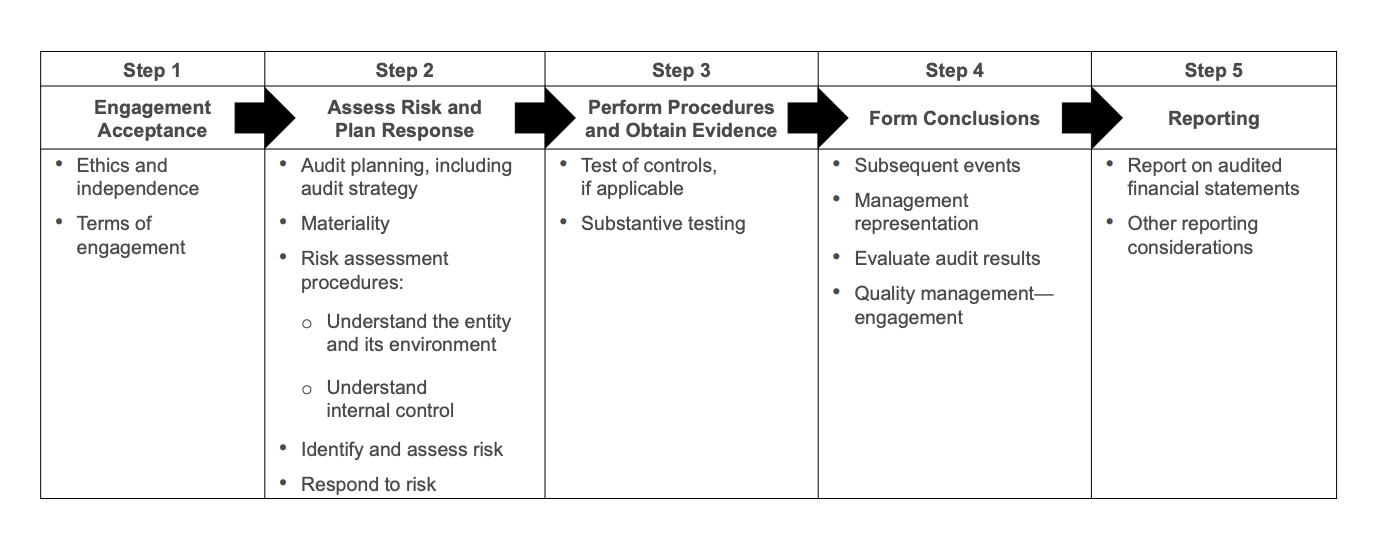
the audit process
communicate w predecessor auditor
CRIME + RMM= Ir*cr*DR
rmm smae as IR*CR
rmm inverse DR
timing nature and extent
substanative procedures required
test of details - gather evidence to support acct bal.
substantive analytical procedures - comparisons of recorded amts
nonissuers: may have an egagament quality reviewr, issuers are required
opion, cams, pcaob