CHAPTER 6 THE AWARE MIND
 Call Kai
 Learn
Learn Practice Test
 Spaced Repetition
 Match
Match Flashcards
 Knowt Play
1/11

Earn XP
Description and Tags
chapter 6 of the textbook
Name | Mastery | Learn | Test | Matching | Spaced | Call with Kai | Chat |
|---|
No analytics yet
Send a link to your students to track their progress
12 Terms
Free will
the ability to consciously control our actions and decisions
Consciousness
refers to knowing or being aware of ongoing experiences occurring both internally and in the world around us.
self-awareness
The special understanding of the self as distinct from other stimuli.
occurs when we focus on ourselves as individuals
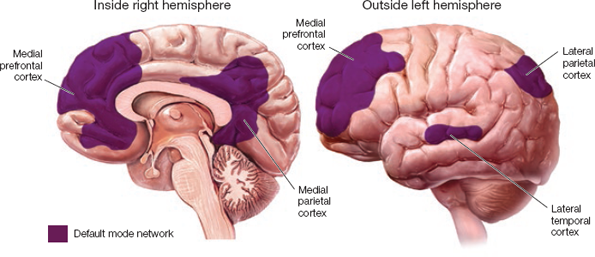
DMN
Default Mode Network.
an interconnected network of brain regions active during wakeful rest and internal thoughts, such as daydreaming and self-reflection.

Sleep
A normal state of consciousness characterized by reduced awareness of external stimuli.
Waking
A normal state of consciousness characterized by alertness and awareness of external stimuli.
REM sleep
The component of sleep characterized by waveforms resembling waking, as measured by electroencephalogram, accompanied by rapid motion of the eyes, muscular paralysis, and sympathetic nervous system activation.

N-REM sleep
non–rapid eye movement sleep
The components of sleep characterized by theta and delta wave activity, as recorded by electroencephalogram, and deep physical relaxation.

Theta waves
A waveform of 4 to 7 cycles per second recorded by electroencephalogram that is characteristic of lighter stages of non–rapid eye movement sleep.
NREM stage 1 (N1)
The transitional phase between wakefulness and sleep.
person may not be aware they’re sleeping

NREM stage 2
Further reductions in heart rate and muscle tension occur, and the EEG begins to show special waveforms called K complexes and sleep spindles that occur only in N-REM sleep.
NREM Stage 3 and 4
After about 15 minutes in stage 2, we enter stage 3 and then stage 4 N-REM sleep. Both of these stages show delta wave activity.
Stages 3 and 4 differ primarily in the amount of delta activity that occurs, with stage 4 having the most.
We are deeply asleep in these stages.